Summary:
For this research point I;
– Watched the documentary suggested in the brief and made notes on what I discovered during 70 minutes of watch time, expanding on the statement made and interpret them in my own words to further understand the decisive moment.
– Reflected on Sluban’s visit to a prison, where he ran a photography workshop and how he approached as well as taught the inmates, emphasising that the composition is extremely important and is more than just pressing a button to provide meaning.
– Explored Bonnefoy’s comments about Simiane-la-Rotonde and how being aware of your surroundings allows you to see a lot more, provides evidence of Cartier-Bresson’s ability to capture a balanced composition through intuition and the importance observing.
– Expanded on Cartier-Bresson’s view on what makes a decisive moment, by finding an example of sensitivity, intuition and sense of geometry in his work Alberto Giacometti rue d’Alésia. A photograph that documents the gaze of his friend Alberto Giocometti and the connection between the two, showing the empathy Cartier-Bresson has for his subjects.
– Briefly covered Arikha’s thoughts about painting and how we are so influenced by recognition, therefore we need to capture what we see, not what we think we see.
– Documented Cartier-Bresson’s approach to capturing decisive moments, by making sure people don’t know he is observing, to avoid an unnatural response from the subject. Once again showing a huge amount of empathy, to somewhat become invisible and connect with the mood of the room.
– Explored the critiques of Liz Wells, who believes that documentary can remove context from an image by dislocating moments in time, in turn creating a less powerful image by not showing what has happened/is happening. However, I challenged this by disagreeing and providing the reasons as to why, before
– Challenging Colin Pantell’s views on Paul Graham’s The Present, where he believes there are many indecisive, decisive moments that we don’t know what to look for, however I feel isn’t true as there is a consistent theme throughout and many focal points throughout.
– Briefly scanned John Suler’s article about the decisive moment, to increase my knowledge of it before continuing with this assignment. Understanding that it is important to look, be more decisive about what you’re shooting, don’t overly influence the shots, if at all and provide balance, questions and tension.
– Reflect on how I feel about the decisive moment as a visual strategy and the power it has to create a strong image, while expressing concerns about the difficulty of being able to capture such moments.
Brief
‘Watch the Henri Cartier-Bresson documentary ‘L’amour de court’ (‘Just plain love’, 2001) available
on Vimeo.
Write up your research on the decisive moment in your learning log taking care to give a proper
account of the three differing views offered above, and any further research you’ve undertaken
independently. What do you feel personally about the decisive moment as a visual strategy, or
just as a way to take pictures? Conclude your post with your own perspective on the debate at
this point in time‘ (Bloomfield, 2018).
Henri Cartier-Bresson’s view on a successful photograph is made evident by emphasising the importance of looking. He feels as if not many people do when stating that ‘75% of the people just press the button’ (L’amour Tout Court, 2001) and don’t necessarily think about the gaze that encourages questions. To think about what you’re capturing, making sure the image is balanced when composed, is more effective than just raising the camera and shooting without much thought. The intentional space gives context to the gaze of the subject, enabling the viewer to think about what may be happening.
This idea is further supported by Klavdij Sluban on his visit to the inmates at Fleury-Merogis Prison for a photography workshop in 1995, educating them on how to take photographs and their approach to the task in a calm, welcoming manner. Sluban communicates to the group that the fascinating element of photography is the composition, as it is a language that you have to learn (L’amour Tout Court, 2001).
Approaching the inmates politely and humanely, enables them to listen and be excited about the workshop, therefore encouraging them to take the photography seriously and give that sense of ‘meaning… an instant of your life’ (L’amour Tout Court, 2001).
Thinking about what you’re about to capture provides that extra level of care and understanding, that to some may just simply be a photograph and nothing more. However, to the more avid viewer, we may be able to discover the relation between the subject and artist by further exploring the deeper layers of the composition, to appreciate how the balance enhances the overall mood of the arrangement. Simiane-la-Rotonde taken in 1969 is an example of this.
Yves Bonnefoy states the square was usually empty and could not recall any children playing or Cartier-Bresson being around to take the image on this day, they simply walked straight past the square as usual (L’amour Tout Court, 2001). We can see that the children in the foreground are relaxed, enjoying the company of one another as if nothing has changed and Cartier-Bresson isn’t observing. A young girl in the background is pointing towards a dog, albeit a stray or a member of the communities, that may suggest sheer excitement of discovering this furry friend. The negative space emphasises the space between each group of people, supporting Bonnefoy’s statement that the square is usually empty. On the other hand, enhances Cartier-Bresson’s intuitive use of the golden section as each person is placed between or near the intersecting lines of the camera grid, keeping the composition balanced.
Bonnefoy understands that the reason he didn’t see this happening on the day he passed by was that Cartier-Bresson is always on the lookout and ready to react to a situation. In contrast, others are usually ‘distracted and unobservant’, Cartier-Bresson doesn’t have to stop for the geometry to play a decisive role in framing the scene (L’amour Tout Court, 2001).
Furthermore, Cartier-Bresson addresses that all it takes to capture a decisive moment is having ‘sensitivity, intuition … a sense of geometry’ (L’amour Tout Court, 2001). He has an incredible amount of empathy and can relate to the subject in the frame, making them feel comfortable.
By photographing Alberto Giacometti in Alberto Giacometti rue d’Alésia crossing the road in the pouring rain, covering his head with a coat for protection, gazing at the photographer across the street with somewhat of a melancholic emotion looking for support, reflects this idea of compassion. The simple connection of eyes forms a relationship between the subjects, good or bad, determined by the expression given. Capturing the distance between them, documenting the walk towards him almost radiates the action of waiting for Giacometti to reach him and feel the warmth of reuniting with a friend on this rainy day.
The painter Avigdor Arikha suggests that ‘our gaze is always conditioned by recognition’ (L’amour Tout Court, 2001); therefore we only see what we recognise and don’t necessarily observe anything further than that. This statement reminds me of an approach my fine art teacher taught our class, that was to draw what you see, not what you think you see. We must observe the form and stray from being influenced by what we assume something should look like, or like Arikha mentions ‘to look openly is to look with the senses’ (L’amour Tout Court, 2001).
Henri Cartier-Bresson doesn’t want the subjects he is photographing to know that he is doing so, since the awareness of observation, can influence someone’s posture, emotion, put on a mask that rids of spontaneity. Bonnefoy feels as if Cartier-Bresson was able to go unnoticed during the funeral of a Kabuki actor because of his ability to recognise and relate to the room, in turn becoming invisible through the act of sympathy (L’amour Tout Court, 2001).
In her book Photography: A Critical Introduction, Liz Wells suggests how this approach to documentary photography can fragment a moment in time and remove the context of an image that could, therefore, explain the photograph in a more significant way. By recording ‘dislocated moments’ (Wells, 2009:93) meant that documenting swayed from capturing major subjects and focused more on implying that something bigger had occurred.
While I almost agree with the idea that this approach can come across as a ‘stylistic cliche’ (Bloomfield, 2018:71), as many photographers have adopted Cartier-Bresson’s way of shooting, therefore removing the uniqueness of the technique, it still raises questions for the viewer. Documentary photography records factual events or environments in daily life or history, consequently may be more potent if you provide context to present an accurate reflection of what is occurring. On the other hand, by fragmenting a situation much like Cartier-Bresson does while maintaining balance, encourages the viewer to understand further what they can see and the impact of an event without being shown what caused it. This approach, in my opinion, can be more impactful than being handed the context of a photograph, as it provokes a more profound sense of comprehension and forces the audience to think about what is in front of them.
A further criticism for the decisive moment comes from Colin Pantall as he reviews Paul Graham’s photographic book The Present, a series of images that are taken in pairs, showing different events taking place in the same location moments apart from one another. Pantall states how Graham wants us to see the opposite of the decisive moment and the prospect of urban life, however, he feels that instead, we get ‘moments so decisively indecisive’ (Pantall, 2012) that we don’t know what to look out for, as a result missing the mark of contemporary life.
After viewing a few examples from Graham’s book, I can’t say I agree with Pantall, purely based on the fact Graham has decided and stuck to the idea of capturing moments through an urban landscape, to see the changes in a particular area. The sequencing of this book also presents the concept of a decisive moment, by grouping the images to allow the viewer to see the small differences over time by looking at both photographs spread out beside one another. Paul Graham has shown consistency in this series and a sense of care by looking out for these shifts in the present, creating a connection between each image, that in itself is decisive. The hustle and bustle of everyday life appear throughout, showing the diversity between each subject, the backgrounds, the journeys people are making and what each person may be doing. It poses a question for the audience, a clear understanding of what Graham is trying to achieve by recording the natural state of people navigating the city. I feel as if this wouldn’t be possible if this were an indecisive moment with conflicting ideas that don’t connect, confusing the viewer due to the inconsistency.
To understand the decisive moment further, I briefly scanned through John Suler’s article The Psychology of the “Decisive Moment”. In this text, he covers critical features of how to capture a “perfect” decisive moment; harmony, meaning, anticipation, uncertainty, unique fleeting moments, one chance shots, candid, objective fact versus subjective interpretation (Suler, 2017).
As a result, Suler shows the importance of looking or thinking about what you are capturing as a photographer. The decisive moment seems to be more complicated than I first expected, as you have to connect with the subjects you are photographing and be aware of the relationship of the whole composition. Stop and be mindful of what is around you and don’t just shoot for the sake of shooting. Be more firm about what it is you’re trying to achieve, whether that is attempting to encourage questions, document balance or tension.
While it sounds complicated, the results that have come from being more open to what you’re are capturing, instead of wanting a particular image makes for a much more substantial photograph.
I feel as if the decisive moment is a powerful visual strategy, as it steps away from a snapshot, it’s much deeper than that and for me is what photography should be about, recording moments with meaning and emotion. We are quick to pick up the camera and shoot multiple images, scanning through a selection to find the best one, however, if a little more effort goes into the composition, instead of hoping for a powerful image it may just come naturally.
References
Bloomfield, R., 2018. Photography 1: Expressing your Vision. 4th ed. [pdf] Barnsley: OCA, p. 72. Available at: https://www.oca-student.com/course/photography-1-expressing-your-vision [Accessed 30 March 2020].
Fondation Henri Cartier-Bresson. (2015) ‘Henri Cartier-Bresson et Alberto Giacometti’ [image] Available at: https://www.henricartierbresson.org/en/expositions/henri-cartier-bresson-alberto-giacometti/ (Accessed 25 March 2020).
H. Cartier-Bresson: l’amour tout court (2001) Directed by O’Byrne, R. [online video] Available at: https://vimeo.com/106009378 |(Accessed 25 March 2020).
Pantall, C. (2012) ‘photo-eye | BLOG: photo-eye Book Reviews: The Present‘ [online] Available at: https://blog.photoeye.com/2012/05/photo-eye-book-reviews-present.html (Accessed 25 March 2020).
Peter Fetterman Gallery. (2019) ‘Henri Cartier-Bresson, Simiane-la-Rotonde, France, 1969/Printed later’ [image] Available at: https://www.peterfetterman.com/artists/75-henri-cartier-bresson/works/24483-henri-cartier-bresson-simiane-la-rotonde-france-1969-printed-later/ (Accessed 25 March 2020).
Suler, J. (2017) ‘Photographic Psychology: The Decisive Moment’ [online] Available at: http://truecenterpublishing.com/photopsy/decisive_moment.htm (Accessed 25 March 2020).
Wells, L. (ed.) (2015) Photography: A Critical Introduction (5th edition). Abingdon: Routledge.
Referencing
Project 1 – The frozen moment – Research
Online Research, Part 3, Practitioner ResearchSummary:
For this research I have;
– Drawn on the work of Eadweard Muybridge, one of the pioneers of the frozen image, most famous for his ability to prove that a horse can indeed lift 4 hooves off the ground at the same time.
– Muybridge’s work was shown via slides, that showed the individual phases of movement that provided a huge step for science and photography.
– As well as improving his camera equipment by developing a motorised shutter that didn’t rely on the subjects movement, before inventing the zoopraxiscope. A machine that projected the moving image and inspired the development of the cinema.
– Explored the work of Harold Edgerton, the inventor of the ‘strobe’ flash, a photographer who froze time and provided images of motion that the naked eye couldn’t see, such as a crown of milk.
– Drawn on the work of Jeff Wall, a conceptual artist who captures everyday occurrences, or ‘micro gestures’, before
– Re-enacting in a different location, allowing him to take control of the composition, while providing tension in the imagery via the lines, gestures or other such elements.
– Reflected on the work of Philip-Lorca diCorcia, a photographer who meticulously plans his compositions by combining elements that don’t necessarily go together
– Challenging the traditions of photography and creates tension between the candid and posed. So while his work may look natural, with further inspection you understand they are not, due to obvious lighting or odd positioning of subjects.
– Reviewed whether I feel the camera captures or fragments time, giving examples of my opinion by harking back to the imagery of the listed artists.
Photographic exposure times developed massively since the early days of photography when exposures used to take hours to produce since reduced to mere points of a second with the evolution of technology.
We have been able to go from hours of standing/sitting still to avoid motion blur, to capturing movement as a still image with no traces whatsoever.
Some of the earliest photographers to experiment with the new, improved film speeds and shutters, are as follows.
Eadweard Muybridge (1830-1904):
Eadweard Muybridge, formally known as Edward James Muggeridge was one of ‘ … the great photographic thinkers and technical pioneers of all time …’ (Huxley Parlour, 2017), who thought way beyond the walls of still photography and was passionate about the evolution of the moving picture.
Leland Standford, a racehorse owner and former governor, hired Muybridge in 1872 to capture photographs of his horse to confirm whether all four hooves can be off the floor at the same time. To achieve this, Muybridge set up multiple cameras and a tripwire which would be activated upon the horse’s movement to capture each stage. After five years full of court trials, travelling and death, he returned to Standford. After producing conclusive results about the horses galloping abilities, this led newspapers to reproduce these images as drawings and artists such as Edgar Degas and Thomas Eakins, referencing them to produce art that was more realistic to life.
After his relationship with Leyland had ended due to lack of recognition following the publication of The Horse in Motion (Muybridge, 1878) , Muybridge began a new set of work for the University of Pennsylvania called Animal Locomotion which became one of his most influential pieces of work. The project allowed the study of movement through a variety of animals and the human form, which was a massive step for both science and photography by capturing each phase of a single action.
Muybridge significantly improved his camera equipment by developing a clockwork motor, meaning he could capture the minutest of movements without relying on the subject to trigger the shutter.
Muybridge’s work has helped contribute towards physiology, biomechanics and a range of artists such as Marcel Duchamp and Jasper Johns. Not only that, but he was the first to invent the machine called the “zoopraxiscope” which projected the moving image and animated a selection of photographs, potentially inspiring the development of cinema.
Harold Edgerton (1903-1990)
Dr Harold Edgerton was born in Nebraska, raised in Aurora and began a career as a professor at the Massachusetts Institute of Technology, which was the reasoning behind his invention of the ‘strobe’ flash and dedication to documenting what the naked eye couldn’t see.
Edgerton shaped the world of photography by freezing time and capturing results such as liquid on liquid forming a symmetrical crown of milk, as well as the ghostly arch that is formed by a golfer swinging their arm as the torso is ‘superimposed on itself 50 times’ (Michael Hoppen Gallery, 2015).
Due to his invention of flash cameras, his influence inspires photographers, journalists and many others today albeit the cameras are much smaller, which shows his impact on the photographic world and how we can capture the subjects around us. Being able to document what cannot be seen and controlling how a moment can be frozen in time, can help people understand how certain events occur and the result of them.
Jeff Wall (1946 – )
Jeff Wall was born in Vancouver and went on to study art history at the University of British Columbia in the 1960s, which is where he discovered Vancouver’s experimental art scene and used this as inspiration to teach himself photography to portray his conceptual ideas.
After many years of studying and receiving his BA and MA degrees at UBC, Wall went on to teach at Nova Scotia College of Art and Design, Halifax, Simon Fraser University, Vancouver and has since been a teacher at UBC where his journey first began (Riggs, 1997).
Having been inspired by the paintings of Goya and Velázquez, Wall wanted to find a way to depict everyday life through the medium of photography following his thought that ‘it was no longer possible for modern artists to paint like the great masters’ (Riggs, 1997). He decided upon creating backlit transparencies, which are large-scale photographs mounted in lightboxes to combine both cinema and sculpture, therefore a successful contemporary approach.
The inspiration for Wall’s pictures is everyday occurrences that he has personally witnessed, as well as his interest in ‘micro-gestures’ which are essentially actions that take place without much previous thought, portraying the tensions within society.
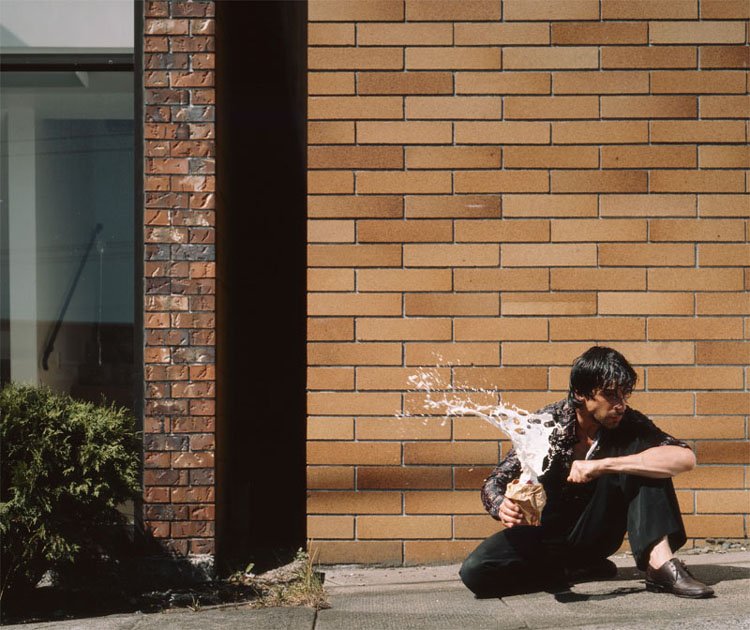
Milk (see fig. 1.) reflects the current state of mind the man in frame is in, portrayed by the explosion of liquid and clenched fists; however, the moments leading up to this moment are unknown. As a result of this, the viewer may wonder what caused such a reaction, creating tension between the two (Tate, 2017).
Wall tends to reconstruct the events he sees, to allow himself to gain control of the composition, which is why he relocated for this particular situation while keeping the formal elements in mind.
‘The grid-like order of the brick wall background, and strong vertical bands that stripe the left side of the image contrast sharply with the tension in the man’s arms and the uncontrolled arc of milk’ (Tate, 2017).
Philip-Lorca diCorcia (1951 – )
Philip-Lorca diCorcia studied at the School of the Museum of Fine Arts, Boston, the University of Hartford, Connecticut and received his Master of Fine Arts from Yale University in 1979. He didn’t initially set out to become a photographer; however, Jan Groover suggested that ‘a photograph should result from careful planning and orchestration’ (Sidley, 2016), which diCorcia may have used as inspiration when he began identifying as a photographer.
DiCorcia’s work challenges and pushes the traditional boundaries of photography by meticulous planning and composing. So, while they may look natural and accidental, they’re not due to the combination of people and places that don’t necessarily go together. This approach creates a tension between random and controlled, directs the imagery towards various paths without a definite conclusion or direction, therefore suggesting a narrative more so than telling a story (Sidley, 2016).
One of the ways DiCorcia executed his shots, for example, Mario (DiCorcia, 1978) was by setting the camera up on a tripod, putting a flash in the fridge and readjusting each element while testing the composition with a Polaroid camera, keeping the desired result in mind. So, while the subject looked completely natural, in deep thought as they observe the contents of the refrigerator, everything was precisely planned at each step (Sidley, 2016).
The use of harsh artificial light is a recurring technique through his work which could be street lighting, however, on closer inspection, the contrasts between the shadows and highlights are almost too intense to be considered accidental. An example of this is the spotlight that hits the subject in Edward Earle Windsor; 20 years old; Atlanta, Georgia; $30 (DiCorcia, 1990-92).
Reflection
‘There is a pleasure and beauty in this fragmenting of time that had little to do with what was happening. It had to do, rather, with seeing the momentary patterning of lines and shapes that had been previously concealed within the flux of movement.’ (Szarkowski, 2007, p.5).
Upon completing some artist research, I would consider that the camera captures time in these images, as well as fragmenting it, it’s isn’t necessarily mutually exclusive.
Muybridge’s images I believe do capture time, by documenting each phase of a singular movement, in turn, supplying context to each photographic plate. While Edgerton’s work also freezes moments in time and form an opinion in the viewers head as to what happened moments before, what we assume happened before shooting the apple may not be correct. As a result, I consider these images to be both a captured moment in time and a fragment.
Wall and diCorcia, on the other hand, fragment time with meticulous planning and creating tension throughout the composition, either through technical decisions or formal. While they are pre-meditated, the body language and locations cleverly help create intrigue for the viewer, making them wonder how the events shot occurred and what caused the particular gestures in that specific place. The imagery doesn’t necessarily look staged at first glance without prior knowledge; therefore, you would believe they are just a brief moment in history frozen forever; however, are not. A fragment of time provides just a slice of the story, not the whole product.
This research has made me question whether the street photography I have seen in the past is just a capture of time, whether there is more the story than initially thought or if it has been pre-planned to convey a particular narrative, controlled by the artist.
References:
Huxley Parlour. (2017) Eadweard Muybridge | Photographer’s Biography & Art. [online] Available at: https://huxleyparlour.com/artists/eadweard-muybridge/ (Accessed 4 March 2020)
Michael Hoppen Gallery. (2015) Dr Harold Edgerton | Michael Hoppen Gallery. [online] Available at: https://www.michaelhoppengallery.com/artists/54-dr-harold-edgerton/overview/#/artworks/9778 (Accessed 4 March 2020)
MoMA. (2019) Philip-Lorca diCorcia. Mario. 1978 | MoMA. [image] Available at: https://www.moma.org/collection/works/46273?artist_id=7027&locale=en&page=1&sov_referrer=artist (Accessed 4 March 2020)
MoMA. (2019) Philip-Lorca diCorcia. Edward Earle Windsor; 20 years old; Atlanta; Georgia; $30. 1990-92. [image] Available at: https://www.moma.org/collection/works/57854?artist_id=7027&locale=en&page=1&sov_referrer=artist (Accessed 4 March 2020)
Riggs, T. (1997) Jeff Wall born 1946 | Tate. [online] Available at: https://www.tate.org.uk/art/artists/jeff-wall-2359 (Accessed 4 March 2020)
Sidley, K. (2016) Philip-Lorca diCorcia | MoMA. [image] Available at: https://www.moma.org/artists/7027 (Accessed 4 March 2020)
Szarkowski, J. (2007) The Photographer’s Eye. New York: MoMA Thompson, K. &
Tate. (2017) Jeff Wall : room guide, room 3 | Tate. [online] Available at: https://www.tate.org.uk/whats-on/tate-modern/exhibition/jeff-wall/jeff-wall-room-guide/jeff-wall-room-guide-room-3 (Accessed 4 March 2020)
Time. (2016) The Horse in Motion |100 Photographs. [image] Available at: http://100photos.time.com/photos/eadweard-muybridge-horse-in-motion (Accessed 2 April 2020)
List of Images:
Figure 1. Wall, J. (1984) Milk [image] Available at: https://www.tate.org.uk/whats-on/tate-modern/exhibition/jeff-wall/jeff-wall-room-guide/jeff-wall-room-guide-room-3 (Accessed 5 March 2020)
Learning how to reference
Notes, Online ResearchSummary:
In this post I
– Gave examples of the citations I created myself after reading the Harvard Referencing Guide from UCA
Referencing examples:
After having a conversation with my brother who recommended I create a few templates to refer to in the future when it comes to my assignments, research and such, I decided to visit the Harvard Referencing guide (UCA, 2014) provided on the UCA library which I will link if you too are struggling.
One of the example’s I created for myself to practice is as follows;
BOOK: Surname, Initial. (Year) Book title Place: Publisher.
Example for bibliography: Rowling, J.K. (1997) Harry Potter and the Philosopher’s Stone London: Bloomsbury Publishing.
CITATION: ‘quote’, (Surname, year:page number).
Example for citation (in text) : ‘Mr and Mrs Dursley, of number four, Privet Drive, were proud to say that they were perfectly normal, thank you very much’, (Rowling, 1997:7).
‘Note: If there is more than one edition of the book you need to state which edition you are referring to. Different editions may have different information, page numbers etc. This is not the same as a reprinted version, which does not include a change of format’, (UCA, 2014:6).
I think I’ve finally gotten the hang of it after sitting and creating multiple versions for a few hours, so hopefully research will go smoothly in the future.
References:
Rowling, J.K. (1997) Harry Potter and the Philosopher’s Stone London: Bloomsbury Publishing
UCA. (2014) UCA Harvard Referencing Guide. UCA: pp. 6, 10 [pdf] Available at: https://www.uca.ac.uk/library/academic-support/harvard-referencing/ [Accessed 22 January 2020].
 Lauren Powell OCA