Selection process for final images.

Assignment 1, Notes, Reflection on assignments, Thoughts & Ideas

Summary:

– I have analysed the contact sheets provided in the previous post, selected the strongest images and edited them slightly by adjusting the highlights/shadows, cropping and straightening.
– The edited images are provided below in a gallery
– Before the selection was cut down once more to help with the final selection process
– Stating why some images weren’t included, for instance, they weren’t strong enough conceptually or technically
– Unlike the photographs shown in the scanned document, that is highlighted and numbered to show the two attempts at image pairing, the numbers being the final choice.
– Brief bullet points have been listed to cover the strong variety of elements within the final collection and why they were paired together.


I decided to select what I feel we’re the best images from the shoot and edited them very slightly. The only photo manipulation that took place was correcting the highlights and shadows, cropping them down and straightening a few of them out where needed, without completely changing what was captured in the camera which was requested in the ‘Expressing Your Vision’ course material.

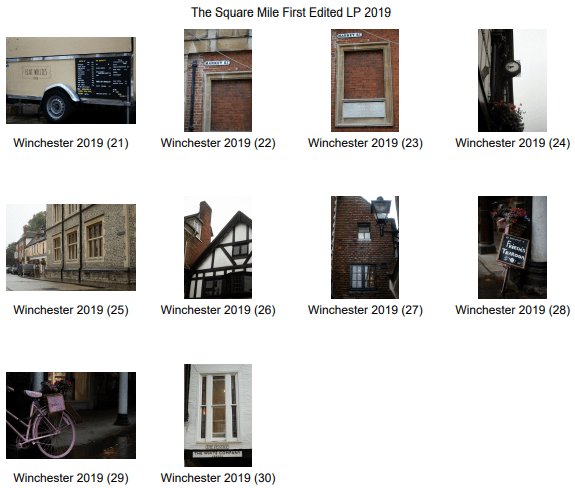
The edited images are as follows :
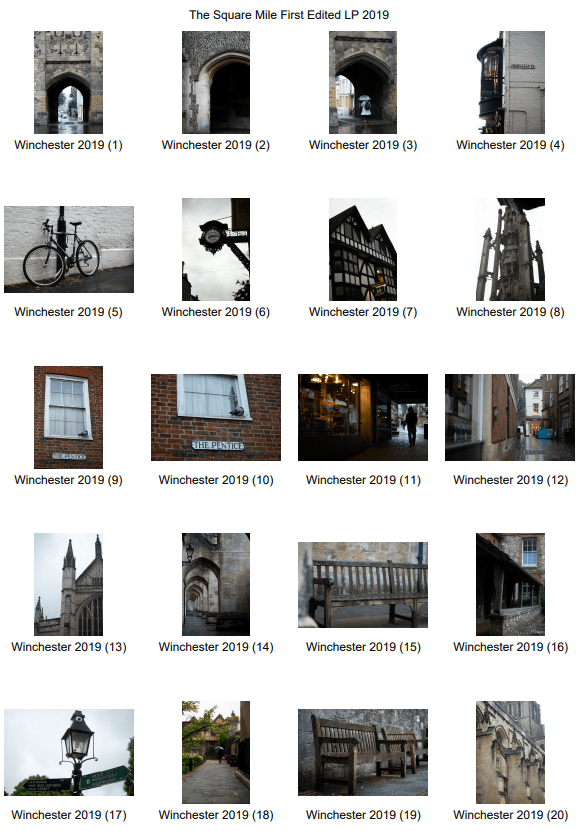
After editing these images, I cut down the selection once more to make it easier to choose my final images for the ‘Square Mile’ assignment.
While there were quite a few images that I liked, some of them just didn’t ‘fit’ or have a strong enough link to the project plan, where I stated that ‘I would like to explore various childhood memories, see how the areas may have changed throughout the years and if they are as I remember them’ (Powell, 2019).

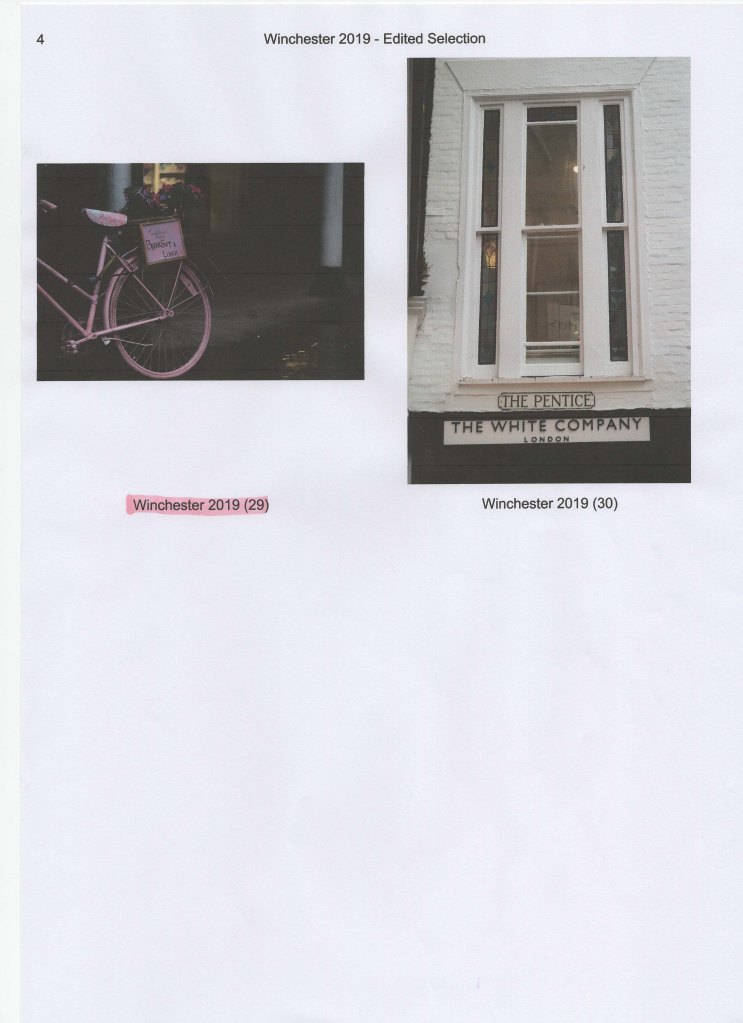
For example, ‘Winchester 2019 28′ (see Fig. 2.) is strong due to composition, the relaxed position of the bike, the highlights and shadows, as well as the shallow depth of field, however, it didn’t compliment the collection. Considering the majority of the images explored architecture, the differences between each building and the effects time has had on them, it became an odd one out.

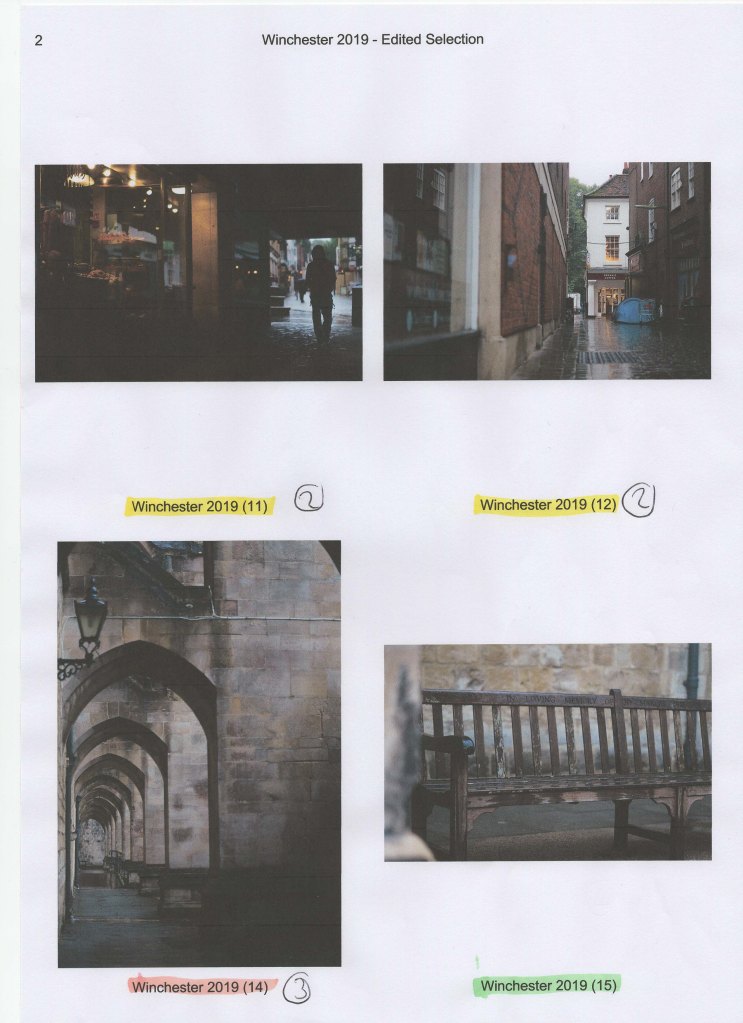
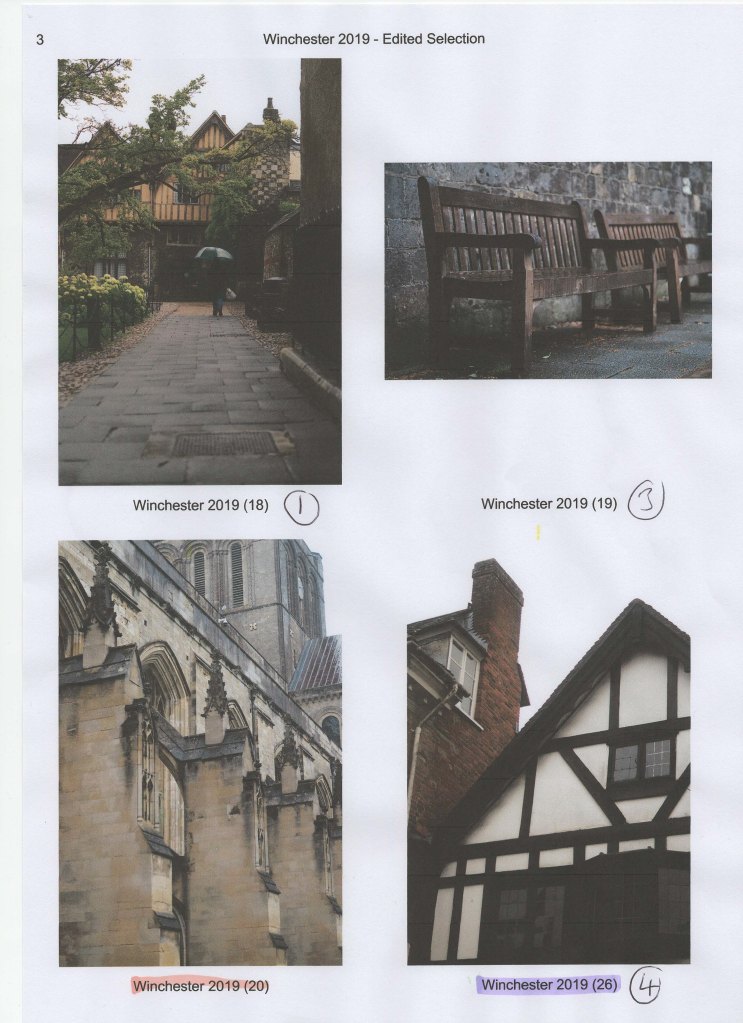
The following images are a part of my second selection process. The scans below show my initial pairings in colour and the final image pairings with numbers. I will provide a brief list as to why I decided to pair up these specific images, to refer back to in my image analysis.
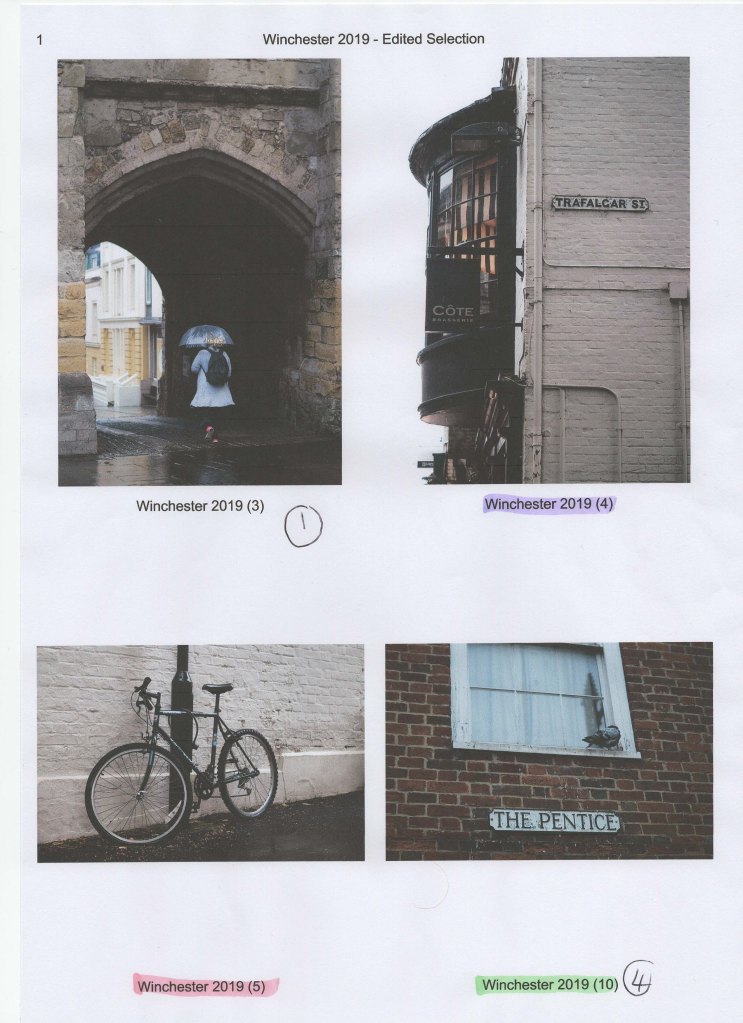
Reasons for pairing up:

While I am aware I didn’t have to pair these images up, to create a cohesive series I felt that it was the best option for me to make sure I achieved what I set out to do, which was to explore Winchester by retracing steps, capturing what had changed, the similarities and presenting a personal view in a different way to which I’m used to. Pairing the photos up has helped me form a short journey through the town, as well as a complementary collection.

Winchester 11 and 12

– Similar compositions.
– Contrasts between light and dark.
– Contrasts between natural and artificial light.
– References to work and daily life.
– Shows human interaction.
– Both significant places I visited with family.

Winchester 14 and 19

– Similar tones.
– Repetition.
– The juxtaposition between architecture and public seating.
– Both in the same area and have a significant connection.

Winchester 3 and 18

– Person framed by architecture and nature.
– Umbrellas.
– Shows daily life.
– Monochrome.
– Pathways.
– Start and end of my journey.
– Special areas vs new.

Winchester 10 and 26

– Similar brickwork.
– Nature vs man-made.
– Similar tones.
– Contrasts in colour.
– Reflection of a significant statue.
– Depth.
– Dirty buildings.
– Buildings are behind one another.
– Family links.


References :

Powell, L. (2019) Plan for ‘The Square Mile’. [online] Available at: https://laurenpowelloca.photo.blog/2019/08/20/plan-for-the-square-mile/ [Accessed 12 September 2019].

List of images:

Figure 1. Powell, L. (2019) Page 1 [PDF, Screenshot] In possession of: Lauren Powell: Eastleigh.

Figure 2. Powell, L. (2019) Page 2 [PDF, Screenshot] In possession of: Lauren Powell: Eastleigh.

Figure 3. Powell, L. (2019) Contact sheet 1 [Scanned Document] In possession of: Lauren Powell: Eastleigh.

Figure 4. Powell, L. (2019) Contact sheet 2 [Scanned Document] In possession of: Lauren Powell: Eastleigh.

Figure 5. Powell, L. (2019) Contact sheet 3 [Scanned Document] In possession of: Lauren Powell: Eastleigh.

Figure 6. Powell, L. (2019) Contact sheet 4 [Scanned Document] In possession of: Lauren Powell: Eastleigh.
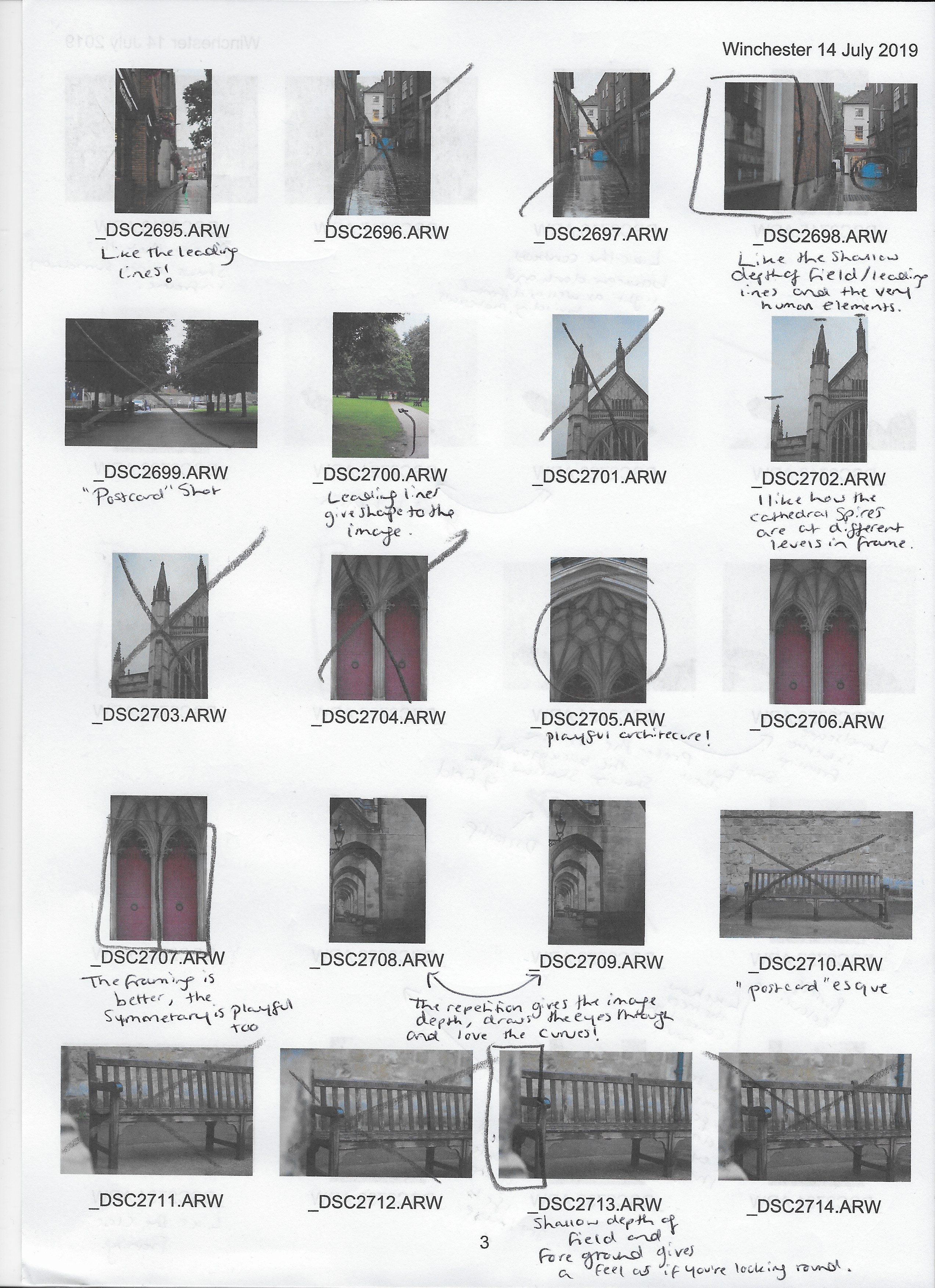
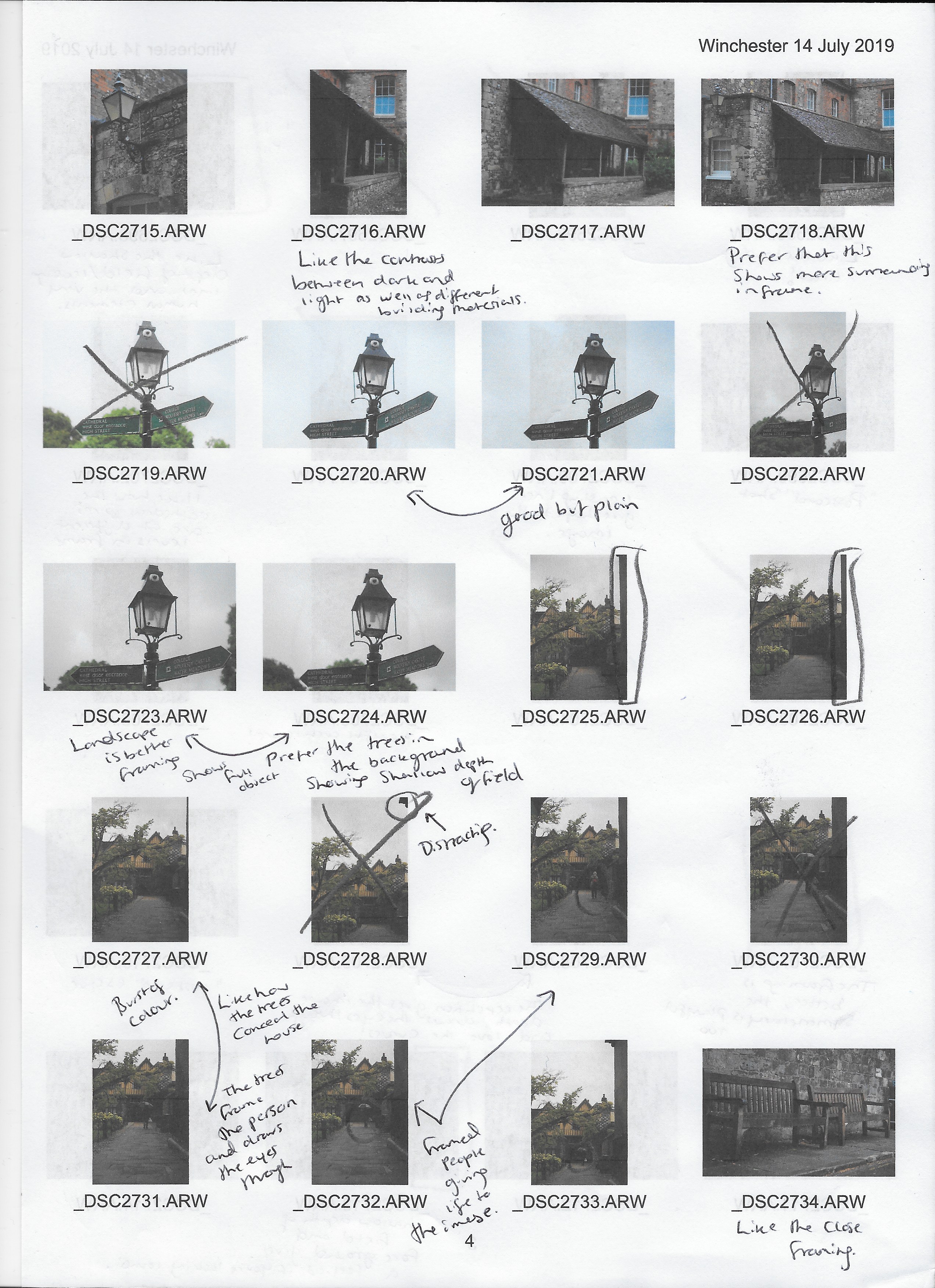
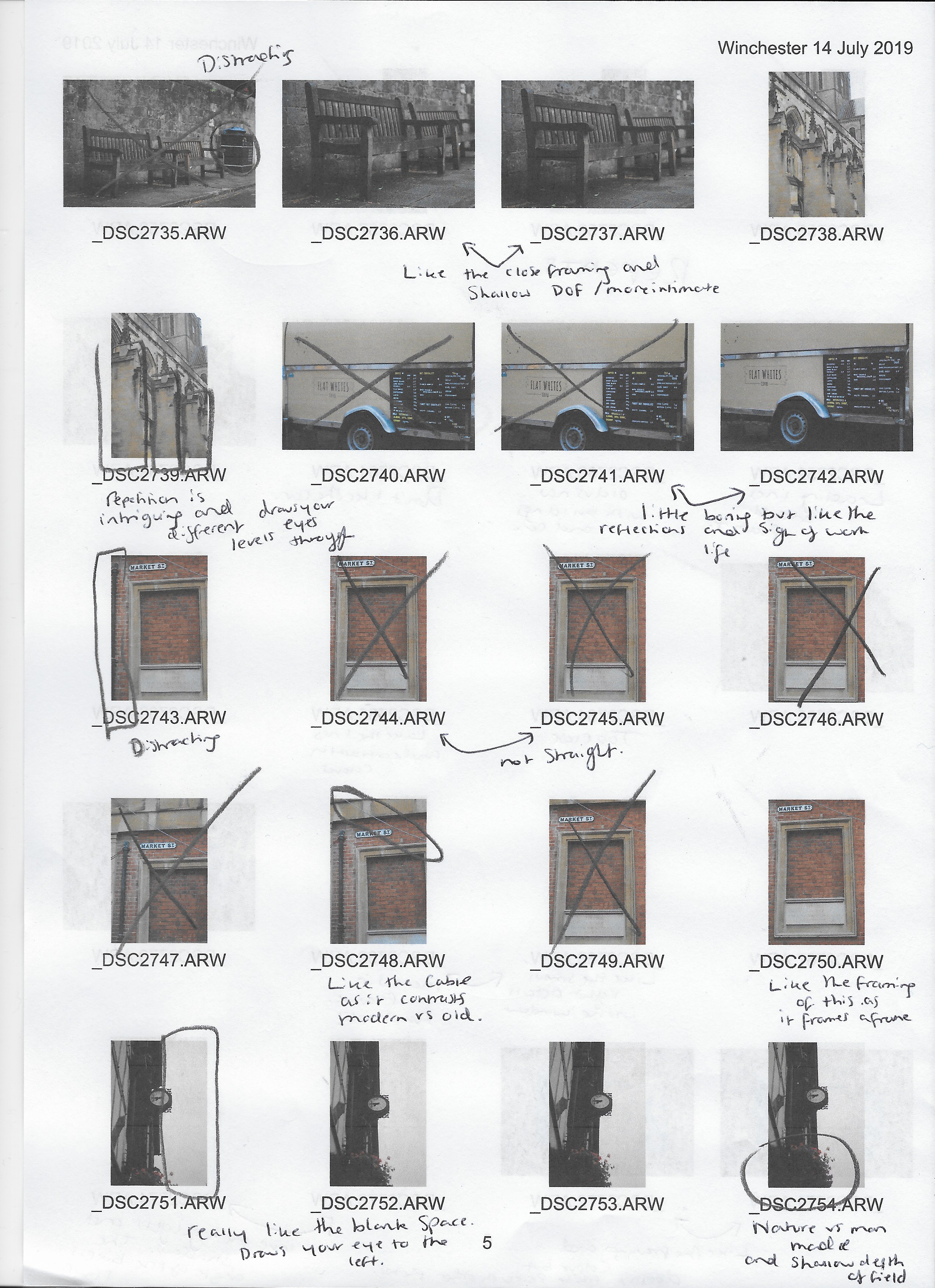
Contact Sheets for ‘The Square Mile’ + reflection.

Assignment 1, Notes, Reflection on assignments, Thoughts & Ideas

Summary:

In this post I have;

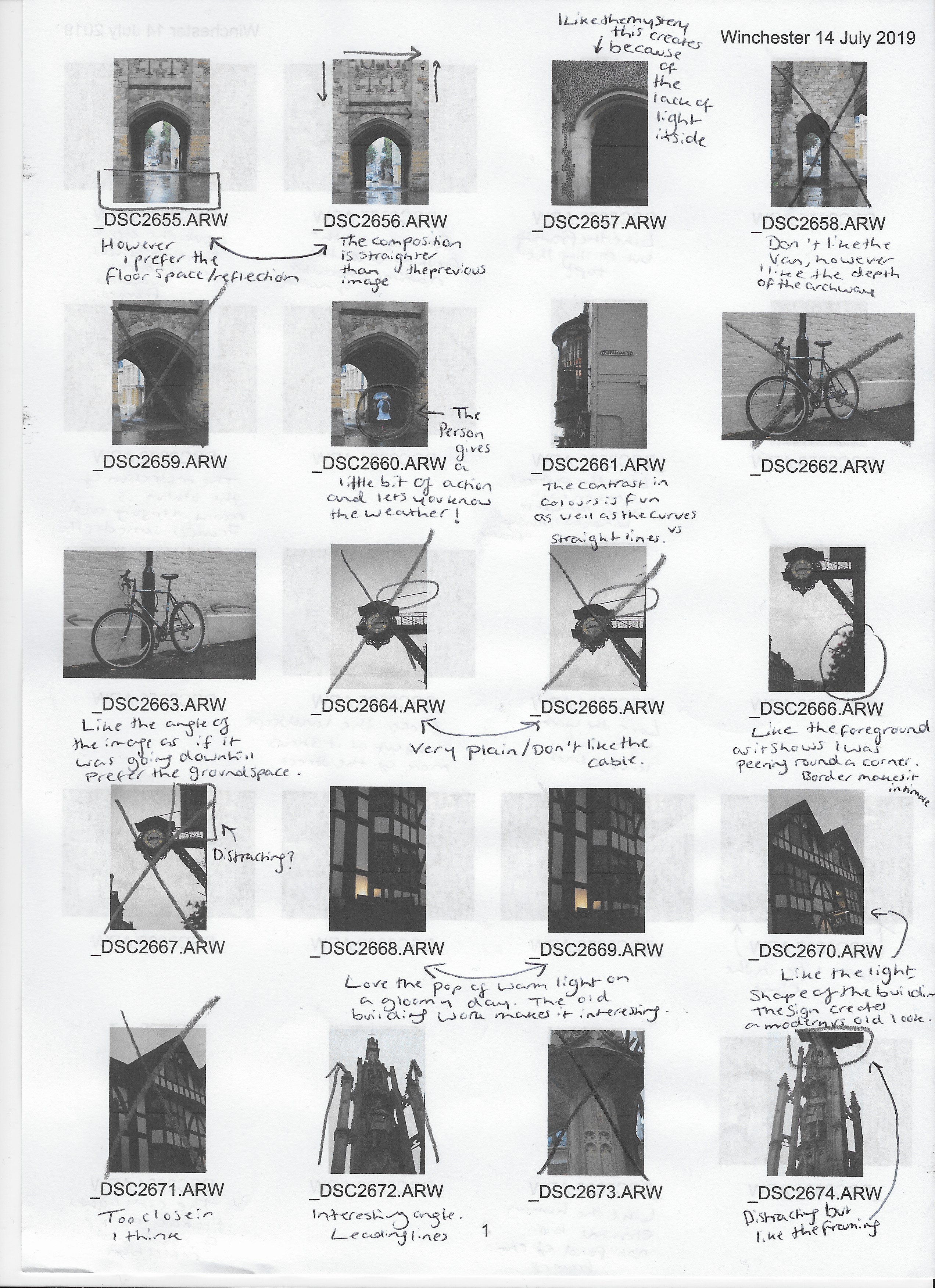
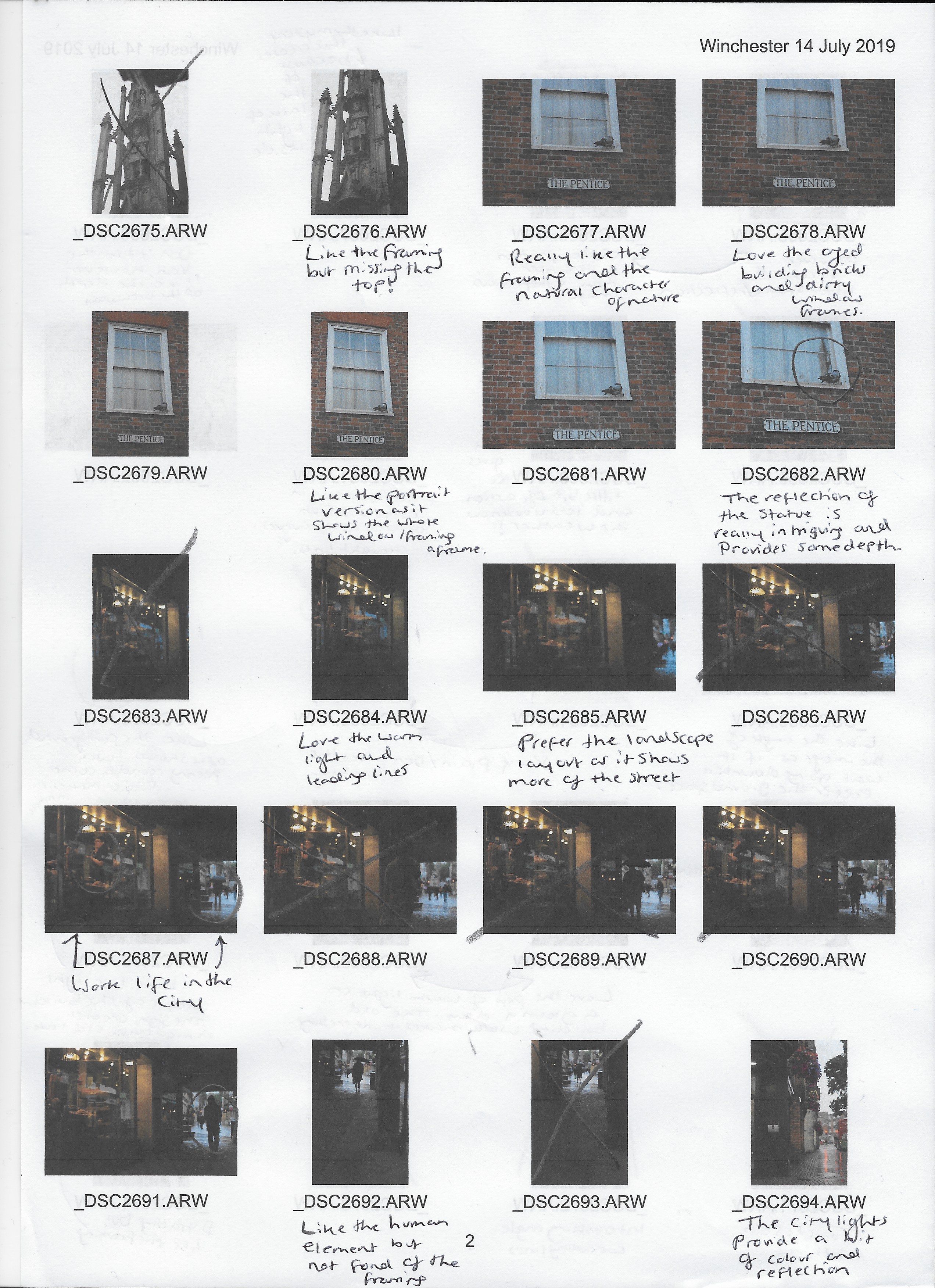
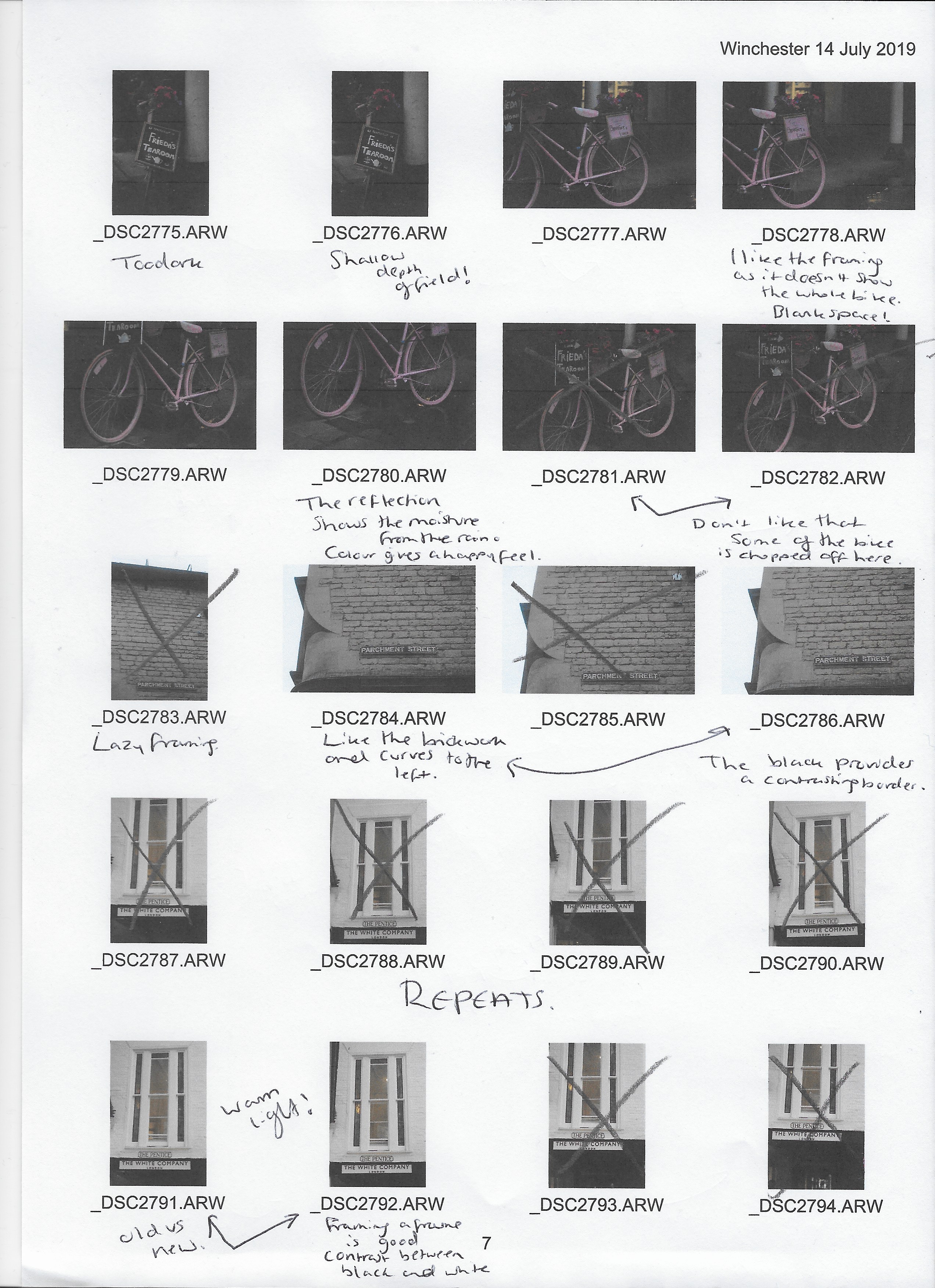
– Provided annotated contact sheets of my shoot around Winchester, noting the strengths and weaknesses of a variety of shots
– As well as a PDF version for a clearer view of the sheets.
– Noted what images worked well and drew on the techniques used, such as consistent framing, natural lighting and such.
– Covered what went well during the shoot, for instance my ability to think about my surroundings to gather a cohesive series much like Keith Arnatt, reflecting on his influence.
– Explored how the shoot went despite an unexpected burst of bad weather, enabling me to achieve the ’empty’ town shots I was looking for and supplying an added interesting atmosphere, as well as
– Stating what could be improved in the future, for example being aware of the angles images are shot at and reducing the amount of duplicate images I capture, in turn being more selective.

Contact sheets:

The following contact sheets include all of the images shot during the ‘Square Mile’ photo-shoot in Winchester, Hampshire. They’ve been annotated and scanned onto my computer, providing suggestions of how the images could’ve been stronger and/or the various elements I enjoyed.

All images were shot in RAW on my Sony A57, so I could then make the basic corrections in post-production without losing too much detail.

Notes :

What do I think of my images?

I’m pleased with how my images turned out, considering that street photography isn’t my usual area of focus and isn’t something I have explored very much. I tried my best to consider similar framing techniques and be aware of the light in my surroundings, to take inspiration from Keith Arnatt who has been part of my practitioner research. Summaries of Arnatt’s work suggest that he ‘may have planned his approach, due to the way he composed the series and stayed consistent with his choice of natural lighting and fixed camera distance’ (Powell, 2019).

What are some of my favourite images?

One of my favourite technical elements from the images shot in the high street (see Fig. 2.) is the contrast between cool, natural light from the gloomy, rainy weather and warm artificial light from the shops and cafes.
Another shot that stands out is the pigeon resting on the window ledge (see Fig. 2.), with the reflection in the glass, very subtly adding tension to the image as you don’t know at first glance what that silhouette may be.

What went well?

The variation of subjects I shot and being able to form a cohesive series purely from my surroundings, successfully achieving my aim to be flexible with what I captured in-camera while keeping the final selection process in mind so I’m not going to be left with a group of random ‘snapshots’ that don’t compliment each other.

What could be improved?

I need to work on my framing and angles a little bit more when shooting. Sometimes my photographs are intentionally taken at an unusual angle, but I also understand that some subjects are better suited with a straight horizon line, which creates more work in post-production if I don’t think about it or can’t get it right the first time round in camera.
Also, I have a habit of taking multiple images which aren’t necessarily an issue, but a few duplicates would be better than half a dozen especially when it comes to producing contact sheets. This is something I will discuss with my tutor to get their opinion on whether I need to work on this or not.

How did the shoot go?

When the shoot was planned, I stated that ‘I would like to go early in the morning so that it isn’t too crowded. This way it’ll allow me to focus on what is around me, what is happening and how I feel about it as a whole’ (Powell, 2019). However, one element not considered was unexpected weather conditions. Thankfully the rain worked in my favour as it was even quieter than expected while creating a moody, dark atmosphere which challenged me to work in conditions that I wouldn’t usually choose to shoot in, due to the inconsistency of light levels, much like direct sunlight at midday.
It was interesting to see how I worked with what I had and how the quality of the images wasn’t necessarily hindered by the weather.

What am I going to do with these images now?

After going through my images as a whole on my computer, I am going to select a few of my best images and apply very basic corrections to them, such as highlight/shadows alterations e.t.c. They will then be cut down again and paired together for the final series of photographs needed for the assignment.

References :

Powell, L. (2019) Keith Arnatt Research. [online] Available at: https://laurenpowelloca.photo.blog/2019/08/13/keith-arnatt-research/ [Accessed 20 July 2019].

Powell, L. (2019) Plan for ‘The Square Mile’. [online] Available at: https://laurenpowelloca.photo.blog/2019/08/20/plan-for-the-square-mile/ [Accessed on 20 July 2019].

List of images:

Powell, L. (2019) Page 1 (Scanned document) In possession of: Lauren Powell: Eastleigh.
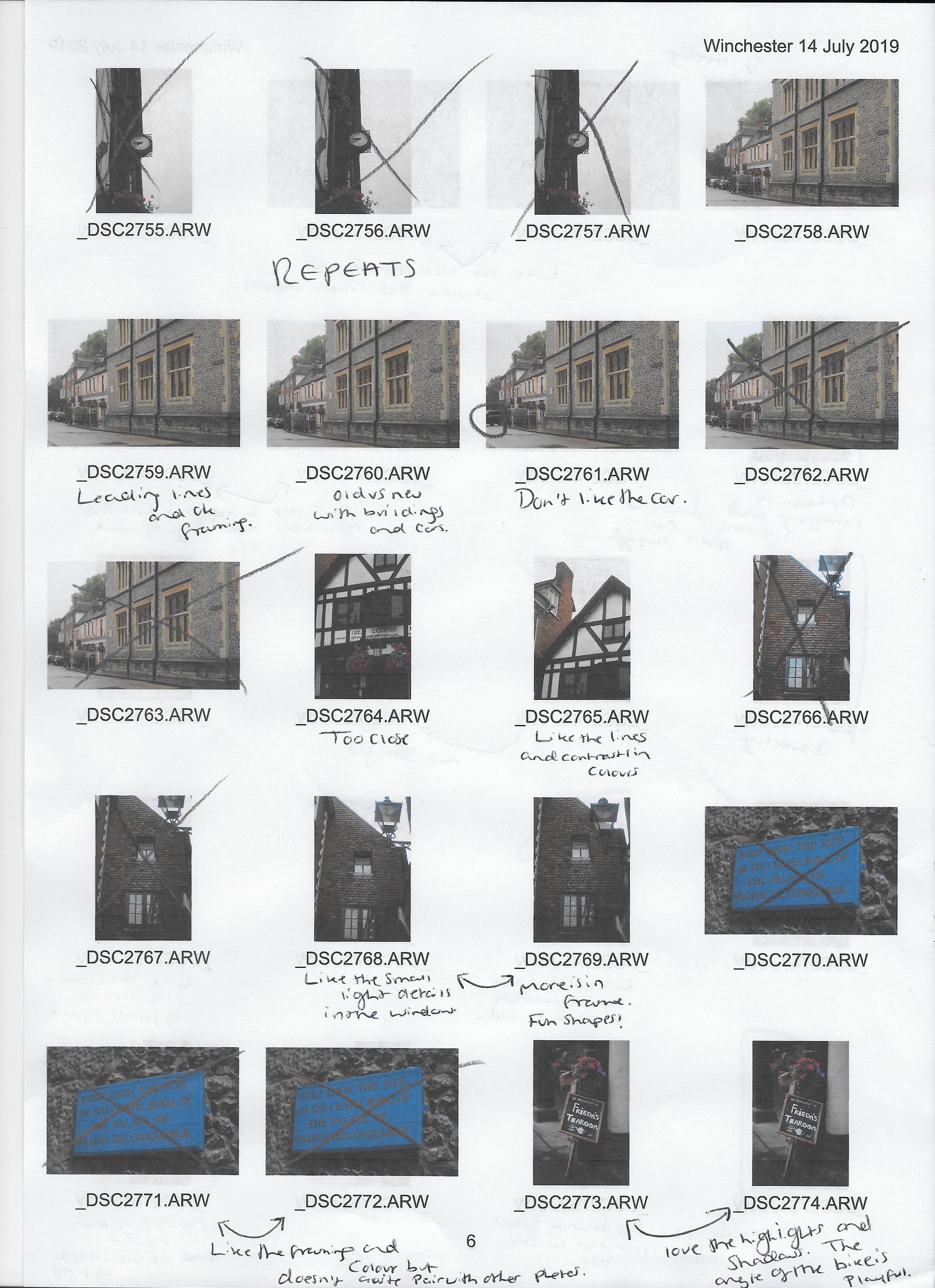
Powell, L. (2019) Page 2 (Scanned document) In possession of: Lauren Powell: Eastleigh.
Powell, L. (2019) Page 3 (Scanned document) In possession of: Lauren Powell: Eastleigh.

Powell, L. (2019) Page 4 (Scanned document) In possession of: Lauren Powell: Eastleigh.

Powell, L. (2019) Page 5 (Scanned document) In possession of: Lauren Powell: Eastleigh.

Powell, L. (2019) Page 6 (Scanned document) In possession of: Lauren Powell: Eastleigh.

Powell, L. (2019) Page 7 (Scanned document) In possession of: Lauren Powell: Eastleigh.

Plan for ‘The Square Mile’

Assignment 1, Notes, Thoughts & Ideas

Summary:

In this post I
– Explained how I planned my shoot using the 5 W’s, H and why
– Listed my plan in bullet points

Plan

I planned my shoot using the 5W’s and H so I could think about my goals and ideas properly, instead of just formulating a list of various aims that were inspired by the mind-map I created.

Area of choice – Where? : Winchester High Street and the surrounding areas

Why? : It holds significant memories with my grandparents, cousins and direct family, so I would like to explore various childhood memories, see how the areas may have changed throughout the years and if they are as I remember them. For example, new buildings vs old architecture, as well as modern-day life within an aging town.

When? I would like to go early in the morning so that it isn’t too crowded. This way it’ll allow me to focus on what is around me, what is happening and how I feel about it as a whole. We also used to go to town fairly early in the day to avoid the rush of people, so it is quite fitting with the routine I followed as a child.

Who? : Depending on whether Winchester is as quiet as I am expecting it to be in the morning, I may include members of the public in my imagery to give a bit of life and action to my photographs. For example, people going about their day, unaware of what significance the town holds for me and vice versa if the town means anything to them. We all share the same space, but we’re not always aware of what people are doing there, how it makes them feel or where they’re headed.

What? : As noted in my post ‘Initial Thoughts About ‘The Square Mile’ + Mindmap’ (Powell, 2019), I will be revisiting some areas I visited or spent significant time with close family. That way I can capture what they look like now, the people/objects surrounding them that may have changed, are consistent or may only be temporary.

How? :

– Go to town early in the morning via train.
– Start from the top of town from the station and work your way down.
– Notice and capture whatever captures your eye as you observe, while keeping original ideas in mind.
– Set the aperture and keep it constant, only change the shutter speed to fit the light settings on the day. SET CAMERA TO MANUAL.
– Have the chosen ideas in mind, but be flexible too. E.G. If something doesn’t work, it’s fine. If you notice something you didn’t think about beforehand, then work with it.
– Think about making a cohesive series – can images/areas be paired up in your final selection process?
– Have fun and go out of your comfort zone.
– Shoot multiple images so you have a reasonable selection.

References :

Powell, L. (2019) Initial Thoughts About ‘The Square Mile’ + Mindmap. [online] Available at : https://laurenpowelloca.photo.blog/2019/08/15/initial-thoughts-about-the-square-mile-mindmap/ [Accessed 20 August 2019].