Assignment 4 – Initial Ideas (Mind-Maps)

Assignment 4, Reflection on assignments, Thoughts & Ideas

Summary

In this post I

– Included the brief for this assignment and

– Listed my initial thoughts, reasonings for choosing a specific path

– Before attaching two mind-maps with various ideas/concepts

– Then listing the pros and cons for each technical approach

– With a short reflection on my ideas and how I will come to decide what I want to do for Languages of Light.

Brief

‘Revisit one of the exercises on daylight, artificial light or controlled light from Part Four (Ex 4.1, Ex 4.2 or Ex 4.3) and develop it into a formal assignment submission. The submission requirement for this assignment is a set of between six and ten high-quality photographic prints‘ (Bloomfield, 2018).

Initial thoughts

As I’ve used natural light a lot for personal work and past assignments, I feel it’s necessary to push myself out of my comfort zone and explore either artificial or controlled light for this particular assignment. Both 4.2 and 4.3 were interesting to do as well as the analysis of the results and what they taught me, so choosing the exercise I would like to revisit may take a little longer than anticipated.

I’ve gathered together multiple ideas for each technical approach and formulated two individual mind-maps, allowing me to figure out the subjects or projects that stand out to me most over the next few days. I plan to sit with these ideas for 2-3 days, see which ones come back to mind most and begin researching the different techniques or approaches, before exploring the chosen project in more detail.


Mindmaps
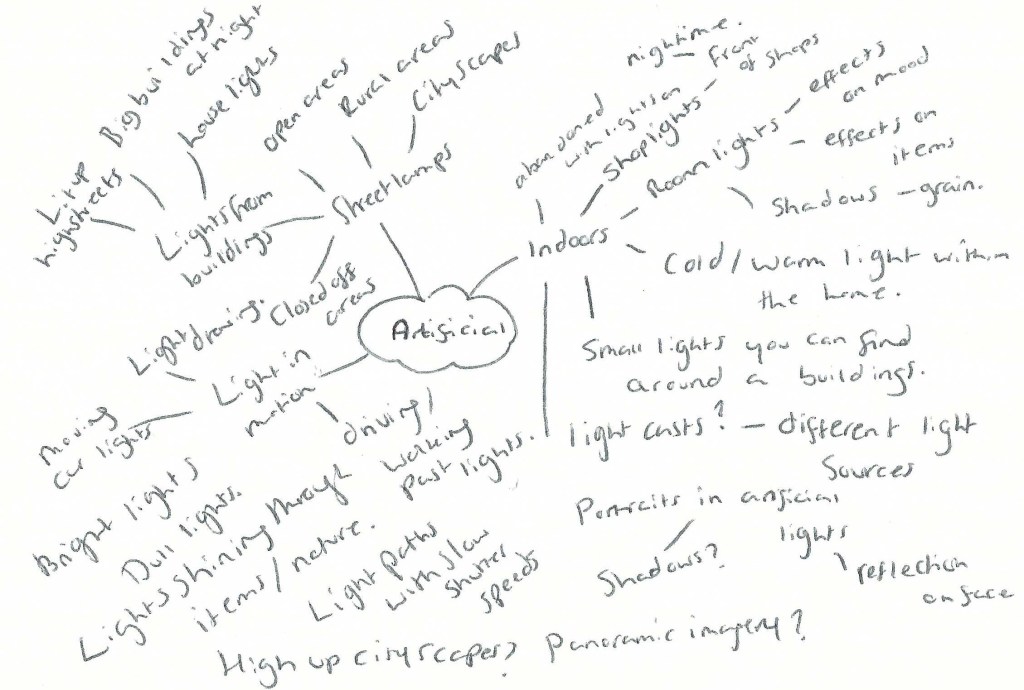
Artificial light

– Shooting with artificial light will remove the option for me to control how the light falls, forcing me to capture it in an interesting way from what is available.

– Working outside would be more realistic currently, given the slow ease of lockdown restrictions.

– If I didn’t want to go outside, there is always the possibility to explore artificial light within the home e.g. lamps, lights from house windows, lights from technology etc.

– Shooting during the night would mean fewer people around so wouldn’t have to worry about social distancing and could capture shop windows/high streets in a way we may not see usually. Ghosttown-esque?

– Could experiment with light paths by capturing images from a moving vehicle or by moving around the light source. Abstract?

– Capturing cityscapes and working at night isn’t something I usually do so would be interesting to explore.

– Portraits would be interesting to take at night, as I’ve never done that before and could result in some really interesting shots depending on location and light source.

– It’s nearing summertime so would have to work much later than expected, which isn’t as ideal.

– May have to travel to photograph cityscapes or highstreets, so would have to plan transport.

– Lighting within the home is possible, but more restrictive and not pushing myself further.

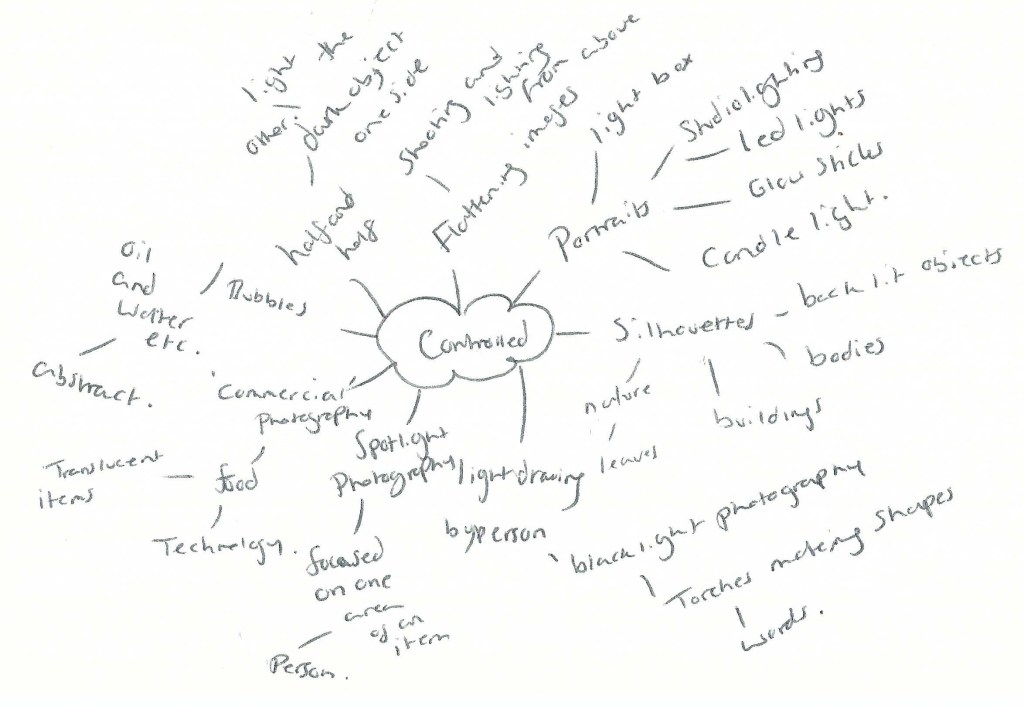
Controlled light

– I have control of the light and how it falls on the subject, which could result in some really interesting shots.

– Would push me far out of my comfort zone, having avoided studio lighting for many years.

– Trying out various light sources would be interesting and provide me with much more knowledge than before.

– Could work within the home which is ideal for social distancing purposes and removing the need to travel.

– Silhouette work would be interesting to explore, as they may have the ability to be much more defined than if I were to shoot using a duller artificial light.

– I could make a set-up within the home or garden, which is easier to do than setting up outside with no electrical sources etc.

– Lightbox photography is something I’ve explored briefly before and could link in with silhouette photography, combining multiple ideas.

– If I wanted to use a model for this project, I would have to consider social distancing still if the set-up was indoors.

– Space would be more restrictive working within the home which may not be ideal, depending on what I decide to shoot.

– May have to invest in more lights for this project, as I have very limited options in my pre-existing kit.

Reflection

There are pros and cons for each exercise, ranging from lack of kit to the planning of travel and considering the time of day. Despite all of this, there are some strong ideas that I’d be more than happy to explore and willing to take the time to gather equipment or plan. Silhouette photography, the use of a lightbox and creating abstract images are currently the strongest contenders for me. If I wanted to use a model for this assignment and work around social distancing, I could either model myself with a tripod set up or ask a family member. Sourcing a variety of lights is also possible with a little bit of research and asking around, but still doable.

Any struggles that may occur during this assignment are making me more excited to explore and shoot for Languages of light, as it will push me to work with what I’ve got, find a way around the difficult stages and grow from it.

Still undecided on whether to use artificial or controlled light, but I have plenty of ideas to think about and research in the meantime. Looking forward to this assignment and what results will come from it.


References

Bloomfield, R., 2018. Photography 1: Expressing your Vision. 4th ed. [pdf] Barnsley: OCA, p. 97. Available at: https://www.oca-student.com/course/photography-1-expressing-your-vision [Accessed 18 May 2021].

List of images

Figure. 1 Powell, L (2021) Collection [Ballpoint pen on paper] In possession of: Lauren Powell: Eastleigh.

Figure. 2 Powell, L (2021) Artificial [Ballpoint pen on paper] In possession of: Lauren Powell: Eastleigh.
Mindmaps + Shoot plan

Assignment 3

Summary:

In this post I have

– Included the assignment brief for the (in)decisive moment.
– Explained briefly that I have researched both moments in further details and considered the ability to shoot during lockdown.
– Discussed why I am heading more towards the (in)decisive moment and working in a domestic environment.
– Included photocopies of my mind maps for both in decisive and (in)decisive moment.
– Written bullet points for each map, covering what I would achieve or find difficult with this particular approach.
– Briefly touched upon my test shoot, including a contact sheet of the images and explored where I’m headed with my final shoot plan.


‘The (in)decisive moment’:

‘The decisive moment is not a dramatic climax but a visual one: the
result is not a story but a picture.’ (Swarkowski, 2007, p.5)


‘You know it’s funny. You come to someplace new, and everything looks
just the same.’(Eddie in Stranger Than Paradise, Dir. Jim Jarmusch, 1984)


Brief

Create a set of between six and ten finished images on the theme of the decisive moment. You
may choose to create imagery that supports the tradition of the ‘decisive moment’ or you may
choose to question or invert the concept by presenting a series of ‘indecisive’ moments. Your
aim isn’t to tell a story, but in order to work naturally as a series there should be a linking theme,
whether it’s a location, event or particular period of time.
(Bloomfield, 2018)

Thoughts

Having researched further about both the decisive and (in)decisive moment, test shoots and taking into consideration that we have gone into another lockdown, I am heading more towards the (in)decisive moment, due to the fact street photography doesn’t feel like the safest option currently. The (in)decisive moment will allow me to capture imagery from a domestic environment, without feeling too restricted in terms of where I can go, what I can document, as well as who.

After completing a mind-map for both routes, there are clearer ideas for the (in)decisive one in comparison to the decisive, this, in turn, helps me understand what I am more comfortable with in regards to concepts, subjects, approaches and results.

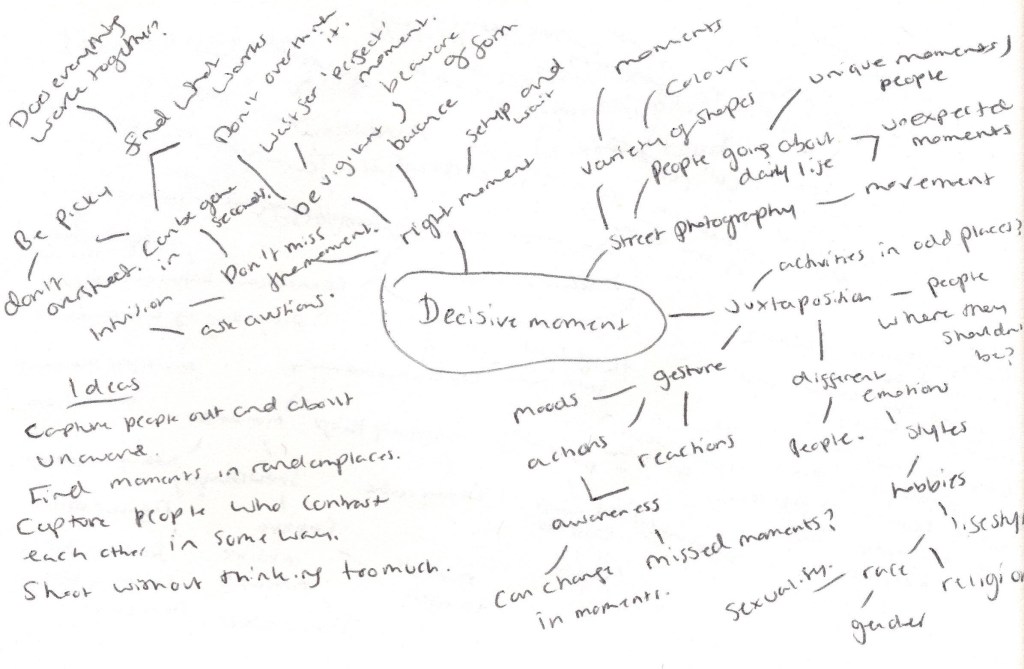
Fig. 1. Decisive Moment (2020)

Reflection on decisive moment mind map (see Fig. 1).

– Would be out of my comfort zone as street photography isn’t something I do often.
– Would have a variety of people and locations to work with and look out for.
– More opportunities to capture something unique or unexpected.
– It would push me to be more selective and intuitive about my shooting process.
– Could play around with expressions, movement and context surrounding them.
– Decisive moments would allow me to be more patient and aware of my surroundings, subjects, timing etc.
– Perhaps more flexibility regarding the ability to create or capture juxtapositions.
– Wouldn’t be safe to do so currently with the global pandemic.
– Restricted on where I can go, travel or enter.
– May not be as many people around due to the pandemic.

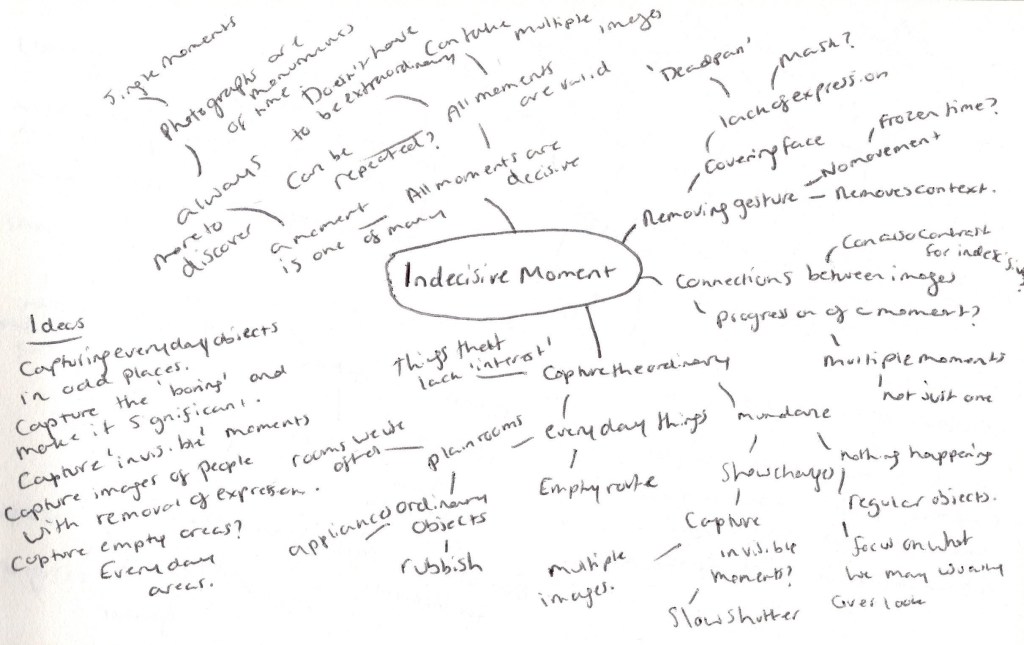
Fig. 2. Indecisive Moment (2020)

Reflection on (in)decisive moment mind map (see Fig. 2).

– I have more control of the composition and what I’m capturing.
– Can remove context if necessary to create questions and tension.
– Would be able to gather together multiple subjects within a safe environment.
– Would link back to my preferred coursework “slow shutter speed”.
– Playing around with the ordinary and bringing focus to the things we are used to is an interesting concept.
– Could play around with empty areas, without breaking covid guidelines.
– Allows me to have multiple chances to get an image I like, rather than missing a moment.
– Maybe not outside of my comfort zone, so would have to figure out a way around it.
– Restricted in terms of unique, unpredictable moments.
– Restricted to my home which in some ways, will reduce the amount of opportunities I may be able to capture.
– Would have to consider what I’m capturing, as I share a home with family.

Fig. 3. Test Sheet (2020)


Following my test shoots where I captured the gradual decay of fruits and flowers (see Fig. 3), I’ve decided to use this idea for my final shoot. Placing an object in isolation to something else would represent our current lockdown situation, without directly shooting images surrounding it. A play on words and subject if you will. Playing around with time, subjects and showing what is invisible, much like the research I did for coursework. I am planning this shoot, have set up a frame as well as time scale I will be shooting these images across, therefore these aren’t spontaneous moments as such as I am in control of them unlike decisive moments. Capturing the mundane indoors, rather than street photography. The removal of context by not having a background involved.

Shoot plan

– Capture the mundane and perishable goods.
– Set up camera up in front of the item to decide the desired frame and adjust the focal length to assure an in focus end result.
– Set up the item and leave it untouched until all images are shot.
– Be aware that camera settings may have to be changed throughout the day depending on light changes.
– Keep out of direct sunlight to avoid harsh light and shadows, as seen in my test shoot.
– Keep shooting at pre-chosen times to document the changes that occur across a set amount of hours or days, before overlapping each picture in Photoshop.
– Explore the idea of invisible time by creating a ‘double exposure’. We know time is passing each minute, but when can’t necessarily see it unless we isolate it. Metaphor for life and death?


References:

Bloomfield, R., 2018. Photography 1: Expressing your Vision. 4th ed. [pdf] Barnsley: OCA, p.74. Available at: https://www.oca-student.com/course/photography-1-expressing-your-vision [Accessed 28 March 2021].

List of images:

Figure. 1. Powell, L. (2020) Decisive Moment [Ballpoint pen on paper] In possession of: Lauren Powell: Eastleigh.
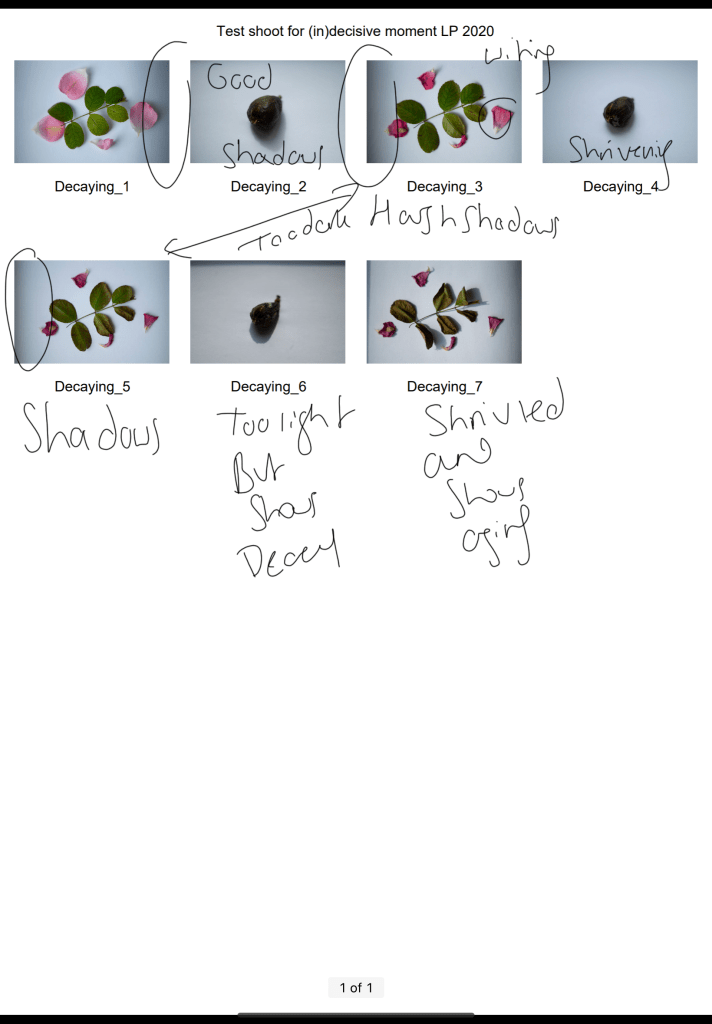
Figure. 2. Powell, L. (2020) Indecisive Moment [Ballpoint pen on paper] In possession of: Lauren Powell: Eastleigh.
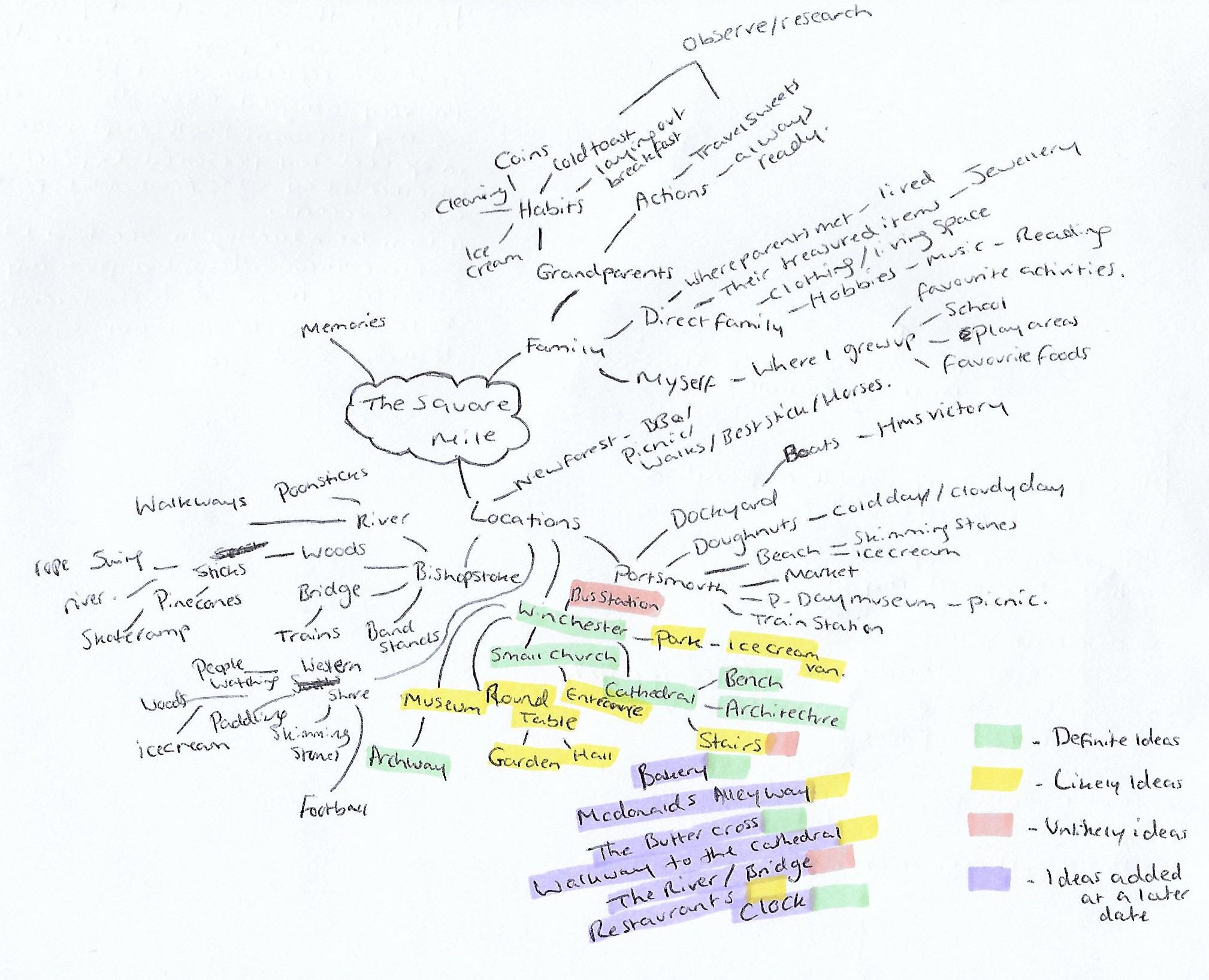
Figure. 3. Powell, L. (2020) Test sheet [scanned document] In possession of: Lauren Powell: Eastleigh.

Initial Thoughts About ‘The Square Mile’ + Mindmap

Assignment 1, Notes, Reflection on assignments, Thoughts & Ideas

Summary :

In this post I have;

– Referred to the brief.
– Noted down my initial thoughts and concerns for this assignment.
– Provided a mind-map of ideas for the Square Mile.
– My chosen subject area and the reasoning as to why it was selected.

‘The Square Mile’:

In our earliest years we know a patch of ground in detail we will never know anywhere again – a site of discovery and putting names to things – people and places – working with difference and similitude – favourite places, places to avoid – neighbours and their habits, gestures and stories – textures, smells – also of play, imagination, experiment – finding the best location for doing things – creating worlds under our own control, fantasy landscapes.’ (Professor Mike Pearson)

‘Photographers and artists have always found inspiration in their immediate location. There is a concept within Welsh culture called Y Filltir Sgwar (The Square Mile), described above by Professor Mike Pearson. It is the intimate connection between people and their childhood ‘home’ surroundings. Use this ‘sense of place’ as the starting place for your assignment.‘ (Bloomfield, 2018)

Brief:

Make a series of six to twelve photographs in response to the concept of ‘The Square Mile’. Use this as an opportunity to take a fresh and experimental look at your surroundings. You may wish to re-trace places you know very well, examining how they might have changed; or, particularly if you’re in a new environment, you may wish to use photography to explore your new surroundings and meet some of the people around you.’ (Bloomfield, 2018).

Initial thoughts about the concept:

– So far I am very intrigued about this concept, as my photography is usually inspired by personal experiences, past and present.

– It will be interesting to see how I can explore these ideas, as well as pushing myself to portray them in a different manner and style to what I am used to.

– Quite anxious to start, but also eager to learn and grow.

Initial plans for the brief:

– Will expand with a mind-map/mood-board? (See Fig. 1)

– Refer to past college project – ‘My Britain’ which explored my childhood. Potentially take ideas from this and work on them differently?

– Explore childhood memories/areas/people?

– Significant buildings/objects/symbols?

– Explore the family tree?

– Photos of people in my chosen area that aren’t linked with my memories or are related to me?

Fig. 1. Mindmap (2019)

Reflection on mind-map

– Pleased with initial ideas and think I already know the route I want to go down.
– The route will be decided after further research and shoot planning.
– Mind-map could be tidier and clearer in the future.
– Maybe use different coloured pens for different areas or subject arms?

I’ve decided to choose ‘Winchester’ as my area of choice mainly due to the family links it holds and the memories experienced here. It isn’t my immediate location as I wasn’t born there, nor do I live there, however, it is a local city that I am fairly familiar with and have grown up visiting multiple times, therefore I felt as if it was significant.
The buildings/locations/objects have been listed, instead of the memories linked with them, hopefully allowing me to view the town with a fresh set of eyes.

Highlighting the chosen area and the things I want to visit while I’m there, make it a lot clearer for those viewing it as well as myself, so I will continue to do this in the future.
Making a key for different colours helps me prioritise what I want to explore in more detail and the less important ideas.

*Purple ideas were added on the 12th August for future reference.

References :

Bloomfield, R., 2018. Photography 1: Expressing your Vision. 4th ed. [pdf] Barnsley: OCA, p.14. Available at: https://www.oca-student.com/course/photography-1-expressing-your-vision [Accessed 12 August 2019].

List of images :

Figure. 1. Powell, L. (2019) Mindmap [scanned document] In possession of: Lauren Powell: Eastleigh.