
Summary:
In this post I
– Gave examples of the citations I created myself after reading the Harvard Referencing Guide from UCA
Referencing examples:
After having a conversation with my brother who recommended I create a few templates to refer to in the future when it comes to my assignments, research and such, I decided to visit the Harvard Referencing guide (UCA, 2014) provided on the UCA library which I will link if you too are struggling.
One of the example’s I created for myself to practice is as follows;
BOOK: Surname, Initial. (Year) Book title Place: Publisher.
Example for bibliography: Rowling, J.K. (1997) Harry Potter and the Philosopher’s Stone London: Bloomsbury Publishing.
CITATION: ‘quote’, (Surname, year:page number).
Example for citation (in text) : ‘Mr and Mrs Dursley, of number four, Privet Drive, were proud to say that they were perfectly normal, thank you very much’, (Rowling, 1997:7).
‘Note: If there is more than one edition of the book you need to state which edition you are referring to. Different editions may have different information, page numbers etc. This is not the same as a reprinted version, which does not include a change of format’, (UCA, 2014:6).
I think I’ve finally gotten the hang of it after sitting and creating multiple versions for a few hours, so hopefully research will go smoothly in the future.
References:
Rowling, J.K. (1997) Harry Potter and the Philosopher’s Stone London: Bloomsbury Publishing
UCA. (2014) UCA Harvard Referencing Guide. UCA: pp. 6, 10 [pdf] Available at: https://www.uca.ac.uk/library/academic-support/harvard-referencing/ [Accessed 22 January 2020].
Harvard Referencing
Initial Thoughts About ‘The Square Mile’ + Mindmap
Assignment 1, Notes, Reflection on assignments, Thoughts & IdeasSummary :
In this post I have;
– Referred to the brief.
– Noted down my initial thoughts and concerns for this assignment.
– Provided a mind-map of ideas for the Square Mile.
– My chosen subject area and the reasoning as to why it was selected.
‘The Square Mile’:
‘In our earliest years we know a patch of ground in detail we will never know anywhere again – a site of discovery and putting names to things – people and places – working with difference and similitude – favourite places, places to avoid – neighbours and their habits, gestures and stories – textures, smells – also of play, imagination, experiment – finding the best location for doing things – creating worlds under our own control, fantasy landscapes.’ (Professor Mike Pearson)‘
‘Photographers and artists have always found inspiration in their immediate location. There is a concept within Welsh culture called Y Filltir Sgwar (The Square Mile), described above by Professor Mike Pearson. It is the intimate connection between people and their childhood ‘home’ surroundings. Use this ‘sense of place’ as the starting place for your assignment.‘ (Bloomfield, 2018)
Brief:
‘Make a series of six to twelve photographs in response to the concept of ‘The Square Mile’. Use this as an opportunity to take a fresh and experimental look at your surroundings. You may wish to re-trace places you know very well, examining how they might have changed; or, particularly if you’re in a new environment, you may wish to use photography to explore your new surroundings and meet some of the people around you.’ (Bloomfield, 2018).
Initial thoughts about the concept:
– So far I am very intrigued about this concept, as my photography is usually inspired by personal experiences, past and present.
– It will be interesting to see how I can explore these ideas, as well as pushing myself to portray them in a different manner and style to what I am used to.
– Quite anxious to start, but also eager to learn and grow.
Initial plans for the brief:
– Will expand with a mind-map/mood-board? (See Fig. 1)
– Refer to past college project – ‘My Britain’ which explored my childhood. Potentially take ideas from this and work on them differently?
– Explore childhood memories/areas/people?
– Significant buildings/objects/symbols?
– Explore the family tree?
– Photos of people in my chosen area that aren’t linked with my memories or are related to me?
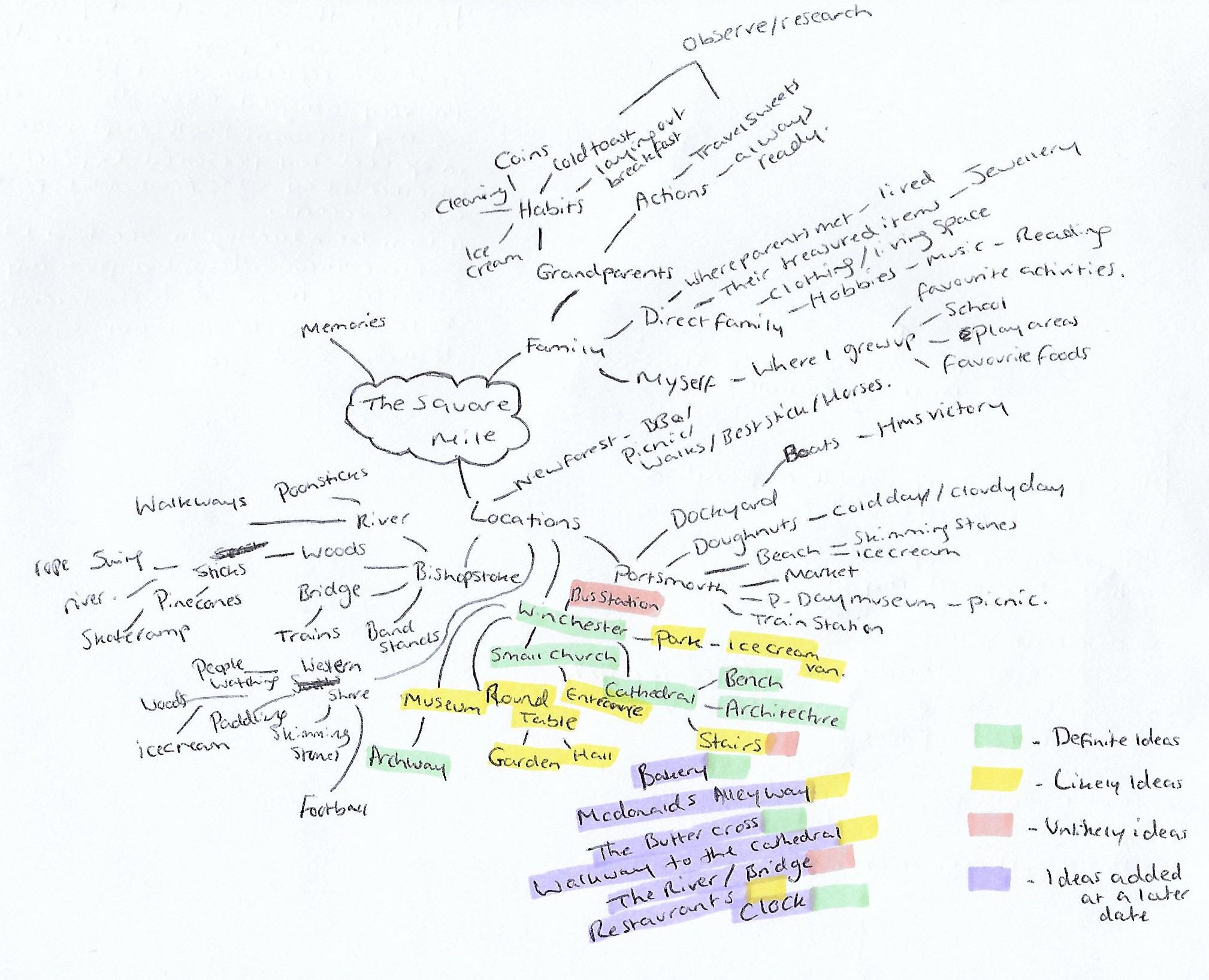
Reflection on mind-map
– Pleased with initial ideas and think I already know the route I want to go down.
– The route will be decided after further research and shoot planning.
– Mind-map could be tidier and clearer in the future.
– Maybe use different coloured pens for different areas or subject arms?
I’ve decided to choose ‘Winchester’ as my area of choice mainly due to the family links it holds and the memories experienced here. It isn’t my immediate location as I wasn’t born there, nor do I live there, however, it is a local city that I am fairly familiar with and have grown up visiting multiple times, therefore I felt as if it was significant.
The buildings/locations/objects have been listed, instead of the memories linked with them, hopefully allowing me to view the town with a fresh set of eyes.
Highlighting the chosen area and the things I want to visit while I’m there, make it a lot clearer for those viewing it as well as myself, so I will continue to do this in the future.
Making a key for different colours helps me prioritise what I want to explore in more detail and the less important ideas.
*Purple ideas were added on the 12th August for future reference.
References :
Bloomfield, R., 2018. Photography 1: Expressing your Vision. 4th ed. [pdf] Barnsley: OCA, p.14. Available at: https://www.oca-student.com/course/photography-1-expressing-your-vision [Accessed 12 August 2019].
List of images :
Figure. 1. Powell, L. (2019) Mindmap [scanned document] In possession of: Lauren Powell: Eastleigh.
 Lauren Powell OCA