Summary :
In this post I have;
– Stated the brief for this exercise.
– Provided the images taken, along with the technical settings and histogram screenshots.
– Documented the camera I used, as well as the settings and
– Briefly covered how I executed the exercise, my choice of a static transparent subject and the changes I saw with the naked eye and the histograms for both the indoor and outdoor shoots.
Brief:
‘Take three or four exposures of the same scene. Don’t change anything on the camera and keep the framing the same.
Preview the shots on the LCD screen. At first glance they look the same, but are they? Perhaps a leaf moved with the wind, the light changed subtly, or the framing changed almost imperceptibly to include one seemingly insignificant object and exclude another. Time flows, the moment of each frame is different, and, as the saying has it, ‘you can’t step into the same river twice’.
Now bring up the histogram on the preview screen. The histogram is a graphical representation of exposure – the camera’s sensitivity to light. As you page through the images you can see small variations in the histograms. Even though the pictures look the same, the histogram data shows that in a matter of seconds the world changes, and these subtle differences are recorded by the camera. If you refine the test conditions – shooting on a tripod to fix the framing, moving indoors and closing the curtains to exclude daylight – still the histogram changes. Probably some of the changes are within the camera mechanism itself; still, the camera is a sensitive enough instrument to record them.
Add the sequence to your learning log with the time info from your camera’s shooting data as your first images for Part One.‘ (Bloomfield, 2018)
Before shooting anything, I made sure my SONY SLT-A57 was set to auto as requested in the OCA Expressing Your Vision Course Handbook, as well as making sure my 50mm lens was switched to auto-focus.
Instead of using a solid object, or a ready-made set up, I decided to use a resin art piece as my subject, due to the fact light can pass through it which seemed like an interesting idea to play with.
For the first set of images, I decided to begin in a more ‘controlled’ area by placing the piece on the window ledge in my kitchen during mid-morning when the sun was shining through.
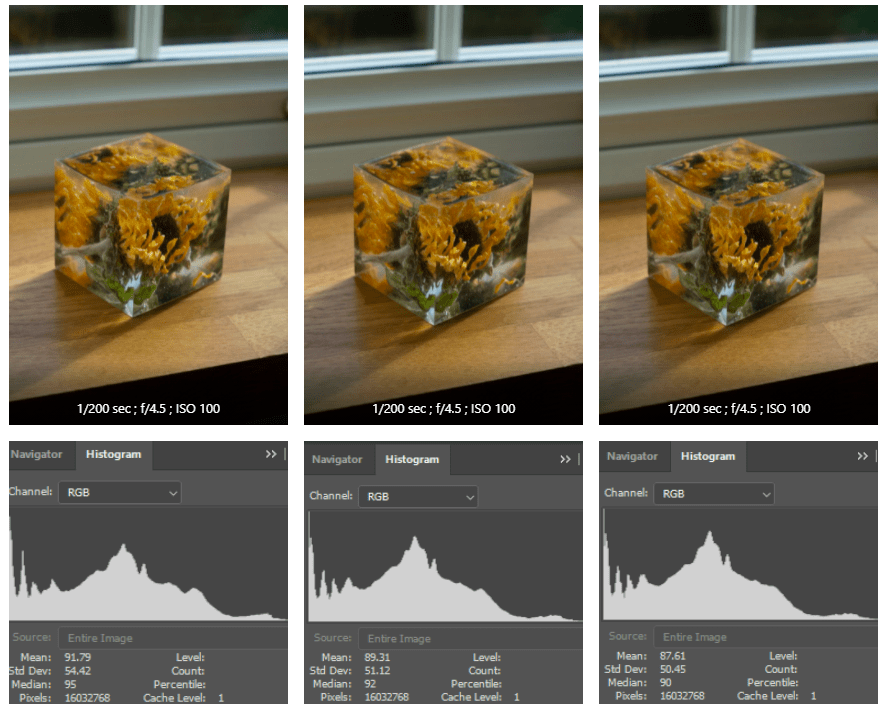
While the changes in the images are very slight (see Fig. 1), you can see that the framing shifts slightly where I wasn’t using a tripod to steady the camera.
As shown in the histograms, the shadows in the first image peak slightly higher than the other two, while the mid-tones in the third image peaks significantly in comparison to the first image.
With the naked eye, these light changes are very difficult to see, if not impossible so it’s really interesting to analyse what the camera can detect.
For the second set of images, I decided to head outside with the same piece and place it in direct sunlight to see how the results would differ.
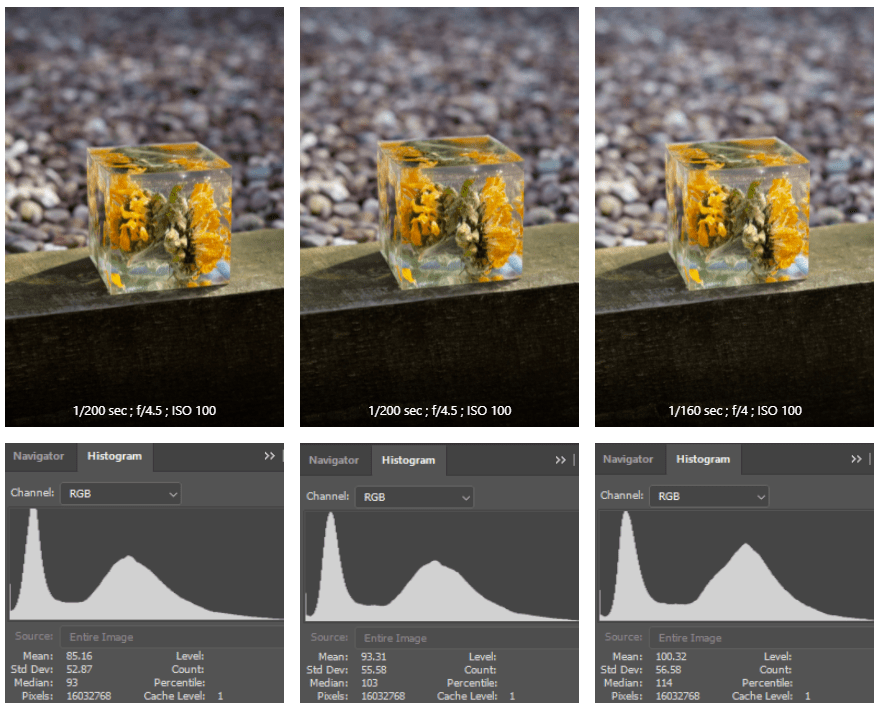
Unlike the first set, I can see the changes in light levels (see Fig. 2). The left is the best of the three (in my opinion) with just enough shadow to define the details within the frame, without being blown out by the highlights. The third picture, however, is significantly brighter and takes away the depth presented in the first.
Once again there are slight differences in the framing due to the lack of tripod for support.
What I’ve found most interesting is the histograms for the images taken outside are much more smooth, with less peaking than the images taken indoors, as well as the fact the shadows are almost if not already clipped off on the histogram.
I would have to do further research on histograms if I wanted to understand why this was the case in much more depth, so I may do this in the future. But what I have taken from this small exercise is the slightest of changes can be picked up, even if you can’t notice it with the naked eye and despite where you capture your imagery.
References :
Bloomfield, R., 2018. Photography 1: Expressing your Vision. 4th ed. [pdf] Barnsley: OCA, p.21. Available at: https://www.oca-student.com/course/photography-1-expressing-your-vision [Accessed 9 November 2019].
List of images:
Figure. 1. Powell, L. (2019) Set 1 [pdf, screenshot] In possession of: Lauren Powell: Eastleigh.
Figure. 2. Powell, L. (2019) Set 2 [pdf, screenshot] In possession of: Lauren Powell: Eastleigh.
 Lauren Powell OCA