Preparing for assessment – LO2 – A selected body of work

Reflection on assignments, Reflection on coursework, Reflection on feedback

Learning outcome 2: ‘A selected body of work’.

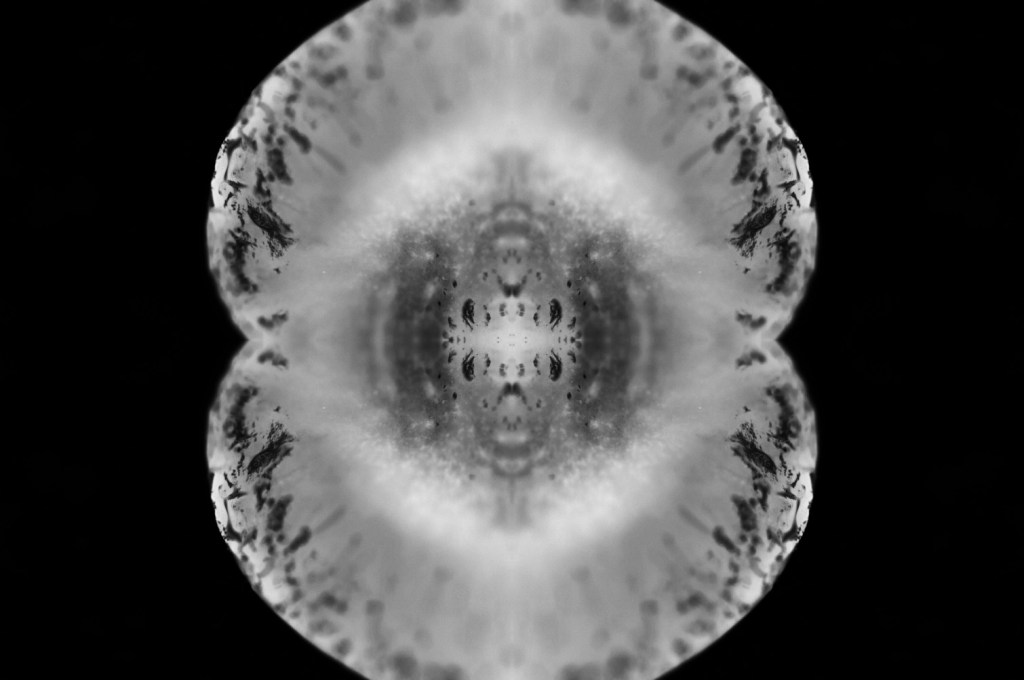
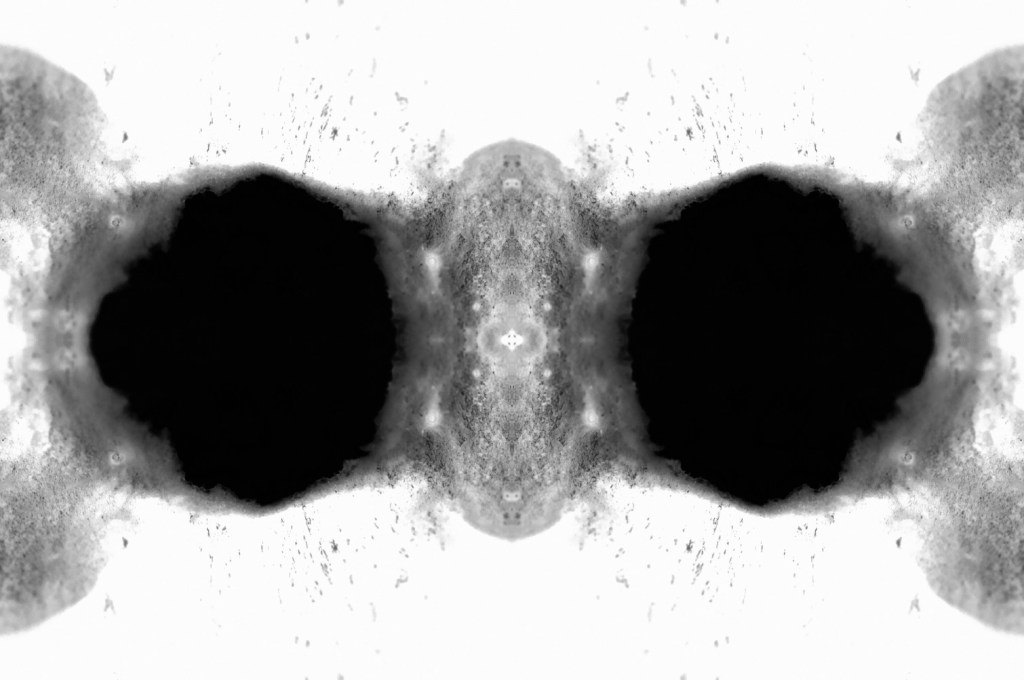
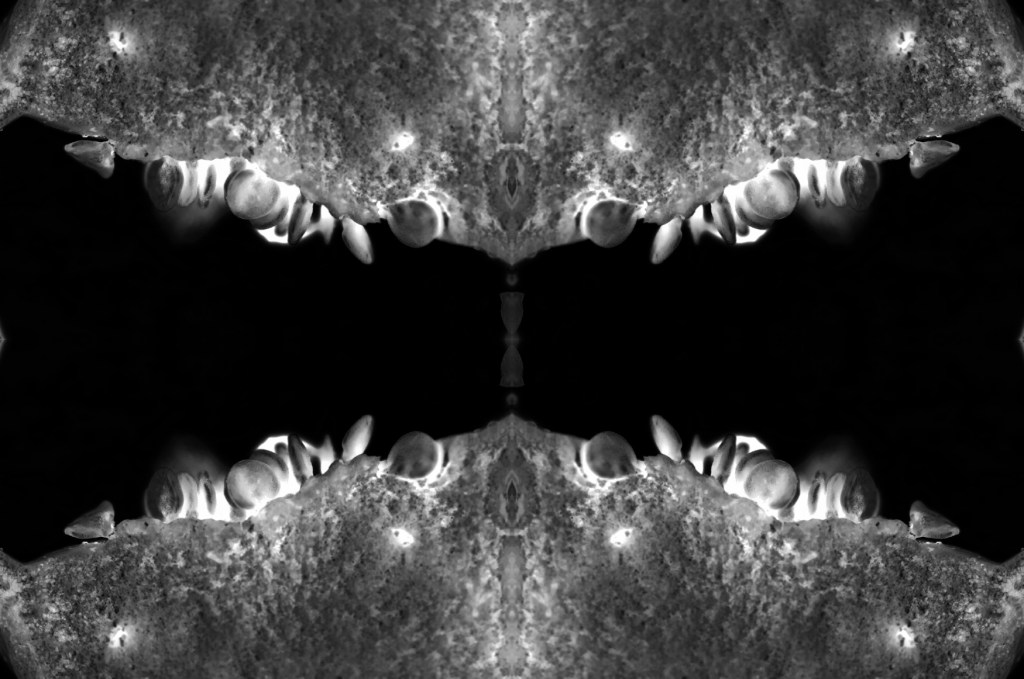
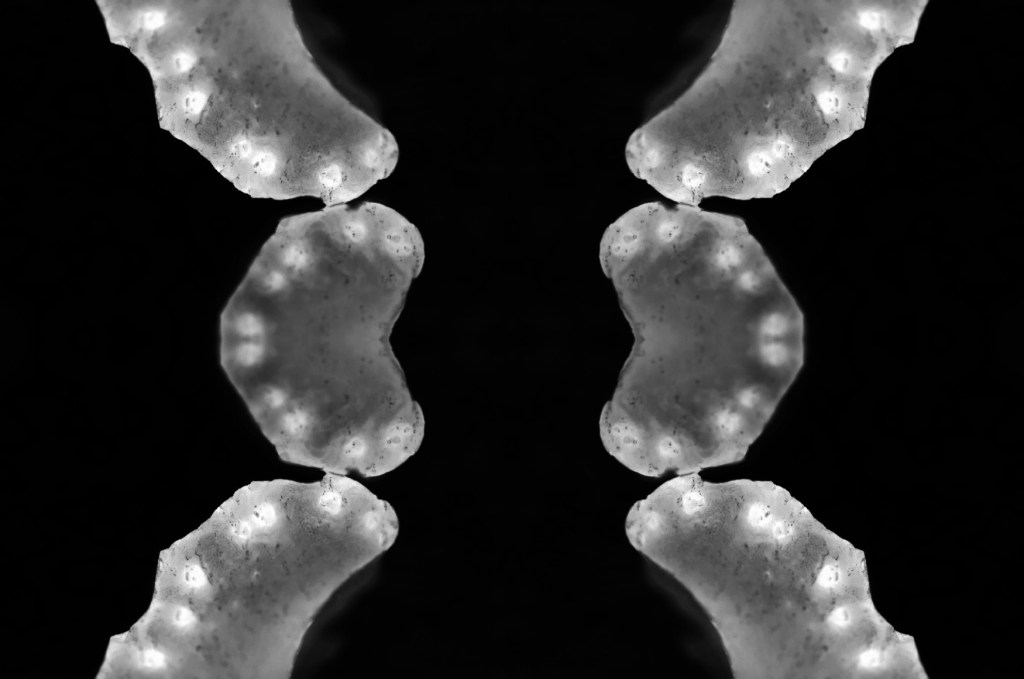
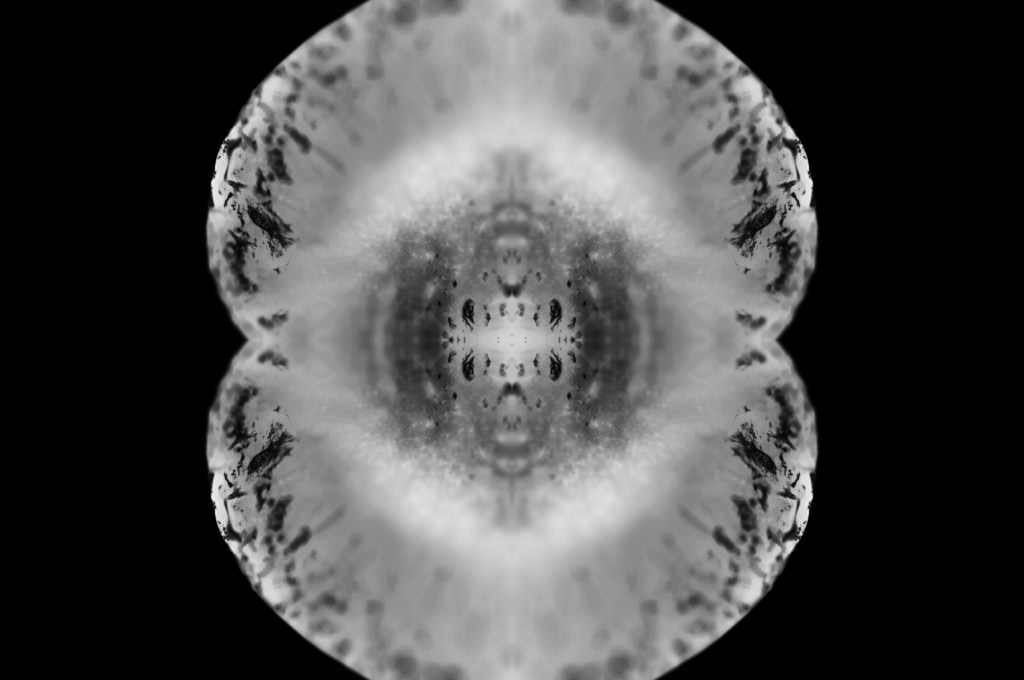
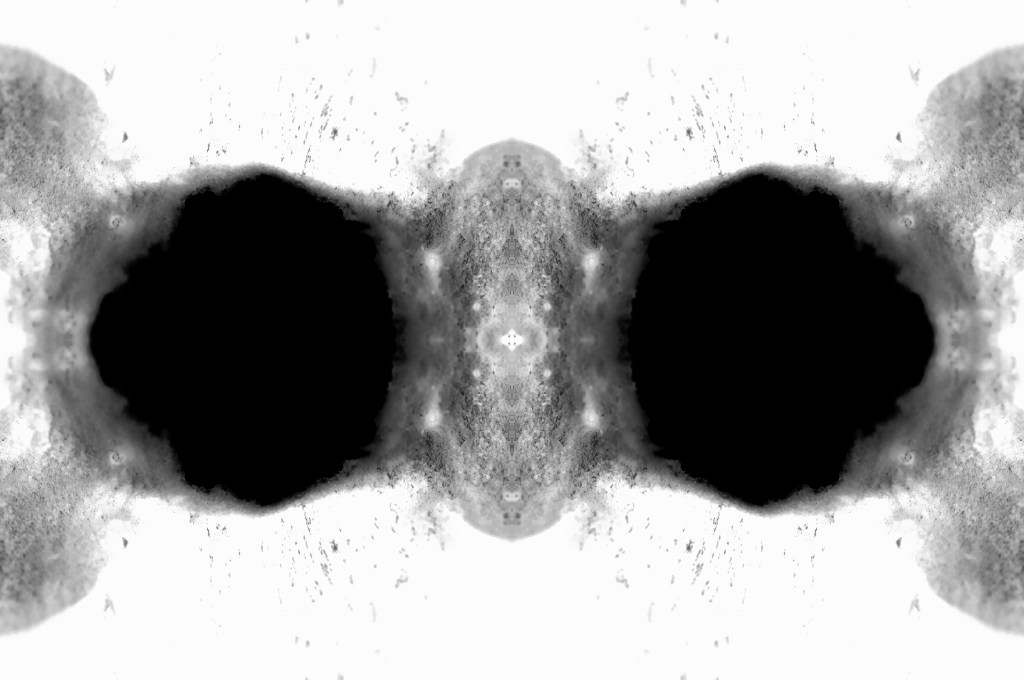
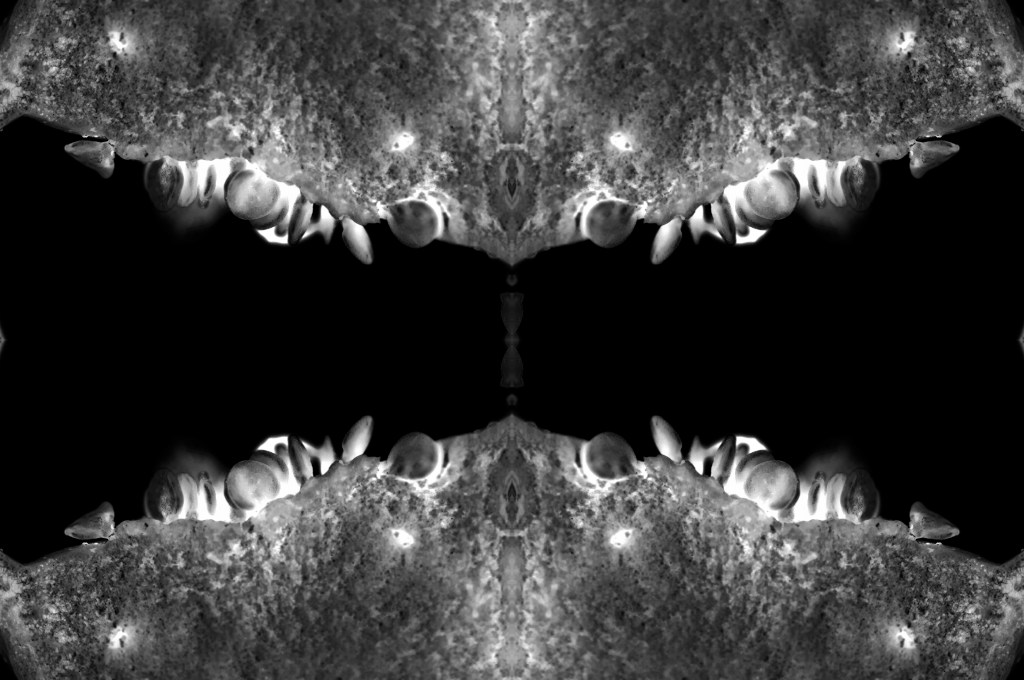
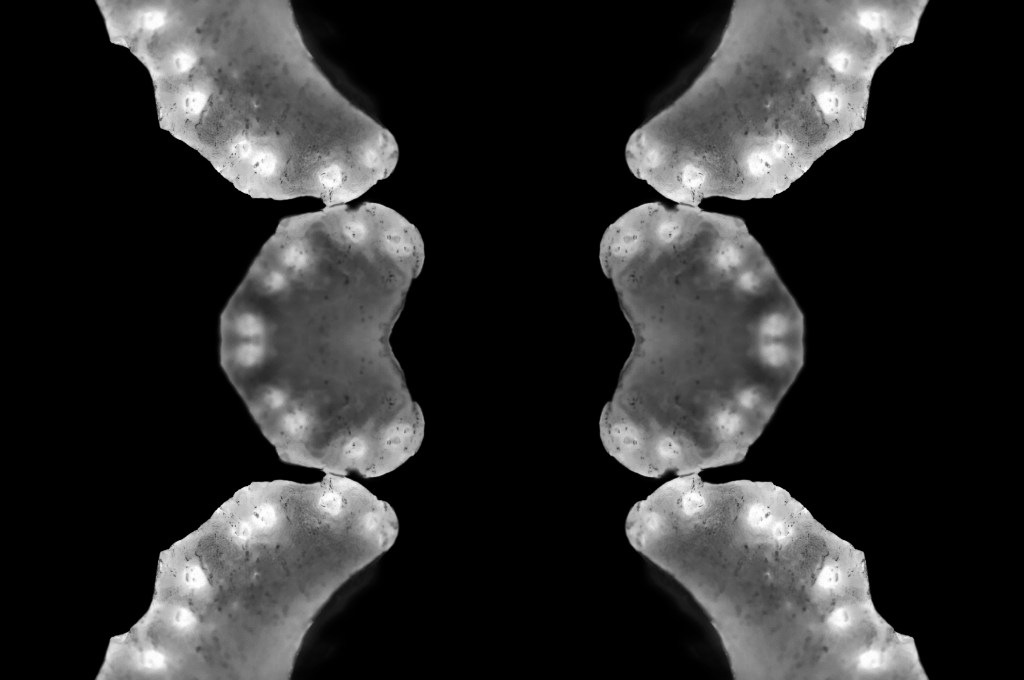
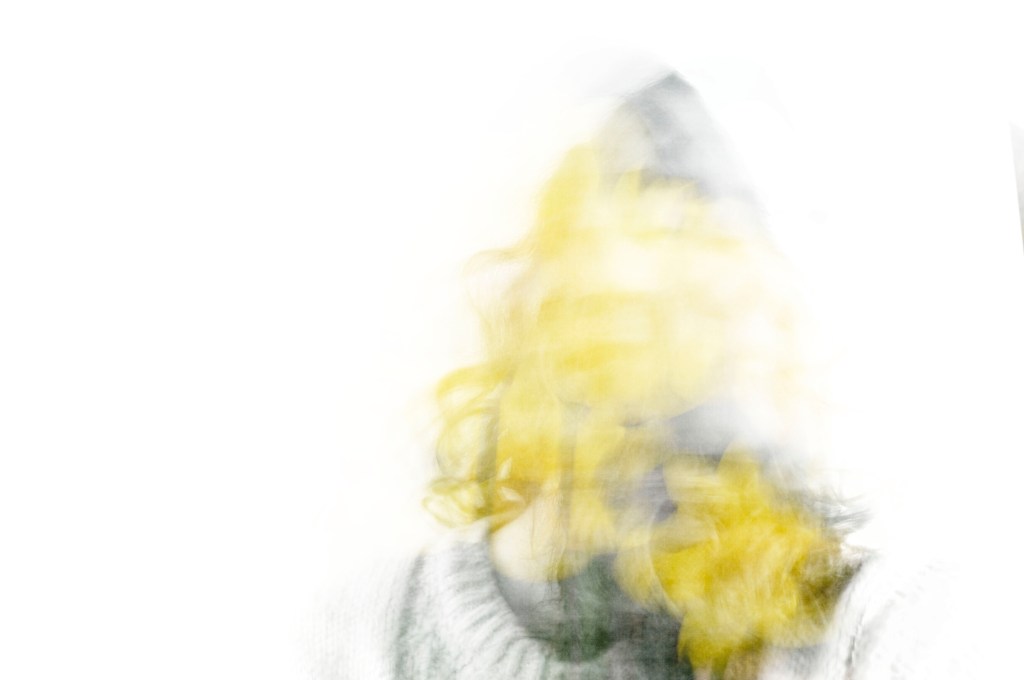
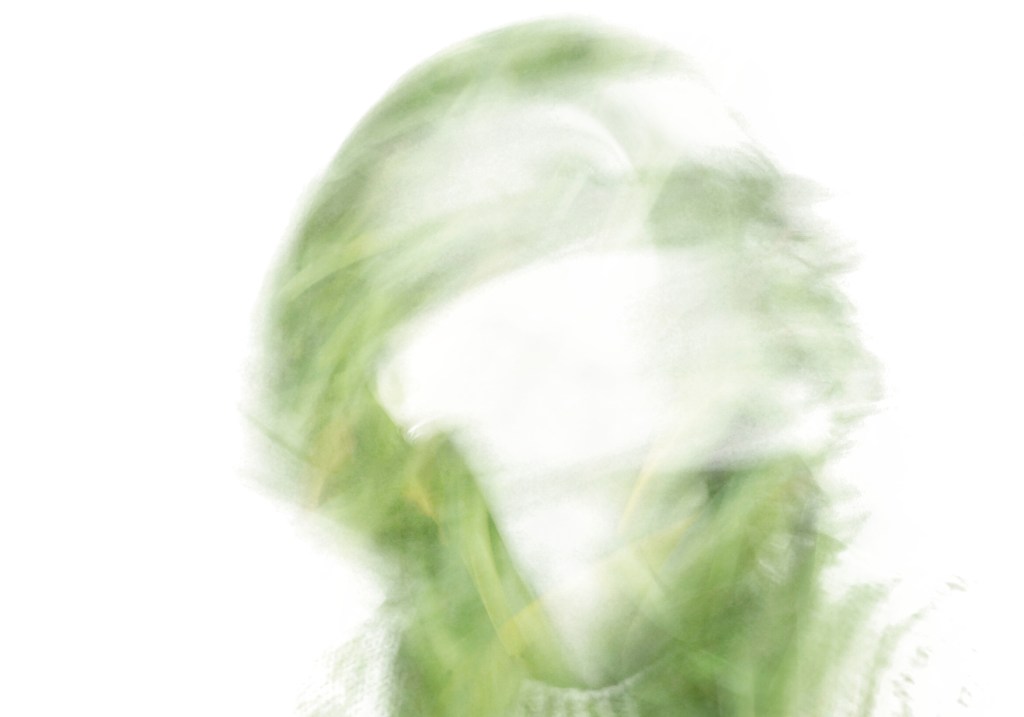
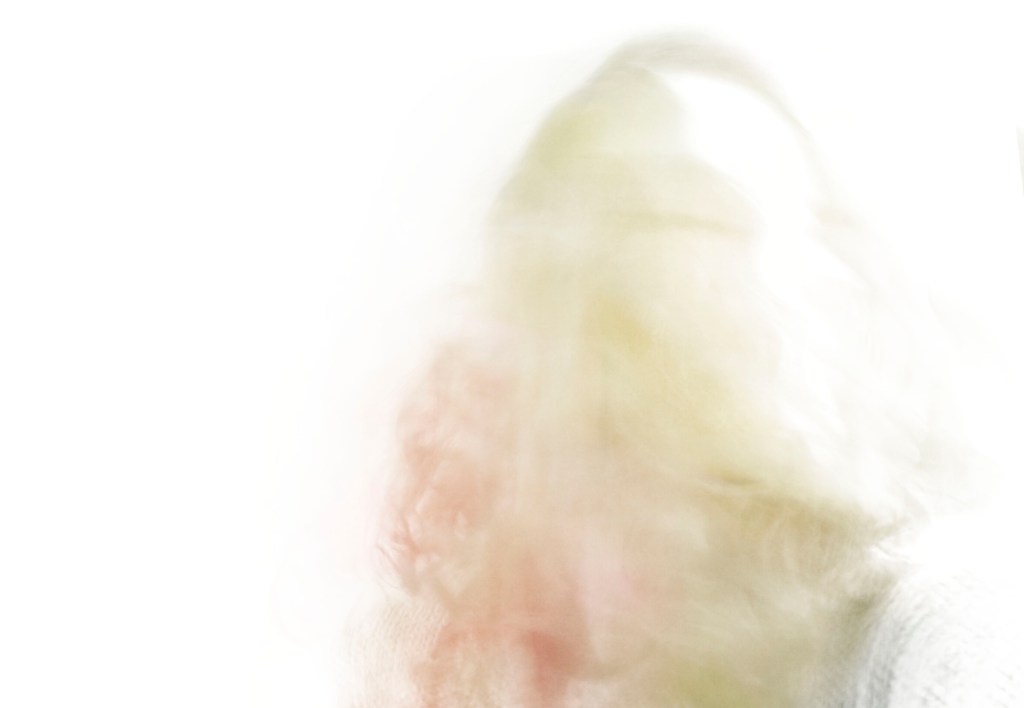
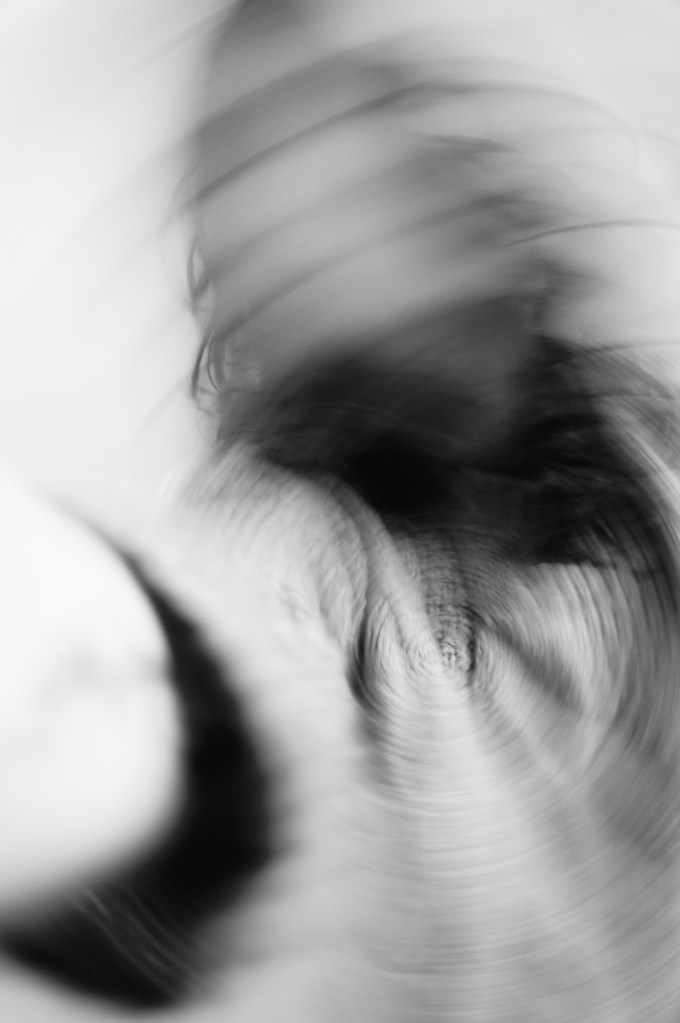
OCA’s assessment guide suggests that you choose four to six images from your strongest assignment for this particular outcome. I have decided to pick four out of the original seven pieces from ‘Languages of Light’ to present a skilful use of controlled light, post-production techniques such as ‘inverting’, the visual impact of mirrored compositions and my understanding of contrast.

To select these images, I revisited my assignment and chose the four shots that best showed variety while considering the importance of a coherent set. The pieces document a range in texture, shape, unique use of light and composition.

The Scan photographs; (see Fig. 1-4) explore intricate details found within the crops we grow, much like a human bodies veins, muscles and skin. Using an LED light pad and thin slices of various foods to document diversity enhanced the textures and densities within the subject. The shallow depth of field softened some areas within the photos, drawing the eyes towards the heavily textured, contrasted and various forms provided by the subject. Creating mirror images from the individual shots exhibited an eerie, human-like set of photos that reflect the ghostly results MRI scans can reproduce. Presenting them as separate prints allow the audience to explore each image in-depth, one by one, rather than a collective that can distract the eyes and overwhelm them with too much information all at once.

Images

Fig. 1. Scan 1 (2021)
Fig. 2. Scan 2 (2021)
Fig. 3. Scan 3 (2021)
Fig. 4. Scan 7 (2021)


List of images:

Figure. 1. Powell, L. (2021) Scan 1 [image] In possession of: Lauren Powell: Eastleigh.

Figure. 2. Powell, L. (2021) Scan 2 [image] In possession of: Lauren Powell: Eastleigh.

Figure. 3. Powell, L. (2021) Scan 3 [image] In possession of: Lauren Powell: Eastleigh.

Figure. 4. Powell, L. (2021) Scan 4 [image] In possession of: Lauren Powell: Eastleigh.

Preparing for assignment – Learning log entries

Reflection on assignments, Reflection on coursework, Reflection on feedback

As the Course Guide for assessment of Photography units (OCA, 2021) suggests, we must acknowledge the learning outcomes listed for our unit. We must also provide evidence of our understanding of these by selecting 2-3 learning log entries for each LO; choose and submit three assignment outcomes, submit any critical reviews/essays and evaluate the unit as a whole.


The learning outcomes for PH4EYV – Photography 1: Expressing Your Vision are as follows:

LO1 – demonstrate an understanding of photographic techniques and image making.

LO2 – present a selected body of photographic work.

LO3 – develop and communicate your ideas as a photographer.

LO4 – demonstrate a critical and contextual understanding of photography and reflect on your own learning.


Learning outcome 1: ‘Understanding photographic techniques and image making’.

Exercise 1.3 Line.

The use of lines in photography can either add depth to an image or flatten the pictorial space depending on how you implement them within your work. 

Exercise 1.3 Line helped me appreciate the importance of leading lines and how they can draw the eyes around or through the images you take, enhancing the overall experience of photographic viewing and compositional strength.

Learning log reference: https://laurenpowelloca.photo.blog/2019/11/12/exercise-1-3-line/

Exercise 2.2 Viewpoint.

Focal lengths can heavily influence the result of your images, dependent on how long or short it is set to, as well as your physical distance from the subject.

Exercise 2.2 Viewpoint allowed me to see and acknowledge the distorting differences between a long focal length such as 55mm and a far distance from the subject, compared to a short focal length such as 18mm and standing close to the subject who hadn’t moved. 

Learning log reference: https://laurenpowelloca.photo.blog/2020/02/05/exercise-2-2-viewpoint/

Assignment 2 – ‘Collection‘.

I explored various lighting techniques, camera filters and framing to understand the process of image making. I learnt that black and white photography visually enhance your subjects by capturing heavily contrasting details, while the use of negative space draws attention to the chosen focal point.

Learning log reference: https://laurenpowelloca.photo.blog/2020/02/26/test-shoot-contact-sheets-for-collection-assignment/


Learning outcome 2: ‘A selected body of photographic work’.

Selected body of images.

This assignment encouraged me to revisit and re-evaluate all my assignments from a critical standpoint to decide upon the strongest one before explaining why.

Languages of light pushed me out of my comfort zone, encouraging me to explore controlled lighting and the possible results if used effectively. Taking inspiration from film negatives and MRI scans allowed me to create a powerful, coherent collection of images to document my understanding of the brief, light sources and develop an idea into a complete assignment.

The following learning log entry explains the reasoning behind my chosen images and how I came to decide on these shots in particular: https://laurenpowelloca.photo.blog/2021/06/25/preparing-for-assessment-lo2-a-selected-body-of-work/.

(Extra learning log entry to provide context to the development of my knowledge on controlled lighting)

Exercise 4.3 – Ex Nihilo.

This exercise helped me acknowledge how the quality, contrast, direction and colour can affect the photograph overall. It was the exercise that aided me in completing assignment four successfully.

Learning log reference: https://laurenpowelloca.photo.blog/2021/05/07/exercise-4-3-ex-nihilo/


Learning outcome 3: ‘Develop and communicate ideas as a photographer’.

Assignment 3 – ‘The decisive moment‘.

The assignment allowed me to develop the slow shutter speed knowledge I learnt from exercise 3.2 Trace and my research on Michael Wesely, a photographer who shot long exposures of fruits and flowers to show the life and death we don’t see with the naked eye. This exercise helped me understand how slow shutter speeds can record traces of time within one image.

Learning log references: Exercise: https://laurenpowelloca.photo.blog/2020/03/20/exercise-3-2-trace/

This assignment encouraged me to develop my skills with slow shutter speed and further explore double/long exposures.

Learning log reference: https://laurenpowelloca.photo.blog/2021/03/28/contact-sheet-and-final-image-selection-2/

Exercise 5.1 – The distance between us.

This exercise turned out to be a subtle reference to my first assignment, The Square Mile. I visited a local area and took images of subjects that encouraged empathy. The emotional and physical effects of deforestation and urbanisation are shown subtly and directly through the topic or the juxtapositions captured throughout.

Learning log reference: https://laurenpowelloca.photo.blog/2021/06/13/exercise-5-1-the-distance-between-us/


Learning outcome 4: ‘Demonstrate critical and contextual understanding of photography and reflect on your own learning’.

Over this unit, I have learnt how to research and understand how practitioner influences can help contextualise the work produced. Practitioner research was something I avoided in my first assignment to prevent being heavily shaped by someone else’s work. Inspiration is critical to explain your work and develop it.

Exercise 5.2 Homage – Research Point.

Studying Terry Barrett’s essay and summarising it provided me with the information I needed to contextualise the ‘Homage’ exercise and any other works following that.

By understanding the meaning and technical approaches behind Carol Sharps nature shots, I could explain the contextual type for my work. As well as this, I was able to describe why I chose specific visual techniques and camera settings to portray the delicate nature of flowers and plants. I was also able to discover the context type for an old homage example as well.

Learning log reference: https://laurenpowelloca.photo.blog/2021/06/13/exercise-5-2-homage-research-point/

Assignment 5 – ‘Photography is simple‘.

Analysing Zinqian Liu’s work, acknowledging her reasoning for combining nature and the human body, learning about instant cameras aided me in contextualising ‘Photography is simple’ and the complexity of both the human body and camera. This assignment pushed me to be more critical about image selection and presentation, acknowledging the importance of editing as a photographer.

Learning log reference: https://laurenpowelloca.photo.blog/2021/06/21/final-shoot-plan-images/

Exercise 4.2 Artificial light.

Sato Shintaro and Rut Blees Luxembergs night photography provided context for this exercise by investigating the influence light can have on photography’s overall mood and details. Looking at images from a critical point helped me further understand the technical and visual impacts lighting has within photography.

Learning log reference: https://laurenpowelloca.photo.blog/2021/04/27/exercise-4-2-artificial-light/


References:

OCA., 2021. Photography 1: Course Guide for assessment of Photography units – July 2021 onwards [pdf] Barnsley: OCA, pp. 1-3. Available at: https://learn.oca.ac.uk/pluginfile.php/24144/mod_resource/content/4/AG_Course%20Guide%20for%20assessment%20of%20Photography%20units_120421.pdf [Accessed 25 June 2021].

Powell, L. (2019) Exercise 1.3 Line [online] Available at: https://laurenpowelloca.photo.blog/2019/11/12/exercise-1-3-line/ [Accessed 22 June 2021].

Powell, L. (2020) Exercise 2.2. Viewpoint [online] Available at: https://laurenpowelloca.photo.blog/2020/02/05/exercise-2-2-viewpoint/ [Accessed 22 June 2021].

Powell, L. (2020) Test shoot contact sheets for collection assignment [online] Available at: https://laurenpowelloca.photo.blog/2020/02/26/test-shoot-contact-sheets-for-collection-assignment/ [Accessed 22 June 2021].

Powell, L. (2020) Exercise 3.2 Trace [online] Available at: https://laurenpowelloca.photo.blog/2020/03/20/exercise-3-2-trace/ [Accessed 22 June 2021].

Powell, L. (2021) Preparing for assessment – LO2 – A selected body of work [online] Available at: https://laurenpowelloca.photo.blog/2021/06/25/preparing-for-assessment-lo2-a-selected-body-of-work/[Accessed 25 June 2021].

Powell, L. (2021) Exercise 4.3 Ex Nihilo [online] Available at: https://laurenpowelloca.photo.blog/2021/05/07/exercise-4-3-ex-nihilo/ [Accessed 25 June 2021].

Powell, L. (2021) Contact sheet and final image selection [online] Available at: https://laurenpowelloca.photo.blog/2021/03/28/contact-sheet-and-final-image-selection-2/ [Accessed 22 June 2021].

Powell, L. (2021) Exercise 5.1 The Distance Between Us [online] Available at: https://laurenpowelloca.photo.blog/2021/06/13/exercise-5-1-the-distance-between-us/ [Accessed 22 June 2021].

Powell, L. (2021) Exercise 5.2 Homage – Research Point [online] Available at: https://laurenpowelloca.photo.blog/2021/06/13/exercise-5-2-homage-research-point/ [Accessed 25 June 2021].

Powell, L. (2021) Final shoot plan images [online] Available at: https://laurenpowelloca.photo.blog/2021/06/21/final-shoot-plan-images/ [Accessed 25 June 2021].

Powell, L. (2021) Exercise 4.2 Artificial Light [online] Available at: https://laurenpowelloca.photo.blog/2021/04/27/exercise-4-2-artificial-light/ [Accessed 25 June 2021].


Exercise 5.3 – Looking at photography

Notes, Online Research, Part 5, Practitioner Research, Reflection on coursework, Thoughts & Ideas

Summary:

In this post I
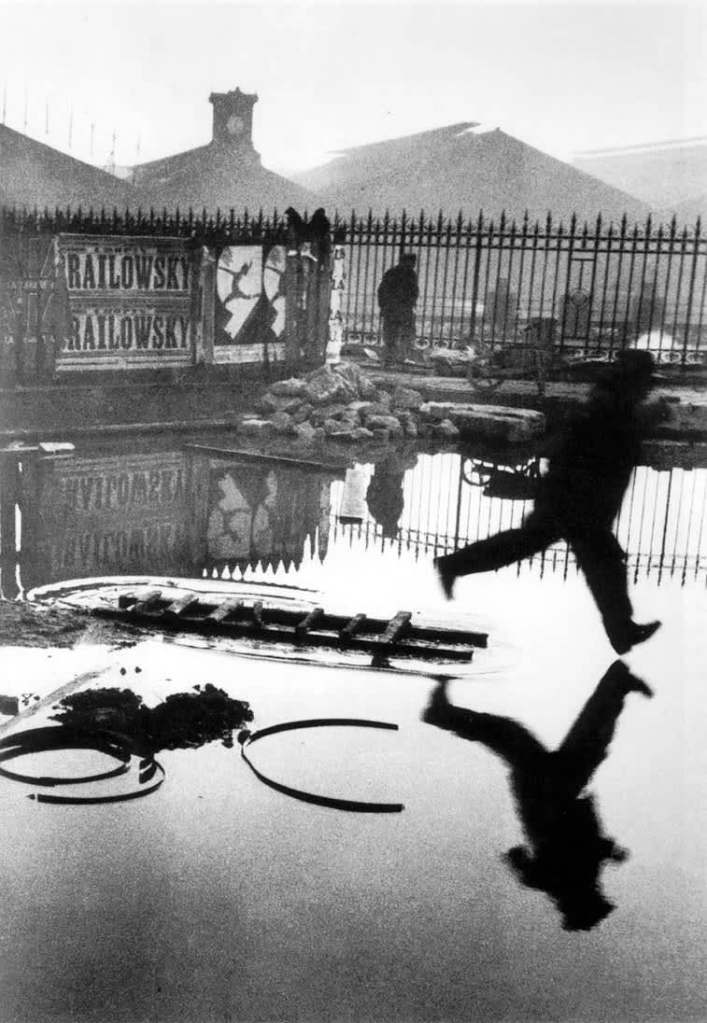
– Included the exercise brief to re-visit Henri Cartier-Bresson’s photograph Behind the Gare Saint-Lazare (1982)
– Before inserting the image and explaining the point within the image I felt was the most signification and why.
– Referenced one of my own images to give context to the use of a focal point and the rule of thirds.
– Included a short reflection on the importance of understanding the pivotal points within a piece of art.

Brief:

If photography is an event then looking at photography should also be an event.
Look again at Henri Cartier-Bresson’s photograph Behind the Gare Saint-Lazare in Part Three.
(If you can get to the Victoria & Albert Museum in London you can see an original print
on permanent display in the Photography Gallery.) Is there a single element in the image
that you could say is the pivotal ‘point’ to which the eye returns again and again? What
information does this ‘point’ contain? Remember that a point is not a shape. It may be a
place, or even a ‘discontinuity’ – a gap. The most important thing though is not to try to
guess the ‘right answer’ but to make a creative response, to articulate your ‘personal voice’.

Include a short response to Behind the Gare Saint-Lazare in your learning log. You can be as
imaginative as you like. In order to contextualise your discussion, you might want to include
one or two of your own shots, and you may wish to refer to Rinko Kawauchi’s photograph
mentioned above or the Theatres series by Hiroshi Sugimoto discussed in Part Three. Write
about 300 words.
‘ (Bloomfield, 2018).

Behind the Gare Saint-Lazare re-visit:

Fig. 1. Behind the Gare Saint-Lazare (1982)

Behind the Gare Saint-Lazare is extraordinary as Cartier-Bresson shot it through a small gap in the wall, unaware of the activity going on behind it. The pivotal point for this shot is the movement. Despite the composition being full of details, textures and shapes becoming a playground for the viewer to explore, the eyes are always drawn back to the blur within the shot. It stands out from the rest, a frozen backdrop in black and white while the mysterious shape to the right flies through the frame.

You are made aware of the direction of movement and the travel speed without being there in the moment. It’s an image that tells its own story, a moment of urgency on a wet day as they jumped over or through the puddles below. You want to know where they are going, why they are running and if something exciting or disastrous happened outside the frame.

The tonal balance within this picture is mixed, with the majority of them being light greys and white. Meanwhile, the silhouette and items nearby are heavily contrasted, making it difficult to ignore.

There is life within the frame, a definitive moment that took place and was unique in photographic execution. Not many images can document a piece of history intriguing enough for the audience to stay and observe it for a length of time over and over. While there may not be a clear leading line, there is an obvious focal point pushing the eyes to look and appreciate it whether they want to or not. It’s so powerful.

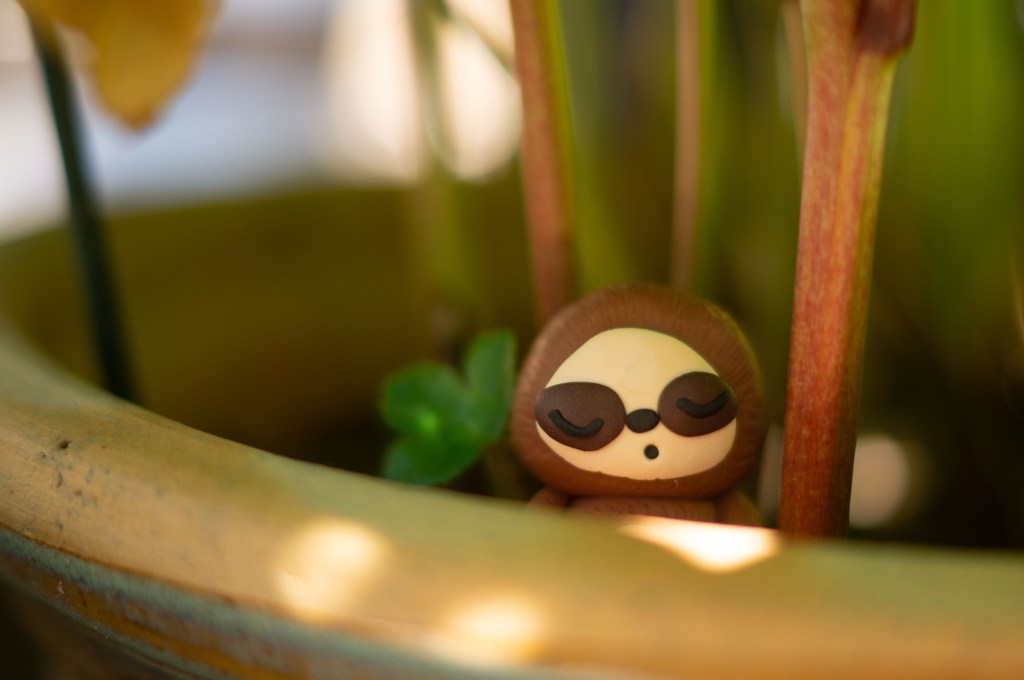
An example of drawing the eyes towards a particular point without a leading line features in one of my product images (see Fig. 1) through the use of the rule of thirds.

Fig. 2. Sloth (2021)

Reflection

Re-visiting an image can help you appreciate the piece of work, especially if you have more knowledge to hand. Understanding what ‘makes’ an image and shapes it, encouraging the viewer to look deeper and sit with the art for longer solidifies the importance of composition, balance and intent.

References:

Bloomfield, R., 2018. Photography 1: Expressing your Vision. 4th ed. [pdf] Barnsley: OCA, p. 109. Available at: https://www.oca-student.com/course/photography-1-expressing-your-vision [Accessed 13 June 2021].

List of images:

Figure. 1. Cartier-Bresson, H. (1932) Behind the Gare Saint-Lazare [image] Available at: https://en.wikipedia.org/wiki/Behind_the_Gare_Saint-Lazare#/media/File:Henri_Cartier-Bresson_-_Behind_the_Gare_Saint-Lazare,_1932.jpg [Accessed 13 June 2021].

Figure. 2. Powell, L. (2021) Sloth [image] In possession of: Lauren Powell: Eastleigh.

Exercise 5.2 Homage – Research point

Notes, Online Research, Part 5, Practitioner Research, Reflection on coursework

Summary:

In this post I;

– Included the research point brief and my response to it by referencing the text throughout.

– Inserted the exercise brief for ‘Homage’.

– Wrote a short paragraph about Carol Sharp and how she connects with her subjects while photographing

– Before comparing one of her images with my own as a homage

– Alongside a brief analysis of my response and the context

– Inserted a couple of extra images to show how I paid homage to Sharp’s work

– Included a past image from my archive, with a short analysis of the message and context behind it

– Before reflecting on what this exercise taught me

Research

For a short introduction to how context operates in relation to photographs, read Terry Barrett’s essay ‘Photographs and Context’: terrybarrettosu.com/wp-content/uploads/2017/08/B_PhotAndCont_97.pdf [accessed 25/01/18]. Barrett suggests that we interpret pictures according to three different types of information: information in the picture, information surrounding the picture and information about the way the picture was made. He calls these the internal context, the external context and the original context‘ (Bloomfield, 2018).

Images can be incredibly flexible in terms of context, based on the environment, the subjects within the frame, the colours or lack thereof. However, the context of a photograph can alter depending on whom it reaches. For example, in Terry Barrett’s Photographs and Contexts (Barrett, 1985) a photograph of a pair sat outside a bar taken by Robert Doisneau was given different contexts; to Gisele Freund’s knowledge, up to five times by various magazines, brochures and galleries. A few examples of this consist of accusations of sex work, alcohol abuse and seduction (Barrett, 1985).

The initial context behind Doisneau’s shot was simply a moment of charm as he enjoyed cafe’s and seeing the couple together was enjoyable.

‘Texts that surround the photograph eliminate any residual ambiguity’ (Barrett, 1985). If we were to put a picture of a beef burger on the front of a vegan magazine, it would probably cause some shock before going on to talk about the environmental effects and immoral behaviour of the industry, however, on the front of a restaurant menu, people would be enticed and seduced by how good it looked.

Images are used for other things, different to their initial intent. Pictures of lungs on a cigarette packet are used to encourage smokers to stop smoking before too much damage occurs but are initially used for scientific and medical research.

The placement of an image is another factor to consider for context. The display of a picture of people in poverty may glorify the situation for the benefit of art and a famous gallery rather than portraying the horrific effect on lives in a place you would expect to see such circumstances.

No matter where you are in the world or what language you speak, photography can be a source of communication for some people (Sander, 1978 referenced in Barrett, 1985:114), whether an artist is documenting their mental state or an audience expressing feeling by sending a photographic meme. Despite the global interaction with these photographs, they may not provide the same message to one person in the way it did to another. Context is still subjective depending on the viewer.

Internal context includes the image, title, date and maker. External context would be the presentational environment, so where it’s displayed. The original context is the ‘causal environment’, in other terms, the physical and psychological elements available to the photographer at the time of capture (Barrett, 1985).

To understand the context as an audience, we need to look deeper and consider everything, including what the photographer may have been doing or thinking at the time. These things combined will help us appreciate the make-up of the image a lot more.

Brief:

Select an image by any photographer of your choice and take a photograph in response to it. You can respond in any way you like to the whole image or to just a part of it, but you must make explicit in your notes what it is that you’re responding to. Is it a stylistic device such as John Davies’ high viewpoint, or Chris Steele Perkins’ juxtapositions? Is it an idea, such as the decisive moment? Is it an approach, such as intention – creating a fully authored image rather than discovering the world through the viewfinder? Add the original photograph together with your response to your learning log. Which of the three types of information discussed by Barrett provides the context in this case? Take your time over writing your response because you’ll submit the relevant part of your learning log as part of Assignment Five.‘ (Bloomfield, 2018).

Carol Sharp

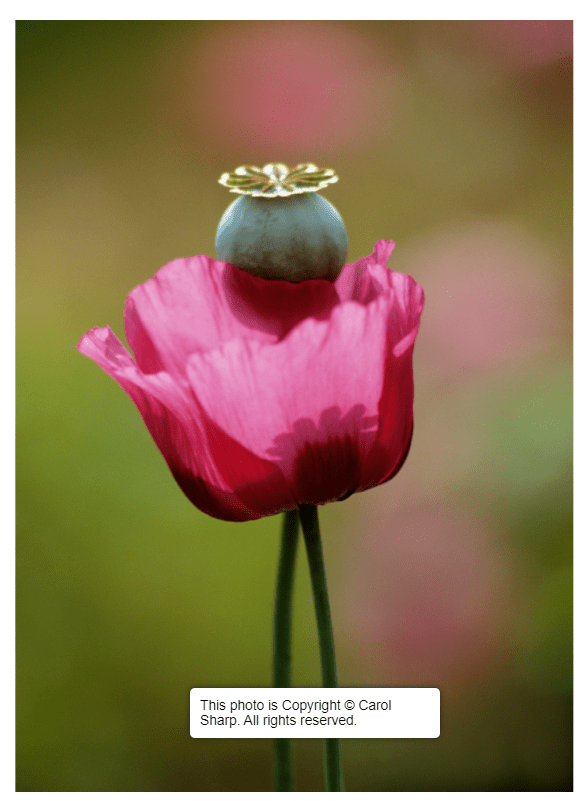
“Carol Sharp is an award winning photographer and fine artist, renowned for her lyrical composition, attention to detail and her delicate touch with light.” (Carol Sharp, n.d.)

Sharp is UK based photographer who has over 20+ years of professional photographic experience, has featured in Chelsea Flower Show posters in the past. Her exploration of the world and its plants is a way to encourage society to reconnect with nature and empathise with it.

“I use different types of perception to not only see their form, but to understand the meaning of the form and to reveal its ‘gesture’. which means having a communion with my subjects and a desire to feel their very life force.” (Sharp, n.d.). Unlike the majority who may pass by a flower or tree without much notice, Sharp truly connects with her subjects to understand them and appreciate them. I think this shines through in her work as the framing is cropped and intimate as shallow depth of field emphasises the soft petals and delicacy of the foliage and flowers in the composition. Vibrant colours bring life to the images, subtly getting the viewer to realise that this life source is living, thriving and a powerful part of our world. Flowers, trees, moss and other forms of plants keep this world functioning, helping us live and grow. It’s important to be grateful for what is around us, something Sharp does very well.

Due to how Sharp talks about her work and the passion for her subjects, I would say that the original context is the most prominent context type in these images. Bearing in mind the importance to the maker, it heavily influences how the viewer sees the subject, making it feel more personal and ripe with life. The images are not just another simple set of shots of a bunch of flora and fauna as time and energy have been taken by the creator to capture the beauty.

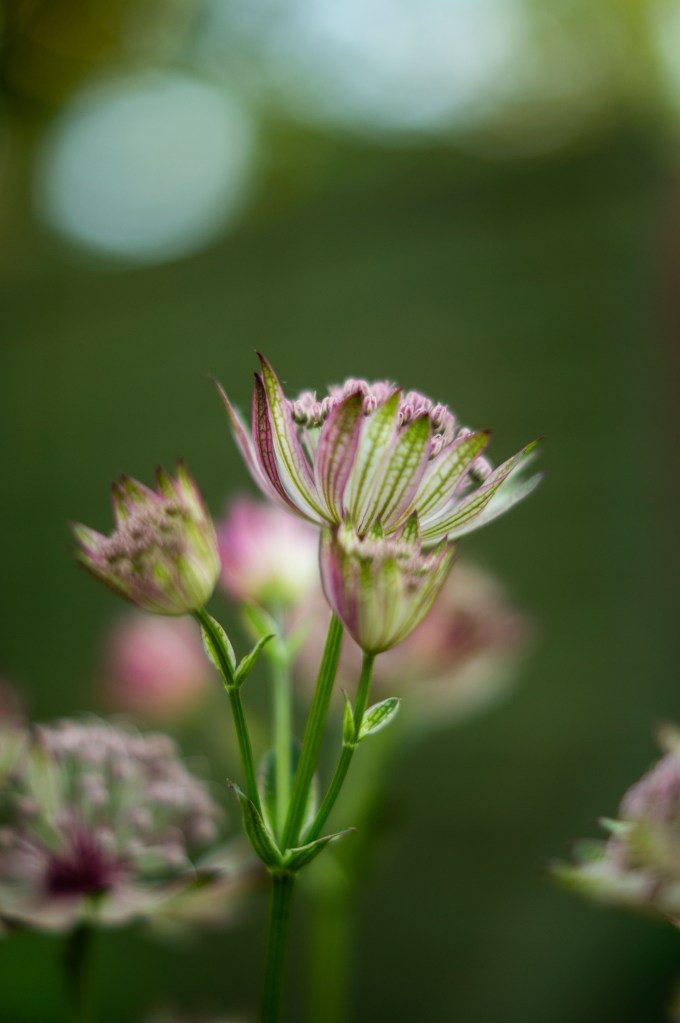
The selection of images I paid homage to for this exercise came from the Plant Portraits (n.d.) album.

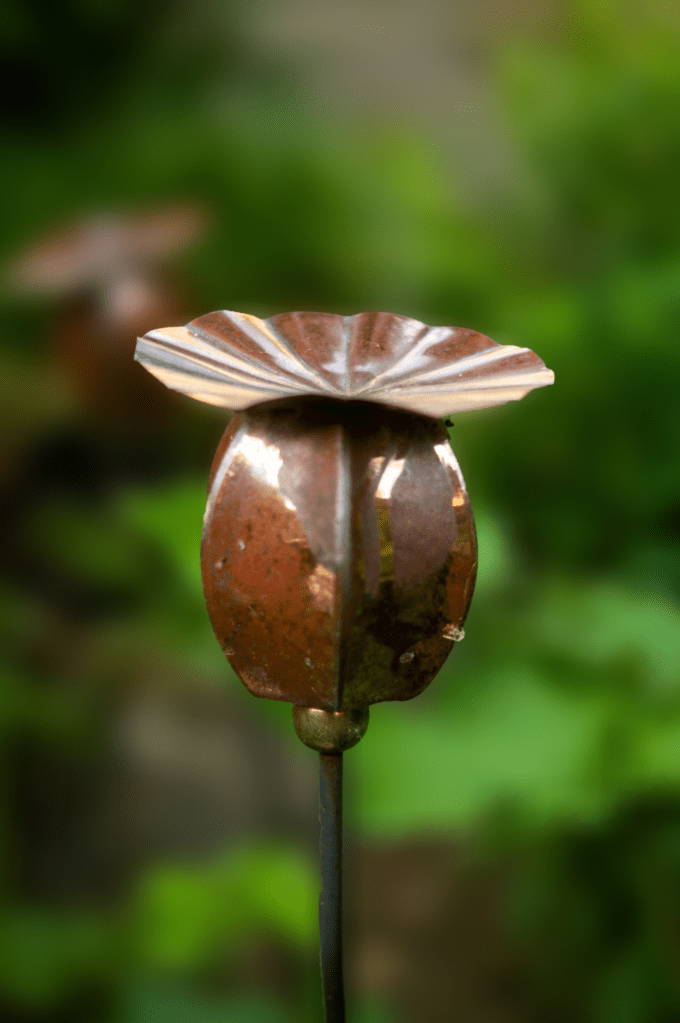
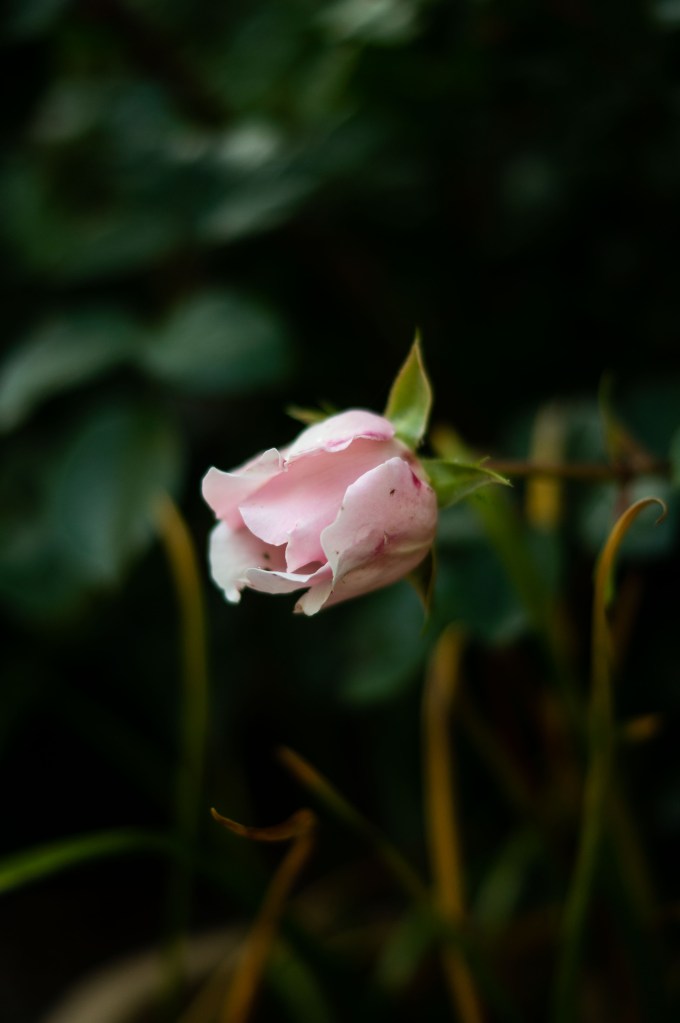
My SONY A57 camera was on manual mode, the aperture was at F/1.8, the shutter speed was 1/250 and ISO was set to 100. The shooting process was simple as I took a walk around my garden during dusk, capturing a few of the flowers available to me. The response to this exercise was to keeping original context at the forefront of my mind by analysing the subjects and connecting with them before pressing the shutter. A creamy shallow depth of field and cropped framing were two of the most important visual and technical elements to include during this shoot.

Homage 3 (see Fig. 2) referenced the feature of a poppy seed head in Sharp’s image (see Fig. 1.) by capturing the metal sculpture in my garden, a permanent piece of art, unlike an actual poppy. Using an aperture of F/1.8 enabled me to get the creamy bokeh effect that flows throughout Sharp’s work so beautifully; focal points draw the eyes of the audience to the subject, all of its details, the textures and colours. Cropping the frame brings the object closer to the camera lens, allowing the viewer to observe it more intimately and connect with what is going on within the composition. Contextually, this metal poppy head was a gift to my dad from my mum for his birthday, so holds a deeper meaning for me, much like Sharp attaches to her subjects to appreciate it more. The colours within Plant portraits are vibrant, warm and full of life, while tones within my homage are earthy, so despite it being artificial, the subtle connection to nature and its rich soil is a clever addition to my piece. From a conceptual point of view, the relationship between the two shots juxtaposes despite a few similarities. Sharp embraces the life and death of plants, reconnecting to their importance for our survival as living beings. On the other hand, I have captured a replica of a pollinating plant that will never pollinate, an unintentional parody of how humans keep making things that do not benefit the world environmentally.

Original context brings more personality to photographs as you understand why it was taken, how it made the creator feel, what was going on at the time and the image that was achieved as a result. It pushes the audience to explore it to understand it as a whole composition rather than a simple picture. The work I shot may be unoriginal visually, but the extra level of information lifts it and makes it a rich piece of art.

The internal and external context is just as important but feels less characteristic for some artworks in my opinion as it allows the viewer to come up with their own story as to what the photograph contains and what it may be portraying. Some photographs need that extra bit of information to steer the observer in the right direction.

Here are a few other images I took for this exercise:


Homage example from past archive:

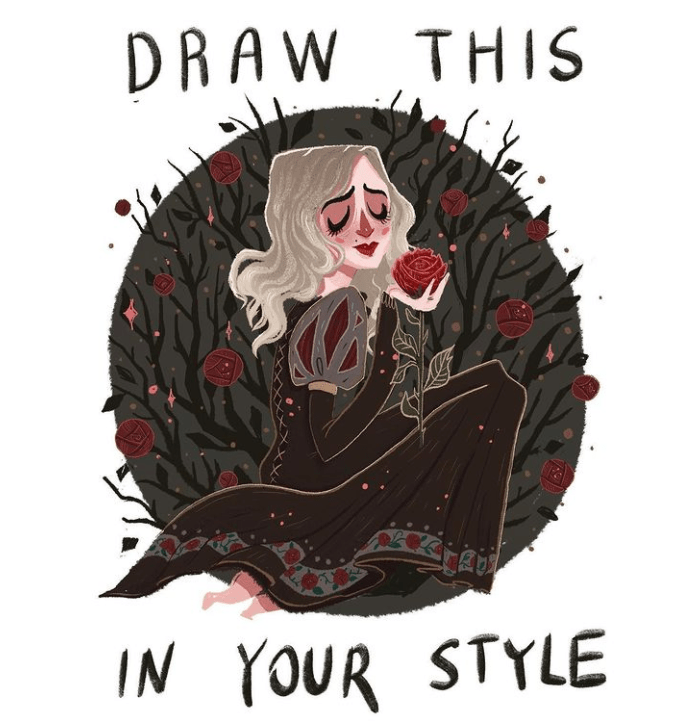
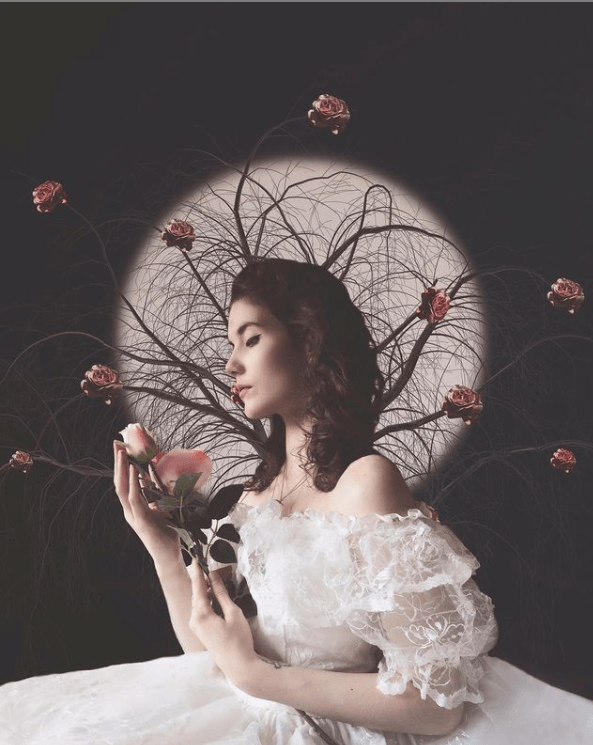
While this isn’t a homage inspired by a photographer, it was an image I created as a tribute to the Draw this in your style (2019) drawing by Ellie Goldwine on Instagram. My response to this piece was approached with intent, having complete control over the props used, outfits and makeup worn, as well as the background, pose and editing. It became a reversed image of the original piece (see Fig. 5), the dress chosen for my composition (see Fig. 6) was the opposite colour creating a juxtaposition between the two. Rather than red roses, light pink roses were used and the circular framing around the drawing in my piece represented the full moon. Everything about the photograph I created was intentional, as the brief was to create something in your style from the reference given.

The context for this piece was internal, as it was inspired by the Draw in your style title and image. Without this information, I may not have been encouraged to replicate it at all.

Reflection

This research point and exercise helped me understand the importance of context, the different types and how the portrayal of images original intent can be influenced. An images original message can be changed through the way it is displayed, the environment in which it’s found, the title and other such information. The original context is a type that features heavily in my work when given the chance, as personality and background mean a lot to me when it comes to creating a piece of work.

References:

Barrett, T., 1985. Photographs and Contexts. [pdf] pp. 110-116. Available at: http://terrybarrettosu.com/wp-content/uploads/2017/08/B_PhotAndCont_97.pdf [Accessed 13 June 2021].

Bloomfield, R., 2018. Photography 1: Expressing your Vision. 4th ed. [pdf] Barnsley: OCA, p. 106. Available at: https://www.oca-student.com/course/photography-1-expressing-your-vision [Accessed 13 June 2021].

Elliegoldwine. (2019) Draw this in your own style [online] Available at: https://www.instagram.com/elliegoldwine/ [Accessed 13 June 2021).

Sanders, A. (1978) ‘Photography as a Universal Language’ In: Photographs and Contexts. [pdf] p. 114. Available at: http://terrybarrettosu.com/wp-content/uploads/2017/08/B_PhotAndCont_97.pdf [Accessed 13 June 2021].

Sharp, C. (n.d.). Biography – Carol Sharp [online] Available at: https://www.carolsharp.co.uk/biography [Accessed 13 June 2021].

Sharp, C. (n.d.). Plant portraits – Carol Sharp [image] Available at: https://www.carolsharp.co.uk/biography [Accessed 13 June 2021].

List of images:

Figure. 1. Sharp, C. (n.d.) Plant portraits [Carol Sharp, screenshot] Available at: https://www.carolsharp.co.uk/plant-portraits [Accessed 13 June 2021).

Figure. 2. Powell, L. (2021) Homage 3 [image] In possession of: Lauren Powell: Eastleigh.

Figure. 3. Powell, L. (2021) Homage 1 [image] In possession of: Lauren Powell: Eastleigh.

Figure. 4. Powell, L. (2021) Homage 5 [image] In possession of: Lauren Powell: Eastleigh.

Figure. 5. Elliegoldwine. (2019) Draw this in your own style [Instagram, screenshot] Available at: https://www.instagram.com/elliegoldwine/ [Accessed 13 June 2021].

Figure. 6. Powell, L. (2019) Rose [image] In possession of: Lauren Powell: Eastleigh.


Exercise 5.1 – The Distance Between Us

Part 5, Reflection on coursework, Thoughts & Ideas

Summary:

In this post I

– Included the brief for this exercise

– Listed my initial plans, concepts and why

– Shared my camera settings and technical information

– Before providing the contact sheets for my shoot

– Inserted 6 of my favourite shots from the set and explained why through analysis

– Chose my ‘select’, analysed the image

– Before discussing why I chose it as the strongest image, the unintentional and conceptual elements discovered

Brief:

Use your camera as a measuring device. This doesn’t refer to the distance scale on the focus ring. Rather, find a subject that you have an empathy with and take a sequence of shots to ‘explore the distance between you’. Add the sequence to your learning log, indicating which is your ‘select’ – your best shot. When you review the set to decide upon a ‘select’, don’t evaluate the shots just according to the idea you had when you took the photographs; instead evaluate it by what you discover within the frame (you’ve already done this in Exercise 1.4). In other words, be open to the unexpected. In conversation with the author, the photographer Alexia Clorinda expressed this idea in the following way. Look critically at the work you did by including what you didn’t mean to do. Include the mistake, or your unconscious, or whatever you want to call it, and analyse it not from the point of view of your intention, but because it is there. (Bloomfield, 2018)

Initial plans

I didn’t want to give too much thought about what to take images of to give myself a challenge; instead, I read the brief and decided to pick the first subject that came to mind in terms of empathy. As a result, the deforestation and increase of littering within my local woodland popped up first.

Growing up next to woodland is something to be grateful for as nature is right on your doorstep and isn’t something everyone has the privilege of having. Unfortunately, I’ve watched this beautiful area be the victim of mass deforestation and urbanisation to allow room for more homes. Building on land to cover the rise in population isn’t so much the problem, but the littering, lack of care taken after trees and foliage removable are.

It’s not satisfying to go on a nature walk, to find metal barriers up that are yet to move, piles of logs and leftover branches scattered around the place with signs and ripped tape on the floor. Seeing all the changes happen and watching it decline since childhood makes me feel empathetic toward the animals that live within those woods, the insects, trees and the pedestrians who want to observe this place.

I used my SONY A57, set my aperture to F/2.8, the focus and camera settings to manual before heading out on a walk around the woods. Not knowing what I was going to find made this exercise more challenging as I wasn’t sure whether there would be enough around to gather a substantial amount of images to choose from, although, wasn’t the case as seen below in my contact sheets.

Contact sheets

A selection of favourite images:

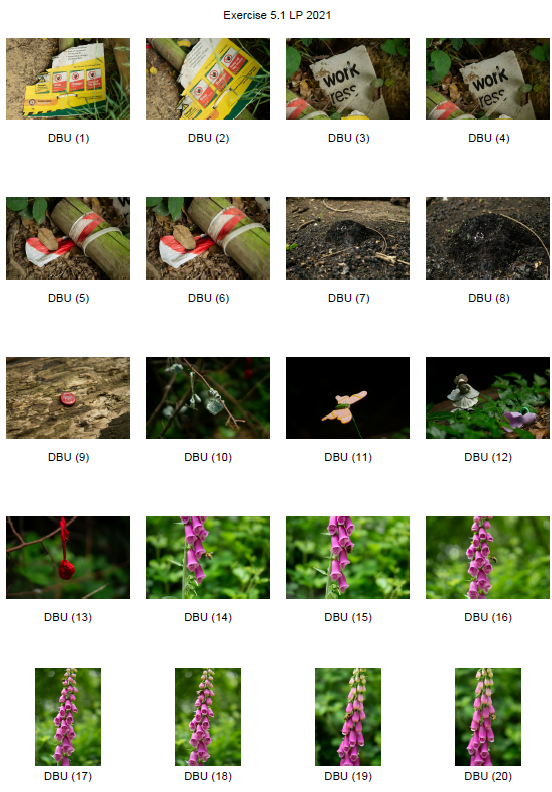
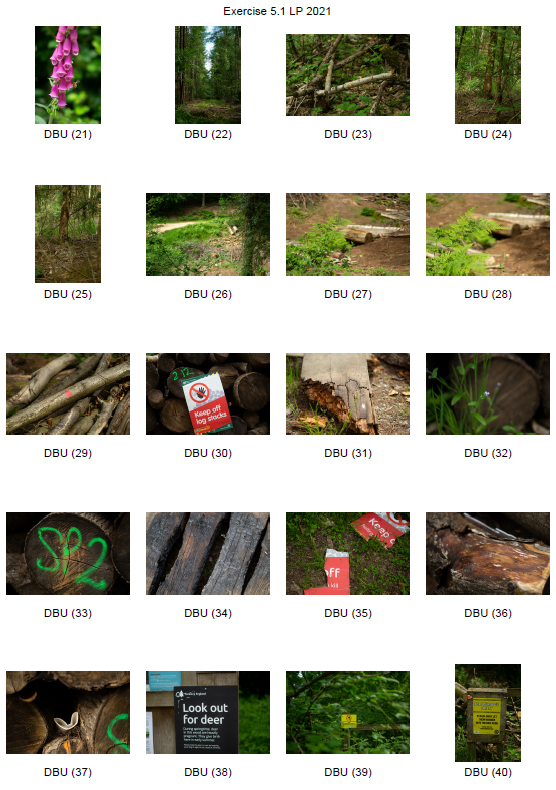
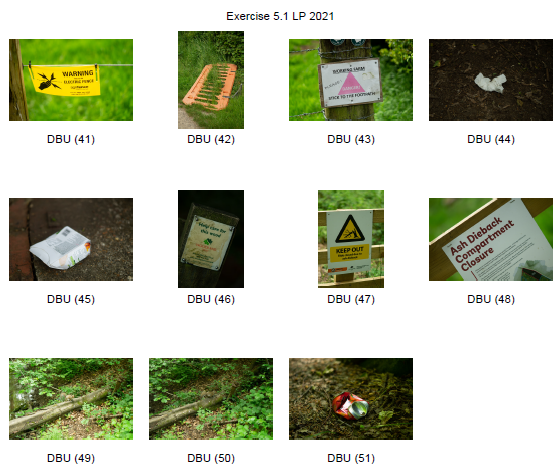
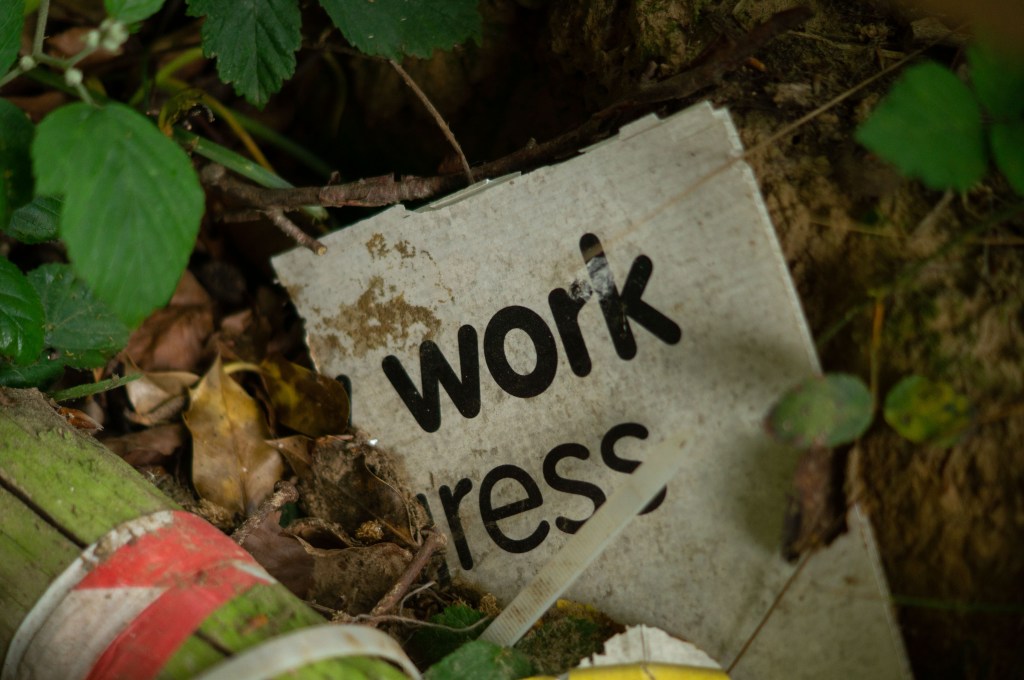
The selection of the six images above is visually strong, well framed and clearly show where the focal points are. Earthy tones perfectly reflect the life and death of nature, rich soil and crisp green foliage. Tonal differences throughout the compositions provide a steady balance between the dark shadowy areas, well lit vibrant sections and shapes that supply a contrast between the organic and more structural man-made subjects featured. Using natural overcast light allowed me to capture diffused shadows and highlights that made the shallow depth of field creamer and smooth, complimenting the fragility of the nature I was documenting. Contextually and conceptually, they present the various elements found within our woodland, from rubbish, to work signs, animals navigating through their home despite it. It may encourage the viewer to think about our effect on the area we live in, how people treat it and the results of these actions. The juxtaposition between nature and man-made objects or situations is jarring as it doesn’t belong and evokes a powerful reaction.

My final ‘select’:

Fig. 10. DBU 16 (2021)

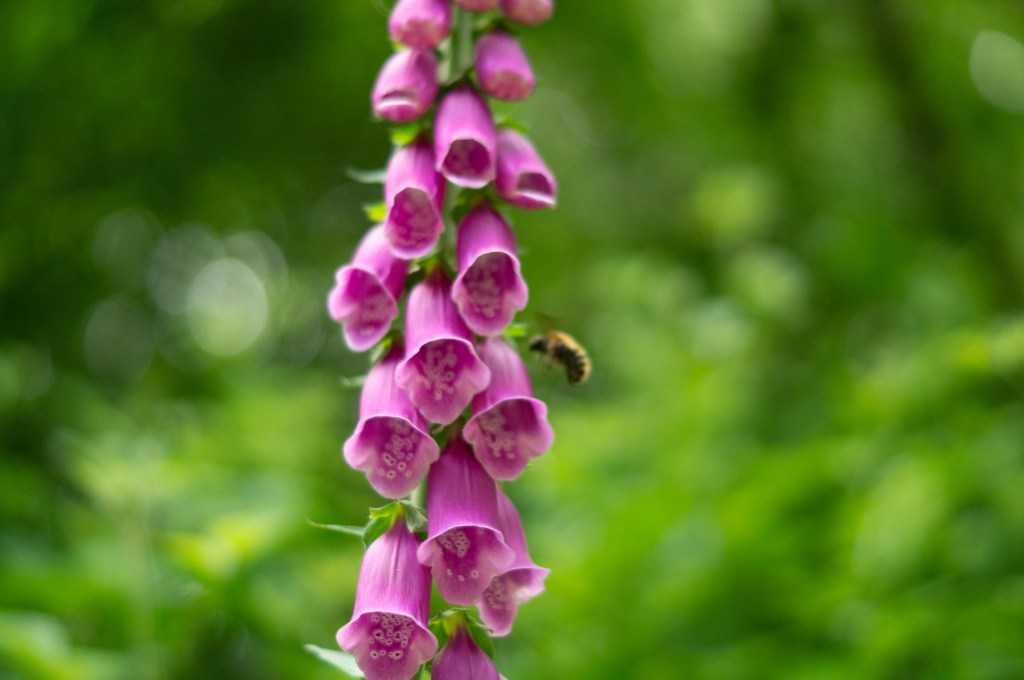
While that collection of photographs were powerful contenders for my ‘select’ and final image, the shot that spoke the most to me was DBU 16 (see Fig. 10). This picture surprised me the most, as it doesn’t necessarily present the idea of deforestation and the massive effect on nature at first glance. Unlike the other compositions, there aren’t any man-made subjects within the frame indicating building work, littering or burnt wood and foliage. Tonally it is balanced, as the shadows and highlights are soft rather than heavily contrasted, while the colours are vibrant and pleasant to look at. Everything about this shot is organic, fresh and full of life, soft due to the natural light and shallow depth of field; a complete juxtaposition to the darker, grittier photographs of old cups, spray-painted trees and plastic items. However, conceptually it still connects with my initial idea of capturing the woodland and its effects on nature and humans etcetera.

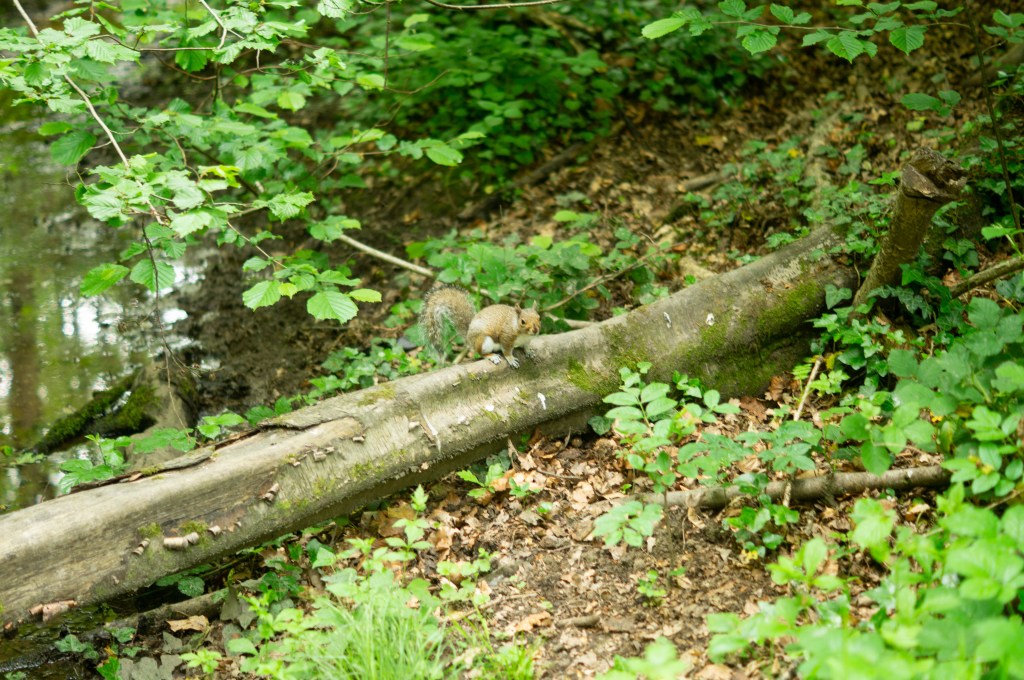
When I saw the foxglove growing in between the grass down a thin, closed off path, I was inclined to capture it even though I felt it didn’t ‘fit’ the aesthetic or context behind this exercise. This flower was in the most secluded area, away from the set path, in the middle of trees and tufts of long grass. Despite the destruction and interactions that have taken place in the area, this piece of nature has thrived. Its petals were vibrant, silky and undamaged, while leaves from the trees behind were crisp, fresh and thriving. Initially, I just thought I was taking a pretty picture, quite a simple shot which some may call a ‘postcard shot’, but when I looked at it closely there was a bee in the background. Nature continues to live on no matter what we’re doing, doing its job, much like the bumblebee in this shot. It wasn’t intentional to have a bee in the frame as the focal point was on the foxglove but it’s added an extra layer to the composition as a whole. Without bees and other insects, we wouldn’t have flowers, trees and a healthy abundance of nature to help us survive. The fact that its wings blurred despite the fast shutter speed and its convenient placement within the shallow depth of field in the background feels like a clever reference to the decrease in bees and the danger they face due to the lack of plants that allow them to pollinate. If the bee was further back we would barely see it; it would disappear in the blur.

The distance between humans and nature isn’t far at all, we need it more than we think.

Reflection:

This exercise was interesting as it lightly linked back to assignment 1, where I revisited important places from childhood to see how they had changed. My final image wasn’t one I was expecting to choose, purely because of the initial plan to explore the destruction and man-made influences within the local woodland. Giving myself a challenge by picking the first idea that came to mind made me focus more on the location which is what photography is all about. It was a risk, but it worked.

The distance between us has taught me that photographs may look simple, plain and just become another pretty picture, but if you take a deeper look you may find something you weren’t anticipating. When selecting images, it’s important to choose those that are compelling even if it’s not one of your favourites to start with. In future, I will be more flexible when it comes to picking a final set and presentation.

References:

Bloomfield, R., 2018. Photography 1: Expressing your Vision. 4th ed. [pdf] Barnsley: OCA, p. 103. Available at: https://www.oca-student.com/course/photography-1-expressing-your-vision [Accessed 13 June 2021].

List of images:

Figure. 1. Powell, L. (2021) Contact sheet 1 [pdf, screenshot] In possession of: Lauren Powell: Eastleigh.

Figure. 2. Powell, L. (2021) Contact sheet 2 [pdf, screenshot] In possession of: Lauren Powell: Eastleigh.

Figure. 3. Powell, L. (2021) Contact sheet 3 [pdf, screenshot] In possession of: Lauren Powell: Eastleigh.

Figure. 4. Powell, L. (2021) DBU 4 [image] In possession of: Lauren Powell: Eastleigh.

Figure. 5. Powell, L. (2021) DBU 12 [image] In possession of: Lauren Powell: Eastleigh.

Figure. 6. Powell, L. (2021) DBU 34 [image] In possession of: Lauren Powell: Eastleigh.

Figure. 7. Powell, L. (2021) DBU 37 [image] In possession of: Lauren Powell: Eastleigh.

Figure. 8. Powell, L. (2021) DBU 39 [image] In possession of: Lauren Powell: Eastleigh.

Figure. 9. Powell, L. (2021) DBU 49 [image] In possession of: Lauren Powell: Eastleigh.

Figure. 10. Powell, L. (2021) DBU 16 [image] In possession of: Lauren Powell: Eastleigh.


Exercise 3.3 – What Matters Is To Look

Notes, Part 3, Reflection on coursework

Summary:

For the final exercise I;

– Expressed the difficulties faced during this task due to the continuing UK lock down and inability to travel far, therefore having to find a work around to achieve an image that fit the brief.
– Explained how I executed the exercise, the camera used, as well as the settings before,
– Documenting what I saw during each layer of the viewpoint and the details within them that I may not have noticed had I just raised my camera and clicked.
– Inserted the end result with the technical details and reflected on the exercise as a whole, the importance of looking and the impact it can have on the composition.

Brief:

‘Find a good viewpoint, perhaps fairly high up (an upstairs window might do) where you
can see a wide view or panorama. Start by looking at the things closest to you in the
foreground. Then pay attention to the details in the middle distance and then the things
towards the horizon. Now try and see the whole view together, from the foreground to
horizon (you can move your eyes). Include the sky in your observation and try to see the
whole visual field together, all in movement. When you’ve got it, raise your camera and
release the shutter. Add the picture and a description of the process to your learning log


(Bloomfield, 2018).

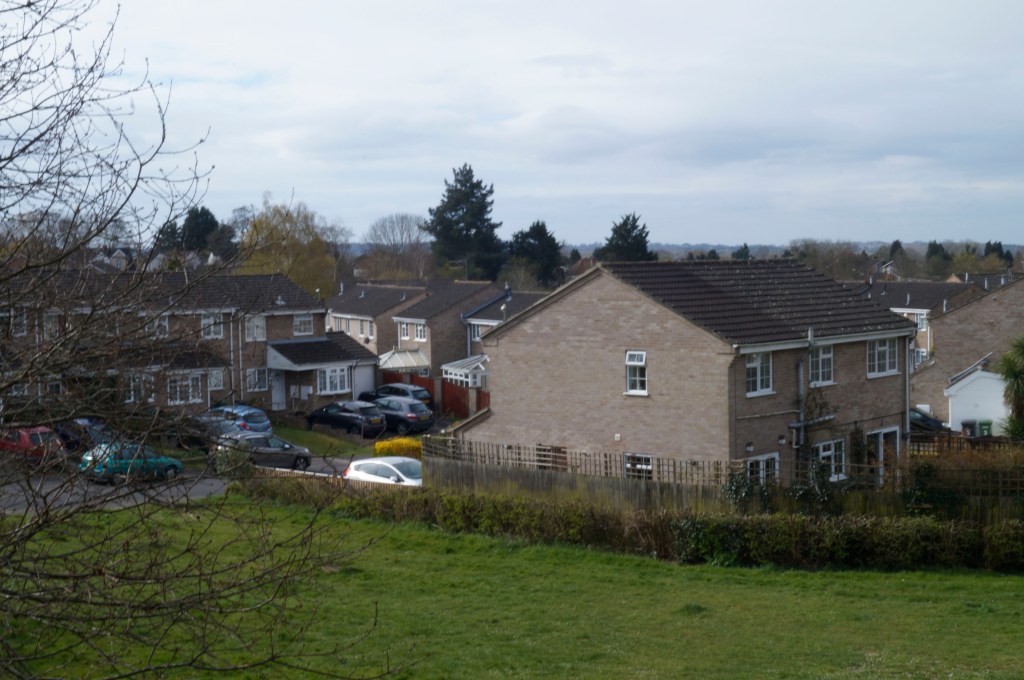
Due to the UK being on lockdown for the time being, I had to find a workaround for this exercise as my upstairs windows do not open wide enough for me to get an unobtrusive shot of the garden, therefore wasn’t a possible option. While I would’ve liked to shoot from a high-rise building to get a broader view, my only alternative was shooting from the hilltop near home.

Before taking this shot (see Fig. 1), I set my SONY A57 to shutter priority mode, used auto-focus to ensure that the image would be entirely focused, as well as adjusting the shutter speed to level out the exposure before raising my camera and shooting.

While observing this viewpoint, I first became aware of the bare tree branches in the foreground creeping into view and blocking the houses to the left of me, shortly before my eyes followed the descent of the hill leading towards the hedges and large bricked house in the middle distance. The houses behind look tiny in comparison as they get further away from the foreground, framed by the variety of evergreen and deciduous trees along the horizon and a faint foggy silhouette of woodland far aware in the background. A blanket of clouds blocked the previously sunny sky, a few grey clouds spread across before it started to rain.

Once I’d looked at all of the elements in their sections, I then sat and viewed the scene as a whole without using my viewfinder in camera. This exercise was slightly challenging as I usually look at what is in front of me through the camera before shooting, so to step back and discover in real-life was an eye-opener.
I took a brief look at the LED screen to make sure the sky was in my composition, then returned my eyes to the view while pressing the shutter button.

Fig. 1. Look (2020)
1/25 sec; f/32; ISO 200

Reflection

These past few exercises and research points have helped my understand the importance of being aware of your surroundings, to look before you shoot instead of raising your camera and taking a snapshot, hoping for the best. By spending more time to observe and understand what is in front of you, makes the shot a lot more meaningful, not only for you as the photographer, but for the viewer as more effort has gone in to make sure the composition looks ‘right’.
While it is difficult to refrain from just raising the camera and looking, it is a task worth doing to spend a few extra moments taking in the scene and what you’re about to capture.

References:

Bloomfield, R., 2018. Photography 1: Expressing your Vision. 4th ed. [pdf] Barnsley: OCA, p. 73. Available at: https://www.oca-student.com/course/photography-1-expressing-your-vision [Accessed 30 March 2020].

List of images:

Figure. 1. Powell, L. (2020) Look [image] In possession of: Lauren Powell: Eastleigh.

Research Point – Henri Cartier-Bresson – L'amour Tout Court

Notes, Online Research, Part 3, Reflection on coursework

Summary:

For this research point I;

– Watched the documentary suggested in the brief and made notes on what I discovered during 70 minutes of watch time, expanding on the statement made and interpret them in my own words to further understand the decisive moment.
– Reflected on Sluban’s visit to a prison, where he ran a photography workshop and how he approached as well as taught the inmates, emphasising that the composition is extremely important and is more than just pressing a button to provide meaning.
– Explored Bonnefoy’s comments about Simiane-la-Rotonde and how being aware of your surroundings allows you to see a lot more, provides evidence of Cartier-Bresson’s ability to capture a balanced composition through intuition and the importance observing.
– Expanded on Cartier-Bresson’s view on what makes a decisive moment, by finding an example of sensitivity, intuition and sense of geometry in his work Alberto Giacometti rue d’Alésia. A photograph that documents the gaze of his friend Alberto Giocometti and the connection between the two, showing the empathy Cartier-Bresson has for his subjects.
– Briefly covered Arikha’s thoughts about painting and how we are so influenced by recognition, therefore we need to capture what we see, not what we think we see.
– Documented Cartier-Bresson’s approach to capturing decisive moments, by making sure people don’t know he is observing, to avoid an unnatural response from the subject. Once again showing a huge amount of empathy, to somewhat become invisible and connect with the mood of the room.
– Explored the critiques of Liz Wells, who believes that documentary can remove context from an image by dislocating moments in time, in turn creating a less powerful image by not showing what has happened/is happening. However, I challenged this by disagreeing and providing the reasons as to why, before
– Challenging Colin Pantell’s views on Paul Graham’s The Present, where he believes there are many indecisive, decisive moments that we don’t know what to look for, however I feel isn’t true as there is a consistent theme throughout and many focal points throughout.
– Briefly scanned John Suler’s article about the decisive moment, to increase my knowledge of it before continuing with this assignment. Understanding that it is important to look, be more decisive about what you’re shooting, don’t overly influence the shots, if at all and provide balance, questions and tension.
– Reflect on how I feel about the decisive moment as a visual strategy and the power it has to create a strong image, while expressing concerns about the difficulty of being able to capture such moments.

Brief

Watch the Henri Cartier-Bresson documentary ‘L’amour de court’ (‘Just plain love’, 2001) available
on Vimeo.


Write up your research on the decisive moment in your learning log taking care to give a proper
account of the three differing views offered above, and any further research you’ve undertaken
independently. What do you feel personally about the decisive moment as a visual strategy, or
just as a way to take pictures? Conclude your post with your own perspective on the debate at
this point in time
‘ (Bloomfield, 2018).

Henri Cartier-Bresson’s view on a successful photograph is made evident by emphasising the importance of looking. He feels as if not many people do when stating that ‘75% of the people just press the button’ (L’amour Tout Court, 2001) and don’t necessarily think about the gaze that encourages questions. To think about what you’re capturing, making sure the image is balanced when composed, is more effective than just raising the camera and shooting without much thought. The intentional space gives context to the gaze of the subject, enabling the viewer to think about what may be happening.

This idea is further supported by Klavdij Sluban on his visit to the inmates at Fleury-Merogis Prison for a photography workshop in 1995, educating them on how to take photographs and their approach to the task in a calm, welcoming manner. Sluban communicates to the group that the fascinating element of photography is the composition, as it is a language that you have to learn (L’amour Tout Court, 2001). 
Approaching the inmates politely and humanely, enables them to listen and be excited about the workshop, therefore encouraging them to take the photography seriously and give that sense of ‘meaning… an instant of your life’ (L’amour Tout Court, 2001). 

Thinking about what you’re about to capture provides that extra level of care and understanding, that to some may just simply be a photograph and nothing more. However, to the more avid viewer, we may be able to discover the relation between the subject and artist by further exploring the deeper layers of the composition, to appreciate how the balance enhances the overall mood of the arrangement. Simiane-la-Rotonde taken in 1969 is an example of this. 

Yves Bonnefoy states the square was usually empty and could not recall any children playing or Cartier-Bresson being around to take the image on this day, they simply walked straight past the square as usual (L’amour Tout Court, 2001). We can see that the children in the foreground are relaxed, enjoying the company of one another as if nothing has changed and Cartier-Bresson isn’t observing. A young girl in the background is pointing towards a dog, albeit a stray or a member of the communities, that may suggest sheer excitement of discovering this furry friend. The negative space emphasises the space between each group of people, supporting Bonnefoy’s statement that the square is usually empty. On the other hand, enhances Cartier-Bresson’s intuitive use of the golden section as each person is placed between or near the intersecting lines of the camera grid, keeping the composition balanced.

Bonnefoy understands that the reason he didn’t see this happening on the day he passed by was that Cartier-Bresson is always on the lookout and ready to react to a situation. In contrast, others are usually ‘distracted and unobservant’, Cartier-Bresson doesn’t have to stop for the geometry to play a decisive role in framing the scene (L’amour Tout Court, 2001).

Furthermore, Cartier-Bresson addresses that all it takes to capture a decisive moment is having ‘sensitivity, intuition … a sense of geometry’ (L’amour Tout Court, 2001). He has an incredible amount of empathy and can relate to the subject in the frame, making them feel comfortable.

By photographing Alberto Giacometti in Alberto Giacometti rue d’Alésia crossing the road in the pouring rain, covering his head with a coat for protection, gazing at the photographer across the street with somewhat of a melancholic emotion looking for support, reflects this idea of compassion. The simple connection of eyes forms a relationship between the subjects, good or bad, determined by the expression given. Capturing the distance between them, documenting the walk towards him almost radiates the action of waiting for Giacometti to reach him and feel the warmth of reuniting with a friend on this rainy day.

The painter Avigdor Arikha suggests that ‘our gaze is always conditioned by recognition’ (L’amour Tout Court, 2001); therefore we only see what we recognise and don’t necessarily observe anything further than that. This statement reminds me of an approach my fine art teacher taught our class, that was to draw what you see, not what you think you see. We must observe the form and stray from being influenced by what we assume something should look like, or like Arikha mentions ‘to look openly is to look with the senses’ (L’amour Tout Court, 2001).

Henri Cartier-Bresson doesn’t want the subjects he is photographing to know that he is doing so, since the awareness of observation, can influence someone’s posture, emotion, put on a mask that rids of spontaneity. Bonnefoy feels as if Cartier-Bresson was able to go unnoticed during the funeral of a Kabuki actor because of his ability to recognise and relate to the room, in turn becoming invisible through the act of sympathy (L’amour Tout Court, 2001). 

In her book Photography: A Critical Introduction, Liz Wells suggests how this approach to documentary photography can fragment a moment in time and remove the context of an image that could, therefore, explain the photograph in a more significant way. By recording ‘dislocated moments’ (Wells, 2009:93) meant that documenting swayed from capturing major subjects and focused more on implying that something bigger had occurred.

While I almost agree with the idea that this approach can come across as a ‘stylistic cliche’ (Bloomfield, 2018:71), as many photographers have adopted Cartier-Bresson’s way of shooting, therefore removing the uniqueness of the technique, it still raises questions for the viewer. Documentary photography records factual events or environments in daily life or history, consequently may be more potent if you provide context to present an accurate reflection of what is occurring. On the other hand, by fragmenting a situation much like Cartier-Bresson does while maintaining balance, encourages the viewer to understand further what they can see and the impact of an event without being shown what caused it. This approach, in my opinion, can be more impactful than being handed the context of a photograph, as it provokes a more profound sense of comprehension and forces the audience to think about what is in front of them.

A further criticism for the decisive moment comes from Colin Pantall as he reviews Paul Graham’s photographic book The Present, a series of images that are taken in pairs, showing different events taking place in the same location moments apart from one another. Pantall states how Graham wants us to see the opposite of the decisive moment and the prospect of urban life, however, he feels that instead, we get ‘moments so decisively indecisive’ (Pantall, 2012) that we don’t know what to look out for, as a result missing the mark of contemporary life.

After viewing a few examples from Graham’s book, I can’t say I agree with Pantall, purely based on the fact Graham has decided and stuck to the idea of capturing moments through an urban landscape, to see the changes in a particular area. The sequencing of this book also presents the concept of a decisive moment, by grouping the images to allow the viewer to see the small differences over time by looking at both photographs spread out beside one another. Paul Graham has shown consistency in this series and a sense of care by looking out for these shifts in the present, creating a connection between each image, that in itself is decisive. The hustle and bustle of everyday life appear throughout, showing the diversity between each subject, the backgrounds, the journeys people are making and what each person may be doing. It poses a question for the audience, a clear understanding of what Graham is trying to achieve by recording the natural state of people navigating the city. I feel as if this wouldn’t be possible if this were an indecisive moment with conflicting ideas that don’t connect, confusing the viewer due to the inconsistency.

To understand the decisive moment further, I briefly scanned through John Suler’s article The Psychology of the “Decisive Moment”. In this text, he covers critical features of how to capture a “perfect” decisive moment; harmony, meaning, anticipation, uncertainty, unique fleeting moments, one chance shots, candid, objective fact versus subjective interpretation (Suler, 2017). 

As a result, Suler shows the importance of looking or thinking about what you are capturing as a photographer. The decisive moment seems to be more complicated than I first expected, as you have to connect with the subjects you are photographing and be aware of the relationship of the whole composition. Stop and be mindful of what is around you and don’t just shoot for the sake of shooting. Be more firm about what it is you’re trying to achieve, whether that is attempting to encourage questions, document balance or tension.
While it sounds complicated, the results that have come from being more open to what you’re are capturing, instead of wanting a particular image makes for a much more substantial photograph.

I feel as if the decisive moment is a powerful visual strategy, as it steps away from a snapshot, it’s much deeper than that and for me is what photography should be about, recording moments with meaning and emotion. We are quick to pick up the camera and shoot multiple images, scanning through a selection to find the best one, however, if a little more effort goes into the composition, instead of hoping for a powerful image it may just come naturally.

References

Bloomfield, R., 2018. Photography 1: Expressing your Vision. 4th ed. [pdf] Barnsley: OCA, p. 72. Available at: https://www.oca-student.com/course/photography-1-expressing-your-vision [Accessed 30 March 2020].

Fondation Henri Cartier-Bresson. (2015) ‘Henri Cartier-Bresson et Alberto Giacometti’ [image] Available at: https://www.henricartierbresson.org/en/expositions/henri-cartier-bresson-alberto-giacometti/ (Accessed 25 March 2020).

H. Cartier-Bresson: l’amour tout court (2001) Directed by O’Byrne, R. [online video] Available at: https://vimeo.com/106009378 |(Accessed 25 March 2020).

Pantall, C. (2012) ‘photo-eye | BLOG: photo-eye Book Reviews: The Present‘ [online] Available at: https://blog.photoeye.com/2012/05/photo-eye-book-reviews-present.html (Accessed 25 March 2020).

Peter Fetterman Gallery. (2019) ‘Henri Cartier-Bresson, Simiane-la-Rotonde, France, 1969/Printed later’ [image] Available at: https://www.peterfetterman.com/artists/75-henri-cartier-bresson/works/24483-henri-cartier-bresson-simiane-la-rotonde-france-1969-printed-later/ (Accessed 25 March 2020).

Suler, J. (2017) ‘Photographic Psychology: The Decisive Moment’ [online] Available at: http://truecenterpublishing.com/photopsy/decisive_moment.htm (Accessed 25 March 2020).

Wells, L. (ed.) (2015) Photography: A Critical Introduction (5th edition). Abingdon: Routledge.
Exercise 3.2 – Trace

Part 3, Reflection on coursework

Summary:

For this exercise I;

– Provided the brief and shared my initial thoughts about it while considering the UK’s current lockdown and how it affected my original plans for this task.

– Briefly explained my new plans for this exercise, taking influence from my portrait work and the artist research gathered in ‘A durational space’.

– Documented the camera used and the settings, along with any changes made to these further on in the shoot.

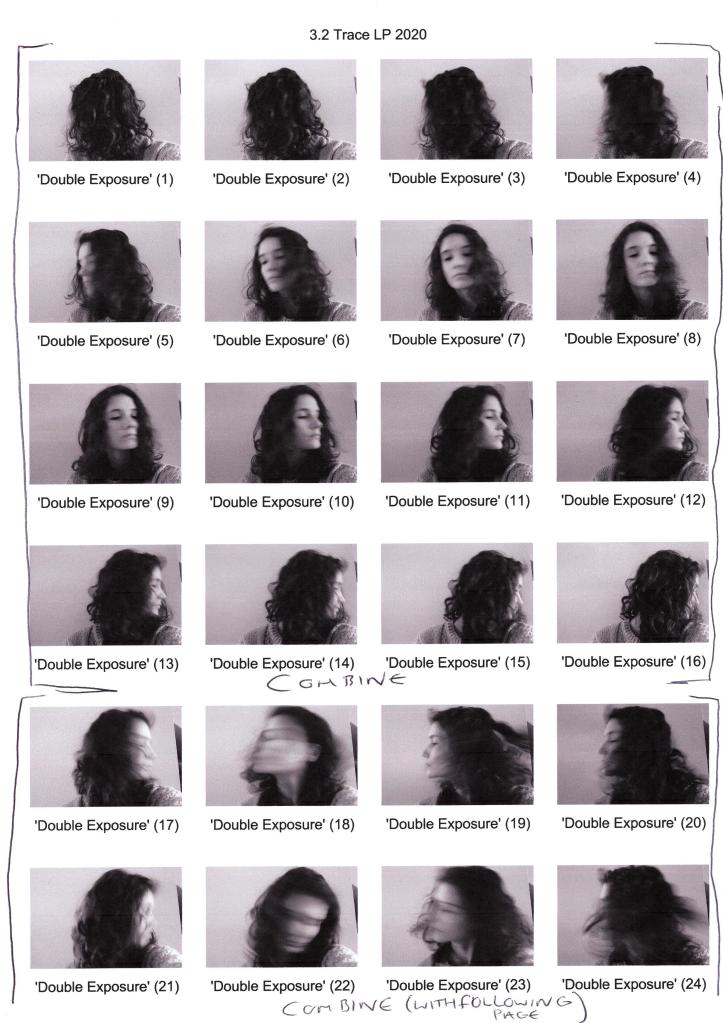
– Inserted annotated contact sheets to show the strengths and weaknesses of each image, as well as the techniques used before analysing a few images to explain how they were shot/edited, what I discovered and what I felt worked or didn’t work.

– Reflected on the exercise as a whole, what I learnt and how my feelings have changed about it.

Brief

Start by doing your own research into some of the artists discussed above. Then, using slow shutter speeds, the multiple exposure function, or another technique inspired by the examples above, try to record the trace of movement within the frame. You can be as experimental as you like. Add a selection of shots together with relevant shooting data and a description of process (how you captured the shots) to your learning log‘ (Bloomfield, 2018).

Initial thoughts

Planning this exercise was challenging as social distancing and reducing travel restricted me to unpopulated areas. As a result, I decided to become the subject for this task, making the most of what was available while using previous knowledge of self-portraits.

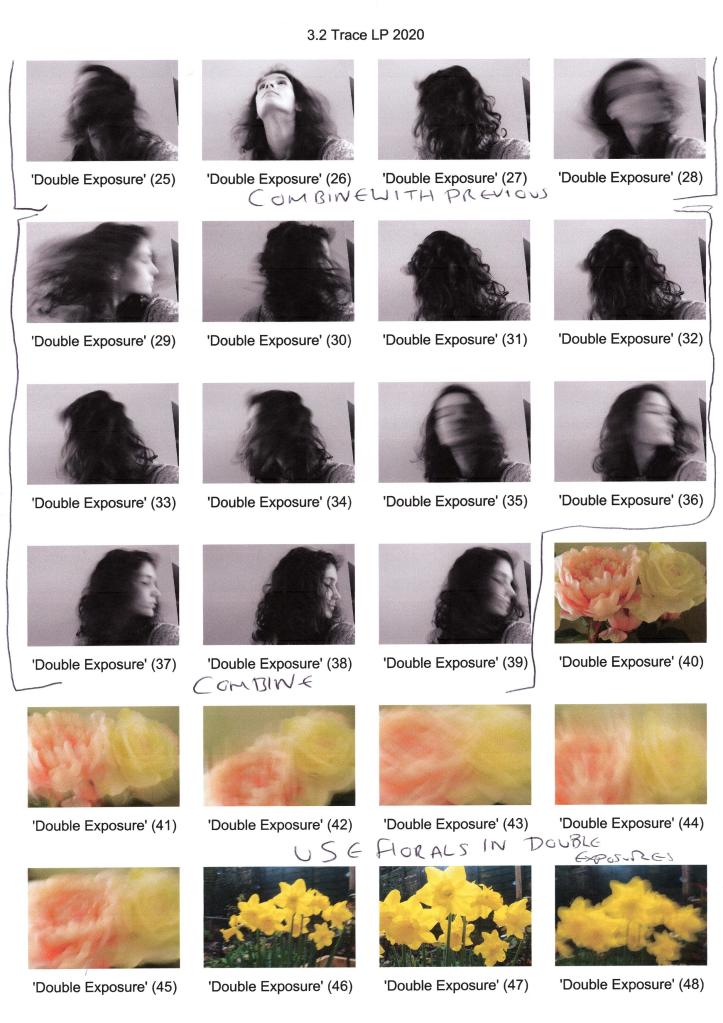
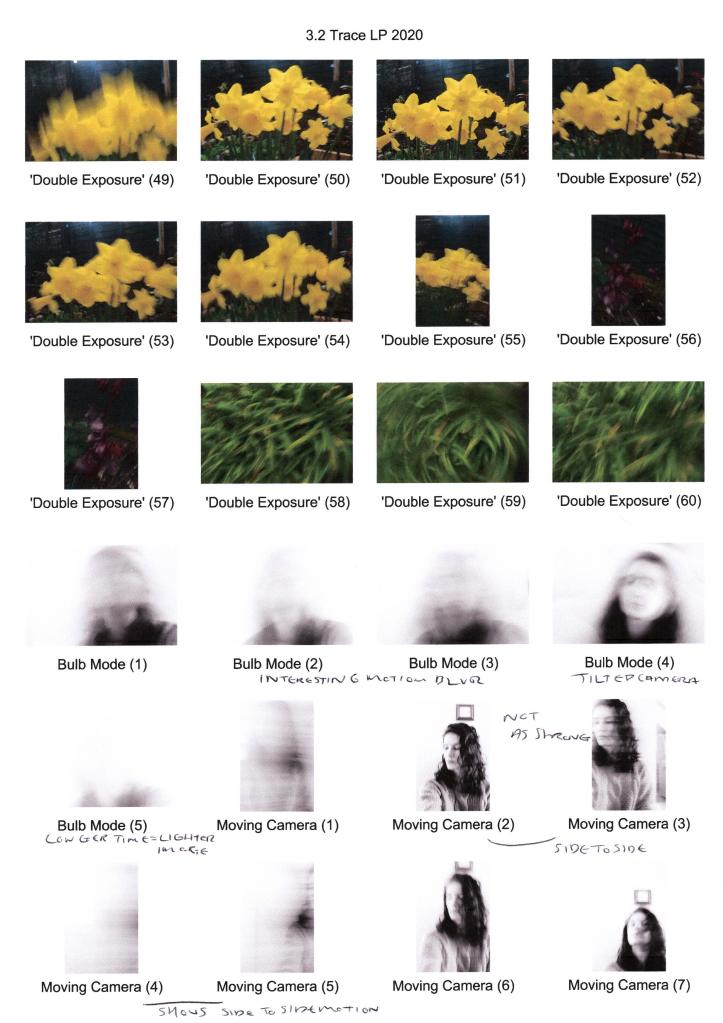
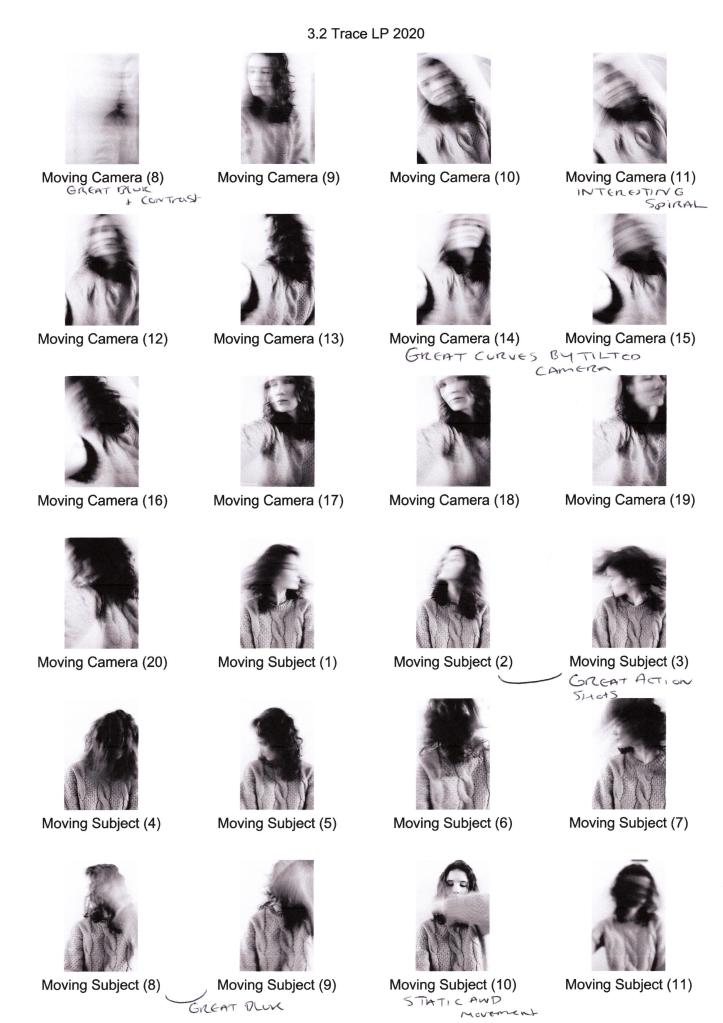
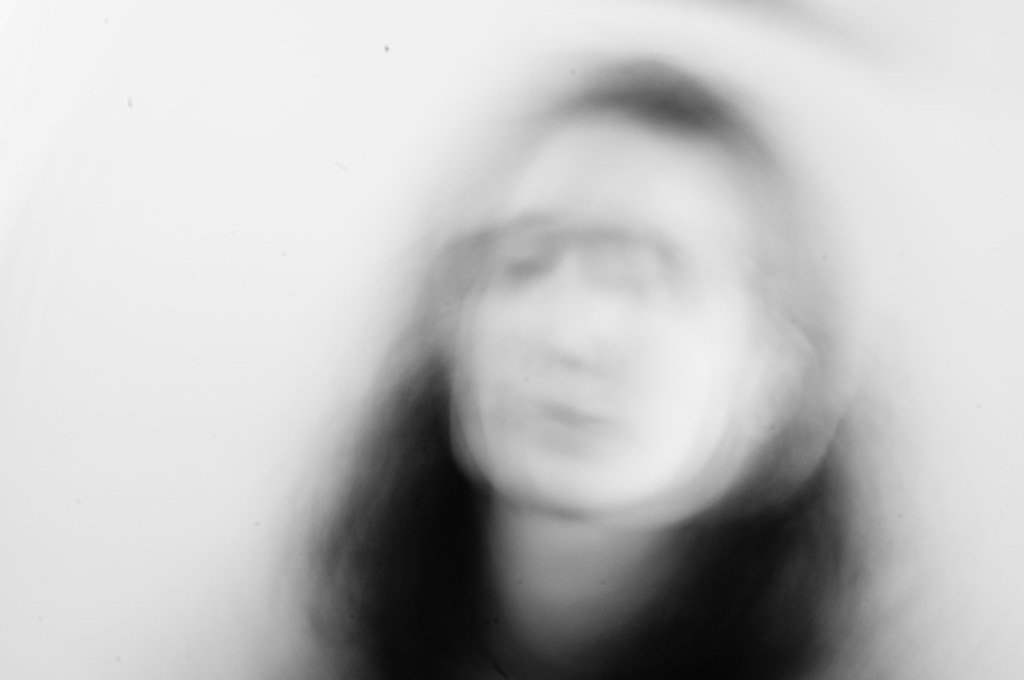
After gathering research on various artists, the techniques I chose to explore for this shoot consisted of capturing long exposures with BULB mode, combining a moving subject with slow shutter speeds, moving the camera and creating double exposures using Photoshop. These ideas have allowed me to experiment with various methods, achieving different effects and tracing time in multiple ways. I was also able to reflect on approaches mentioned in the practitioner research.

Before shooting, I set my SONY A57 to shutter priority mode, attached a SONY 18-55 3.5-5.6 SAM lens to allow for focal length adjustment if necessary and used a high-contrast black and white filter to re-create the ghost-like effects captured in Francesca Woodman’s work. In addition to that, I lowered the ISO to 100 to reduce the camera’s sensitivity to light as the shutter would be open for longer. The ISO was increased slightly for some images to allow for more light, but no higher than 300 to avoid any blowouts.

Contact sheets:

Images:

As the SONY A57 doesn’t have a multiple exposure setting, I used continuous shoot mode to capture numerous shots by holding the shutter release button. As a result of moving with a slow shutter speed of 1/10 second, motion blur occurred, showing a trace of time similar to Michael Wesely’s work. Each piece (see Fig. 6., Fig. 7., and Fig. 8.) consists of up to 10-16 individual photographs layered on top of one another and altered to either the screen or hard light blend modes, consequently achieving the ghostly figures I desired. Using the coloured floral images brings life to the composition by inserting a pop of colour throughout the monochrome shadows. On closer inspection, the direction of movement can be seen via the curves and lines within the arrangements, informing the viewer about the motions that may have taken place across a short space of time. The contrasts enhance the texture of the hair and floral elements while also forming a white silhouette, capturing the act of disappearance.

For the BULB mode experiment, I held down the shutter release whilst rapidly moving for a variety of seconds to see the outcome of each timespan. The shortest exposure time of 4 seconds (see Fig. 9.) allowed me to capture motion blur and an outline of facial features that show the circular movement of the head through the swirling curves documented. Looking at the contrasts, the viewer can see that the hair is dark, the lighter areas of skin are bright and highlighted, showing a clear distinction between black and white. As can be seen with an exposure of 6 seconds (see Fig. 10), the shadows are a blend of lighter greys rather than a deeper black due to the combination of transparency caused by a moving subject and a bright white wall that enhanced highlighted areas. The smudged path left behind from the model implies the simple act of looking side to side via the blurred lines. Using an exposure time of 11 seconds (see Fig. 11) meant that more light entered the camera, brightening the composition as a whole. The lack of features again reflects the idea of documenting disappearance as it is evident that something is there yet invisible. While the motion blur indicates movement, the traces aren’t as strong as the previous two examples.

The final images show the results of moving both the camera and subject, but using the same settings keep some form of consistency. Tilting the camera causes an intriguing spiral to appear (see Fig. 12), drawing the eyes in and out of the image. Once again, the subject’s face is blurred as if it spinning, preserving the identity and brings mystery to the composition. A combination of contrasts brings depth to the image, as does the hand in the foreground, showing the distance between the face and arm. There are three traces of time documented in this image, movement of the camera, the journey the hand took to reach the camera and the motion of a head shaking.
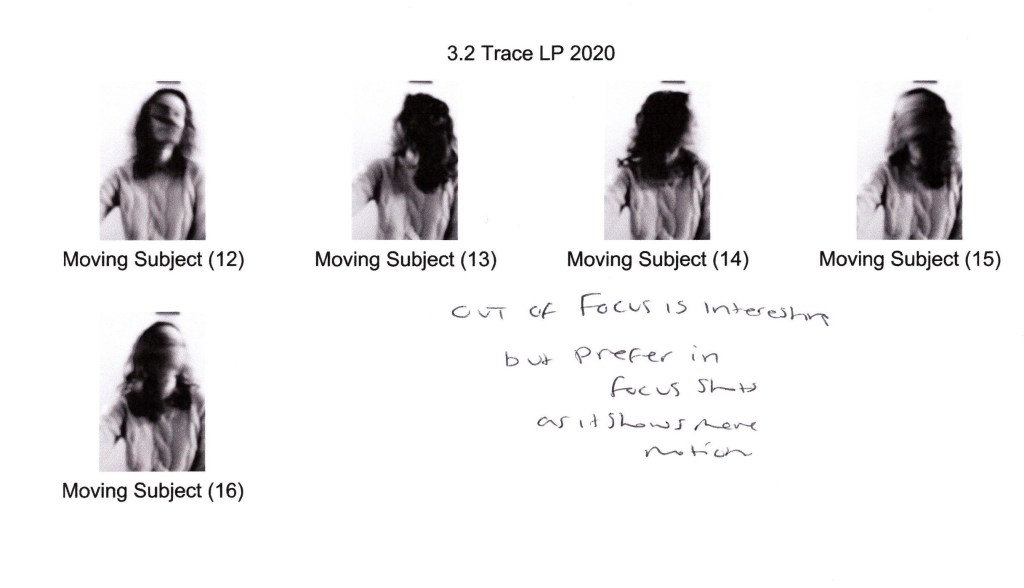
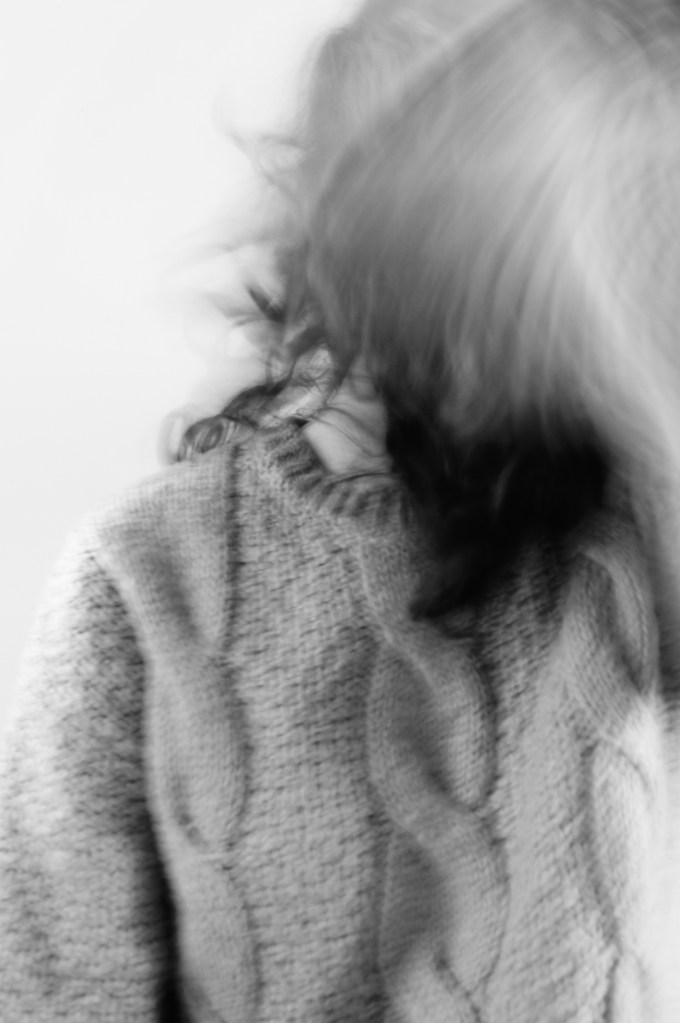
Moving subject (see Fig. 13) isn’t as busy as the previous example; however, it still suggests movement regardless of the amount documented. Due to the severe blurring in front of the face, implies a swift gesture took place as multiple curved lines are overlapping one another, as opposed to a single spiral. For this particular image, I wanted to combine both static and motion to create a juxtaposition between the two, challenging the idea of a still image; however, I wasn’t successful this time round as the clothing is still slightly obscured. The fabric of the jumper brings texture to the surface of the image, therefore, not completely smooth and smudged.

Reflection

Overall, I am pleased with the outcome of this particular exercise, as a broader range of experiments took place than the previous task, which in turn allowed for a variety of results. Consequently, slow shutter speeds and long exposures helped me gather a selection of intriguing abstract images and push my abilities in a somewhat restricted situation, therefore meeting the expectations of this particular section.

As well as stepping out of my comfort zone, I made sure to reflect on the techniques and visual elements discovered in my artist research regularly to show what I learnt, instead of going on a tangent and doing my own thing without considering different techniques.

References

Bloomfield, R., 2018. Photography 1: Expressing your Vision. 4th ed. [pdf] Barnsley: OCA, p. 68. Available at: https://www.oca-student.com/course/photography-1-expressing-your-vision [Accessed 3 February 2020].

List of images:

Figure. 1. Powell, L. (2020) Contact sheet 1 [scanned document] In possession of: Lauren Powell: Eastleigh.
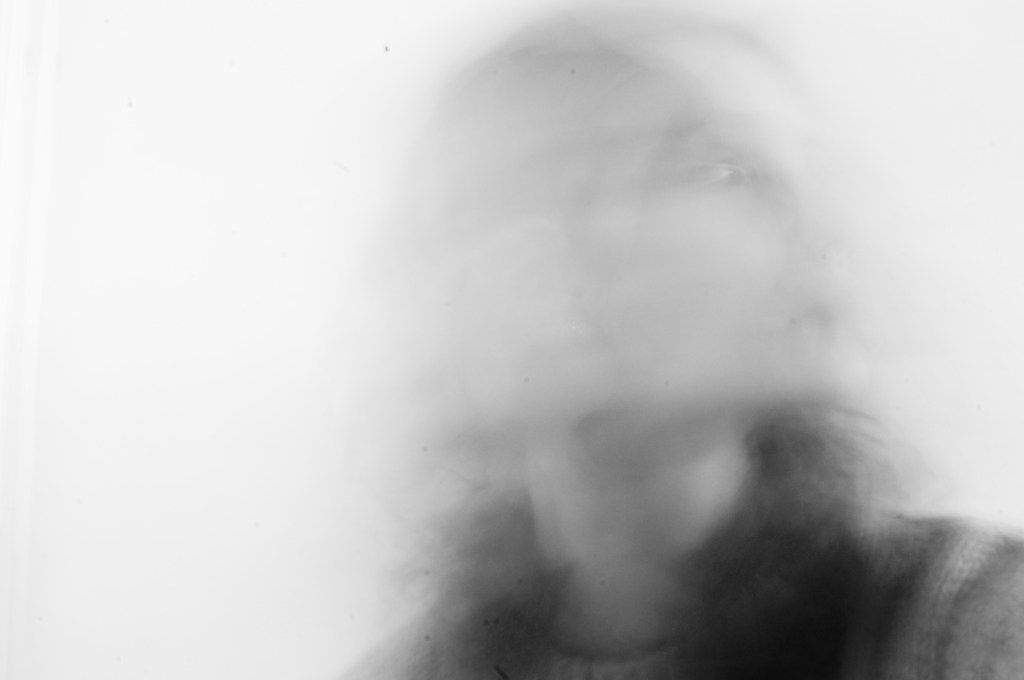
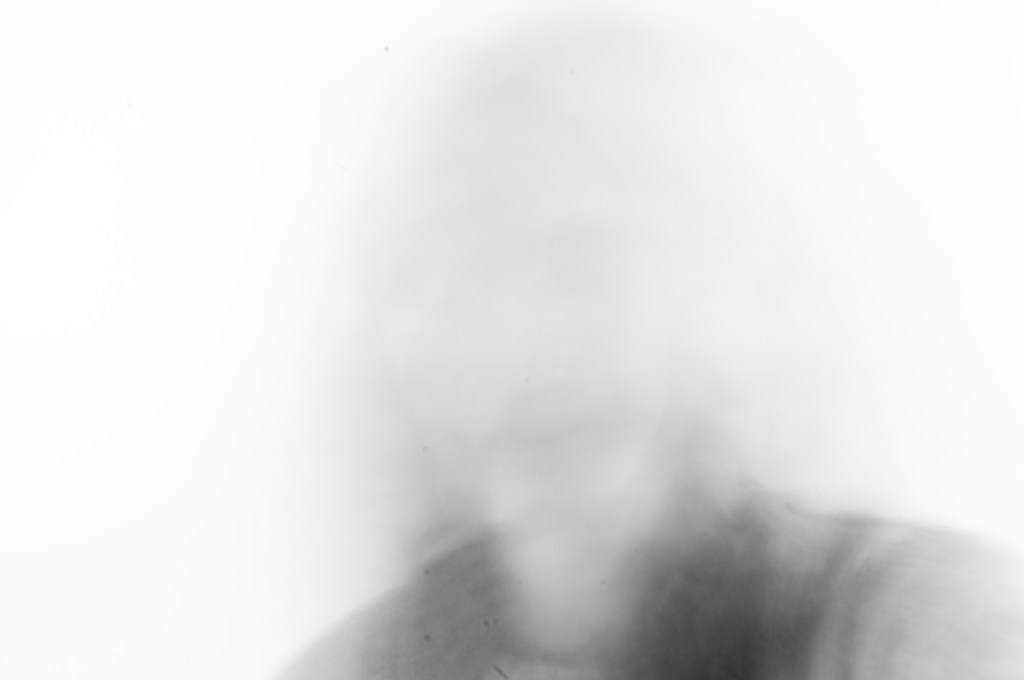
Figure. 2. Powell, L. (2020) Contact sheet 2 [scanned document] In possession of: Lauren Powell: Eastleigh.

Figure. 3. Powell, L. (2020) Contact sheet 3 [scanned document] In possession of: Lauren Powell: Eastleigh.

Figure. 4. Powell, L. (2020) Contact sheet 4 [scanned document] In possession of: Lauren Powell: Eastleigh.

Figure. 5. Powell, L. (2020) Contact sheet 5 [scanned document] In possession of: Lauren Powell: Eastleigh.

Figure. 6. Powell, L. (2020) Trace 1 [image] In possession of: Lauren Powell: Eastleigh.

Figure. 7. Powell, L. (2020) Trace 2 [image] In possession of: Lauren Powell: Eastleigh.

Figure. 8. Powell, L. (2020) Trace 3 [image] In possession of: Lauren Powell: Eastleigh.

Figure. 9. Powell, L. (2020) BULB MODE [image] In possession of: Lauren Powell: Eastleigh.

Figure. 10. Powell, L. (2020) BULB MODE 2 [image] In possession of: Lauren Powell: Eastleigh.

Figure. 11. Powell, L. (2020) BULB MODE 3 [image] In possession of: Lauren Powell: Eastleigh.

Figure. 12. Powell, L. (2020) Moving Camera [image] In possession of: Lauren Powell: Eastleigh.

Figure. 13. Powell, L. (2020) Moving subject [image] In possession of: Lauren Powell: Eastleigh.


Exercise 3.1 – Freeze

Part 3, Reflection on coursework

Summary:

For this exercise I;

– Documented the brief and my initial thoughts about it, stating my nerves towards it alongside my plans for the task.
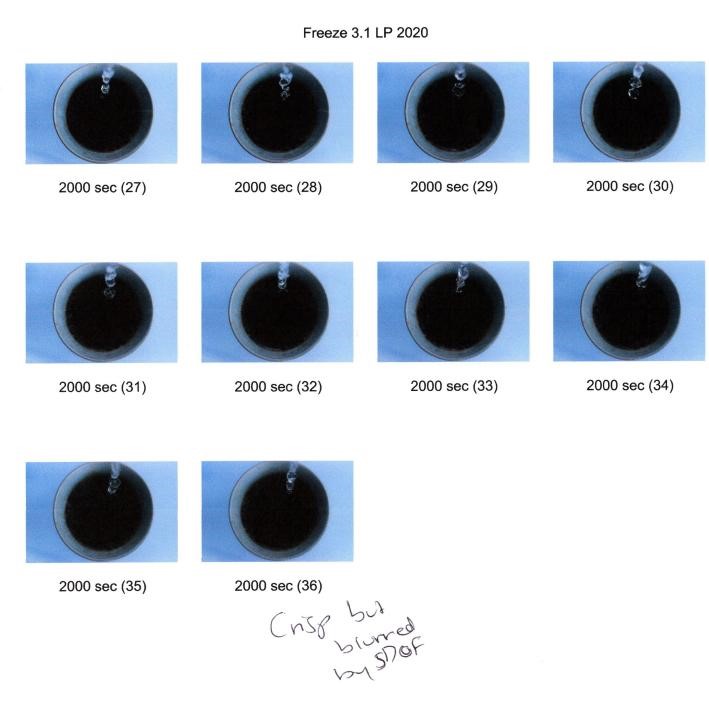
– Stated the camera settings used, fitting what was requested in the brief as well as personal choices to reflect the light levels in my home.
– Provided annotated contact sheets of the images shot during this exercise, before selecting a few examples with technical details, to show what was captured, the strengths and weaknesses of each and the images I felt were the strongest.
– Reflected on my initial thoughts and how these have changed having done the exercise, as well as what I have learnt from this task and how the techniques may influence me in the future.

Brief:

Start by doing some of your own research into the photographers discussed above. Then,
using fast shutter speeds, try to isolate a frozen moment of time in a moving subject.
Depending on the available light you may have to select a high ISO to avoid visible blur
in the photograph. Add a selection of shots, together with relevant shooting data and a
description of process (how you captured the images), to your learning log
‘ (Bloomfield 2018).

Initial thoughts

After researching the suggested photographers, I was slightly apprehensive as to how to experiment with shutter speed due to the lack of an electronic flash that can help with freezing a moment and supply extra light if needed.
However, despite the lack of equipment, I took into consideration the encouragement to step out of the comfort zone and go ahead with the idea that may not have been the easiest to execute.

‘The key to a successful third assignment is simple – the depth of your experimentation in the practical exercises …’ (Bloomfield, 2018:57).

One idea that came to mind was to try and capture a subject flicking their hair with a variety of shutter speeds, to see if any motion blur would occur or whether the movements would be frozen completely. After much thought, this approach seemed too easy to use as I have done this previously for personal work, hence my decision to freeze the process of making a cup of coffee with the challenge of restricted light.

As instructed in the course handbook, I set my SONY A57 to shutter priority mode, continuous shooting and set the ISO to 6400 to allow for a faster shutter speed to be used, without causing too much grain in the images. Despite these settings, the exposure was still slightly too dark; therefore, I made small adjustments in post-production so the imagery was much clearer to study.

For this exercise, I placed my camera onto a tripod and positioned it firmly on the table, making sure the lens was facing directly above the cup. To avoid any distraction from the tripod legs and jugs used to pour the liquids, I adjusted the SONY 18-55 3.5-5.6 SAM lens the longest focal length of 55mm and in turn, tightly framed the coffee cup.

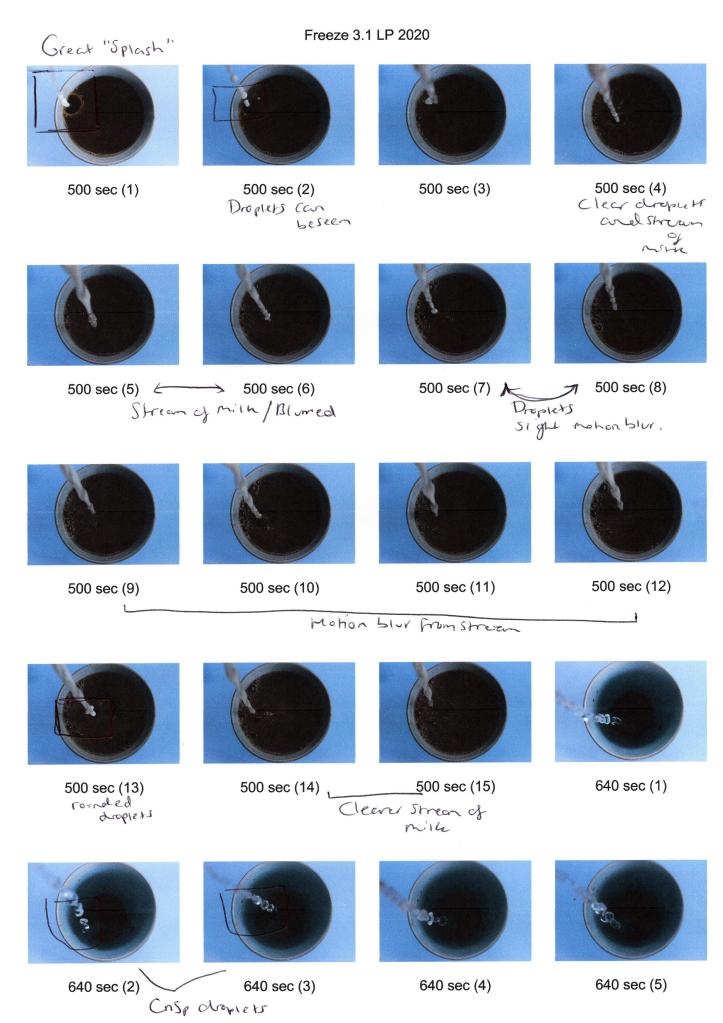
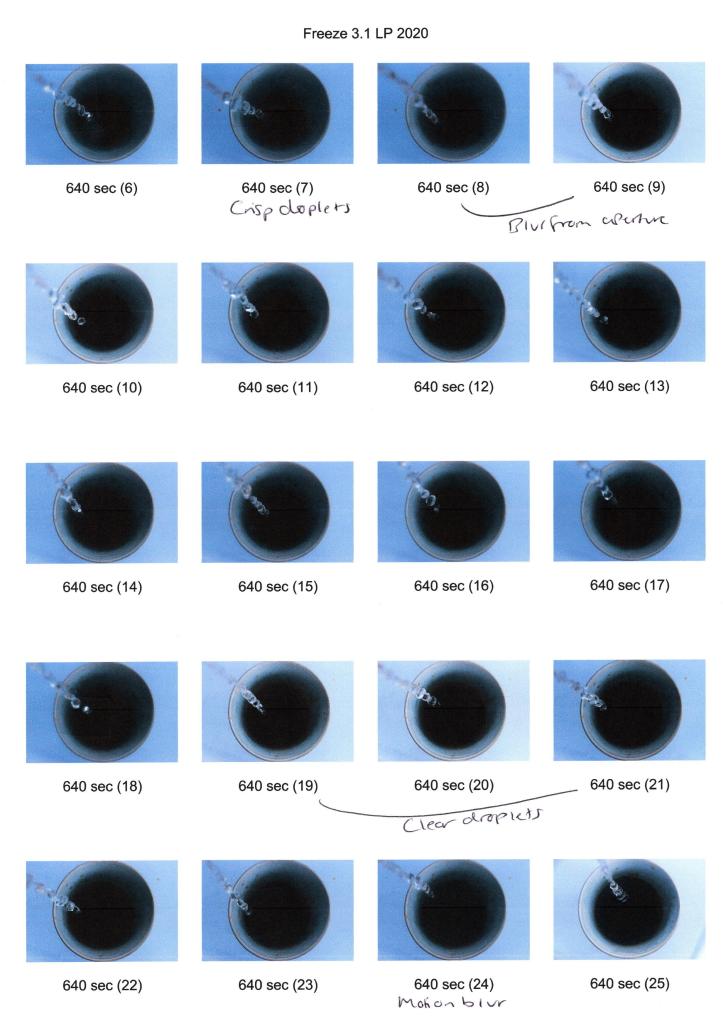
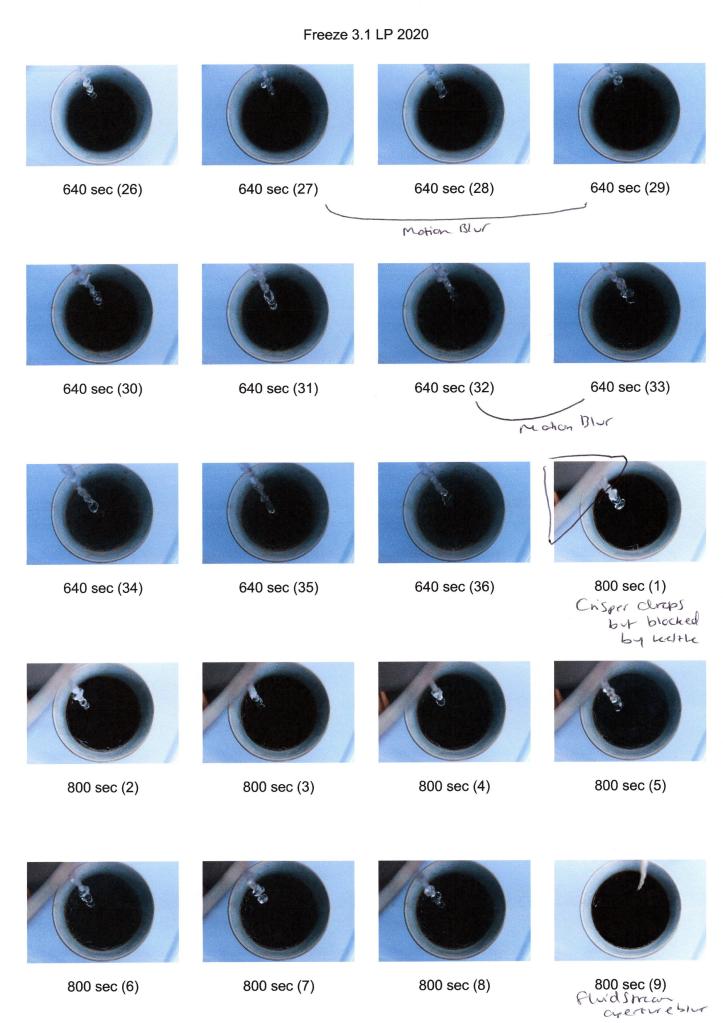
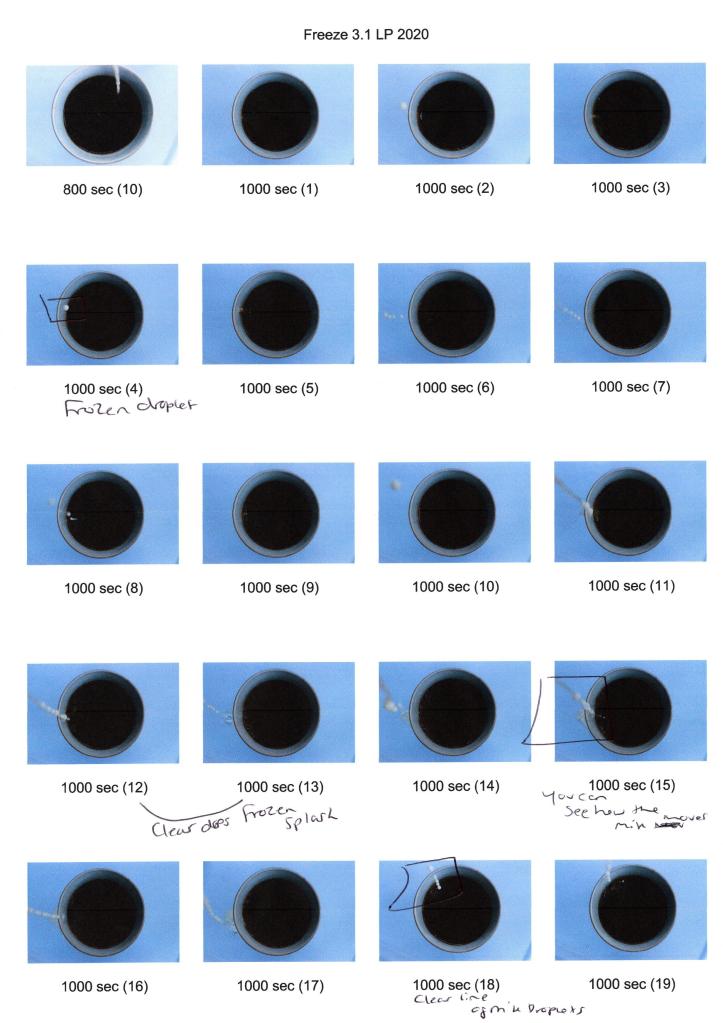
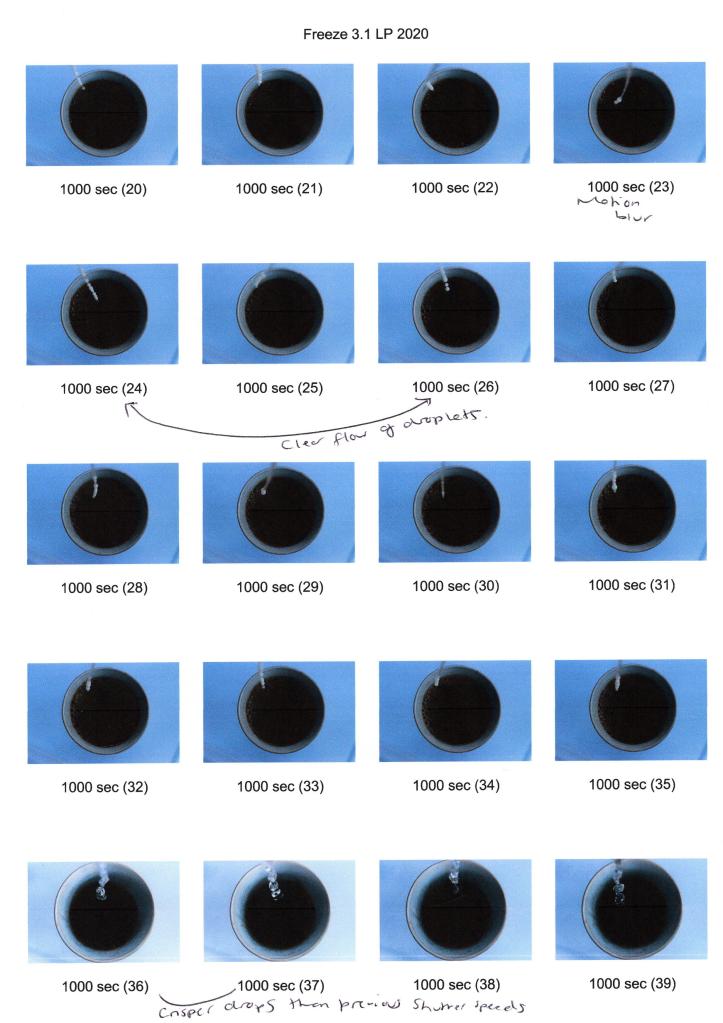
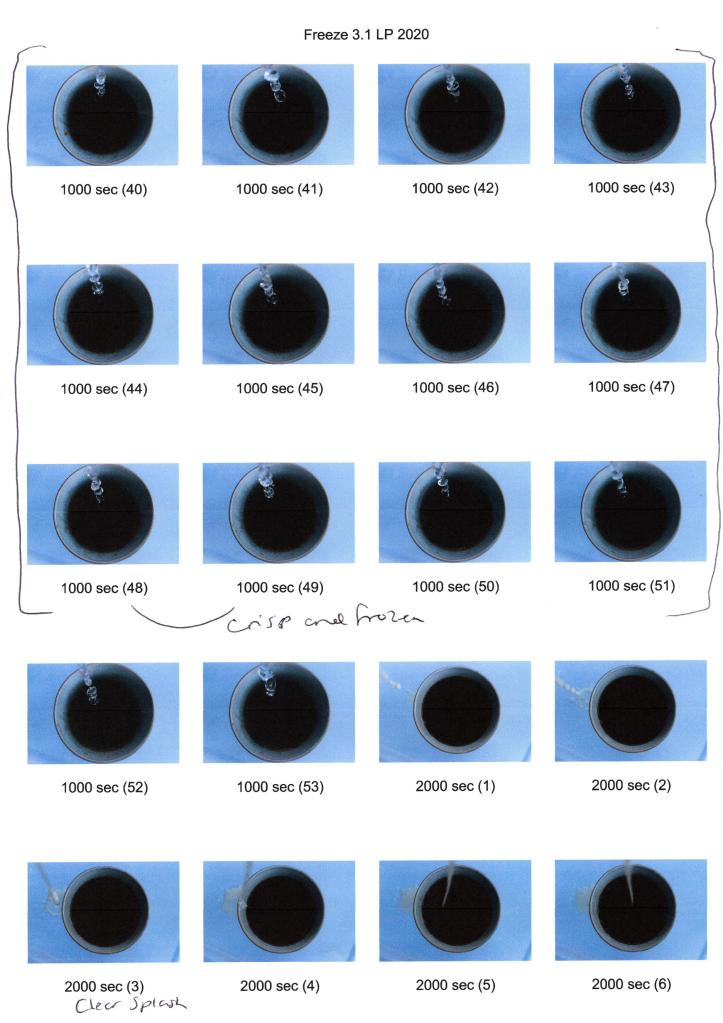
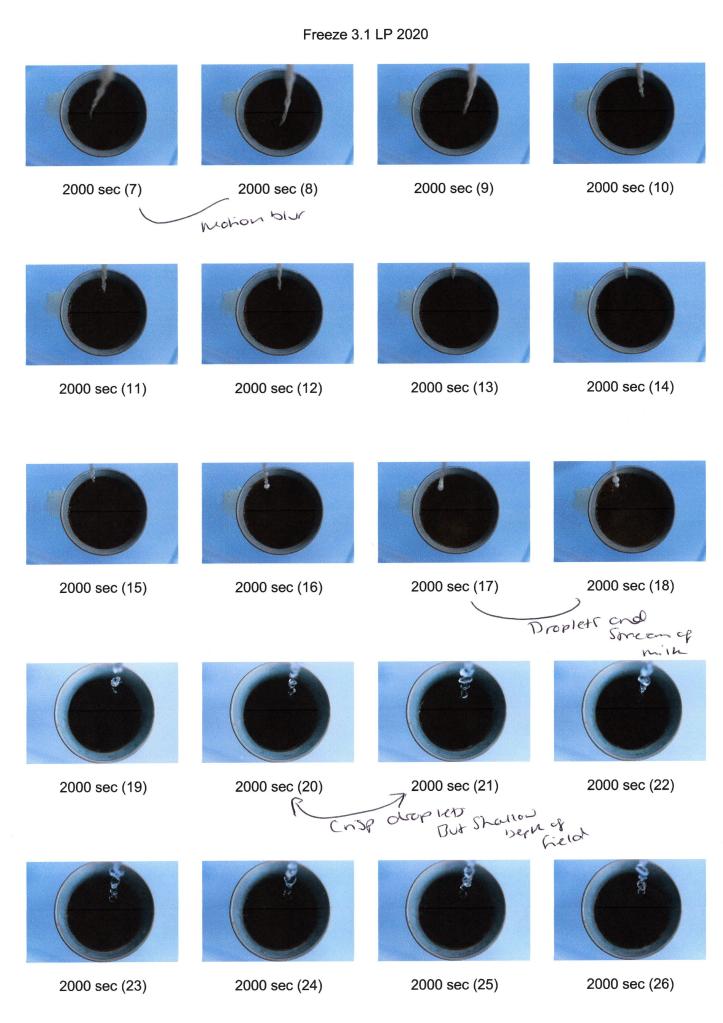
Using a ring light to provide extra light, didn’t make any difference at all due to the natural light already in the room; consequently I decided to go ahead with the daylight already available and kept the exposure in mind when altering the shutter speeds. As seen above, the selected speeds to experiment with were 1/500, 1/640, 1/800, 1/1000 and 1/2000, allowing me to capture a range of shots to compare and understand frozen moments in time.

Unfortunately, the fastest shutter speed I could use was 1/2000, before the exposure started to get darker due to the camera’s light sensitivity limit. While I would’ve liked to have used an even higher setting, the chosen speeds still provided me with a distinct, frozen set of shots to complete this exercise.

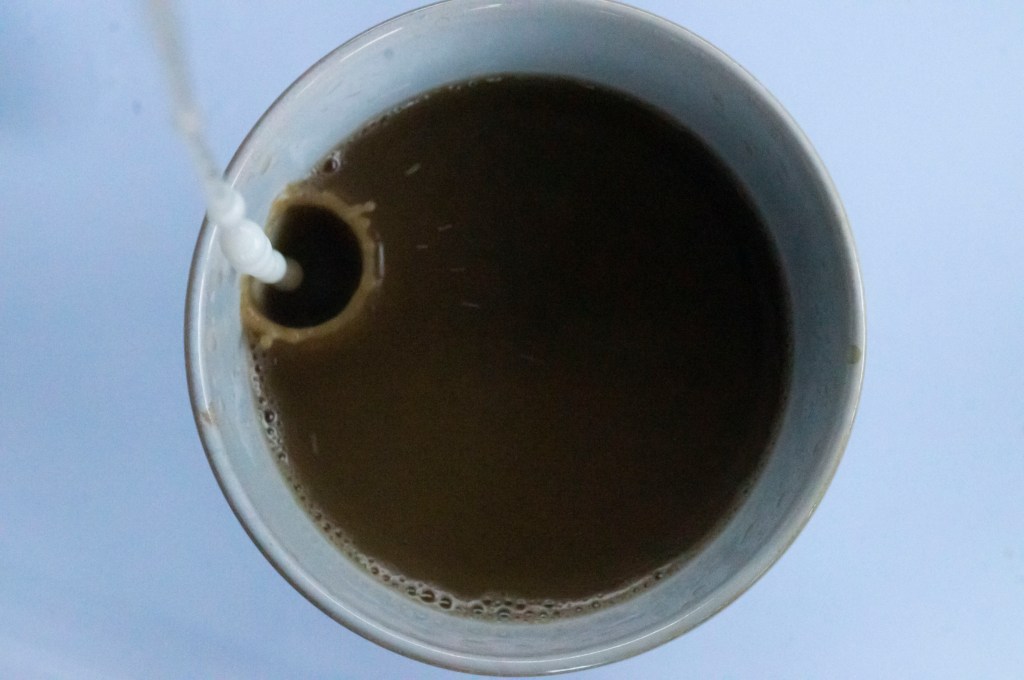
Fig. 9. Freeze 1 (2020)
1/500 sec; f/16; ISO 6400

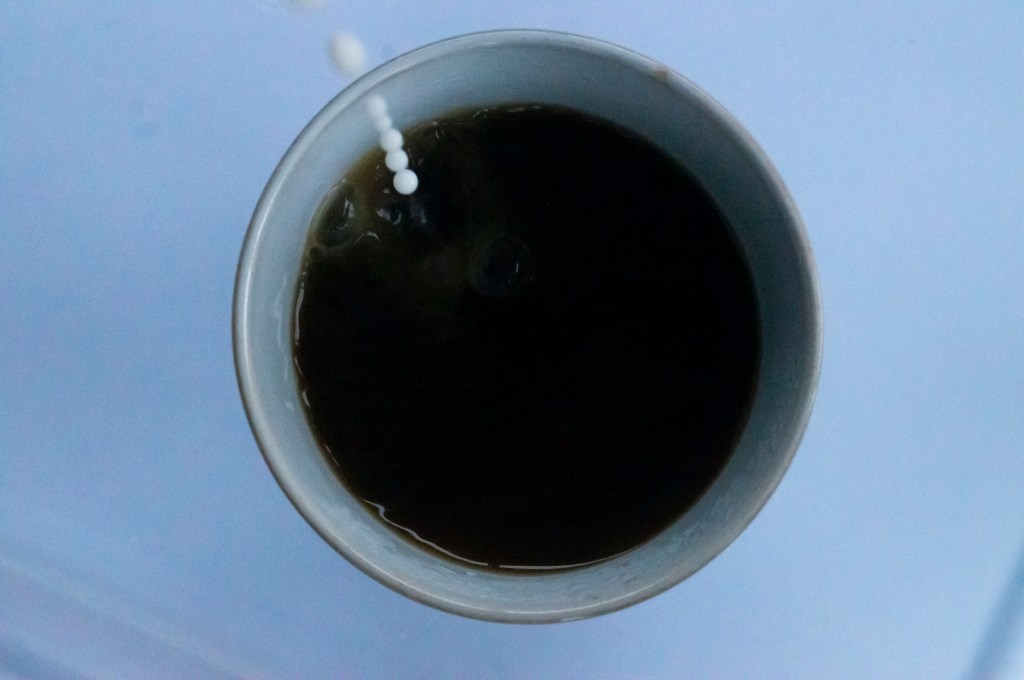
A shutter speed of 1/500 captures the small splash of liquid, showing the forceful impact the milk had on the coffee after being poured from a height of 15 centimetres (see Fig. 9). If the milk were poured gently from a reasonable height, there would be fewer droplets, little to no splashes and as a result, wouldn’t create such an intense surface tension. While the majority of the shot is crisp, there is some motion blur just below the droplets and surrounding the crown of liquid, therefore does not freeze the action in its entirety and proves that a faster shutter speed is more appropriate for this experiment.

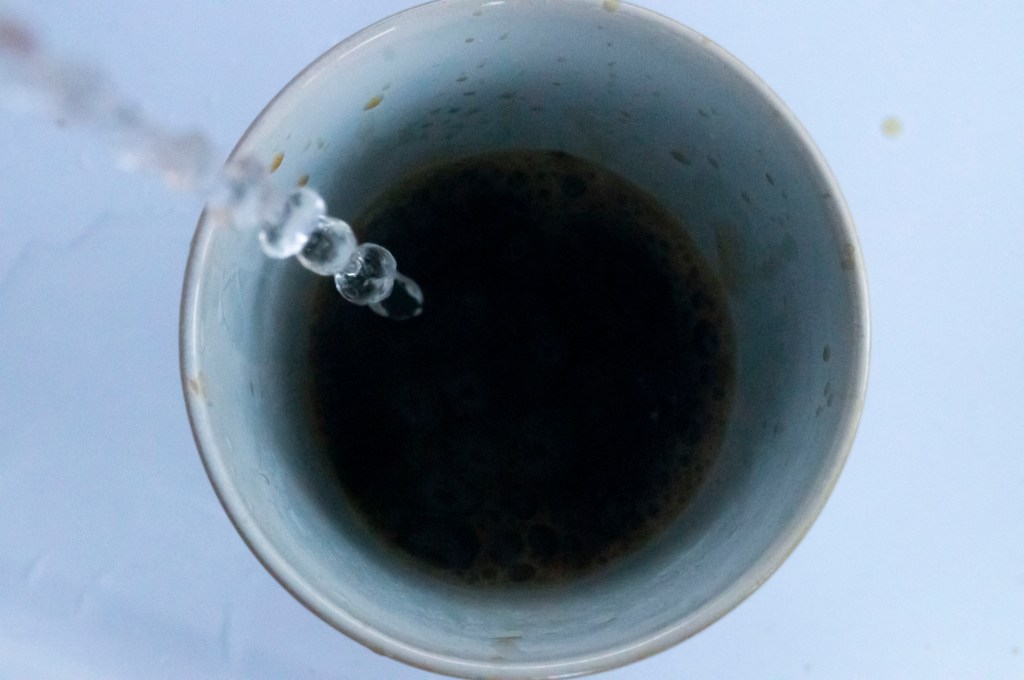
Fig. 10. Freeze 2 (2020)
1/640 sec; f/13; ISO 6400

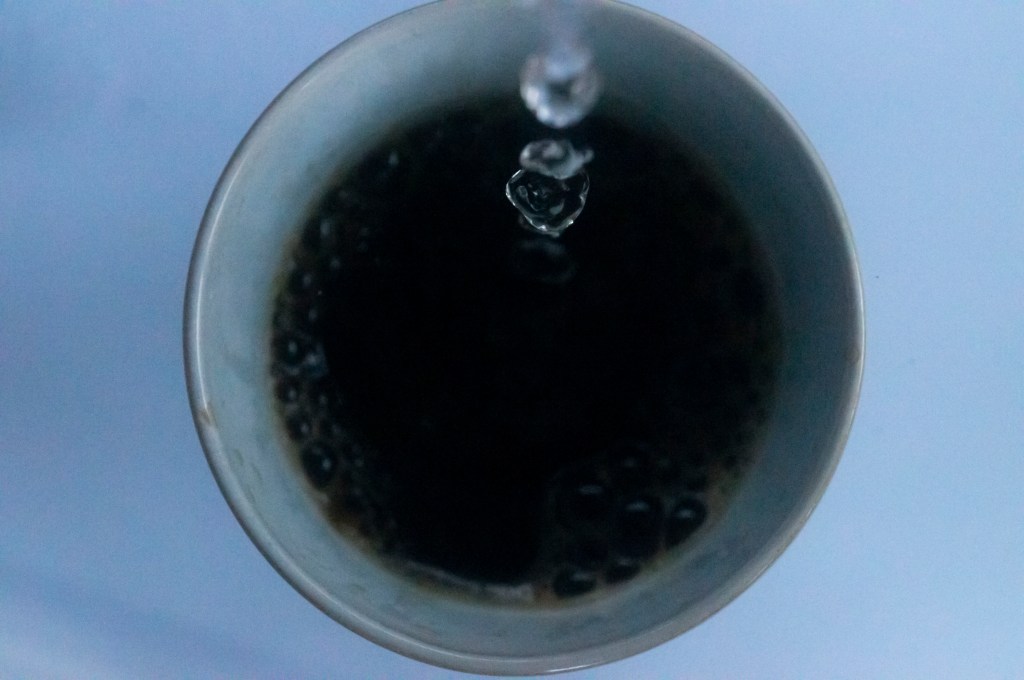
The water droplets in this image (see Fig. 10) are seen to be connected with thinner links of liquid in between each sphere, showing how a stream of water isn’t always as smooth as the naked eye would see. Each droplet is a different shape and warps from the gravity and height of the kettle compared to the cup. Once again, the shot isn’t entirely crisp due to some motion blur surrounding the water, however, is slightly better than the previous image and as a result, shows how small changes in shutter speed can affect the result of a shot significantly.

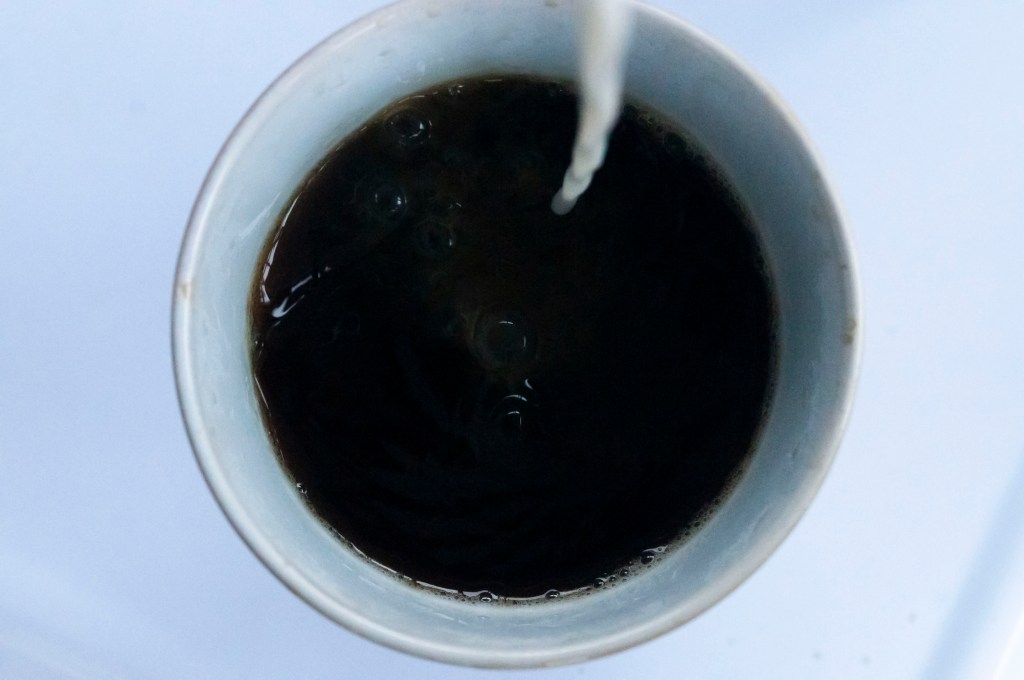
Fig. 11. Freeze 3 (2020)
1/800 sec; f/9; ISO 6400

Using a shutter speed of 1/800 enabled me to capture a much smoother stream of milk (see Fig. 11), as opposed to heavy droplets of liquid as seen in previous images which were interesting to see, as this is a more accurate visual of what we would see in the flesh. Due to the shallow depth of field, however, the flow isn’t as sharp and shows the downside of using a faster shutter speed at this particular angle as the aperture becomes wider to allow more light in, yet reduces the area of focus and distorts the shot. Despite this, we can focus on the small ripples created in the coffee not seen in previous shots as the imagery wasn’t as clear as this, allowing the viewer to discover a whole new layer of movement.

Fig. 12. Freeze 4 (2020)
1/1000 sec; f/10; ISO 6400

Comparing this image (see Fig. 12) to the first example shows how vital shutter speed can be when it comes to freezing movement as the droplets are precise, crisp and utterly void of motion blur. However, once again, the shallow depth of field prevents an entirely in-focus shot. Due to a wider aperture, the exposure is brighter than previous shots and has reduced the grain created by the ISO. While the earlier settings did capture movement that would be difficult to see clearly with the naked eye, it is clear to see that shutter speeds above 1000 are the most successful if you want to completely freeze the most minute of moments in it’s sharpest form.

Fig. 13. Freeze 5 (2020)
1/2000 sec; f/7.1; ISO 6400

Even though the shallow depth of field has once again prevented the image from being fully in focus, it enhances the details we can see and directs our eyes towards the clear droplets mid-frame (see Fig. 13). Instead of a frozen sphere, the camera has managed to capture the water breaking and flattening due to gravity which we wouldn’t usually see without slow-motion technology or fast shutter speeds. After reviewing the whole shoot, this is the most prominent and unique as the physics of the water has been visibly documented, which is fascinating.

Fig. 14. Freeze 6 (2020)
1/1000 sec; f/11; ISO 6400

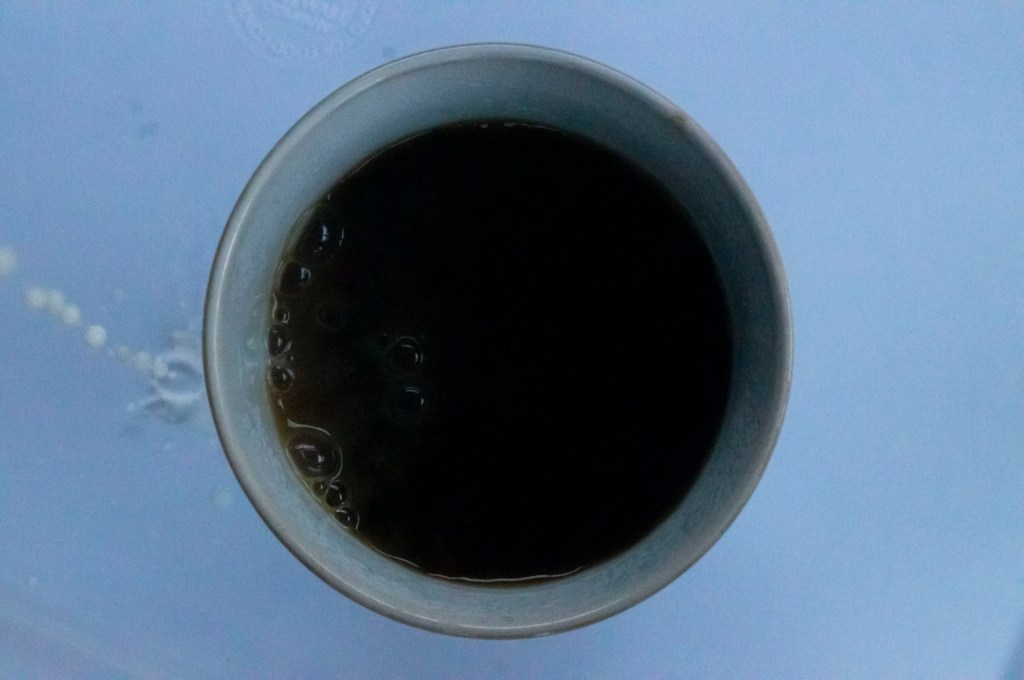
This example (see Fig. 14) is more of an ‘outtake’ than anything else, however was an image I wanted to include to reflect back on the idea of fragmenting time. Due to the height of the milk jug, it was extremely difficult to keep the liquid pouring in one fluid stream especially as it began to run out, causing the milk to break in flow and splash down the side of the cup. This event isn’t something that the viewer would’ve seen if not included in this set, therefore is a slice of time that could remove context from the shooting process.

Reflection

Despite my apprehension at the start of this exercise, these images have helped me to understand both the importance and impact of shutter speeds, how time can be frozen, and we can discover the most minute details because of it.

There is only so much you can see with the naked eye that if you blink, you can miss the most spectacular moments created in milliseconds, yet we can freeze and keep these moments forever with just a click of a button. Capturing these moving subjects help challenge the viewer’s perception of movement and all of the elements that make up one constant motion, as well as being able to admire the beauty of a frozen moment and its intricacies.

It is fascinating to see the individual phases of event and the small details we can discover within, that we may not have noticed before.

References:

Bloomfield, R., 2018. Photography 1: Expressing your Vision. 4th ed. [pdf] Barnsley: OCA, p. 61. Available at: https://www.oca-student.com/course/photography-1-expressing-your-vision [Accessed 16 March 2020].

List of images:

Figure. 1. Powell, L. (2020) Contact sheet 1 [scanned document] In possession of: Lauren Powell: Eastleigh.

Figure. 2. Powell, L. (2020) Contact sheet 2 [scanned document] In possession of: Lauren Powell: Eastleigh.

Figure. 3. Powell, L. (2020) Contact sheet 3 [scanned document] In possession of: Lauren Powell: Eastleigh.

Figure. 4. Powell, L. (2020) Contact sheet 4 [scanned document] In possession of: Lauren Powell: Eastleigh.

Figure. 5. Powell, L. (2020) Contact sheet 5 [scanned document] In possession of: Lauren Powell: Eastleigh.

Figure. 6. Powell, L. (2020) Contact sheet 6 [scanned document] In possession of: Lauren Powell: Eastleigh.

Figure. 7. Powell, L. (2020) Contact sheet 7 [scanned document] In possession of: Lauren Powell: Eastleigh.

Figure. 8. Powell, L. (2020) Contact sheet 8 [scanned document] In possession of: Lauren Powell: Eastleigh.

Figure. 9. Powell, L. (2020) Freeze 1 [image] In possession of: Lauren Powell: Eastleigh.

Figure. 10. Powell, L. (2020) Freeze 2 [image] In possession of: Lauren Powell: Eastleigh.

Figure. 11. Powell, L. (2020) Freeze 3 [image] In possession of: Lauren Powell: Eastleigh.

Figure. 12. Powell, L. (2020) Freeze 4 [image] In possession of: Lauren Powell: Eastleigh.

Figure. 13. Powell, L. (2020) Freeze 5 [image] In possession of: Lauren Powell: Eastleigh.

Figure. 14. Powell, L. (2020) Freeze 6 [image] In possession of: Lauren Powell: Eastleigh.

Project 1 – The frozen moment – Research

Online Research, Part 3, Practitioner Research

Summary:

For this research I have;

– Drawn on the work of Eadweard Muybridge, one of the pioneers of the frozen image, most famous for his ability to prove that a horse can indeed lift 4 hooves off the ground at the same time.
– Muybridge’s work was shown via slides, that showed the individual phases of movement that provided a huge step for science and photography.
– As well as improving his camera equipment by developing a motorised shutter that didn’t rely on the subjects movement, before inventing the zoopraxiscope. A machine that projected the moving image and inspired the development of the cinema.
– Explored the work of Harold Edgerton, the inventor of the ‘strobe’ flash, a photographer who froze time and provided images of motion that the naked eye couldn’t see, such as a crown of milk.
– Drawn on the work of Jeff Wall, a conceptual artist who captures everyday occurrences, or ‘micro gestures’, before
– Re-enacting in a different location, allowing him to take control of the composition, while providing tension in the imagery via the lines, gestures or other such elements.
– Reflected on the work of Philip-Lorca diCorcia, a photographer who meticulously plans his compositions by combining elements that don’t necessarily go together
– Challenging the traditions of photography and creates tension between the candid and posed. So while his work may look natural, with further inspection you understand they are not, due to obvious lighting or odd positioning of subjects.
– Reviewed whether I feel the camera captures or fragments time, giving examples of my opinion by harking back to the imagery of the listed artists.

Photographic exposure times developed massively since the early days of photography when exposures used to take hours to produce since reduced to mere points of a second with the evolution of technology. 

We have been able to go from hours of standing/sitting still to avoid motion blur, to capturing movement as a still image with no traces whatsoever. 

Some of the earliest photographers to experiment with the new, improved film speeds and shutters, are as follows.

Eadweard Muybridge (1830-1904):

Eadweard Muybridge, formally known as Edward James Muggeridge was one of ‘ … the great photographic thinkers and technical pioneers of all time …’ (Huxley Parlour, 2017), who thought way beyond the walls of still photography and was passionate about the evolution of the moving picture.

Leland Standford, a racehorse owner and former governor, hired Muybridge in 1872 to capture photographs of his horse to confirm whether all four hooves can be off the floor at the same time. To achieve this, Muybridge set up multiple cameras and a tripwire which would be activated upon the horse’s movement to capture each stage. After five years full of court trials, travelling and death, he returned to Standford. After producing conclusive results about the horses galloping abilities, this led newspapers to reproduce these images as drawings and artists such as Edgar Degas and Thomas Eakins, referencing them to produce art that was more realistic to life.

After his relationship with Leyland had ended due to lack of recognition following the publication of The Horse in Motion (Muybridge, 1878) , Muybridge began a new set of work for the University of Pennsylvania called Animal Locomotion which became one of his most influential pieces of work. The project allowed the study of movement through a variety of animals and the human form, which was a massive step for both science and photography by capturing each phase of a single action. 

Muybridge significantly improved his camera equipment by developing a clockwork motor, meaning he could capture the minutest of movements without relying on the subject to trigger the shutter. 

Muybridge’s work has helped contribute towards physiology, biomechanics and a range of artists such as Marcel Duchamp and Jasper Johns. Not only that, but he was the first to invent the machine called the “zoopraxiscope” which projected the moving image and animated a selection of photographs, potentially inspiring the development of cinema.

Harold Edgerton (1903-1990)

Dr Harold Edgerton was born in Nebraska, raised in Aurora and began a career as a professor at the Massachusetts Institute of Technology, which was the reasoning behind his invention of the ‘strobe’ flash and dedication to documenting what the naked eye couldn’t see. 

Edgerton shaped the world of photography by freezing time and capturing results such as liquid on liquid forming a symmetrical crown of milk, as well as the ghostly arch that is formed by a golfer swinging their arm as the torso is ‘superimposed on itself 50 times’ (Michael Hoppen Gallery, 2015).

Due to his invention of flash cameras, his influence inspires photographers, journalists and many others today albeit the cameras are much smaller, which shows his impact on the photographic world and how we can capture the subjects around us. Being able to document what cannot be seen and controlling how a moment can be frozen in time, can help people understand how certain events occur and the result of them.

Jeff Wall (1946 – )

Jeff Wall was born in Vancouver and went on to study art history at the University of British Columbia in the 1960s, which is where he discovered Vancouver’s experimental art scene and used this as inspiration to teach himself photography to portray his conceptual ideas. 
After many years of studying and receiving his BA and MA degrees at UBC, Wall went on to teach at Nova Scotia College of Art and Design, Halifax, Simon Fraser University, Vancouver and has since been a teacher at UBC where his journey first began (Riggs, 1997).

Having been inspired by the paintings of Goya and Velázquez, Wall wanted to find a way to depict everyday life through the medium of photography following his thought that ‘it was no longer possible for modern artists to paint like the great masters’ (Riggs, 1997). He decided upon creating backlit transparencies, which are large-scale photographs mounted in lightboxes to combine both cinema and sculpture, therefore a successful contemporary approach. 

The inspiration for Wall’s pictures is everyday occurrences that he has personally witnessed, as well as his interest in ‘micro-gestures’ which are essentially actions that take place without much previous thought, portraying the tensions within society.
Milk (see fig. 1.) reflects the current state of mind the man in frame is in, portrayed by the explosion of liquid and clenched fists; however, the moments leading up to this moment are unknown. As a result of this, the viewer may wonder what caused such a reaction, creating tension between the two (Tate, 2017).

Wall tends to reconstruct the events he sees, to allow himself to gain control of the composition, which is why he relocated for this particular situation while keeping the formal elements in mind. 
‘The grid-like order of the brick wall background, and strong vertical bands that stripe the left side of the image contrast sharply with the tension in the man’s arms and the uncontrolled arc of milk’ (Tate, 2017). 

Fig. 1. Milk (1984)

Philip-Lorca diCorcia (1951 – )

Philip-Lorca diCorcia studied at the School of the Museum of Fine Arts, Boston, the University of Hartford, Connecticut and received his Master of Fine Arts from Yale University in 1979. He didn’t initially set out to become a photographer; however, Jan Groover suggested that ‘a photograph should result from careful planning and orchestration’ (Sidley, 2016), which diCorcia may have used as inspiration when he began identifying as a photographer. 

DiCorcia’s work challenges and pushes the traditional boundaries of photography by meticulous planning and composing. So, while they may look natural and accidental, they’re not due to the combination of people and places that don’t necessarily go together. This approach creates a tension between random and controlled, directs the imagery towards various paths without a definite conclusion or direction, therefore suggesting a narrative more so than telling a story (Sidley, 2016).

One of the ways DiCorcia executed his shots, for example, Mario (DiCorcia, 1978) was by setting the camera up on a tripod, putting a flash in the fridge and readjusting each element while testing the composition with a Polaroid camera, keeping the desired result in mind. So, while the subject looked completely natural, in deep thought as they observe the contents of the refrigerator, everything was precisely planned at each step (Sidley, 2016).

The use of harsh artificial light is a recurring technique through his work which could be street lighting, however, on closer inspection, the contrasts between the shadows and highlights are almost too intense to be considered accidental. An example of this is the spotlight that hits the subject in Edward Earle Windsor; 20 years old; Atlanta, Georgia; $30 (DiCorcia, 1990-92). 

Reflection

‘There is a pleasure and beauty in this fragmenting of time that had little to do with what was happening. It had to do, rather, with seeing the momentary patterning of lines and shapes that had been previously concealed within the flux of movement.’ (Szarkowski, 2007, p.5).

Upon completing some artist research, I would consider that the camera captures time in these images, as well as fragmenting it, it’s isn’t necessarily mutually exclusive. 

Muybridge’s images I believe do capture time, by documenting each phase of a singular movement, in turn, supplying context to each photographic plate. While Edgerton’s work also freezes moments in time and form an opinion in the viewers head as to what happened moments before, what we assume happened before shooting the apple may not be correct. As a result, I consider these images to be both a captured moment in time and a fragment.

Wall and diCorcia, on the other hand, fragment time with meticulous planning and creating tension throughout the composition, either through technical decisions or formal. While they are pre-meditated, the body language and locations cleverly help create intrigue for the viewer, making them wonder how the events shot occurred and what caused the particular gestures in that specific place. The imagery doesn’t necessarily look staged at first glance without prior knowledge; therefore, you would believe they are just a brief moment in history frozen forever; however, are not. A fragment of time provides just a slice of the story, not the whole product.

This research has made me question whether the street photography I have seen in the past is just a capture of time, whether there is more the story than initially thought or if it has been pre-planned to convey a particular narrative, controlled by the artist. 

References: 

Huxley Parlour. (2017) Eadweard Muybridge | Photographer’s Biography & Art. [online] Available at: https://huxleyparlour.com/artists/eadweard-muybridge/ (Accessed 4 March 2020)

Michael Hoppen Gallery. (2015) Dr Harold Edgerton | Michael Hoppen Gallery. [online] Available at: https://www.michaelhoppengallery.com/artists/54-dr-harold-edgerton/overview/#/artworks/9778 (Accessed 4 March 2020)

MoMA. (2019) Philip-Lorca diCorcia. Mario. 1978 | MoMA. [image] Available at: https://www.moma.org/collection/works/46273?artist_id=7027&locale=en&page=1&sov_referrer=artist (Accessed 4 March 2020)

MoMA. (2019) Philip-Lorca diCorcia. Edward Earle Windsor; 20 years old; Atlanta; Georgia; $30. 1990-92. [image] Available at: https://www.moma.org/collection/works/57854?artist_id=7027&locale=en&page=1&sov_referrer=artist (Accessed 4 March 2020)

Riggs, T. (1997) Jeff Wall born 1946 | Tate. [online] Available at: https://www.tate.org.uk/art/artists/jeff-wall-2359 (Accessed 4 March 2020)

Sidley, K. (2016) Philip-Lorca diCorcia | MoMA. [image] Available at: https://www.moma.org/artists/7027 (Accessed 4 March 2020)

Szarkowski, J. (2007) The Photographer’s Eye. New York: MoMA Thompson, K. &

Tate. (2017) Jeff Wall : room guide, room 3 | Tate. [online] Available at: https://www.tate.org.uk/whats-on/tate-modern/exhibition/jeff-wall/jeff-wall-room-guide/jeff-wall-room-guide-room-3 (Accessed 4 March 2020)

Time. (2016) The Horse in Motion |100 Photographs. [image] Available at: http://100photos.time.com/photos/eadweard-muybridge-horse-in-motion (Accessed 2 April 2020)

List of Images:

Figure 1. Wall, J. (1984) Milk [image] Available at: https://www.tate.org.uk/whats-on/tate-modern/exhibition/jeff-wall/jeff-wall-room-guide/jeff-wall-room-guide-room-3 (Accessed 5 March 2020)