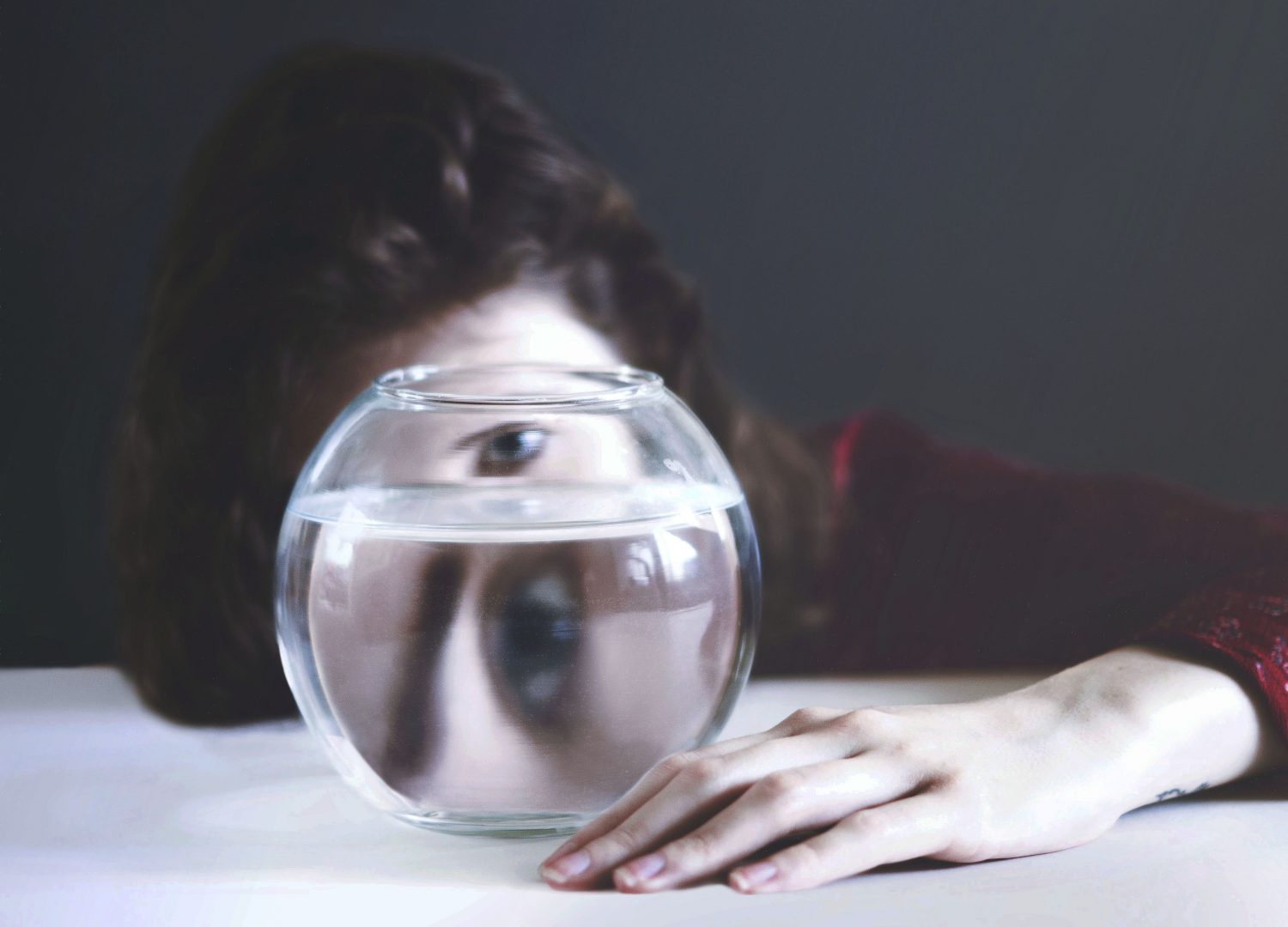
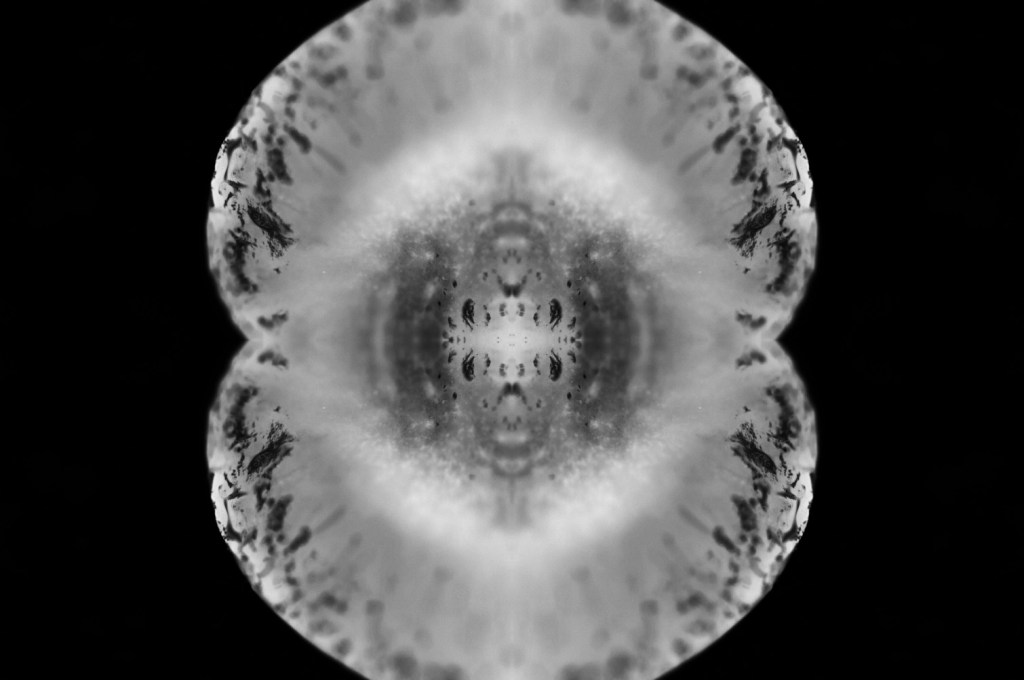
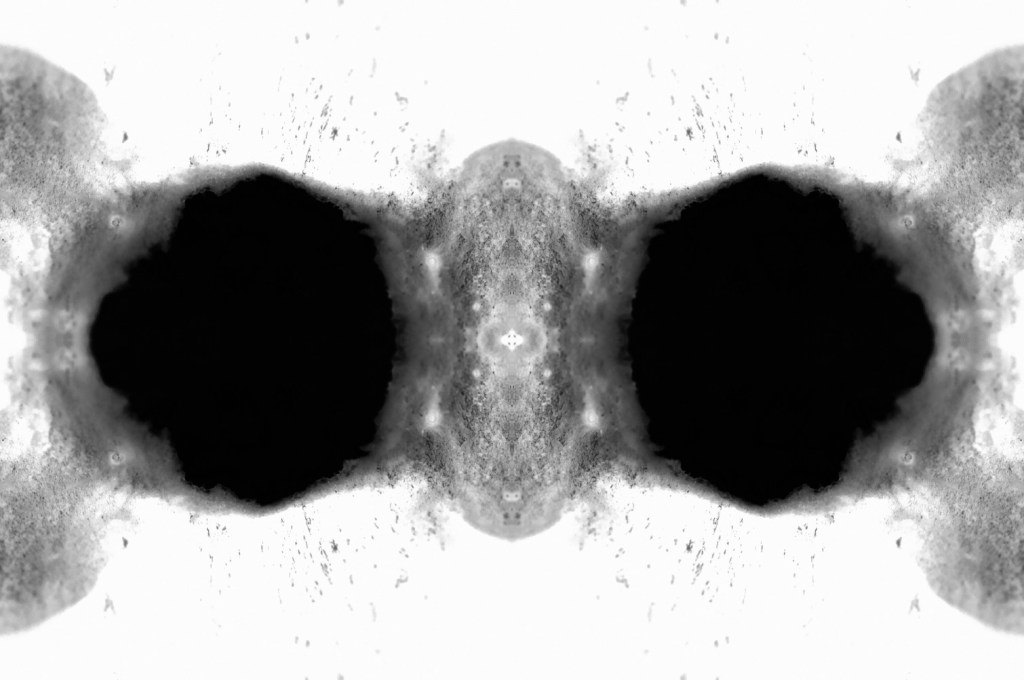
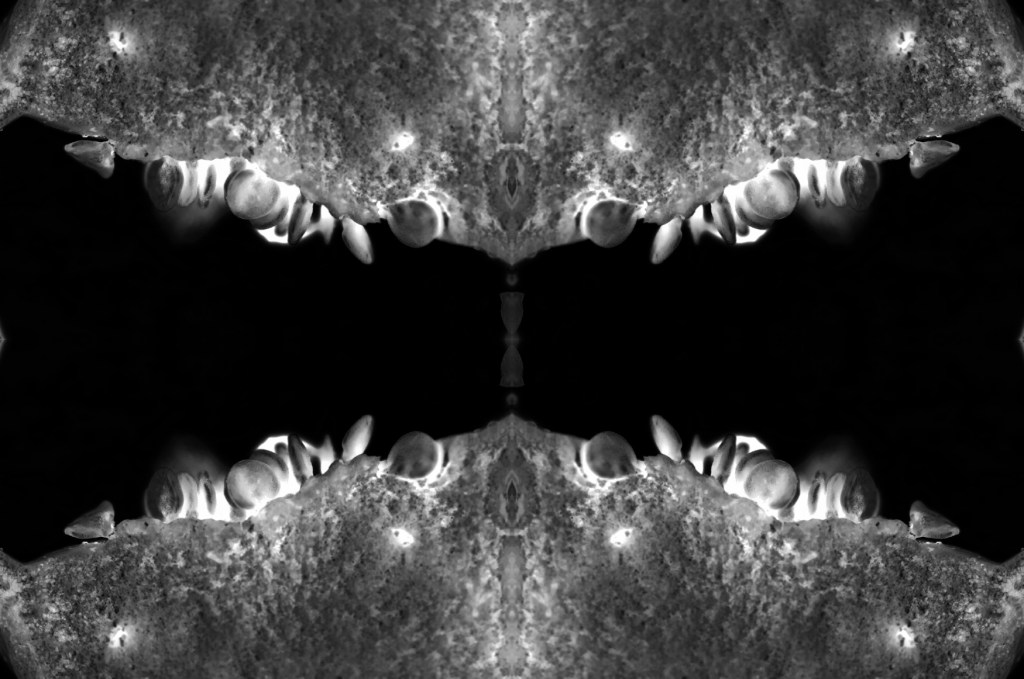
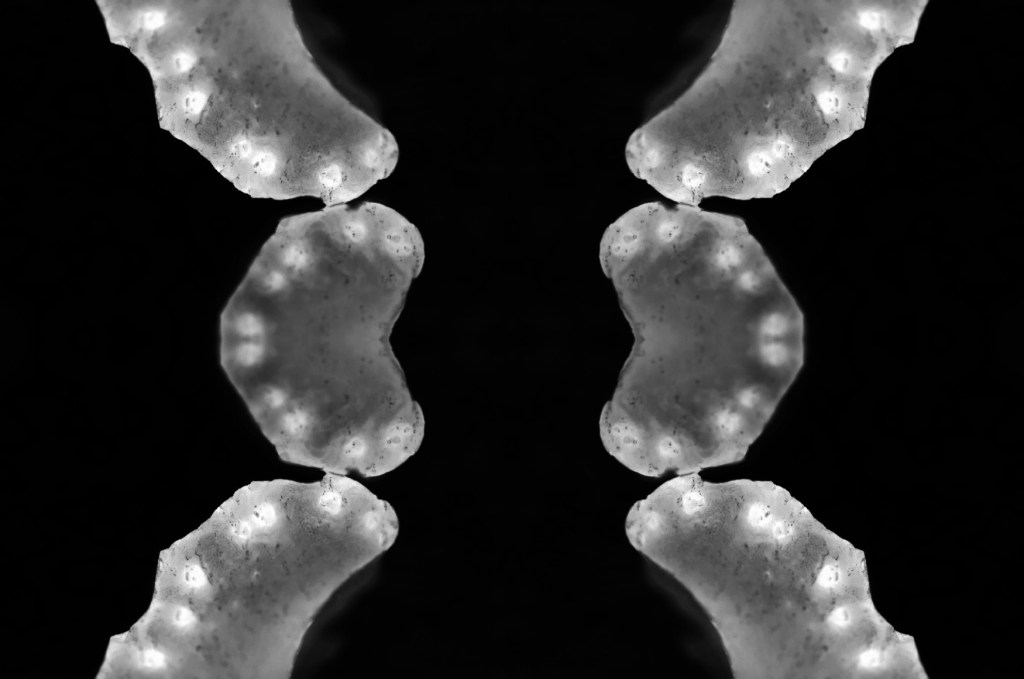
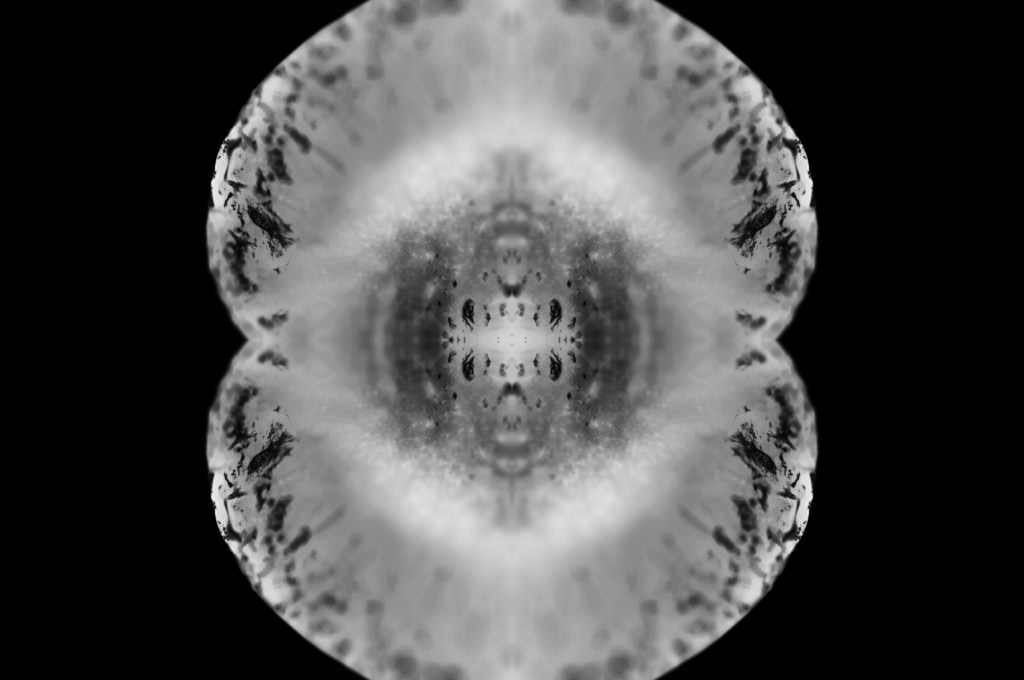
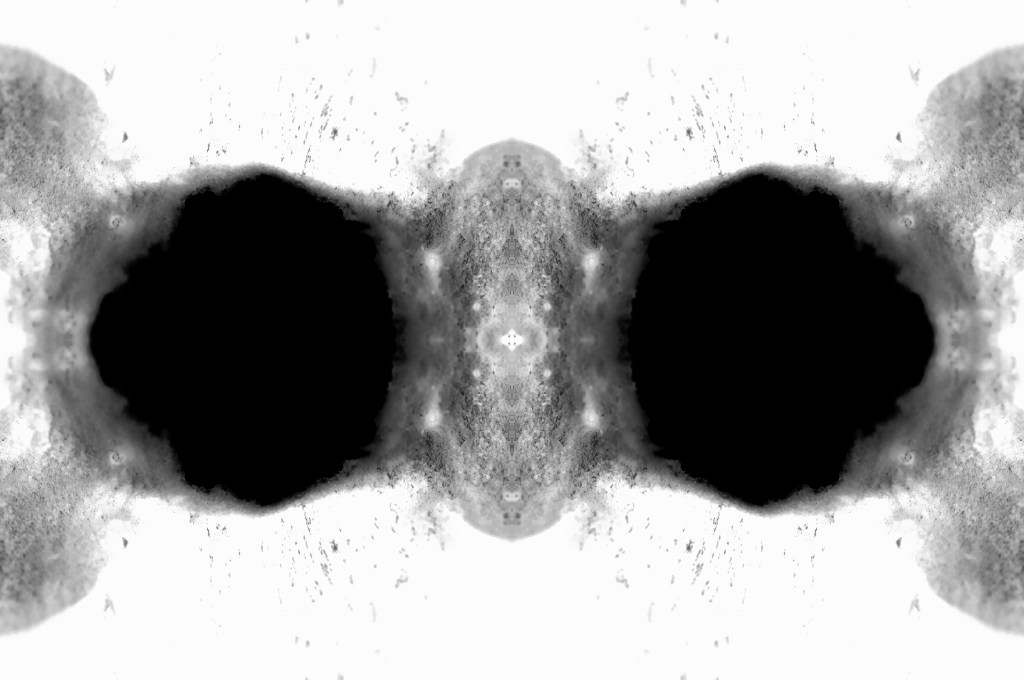
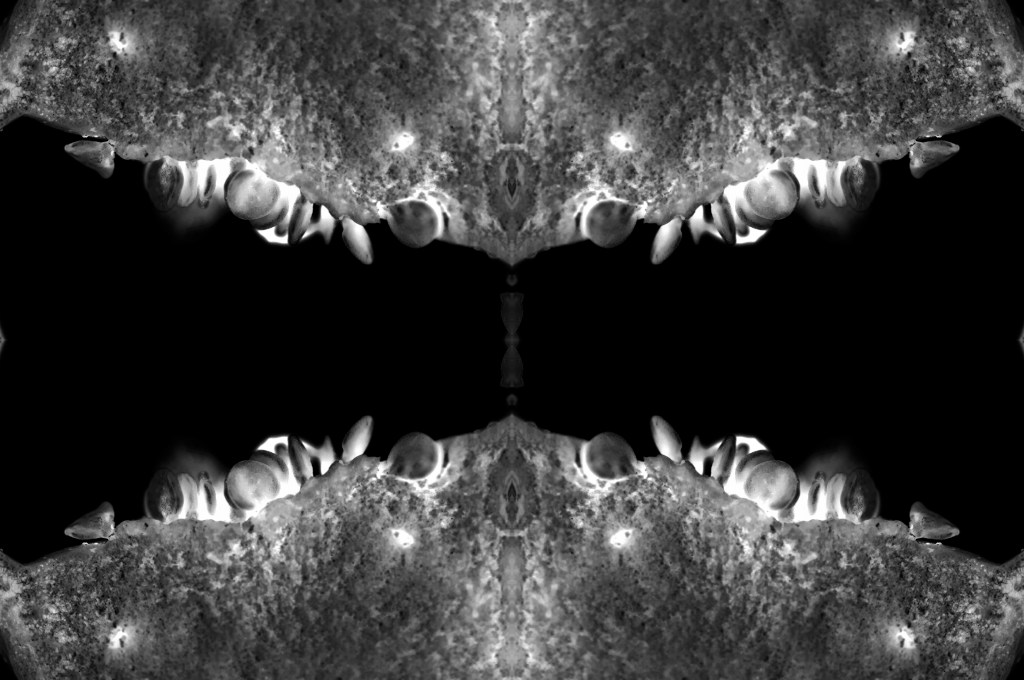
OCA’s assessment guide suggests that you choose four to six images from your strongest assignment for this particular outcome. I have decided to pick four out of the original seven pieces from ‘Languages of Light’ to present a skilful use of controlled light, post-production techniques such as ‘inverting’, the visual impact of mirrored compositions and my understanding of contrast.
To select these images, I revisited my assignment and chose the four shots that best showed variety while considering the importance of a coherent set. The pieces document a range in texture, shape, unique use of light and composition.
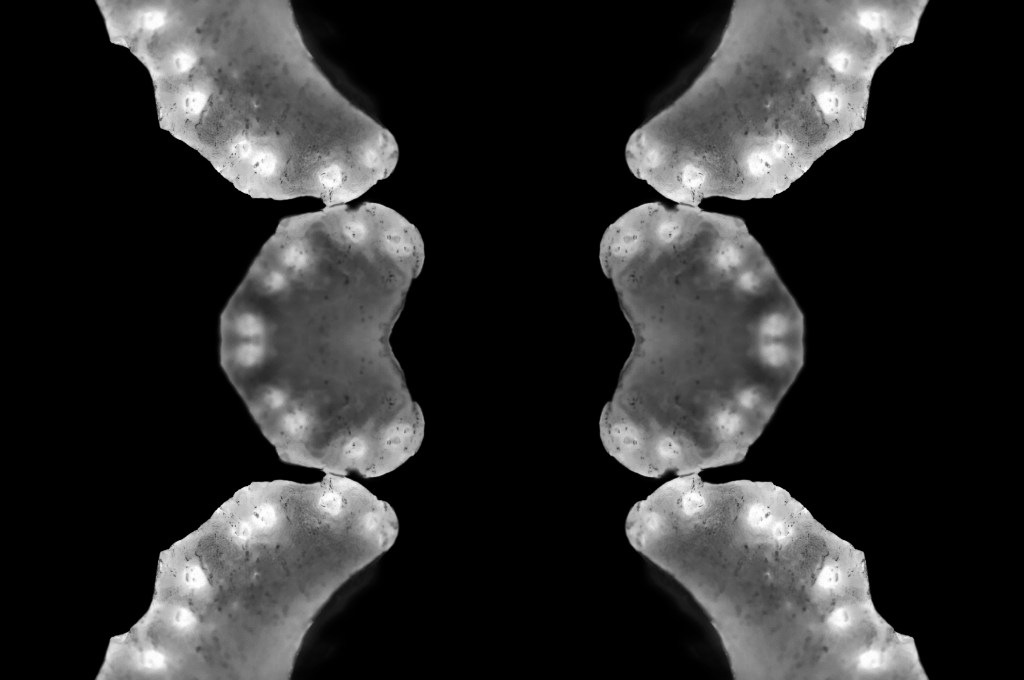
The Scan photographs; (see Fig. 1-4) explore intricate details found within the crops we grow, much like a human bodies veins, muscles and skin. Using an LED light pad and thin slices of various foods to document diversity enhanced the textures and densities within the subject. The shallow depth of field softened some areas within the photos, drawing the eyes towards the heavily textured, contrasted and various forms provided by the subject. Creating mirror images from the individual shots exhibited an eerie, human-like set of photos that reflect the ghostly results MRI scans can reproduce. Presenting them as separate prints allow the audience to explore each image in-depth, one by one, rather than a collective that can distract the eyes and overwhelm them with too much information all at once.
As the Course Guide for assessment of Photography units (OCA, 2021) suggests, we must acknowledge the learning outcomes listed for our unit. We must also provide evidence of our understanding of these by selecting 2-3 learning log entries for each LO; choose and submit three assignment outcomes, submit any critical reviews/essays and evaluate the unit as a whole.
The learning outcomes for PH4EYV – Photography 1: Expressing Your Vision are as follows:
LO1 – demonstrate an understanding of photographic techniques and image making.
LO2 – present a selected body of photographic work.
LO3 – develop and communicate your ideas as a photographer.
LO4 – demonstrate a critical and contextual understanding of photography and reflect on your own learning.
Learning outcome 1: ‘Understanding photographic techniques and image making’.
The use of lines in photography can either add depth to an image or flatten the pictorial space depending on how you implement them within your work.
Exercise 1.3 Line helped me appreciate the importance of leading lines and how they can draw the eyes around or through the images you take, enhancing the overall experience of photographic viewing and compositional strength.
Focal lengths can heavily influence the result of your images, dependent on how long or short it is set to, as well as your physical distance from the subject.
Exercise 2.2 Viewpoint allowed me to see and acknowledge the distorting differences between a long focal length such as 55mm and a far distance from the subject, compared to a short focal length such as 18mm and standing close to the subject who hadn’t moved.
I explored various lighting techniques, camera filters and framing to understand the process of image making. I learnt that black and white photography visually enhance your subjects by capturing heavily contrasting details, while the use of negative space draws attention to the chosen focal point.
This assignment encouraged me to revisit and re-evaluate all my assignments from a critical standpoint to decide upon the strongest one before explaining why.
Languages of light pushed me out of my comfort zone, encouraging me to explore controlled lighting and the possible results if used effectively. Taking inspiration from film negatives and MRI scans allowed me to create a powerful, coherent collection of images to document my understanding of the brief, light sources and develop an idea into a complete assignment.
This exercise helped me acknowledge how the quality, contrast, direction and colour can affect the photograph overall. It was the exercise that aided me in completing assignment four successfully.
The assignment allowed me to develop the slow shutter speed knowledge I learnt from exercise 3.2 Trace and my research on Michael Wesely, a photographer who shot long exposures of fruits and flowers to show the life and death we don’t see with the naked eye. This exercise helped me understand how slow shutter speeds can record traces of time within one image.
This exercise turned out to be a subtle reference to my first assignment, The Square Mile. I visited a local area and took images of subjects that encouraged empathy. The emotional and physical effects of deforestation and urbanisation are shown subtly and directly through the topic or the juxtapositions captured throughout.
Learning outcome 4: ‘Demonstrate critical and contextual understanding of photography and reflect on your own learning’.
Over this unit, I have learnt how to research and understand how practitioner influences can help contextualise the work produced. Practitioner research was something I avoided in my first assignment to prevent being heavily shaped by someone else’s work. Inspiration is critical to explain your work and develop it.
Studying Terry Barrett’s essay and summarising it provided me with the information I needed to contextualise the ‘Homage’ exercise and any other works following that.
By understanding the meaning and technical approaches behind Carol Sharps nature shots, I could explain the contextual type for my work. As well as this, I was able to describe why I chose specific visual techniques and camera settings to portray the delicate nature of flowers and plants. I was also able to discover the context type for an old homage example as well.
Analysing Zinqian Liu’s work, acknowledging her reasoning for combining nature and the human body, learning about instant cameras aided me in contextualising ‘Photography is simple’ and the complexity of both the human body and camera. This assignment pushed me to be more critical about image selection and presentation, acknowledging the importance of editing as a photographer.
Sato Shintaro and Rut Blees Luxembergs night photography provided context for this exercise by investigating the influence light can have on photography’s overall mood and details. Looking at images from a critical point helped me further understand the technical and visual impacts lighting has within photography.
In this post I – Included the exercise brief to re-visit Henri Cartier-Bresson’s photograph Behind the Gare Saint-Lazare (1982) – Before inserting the image and explaining the point within the image I felt was the most signification and why. – Referenced one of my own images to give context to the use of a focal point and the rule of thirds. – Included a short reflection on the importance of understanding the pivotal points within a piece of art.
Brief:
‘If photography is an event then looking at photography should also be an event. Look again at Henri Cartier-Bresson’s photograph Behind the Gare Saint-Lazare in Part Three. (If you can get to the Victoria & Albert Museum in London you can see an original print on permanent display in the Photography Gallery.) Is there a single element in the image that you could say is the pivotal ‘point’ to which the eye returns again and again? What information does this ‘point’ contain? Remember that a point is not a shape. It may be a place, or even a ‘discontinuity’ – a gap. The most important thing though is not to try to guess the ‘right answer’ but to make a creative response, to articulate your ‘personal voice’.
Include a short response to Behind the Gare Saint-Lazare in your learning log. You can be as imaginative as you like. In order to contextualise your discussion, you might want to include one or two of your own shots, and you may wish to refer to Rinko Kawauchi’s photograph mentioned above or the Theatres series by Hiroshi Sugimoto discussed in Part Three. Write about 300 words.‘ (Bloomfield, 2018).
Behind the Gare Saint-Lazare re-visit:
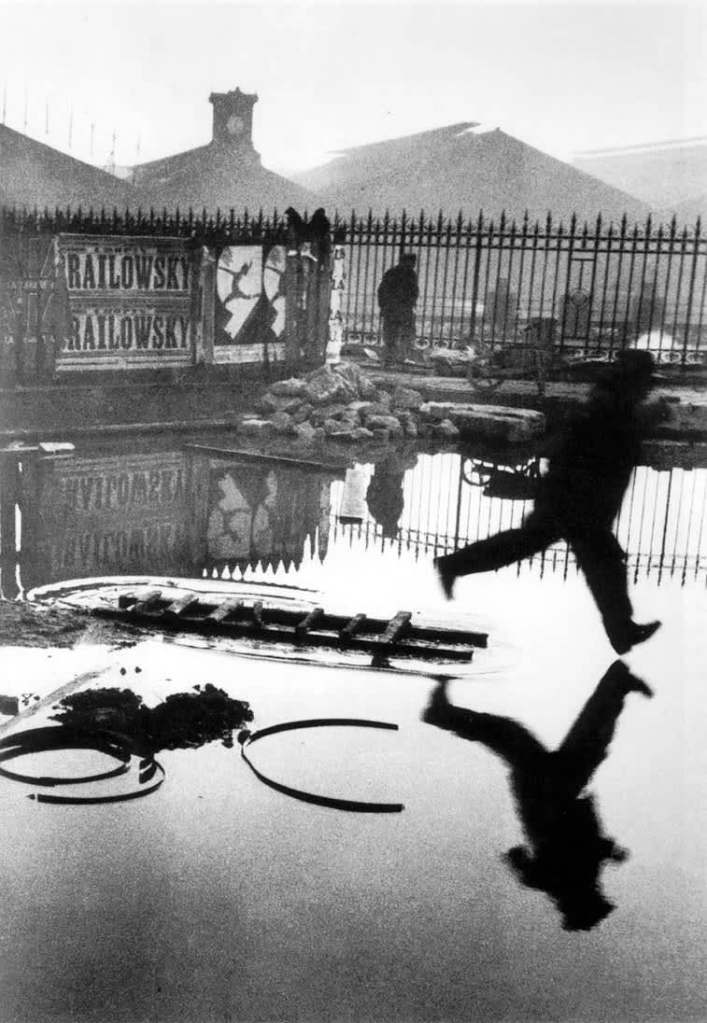
Fig. 1. Behind the Gare Saint-Lazare (1982)
Behind the Gare Saint-Lazare is extraordinary as Cartier-Bresson shot it through a small gap in the wall, unaware of the activity going on behind it. The pivotal point for this shot is the movement. Despite the composition being full of details, textures and shapes becoming a playground for the viewer to explore, the eyes are always drawn back to the blur within the shot. It stands out from the rest, a frozen backdrop in black and white while the mysterious shape to the right flies through the frame.
You are made aware of the direction of movement and the travel speed without being there in the moment. It’s an image that tells its own story, a moment of urgency on a wet day as they jumped over or through the puddles below. You want to know where they are going, why they are running and if something exciting or disastrous happened outside the frame.
The tonal balance within this picture is mixed, with the majority of them being light greys and white. Meanwhile, the silhouette and items nearby are heavily contrasted, making it difficult to ignore.
There is life within the frame, a definitive moment that took place and was unique in photographic execution. Not many images can document a piece of history intriguing enough for the audience to stay and observe it for a length of time over and over. While there may not be a clear leading line, there is an obvious focal point pushing the eyes to look and appreciate it whether they want to or not. It’s so powerful.
An example of drawing the eyes towards a particular point without a leading line features in one of my product images (see Fig. 1) through the use of the rule of thirds.
Fig. 2. Sloth (2021)
Reflection
Re-visiting an image can help you appreciate the piece of work, especially if you have more knowledge to hand. Understanding what ‘makes’ an image and shapes it, encouraging the viewer to look deeper and sit with the art for longer solidifies the importance of composition, balance and intent.
– Included the research point brief and my response to it by referencing the text throughout.
– Inserted the exercise brief for ‘Homage’.
– Wrote a short paragraph about Carol Sharp and how she connects with her subjects while photographing
– Before comparing one of her images with my own as a homage
– Alongside a brief analysis of my response and the context
– Inserted a couple of extra images to show how I paid homage to Sharp’s work
– Included a past image from my archive, with a short analysis of the message and context behind it
– Before reflecting on what this exercise taught me
Research
‘For a short introduction to how context operates in relation to photographs, read Terry Barrett’sessay ‘Photographs and Context’:terrybarrettosu.com/wp-content/uploads/2017/08/B_PhotAndCont_97.pdf[accessed 25/01/18].Barrett suggests that we interpret pictures according to three different types of information:information in the picture, information surrounding the picture and information about the waythe picture was made. He calls these the internal context, the external context and the originalcontext‘ (Bloomfield, 2018).
Images can be incredibly flexible in terms of context, based on the environment, the subjects within the frame, the colours or lack thereof. However, the context of a photograph can alter depending on whom it reaches. For example, in Terry Barrett’s Photographs and Contexts (Barrett, 1985) a photograph of a pair sat outside a bar taken by Robert Doisneau was given different contexts; to Gisele Freund’s knowledge, up to five times by various magazines, brochures and galleries. A few examples of this consist of accusations of sex work, alcohol abuse and seduction (Barrett, 1985).
The initial context behind Doisneau’s shot was simply a moment of charm as he enjoyed cafe’s and seeing the couple together was enjoyable.
‘Texts that surround the photograph eliminate any residual ambiguity’ (Barrett, 1985). If we were to put a picture of a beef burger on the front of a vegan magazine, it would probably cause some shock before going on to talk about the environmental effects and immoral behaviour of the industry, however, on the front of a restaurant menu, people would be enticed and seduced by how good it looked.
Images are used for other things, different to their initial intent. Pictures of lungs on a cigarette packet are used to encourage smokers to stop smoking before too much damage occurs but are initially used for scientific and medical research.
The placement of an image is another factor to consider for context. The display of a picture of people in poverty may glorify the situation for the benefit of art and a famous gallery rather than portraying the horrific effect on lives in a place you would expect to see such circumstances.
No matter where you are in the world or what language you speak, photography can be a source of communication for some people (Sander, 1978 referenced in Barrett, 1985:114), whether an artist is documenting their mental state or an audience expressing feeling by sending a photographic meme. Despite the global interaction with these photographs, they may not provide the same message to one person in the way it did to another. Context is still subjective depending on the viewer.
Internal context includes the image, title, date and maker. External context would be the presentational environment, so where it’s displayed. The original context is the ‘causal environment’, in other terms, the physical and psychological elements available to the photographer at the time of capture (Barrett, 1985).
To understand the context as an audience, we need to look deeper and consider everything, including what the photographer may have been doing or thinking at the time. These things combined will help us appreciate the make-up of the image a lot more.
Brief:
‘Select an image by any photographer of your choice and take a photograph in responseto it. You can respond in any way you like to the whole image or to just a part of it, but youmust make explicit in your notes what it is that you’re responding to. Is it a stylistic devicesuch as John Davies’ high viewpoint, or Chris Steele Perkins’ juxtapositions? Is it an idea,such as the decisive moment? Is it an approach, such as intention – creating a fully authoredimage rather than discovering the world through the viewfinder?Add the original photograph together with your response to your learning log. Which of thethree types of information discussed by Barrett provides the context in this case? Take yourtime over writing your response because you’ll submit the relevant part of your learning logas part of Assignment Five.‘ (Bloomfield, 2018).
Carol Sharp
“Carol Sharp is an award winning photographer and fine artist, renowned for her lyrical composition, attention to detail and her delicate touch with light.” (Carol Sharp, n.d.)
Sharp is UK based photographer who has over 20+ years of professional photographic experience, has featured in Chelsea Flower Show posters in the past. Her exploration of the world and its plants is a way to encourage society to reconnect with nature and empathise with it.
“I use different types of perception to not only see their form, but to understand the meaning of the form and to reveal its ‘gesture’. which means having a communion with my subjects and a desire to feel their very life force.” (Sharp, n.d.). Unlike the majority who may pass by a flower or tree without much notice, Sharp truly connects with her subjects to understand them and appreciate them. I think this shines through in her work as the framing is cropped and intimate as shallow depth of field emphasises the soft petals and delicacy of the foliage and flowers in the composition. Vibrant colours bring life to the images, subtly getting the viewer to realise that this life source is living, thriving and a powerful part of our world. Flowers, trees, moss and other forms of plants keep this world functioning, helping us live and grow. It’s important to be grateful for what is around us, something Sharp does very well.
Due to how Sharp talks about her work and the passion for her subjects, I would say that the original context is the most prominent context type in these images. Bearing in mind the importance to the maker, it heavily influences how the viewer sees the subject, making it feel more personal and ripe with life. The images are not just another simple set of shots of a bunch of flora and fauna as time and energy have been taken by the creator to capture the beauty.
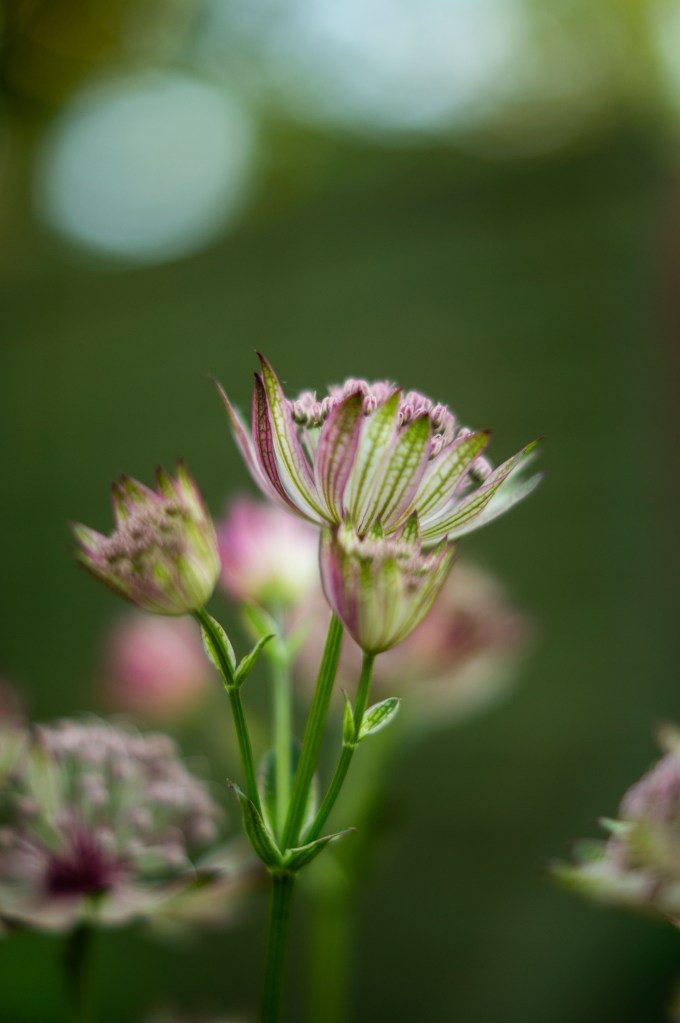
The selection of images I paid homage to for this exercise came from the Plant Portraits (n.d.) album.
My SONY A57 camera was on manual mode, the aperture was at F/1.8, the shutter speed was 1/250 and ISO was set to 100. The shooting process was simple as I took a walk around my garden during dusk, capturing a few of the flowers available to me. The response to this exercise was to keeping original context at the forefront of my mind by analysing the subjects and connecting with them before pressing the shutter. A creamy shallow depth of field and cropped framing were two of the most important visual and technical elements to include during this shoot.
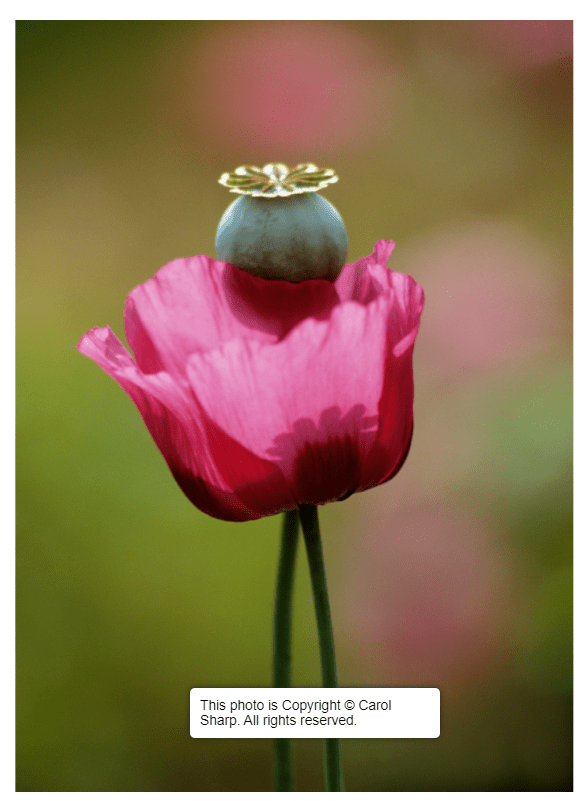
Fig. 1. Plant portraits (n.d.)
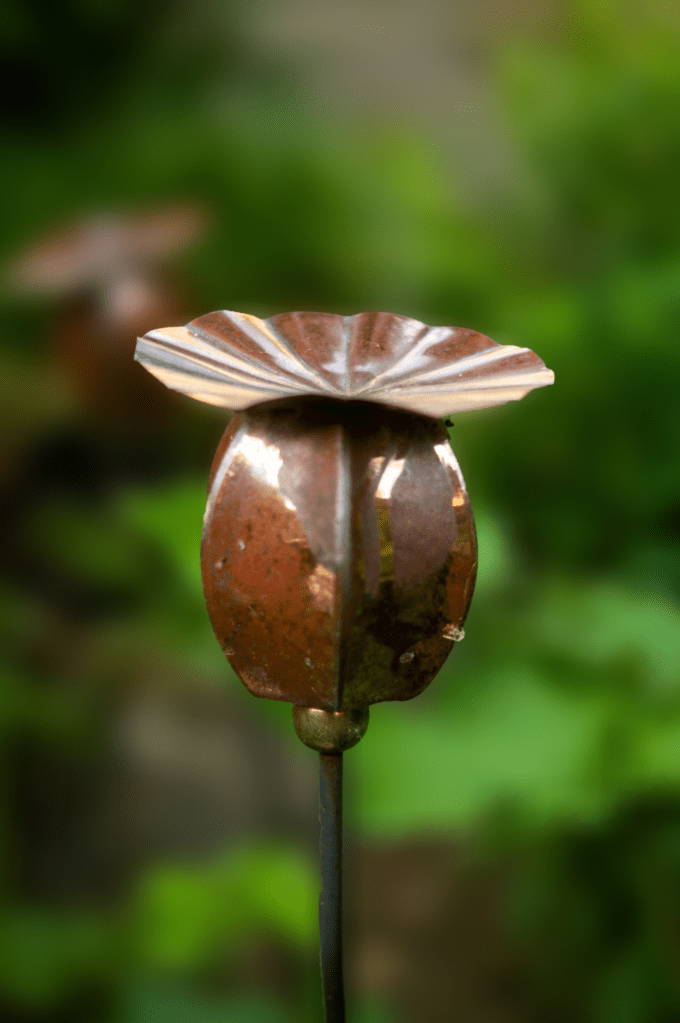
Fig. 2. Homage 3 (2021)
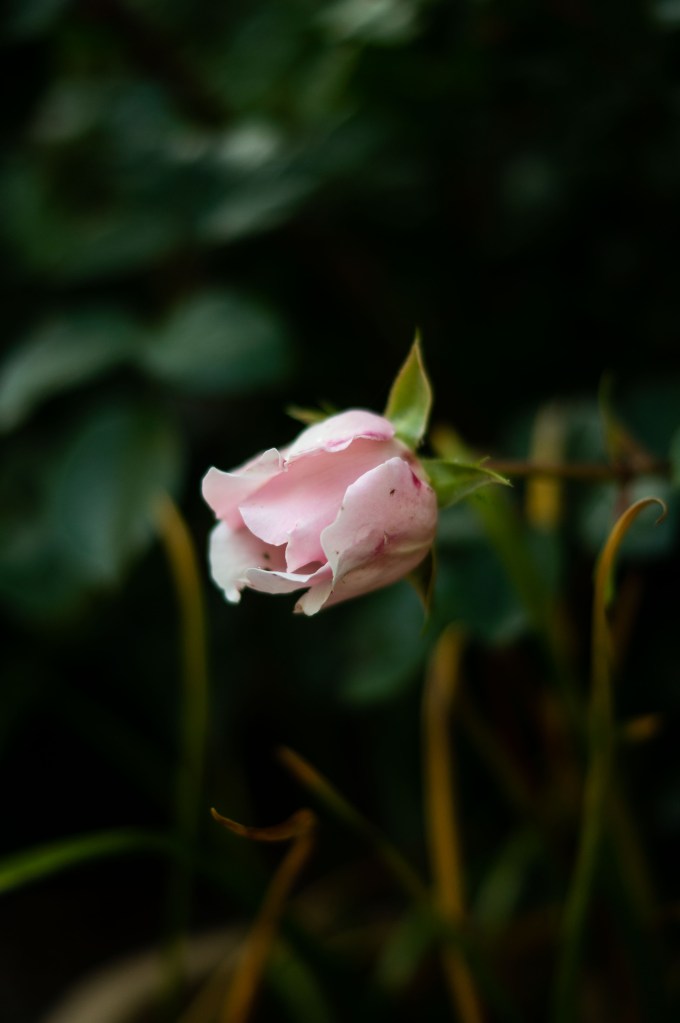
Homage 3 (see Fig. 2) referenced the feature of a poppy seed head in Sharp’s image (see Fig. 1.) by capturing the metal sculpture in my garden, a permanent piece of art, unlike an actual poppy. Using an aperture of F/1.8 enabled me to get the creamy bokeh effect that flows throughout Sharp’s work so beautifully; focal points draw the eyes of the audience to the subject, all of its details, the textures and colours. Cropping the frame brings the object closer to the camera lens, allowing the viewer to observe it more intimately and connect with what is going on within the composition. Contextually, this metal poppy head was a gift to my dad from my mum for his birthday, so holds a deeper meaning for me, much like Sharp attaches to her subjects to appreciate it more. The colours within Plant portraits are vibrant, warm and full of life, while tones within my homage are earthy, so despite it being artificial, the subtle connection to nature and its rich soil is a clever addition to my piece. From a conceptual point of view, the relationship between the two shots juxtaposes despite a few similarities. Sharp embraces the life and death of plants, reconnecting to their importance for our survival as living beings. On the other hand, I have captured a replica of a pollinating plant that will never pollinate, an unintentional parody of how humans keep making things that do not benefit the world environmentally.
Original context brings more personality to photographs as you understand why it was taken, how it made the creator feel, what was going on at the time and the image that was achieved as a result. It pushes the audience to explore it to understand it as a whole composition rather than a simple picture. The work I shot may be unoriginal visually, but the extra level of information lifts it and makes it a rich piece of art.
The internal and external context is just as important but feels less characteristic for some artworks in my opinion as it allows the viewer to come up with their own story as to what the photograph contains and what it may be portraying. Some photographs need that extra bit of information to steer the observer in the right direction.
Here are a few other images I took for this exercise:
Fig. 3. Homage 1 (2021)
Fig. 4. Homage 5 (2021)
Homage example from past archive:
Fig. 5. Draw this in your style (2019)
Fig. 6. Rose (2019)
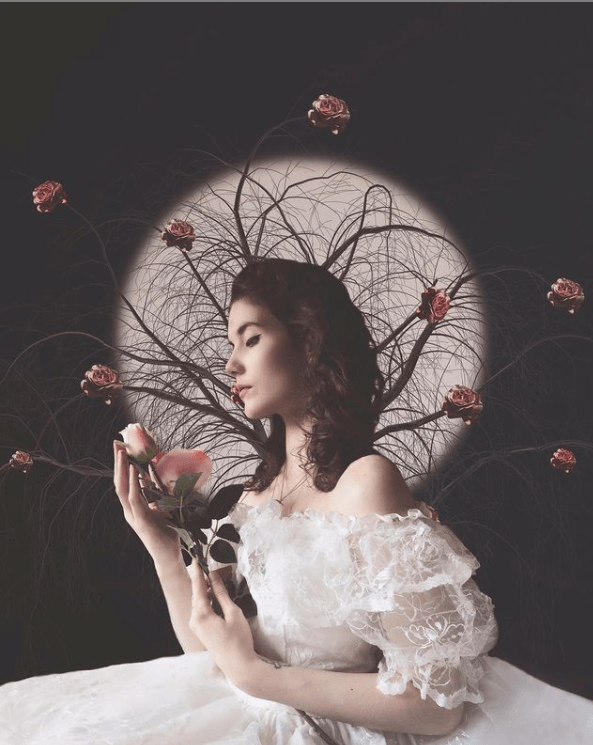
While this isn’t a homage inspired by a photographer, it was an image I created as a tribute to the Draw this in your style (2019) drawing by Ellie Goldwine on Instagram. My response to this piece was approached with intent, having complete control over the props used, outfits and makeup worn, as well as the background, pose and editing. It became a reversed image of the original piece (see Fig. 5), the dress chosen for my composition (see Fig. 6) was the opposite colour creating a juxtaposition between the two. Rather than red roses, light pink roses were used and the circular framing around the drawing in my piece represented the full moon. Everything about the photograph I created was intentional, as the brief was to create something in your style from the reference given.
The context for this piece was internal, as it was inspired by the Draw in your style title and image. Without this information, I may not have been encouraged to replicate it at all.
Reflection
This research point and exercise helped me understand the importance of context, the different types and how the portrayal of images original intent can be influenced. An images original message can be changed through the way it is displayed, the environment in which it’s found, the title and other such information. The original context is a type that features heavily in my work when given the chance, as personality and background mean a lot to me when it comes to creating a piece of work.
Figure. 2. Powell, L. (2021) Homage 3 [image] In possession of: Lauren Powell: Eastleigh.
Figure. 3. Powell, L. (2021) Homage 1 [image] In possession of: Lauren Powell: Eastleigh.
Figure. 4. Powell, L. (2021) Homage 5 [image] In possession of: Lauren Powell: Eastleigh.
Figure. 5. Elliegoldwine. (2019) Draw this in your own style [Instagram, screenshot] Available at: https://www.instagram.com/elliegoldwine/ [Accessed 13 June 2021].
Figure. 6. Powell, L. (2019) Rose [image] In possession of: Lauren Powell: Eastleigh.
– Shared my camera settings and technical information
– Before providing the contact sheets for my shoot
– Inserted 6 of my favourite shots from the set and explained why through analysis
– Chose my ‘select’, analysed the image
– Before discussing why I chose it as the strongest image, the unintentional and conceptual elements discovered
Brief:
Use your camera as a measuring device. This doesn’t refer to the distance scale on the focusring. Rather, find a subject that you have an empathy with and take a sequence of shots to‘explore the distance between you’. Add the sequence to your learning log, indicating whichis your ‘select’ – your best shot.When you review the set to decide upon a ‘select’, don’t evaluate the shots just according tothe idea you had when you took the photographs; instead evaluate it by what you discoverwithin the frame (you’ve already done this in Exercise 1.4). In other words, be open to theunexpected. In conversation with the author, the photographer Alexia Clorinda expressedthis idea in the following way. Look critically at the work you did by including what you didn’t mean to do. Include the mistake,or your unconscious, or whatever you want to call it, and analyse it not from the point of view ofyour intention, but because it is there. (Bloomfield, 2018)
Initial plans
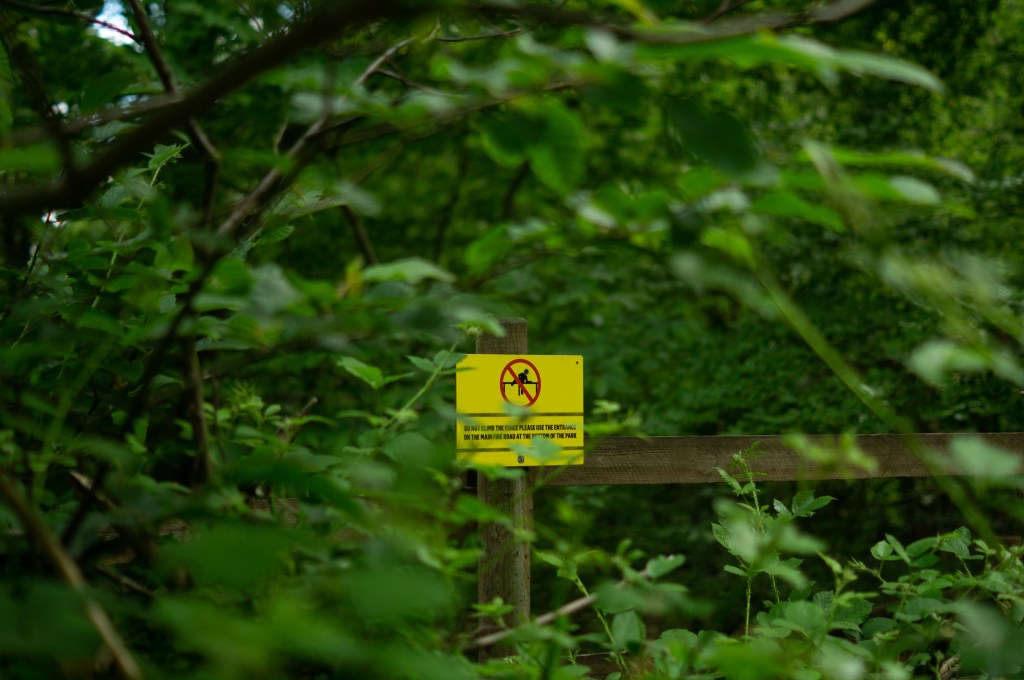
I didn’t want to give too much thought about what to take images of to give myself a challenge; instead, I read the brief and decided to pick the first subject that came to mind in terms of empathy. As a result, the deforestation and increase of littering within my local woodland popped up first.
Growing up next to woodland is something to be grateful for as nature is right on your doorstep and isn’t something everyone has the privilege of having. Unfortunately, I’ve watched this beautiful area be the victim of mass deforestation and urbanisation to allow room for more homes. Building on land to cover the rise in population isn’t so much the problem, but the littering, lack of care taken after trees and foliage removable are.
It’s not satisfying to go on a nature walk, to find metal barriers up that are yet to move, piles of logs and leftover branches scattered around the place with signs and ripped tape on the floor. Seeing all the changes happen and watching it decline since childhood makes me feel empathetic toward the animals that live within those woods, the insects, trees and the pedestrians who want to observe this place.
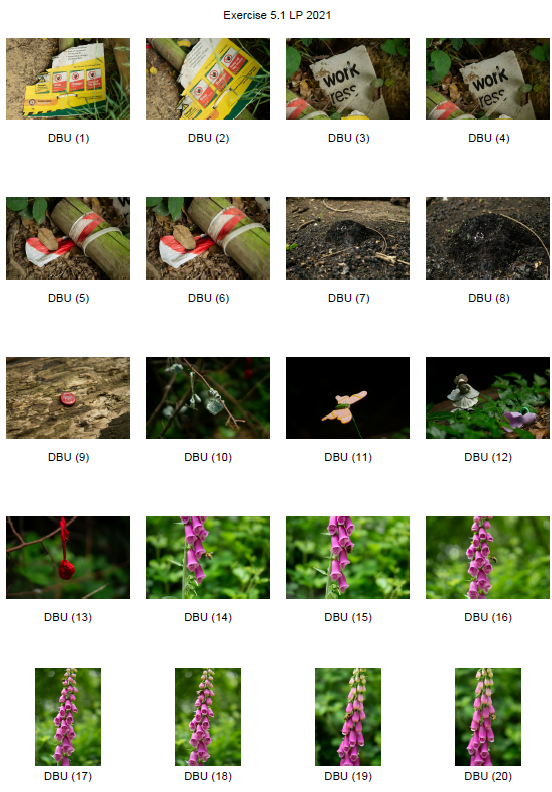
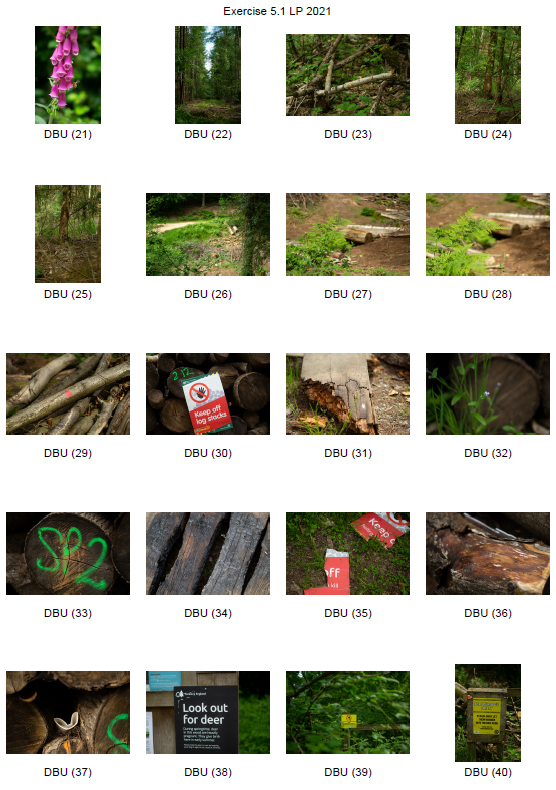
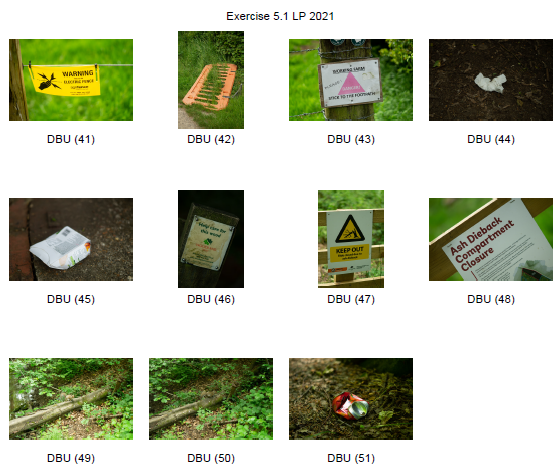
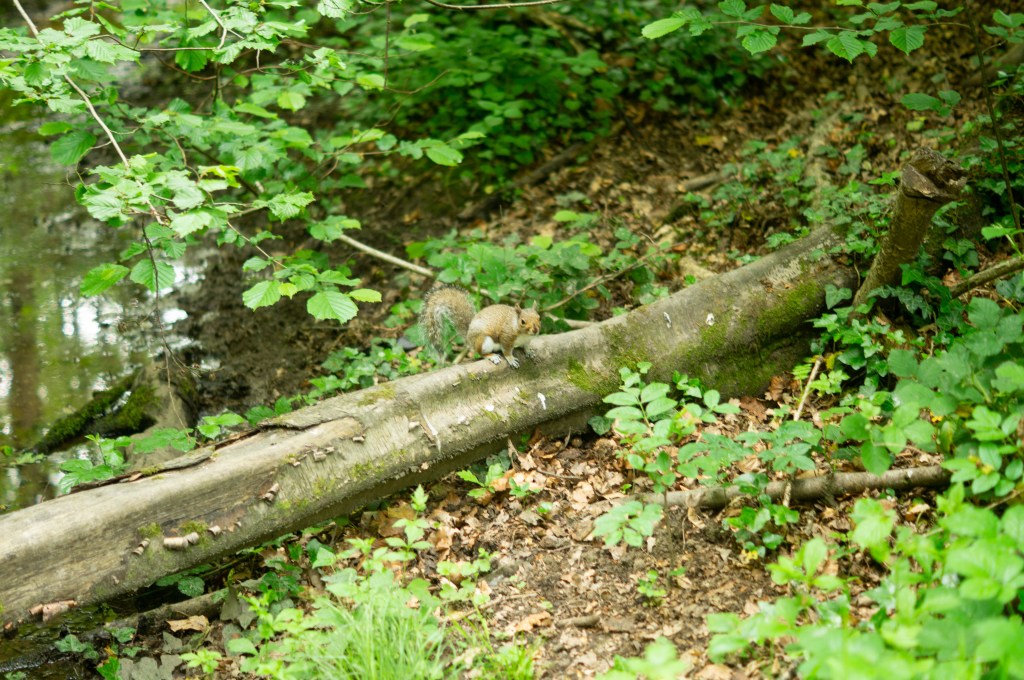
I used my SONY A57, set my aperture to F/2.8, the focus and camera settings to manual before heading out on a walk around the woods. Not knowing what I was going to find made this exercise more challenging as I wasn’t sure whether there would be enough around to gather a substantial amount of images to choose from, although, wasn’t the case as seen below in my contact sheets.
Contact sheets
Fig. 1. Contact sheet 1 (2021)
Fig. 2. Contact sheet 2 (2021)
Fig. 3. Contact sheet 3 (2021)
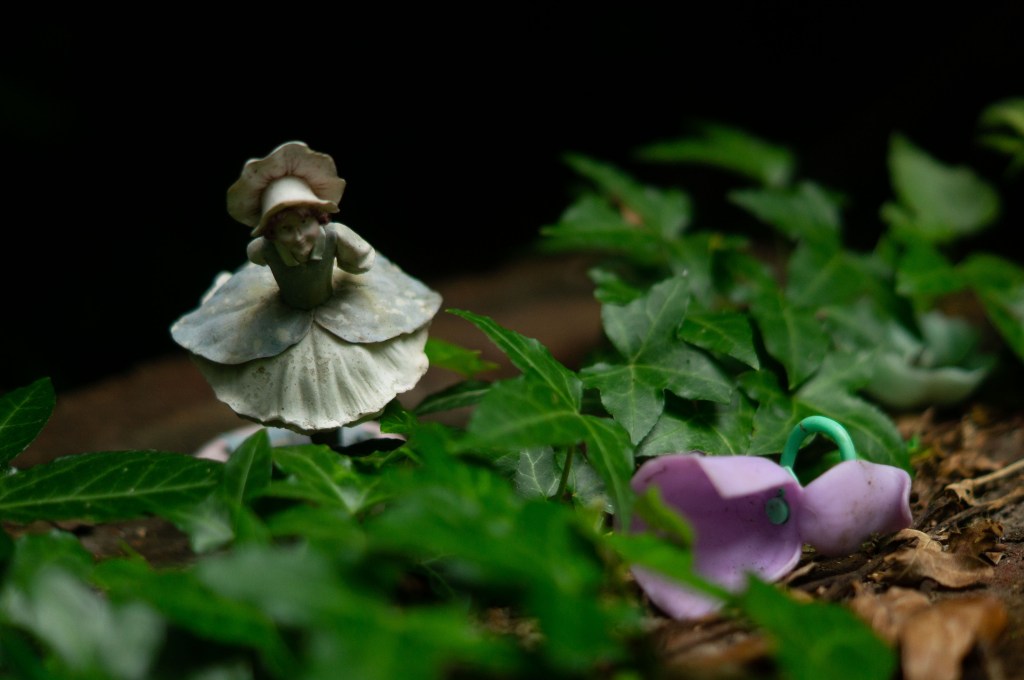
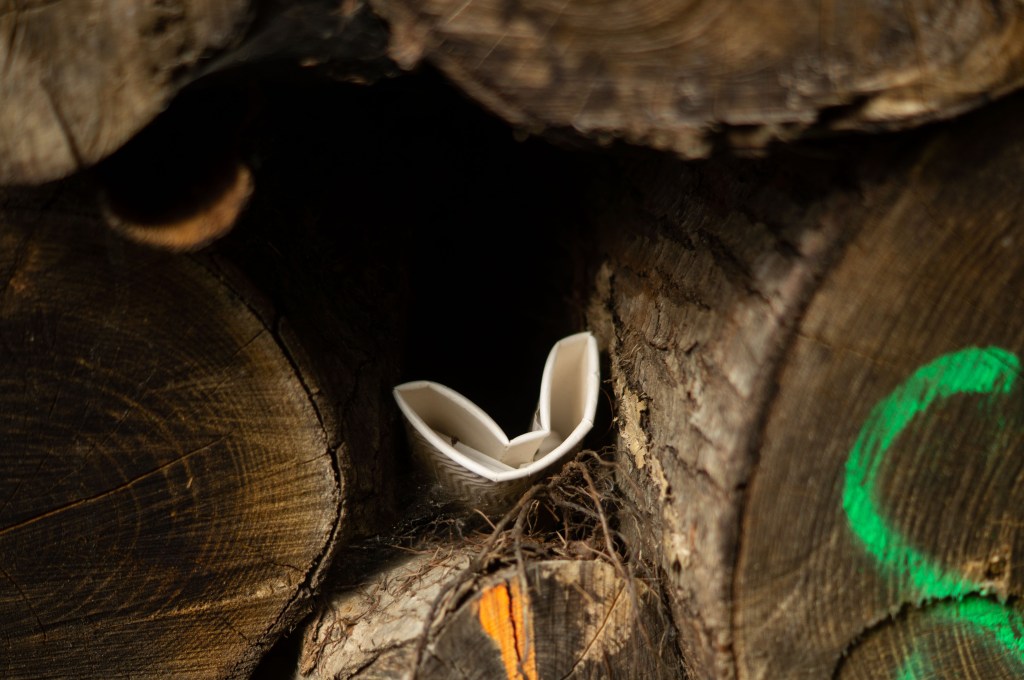
A selection of favourite images:
Fig. 4. DBU 4 (2021)
Fig. 5. DBU 12 (2021)
Fig. 6. DBU34 (2021)
Fig. 7. DBU 37 (2021)
Fig. 8. DBU 39 (2021)
Fig. 9. DBU 49 (2021)
The selection of the six images above is visually strong, well framed and clearly show where the focal points are. Earthy tones perfectly reflect the life and death of nature, rich soil and crisp green foliage. Tonal differences throughout the compositions provide a steady balance between the dark shadowy areas, well lit vibrant sections and shapes that supply a contrast between the organic and more structural man-made subjects featured. Using natural overcast light allowed me to capture diffused shadows and highlights that made the shallow depth of field creamer and smooth, complimenting the fragility of the nature I was documenting. Contextually and conceptually, they present the various elements found within our woodland, from rubbish, to work signs, animals navigating through their home despite it. It may encourage the viewer to think about our effect on the area we live in, how people treat it and the results of these actions. The juxtaposition between nature and man-made objects or situations is jarring as it doesn’t belong and evokes a powerful reaction.
My final ‘select’:
Fig. 10. DBU 16 (2021)
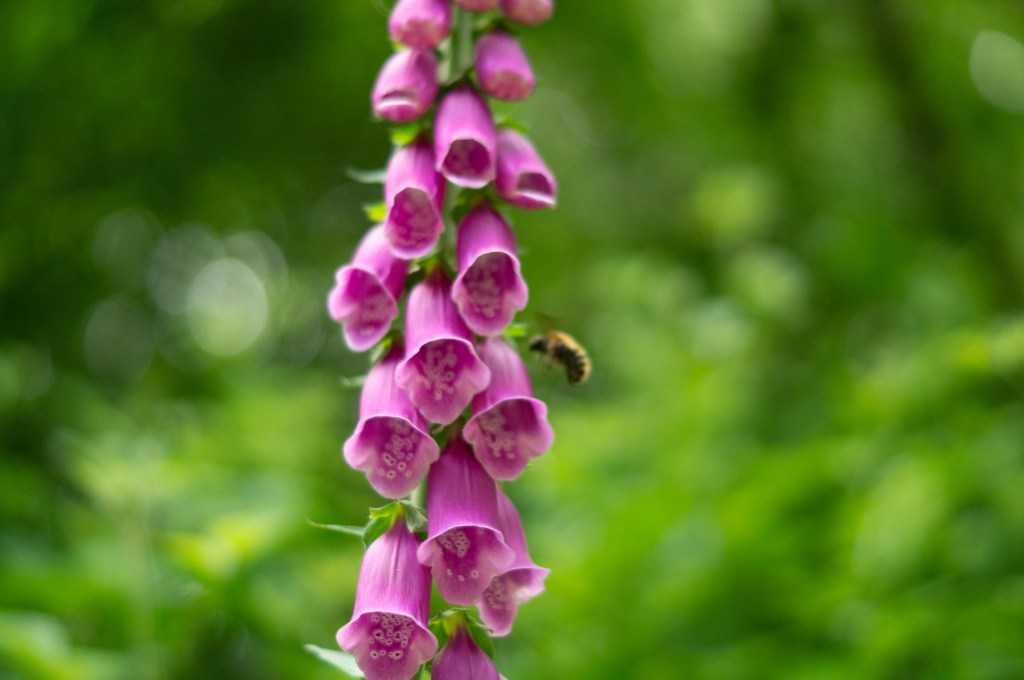
While that collection of photographs were powerful contenders for my ‘select’ and final image, the shot that spoke the most to me was DBU 16 (see Fig. 10). This picture surprised me the most, as it doesn’t necessarily present the idea of deforestation and the massive effect on nature at first glance. Unlike the other compositions, there aren’t any man-made subjects within the frame indicating building work, littering or burnt wood and foliage. Tonally it is balanced, as the shadows and highlights are soft rather than heavily contrasted, while the colours are vibrant and pleasant to look at. Everything about this shot is organic, fresh and full of life, soft due to the natural light and shallow depth of field; a complete juxtaposition to the darker, grittier photographs of old cups, spray-painted trees and plastic items. However, conceptually it still connects with my initial idea of capturing the woodland and its effects on nature and humans etcetera.
When I saw the foxglove growing in between the grass down a thin, closed off path, I was inclined to capture it even though I felt it didn’t ‘fit’ the aesthetic or context behind this exercise. This flower was in the most secluded area, away from the set path, in the middle of trees and tufts of long grass. Despite the destruction and interactions that have taken place in the area, this piece of nature has thrived. Its petals were vibrant, silky and undamaged, while leaves from the trees behind were crisp, fresh and thriving. Initially, I just thought I was taking a pretty picture, quite a simple shot which some may call a ‘postcard shot’, but when I looked at it closely there was a bee in the background. Nature continues to live on no matter what we’re doing, doing its job, much like the bumblebee in this shot. It wasn’t intentional to have a bee in the frame as the focal point was on the foxglove but it’s added an extra layer to the composition as a whole. Without bees and other insects, we wouldn’t have flowers, trees and a healthy abundance of nature to help us survive. The fact that its wings blurred despite the fast shutter speed and its convenient placement within the shallow depth of field in the background feels like a clever reference to the decrease in bees and the danger they face due to the lack of plants that allow them to pollinate. If the bee was further back we would barely see it; it would disappear in the blur.
The distance between humans and nature isn’t far at all, we need it more than we think.
Reflection:
This exercise was interesting as it lightly linked back to assignment 1, where I revisited important places from childhood to see how they had changed. My final image wasn’t one I was expecting to choose, purely because of the initial plan to explore the destruction and man-made influences within the local woodland. Giving myself a challenge by picking the first idea that came to mind made me focus more on the location which is what photography is all about. It was a risk, but it worked.
The distance between us has taught me that photographs may look simple, plain and just become another pretty picture, but if you take a deeper look you may find something you weren’t anticipating. When selecting images, it’s important to choose those that are compelling even if it’s not one of your favourites to start with. In future, I will be more flexible when it comes to picking a final set and presentation.
– Provided the brief for this exercise, – As well as writing a short research point about Ernst Haas and his photograph Geranium, USA 1961. – Inserted a screenshot from google, having searched “Green leaves” as my subject, – Before explaining my shoot plan in brief, along with camera settings. – My contact sheets for this exercise are attached to show a variety of shots, – But only one final image was chosen and analysed in further detail. – A short reflection at the end explains how this exercise has confirmed to me that each image is different and unique, regardless of subject.
Brief
‘Make a Google Images search for ‘landscape’, ‘portrait’, or any ordinary subject such as ‘apple’ or ‘sunset’. Add a screengrab of a representative page to your learning log and note down the similarities you find between the images. Now take a number of your own photographs of the same subject, paying special attention to the ‘Creativity’ criteria at the end of Part One. You might like to make the subject appear ‘incidental’, for instance by using focus or framing. Or you might begin with the observation of Ernst Haas, or the ‘camera vision’ of Bill Brandt. Or if you’re feeling bold you might forget about your camera completely and think about the tricky question of originality in a different way – http://penelopeumbrico.net/index.php/project/suns/ Add a final image to your learning log, together with a selection of preparatory shots. In your notes describe how your photograph or representation differs from your Google Images source images of the same subject‘ (Bloomfield, 2018:96).
Research:
Ernst Haas (1921 – 1986)
Ernst Haas was a well known European photographer, born in Vienna, Austria; mostly celebrated for his involvement in colour photography and his work documenting the Austrian prisoners of war returning home. Haas moved to the United States in his 30’s where he began exploring Kodachrome Colour Film, in turn, making him one of the first to have a colour photo feature in LIFE magazine (Ernst Haas Estate, 2018). A few years later, his work was exhibited in New York’s MoMA and again was one of the first colour photography exhibitions.
The Ernst Haas Estate website has a wide range of Haas’ photographic works from across the years, exploring both his B&W pieces, portraiture, coloured compositions using multiple techniques and subjects such as flora, rubbish, people and architectural elements.
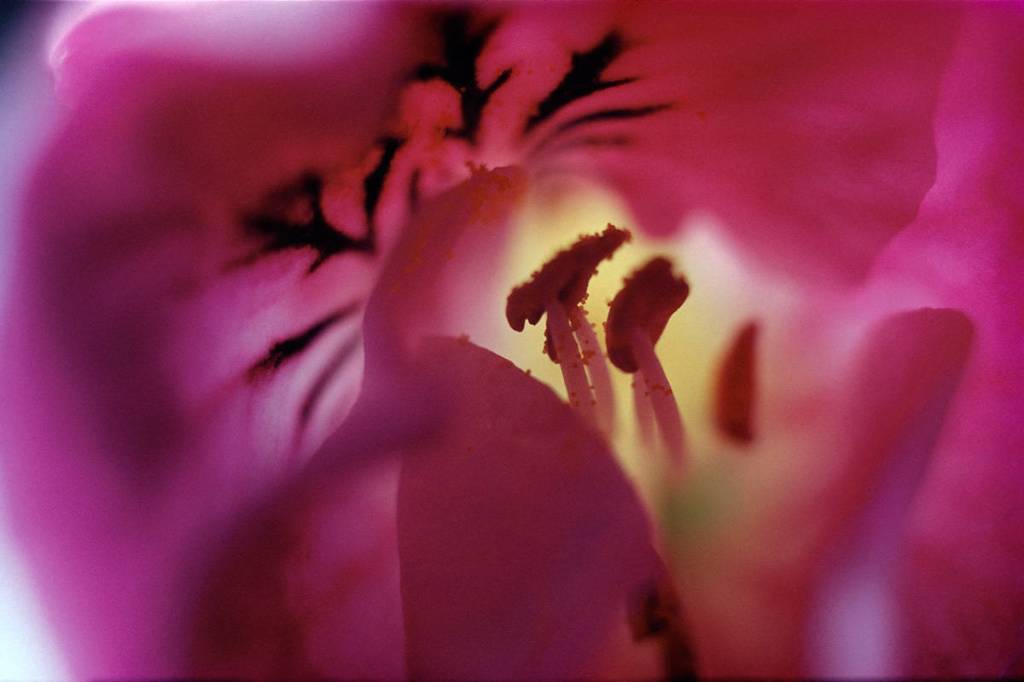
Haas’ New Color Collection: Creation (1959-85) is more neutral in its colour palette, enhancing the earthy colours within the earth’s desert locations and the animals that inhabit them, whereas his Classic Color Collection: Creation (1960-81) is vibrant, full of flora, snow and water. Geranium, USA 1961 (see fig.1) is one of my favourites from the Classic Color Creation collection, as the use of what seems to be a macro lens, captures the minute vein details within the flower petals, the ‘hairs’ of the stamen as it’s surrounded by a warm yellow glow in amongst a sea of pinks.
Shallow depth of field allows the subject that isn’t in the frame to be out of focus and soft, in this case, enhancing the delicate nature of the flower petals and how silky they feel to the touch. Haas captures his subjects in a more detailed and intimate way, rather than shooting them from a distance to get the whole object in the frame. This helps us understand the beauty of nature much more and gives us the ability to explore what some of us may not have taken the time to examine.
Fig. 1. Geranium, USA (1961)
Shoot plan:
Fig. 2. Green Leaves (2021)
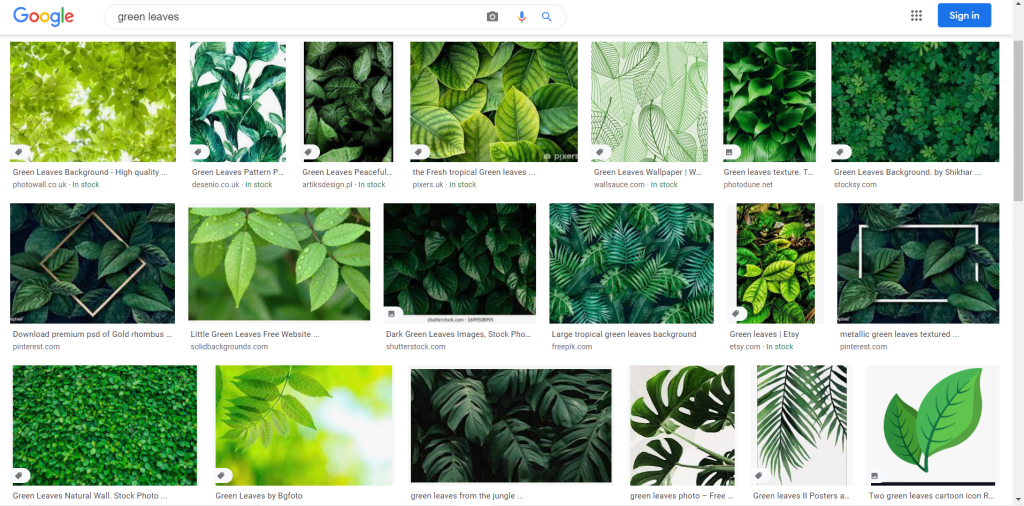
For this exercise, I googled “Green Leaves” (see Fig. 2) to see the variety of images that would come up and how I could explore this subject in my photography. Thankfully there was enough of a range that I could take inspiration and look around my garden to see what I could find in correlation to this search.
My SONY A57 was on manual mode, as was the Sony DT 50mm F1.8 SAM lens, this was so I could have more control over the focus and shutter speed for the exposure. The ISO was at 100, while the aperture was set to f/1.8 to achieve a shallow depth of field when capturing the leaves in a group or in front of other objects. The exercise was quick and easy as it took place in my garden, but despite the ease it beneficial as well as successful.
Contact Sheet:
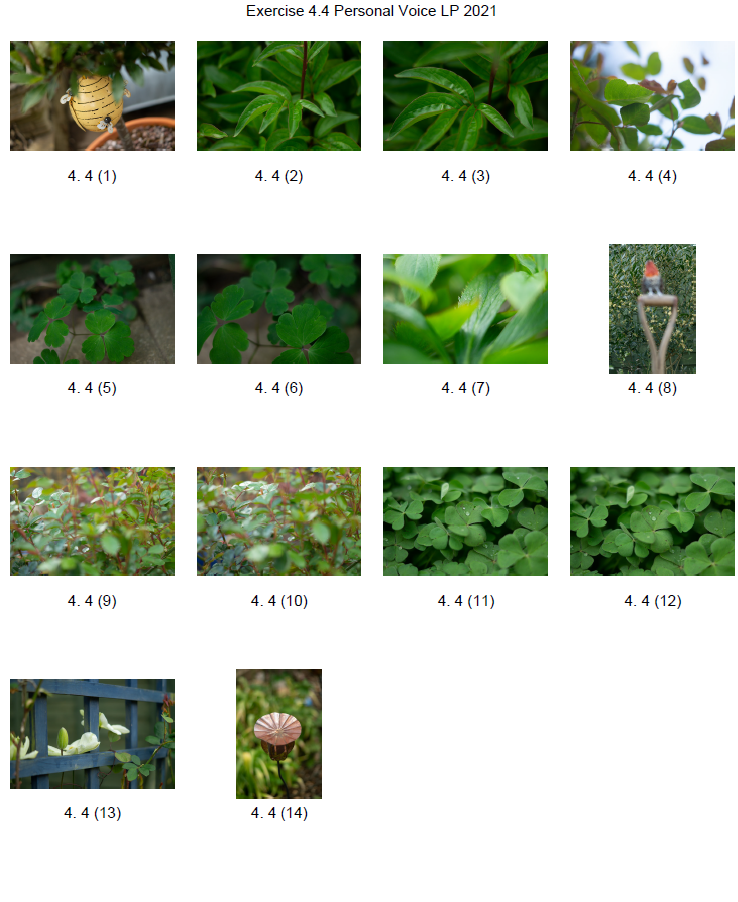
Fig. 3. Contact sheet (2021)
Final image for analysis:
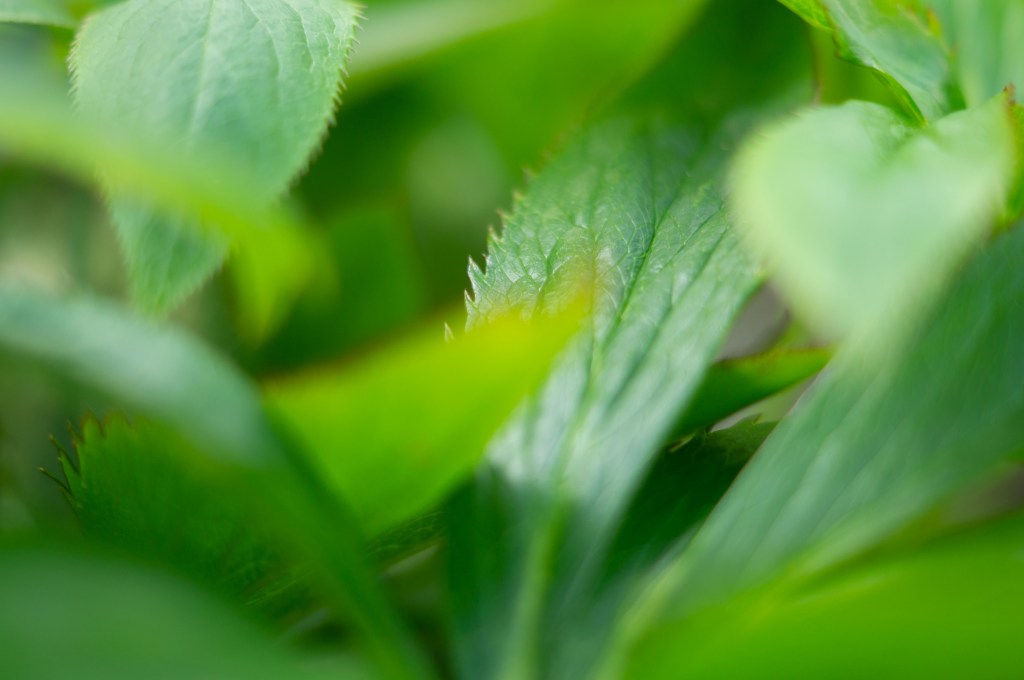
Fig. 4. 4.4 8 (2021)
By observing and looking further into the subject at hand (see fig. 2), I was able to capture the fine, wrinkled veins of the leaves through the shallow depth of field in the foreground. They look similar to the wrinkles we find on the palm of our hands, which go in all sorts of directions, are different depths and shapes. The natural light bounces off of the leaves from the left, giving texture to the image and helping the viewer understand that this is a smooth and shiny leaf, as opposed to a rough, matte leaf. The focal point being in the midframe pushes the eyes to be drawn into the image, rather than the subject being in the foreground and giving the audience a direct path to reach. It’s more like rummaging through the leaves yourself via a photograph, which is a fun concept to me. Shooting this in landscape was a reference to the majority of the images found via google, however, the differences between this composition and the ones in the screenshot make it my own.
None of the images in the screengrab includes the focal point being midframe or behind a group of other leaves, creating a ‘blockage’ in the foreground. The use of shallow depth of field is used, but the subjects are directly in the foreground, creating a blurred background instead. Most of the green leaf shots seen above are darker and more tropical, whereas the exposure for mine is light, airy and a more typical form of leaf you would find in the garden. Lighting in the google searches is usually either coming from behind the leaves or lit from above minus a few exceptions in the middle row. The final image I have chosen feels like an adventure that you feel involved in, to understand the details, whereas the photographs above provide a clear frame of leaves, in focus, detailed and pretty direct.
Reflection:
While images may be the same in terms of subject matter, orientation or colour, it depends on how it is captured that makes the difference. For example, Ernst Haas’ choice to shoot images of flora up close and personal, allows the viewer to understand the parts that make up a flower, rather than the subject as a whole.
Taking the time to observe, explore and look at what you are capturing, brings a whole new depth into the photograph as you connect with it more, you’ve planned it and taken the time to understand the composition more. Every image is unique, no matter whether it’s framed the same way or not, they are taken at different times, by different people, with a variety of equipment, weather changes, life circumstances and so much more. Sometimes you may not even intend to shoot a particular subject, but it makes its way into the frame anyway which is wonderful.
Each photograph is always different and personal to each individual, no matter how many times it’s documented.
– Provided short descriptions for Quality, Contrast, Colour and Direction.
– Described my shoot set up, with camera details,
– And provided the contact sheets for this exercise.
– Chose six final images to analyse briefly,
– Before reflecting on this exercise, what it taught me and what I could’ve explored more.
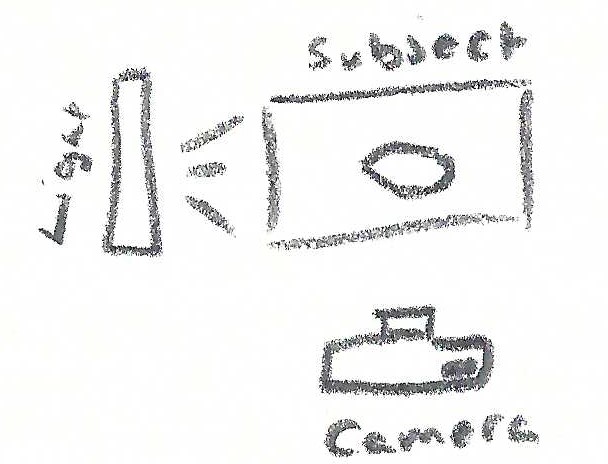
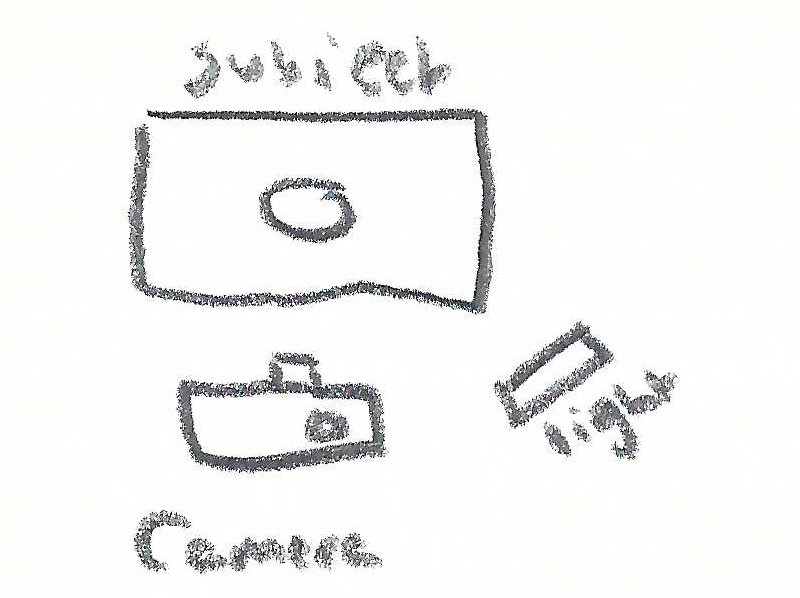
‘Use a combination of quality, contrast, direction and colour to light an object in order toreveal its form. For this exercise, we recommend that you choose a natural or organic objectsuch as an egg or stone rather than a man-made object. Man-made or cultural artefactscan be fascinating to light but they’re already authored to some degree, which requiresinterpretation by the photographer; this exercise is just about controlling the light to revealform.Add the sequence to your learning log. Draw a simple lighting diagram for each of yourshots showing the position of the camera, the subject and the direction of the key light andfill. Don’t labour the diagrams; quick sketches with notes will be just as useful as perfectgraphics‘ (Bloomfield, 2018:91).
Unlike the previous exercises where the light was found, observed and uncontrollable, this exercise explores studio lighting and the photographer’s ability to control the lighting that falls on the subject in the frame.
There is a brief description in the coursebook explaining what quality, contrast, direction and colour is, along with the possible effects on the image and subjects themselves.
The quality of light is determined by how it looks when it falls, for example, soft shadows are caused by a diffused light, whereas harsher, more defined shadows are due to hard light like direct sunlight at midday.
Contrast is controllable by a fill light, which can either be another light source or a reflector of some kind like a whiteboard. The ratio between highlights and shadows is measured to determine the contrast ‘if you measure the shadows at f5.6 and the highlights at f8 you have a ratio of 1:2, which means that the fill light is half the intensity of the main light’ (Bloomfield, 2018).
The direction of light can alter an image dependent on the distance and the angle. If the light is placed directly in front, the subject will be significantly flatter than being lit from below or the side. As a result, harsher shadows enhancing the shapes and textures within the frame would occur.
Colour can be significant within photography to give context to the composition or encourage a specific mood and emotion to come through. Lighting filters can cover the lights to colour the background, or ‘by light bounced from a coloured reflector’ (Bloomfield, 2018).
Shoot set up:
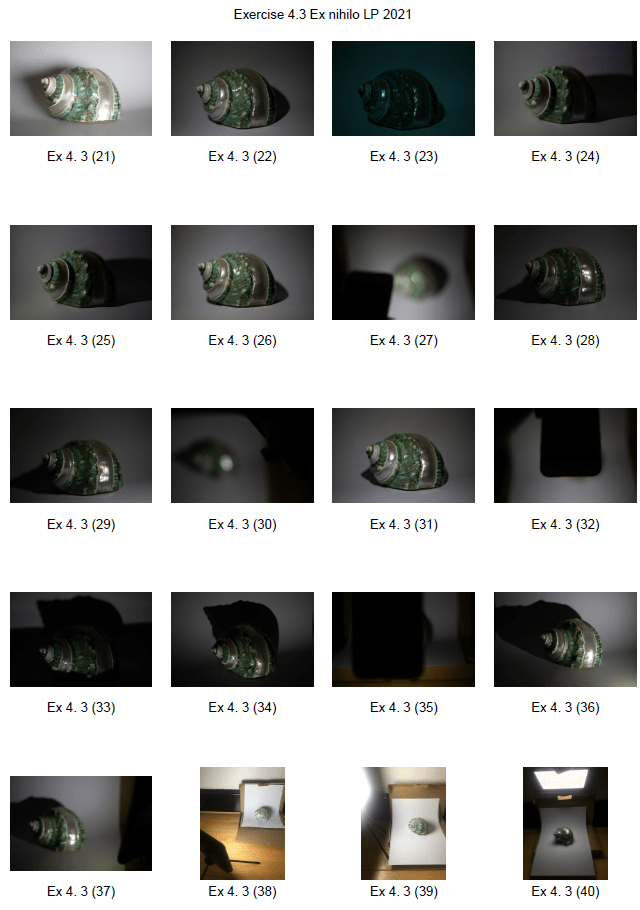
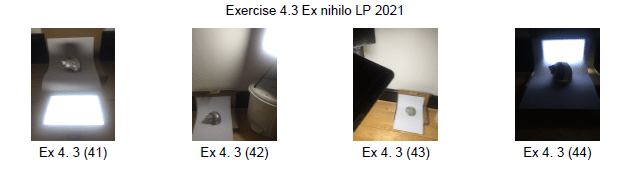
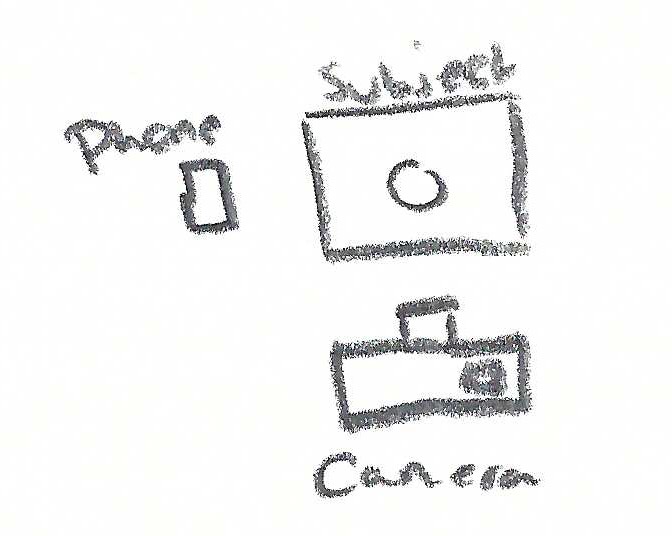
My Sony A57 was on manual mode, with an aperture of f/1.8 and an ISO of 200. The only changes made were the shutter speed and focal length where necessary. The subject sat in the corner of a bedroom to compensate for how small my LED light is, ultimately a wise choice as the shadows became very soft when pulled away from the corner. A sheet of A4 paper was on a small cardboard box to act as a curved background for the shell to sit and reflect the light. I used a small LED lightbox on a tripod as a stabiliser when stood up and a handle when lifting the light from the floor. During the second part of the shoot, I used the light from my iPhone 6 to see the effects a tiny, duller light would have on the shell.
Contact Sheets:
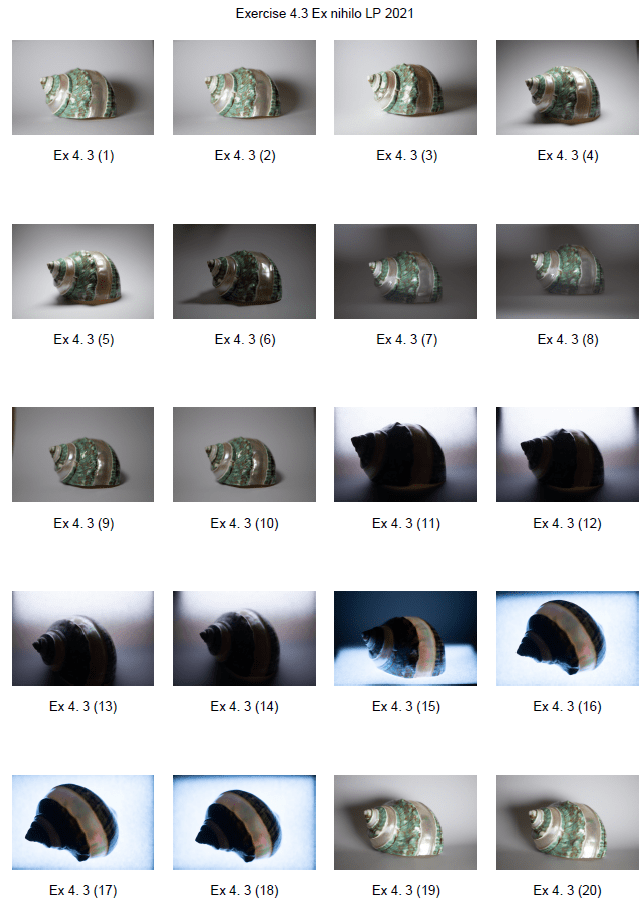
Fig. 1. Contact sheet 1 (2021)
Fig. 2. Contact sheet 2 (2021)
Fig. 3. Contact sheet 3 (2021)
Images for analysis:
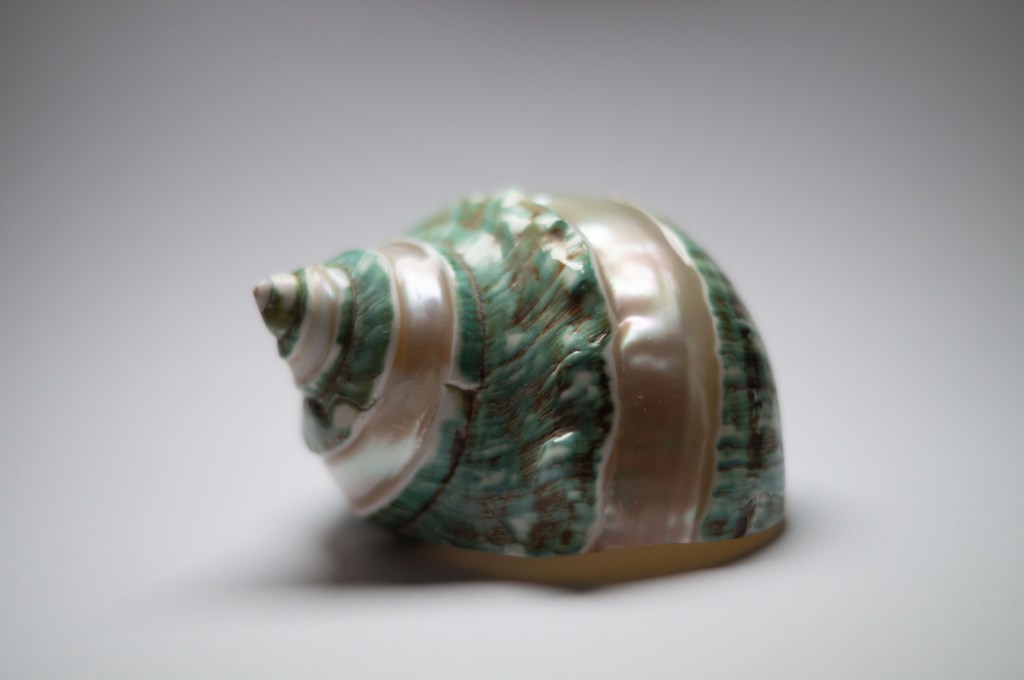
Fig. 4. 1 (2021)
Fig. 5. Diagram 1 (2021)
Fig. 6. 2 (2021)
Fig. 7. Diagram 2 (2021)
Fig. 8. 3 (2021)
Fig. 9. Diagram 3 (2021)
Fig. 10. 4 (2021)
Fig. 11. Diagram 4 (2021)
Fig. 12. 5 (2021)
Fig. 13. Diagram 5 (2021)
Fig. 14. 6 (2021)
Fig. 15. Diagram 6 (2021)
1- The LED box placed close to the side of the shell resulted in a softer diffused shadow, which follows the curve of the paper. Due to the intensity of the light, there are bright highlighted patches by the point of the shell, enhancing the shiny reflecting surface while the shadows fill in the grooves and curves. A very subtle yellow colour can be seen underneath the shadow, a reflection of the light entering and bouncing off of the inside of the shell, providing a bit of warmth to the aqua greens.
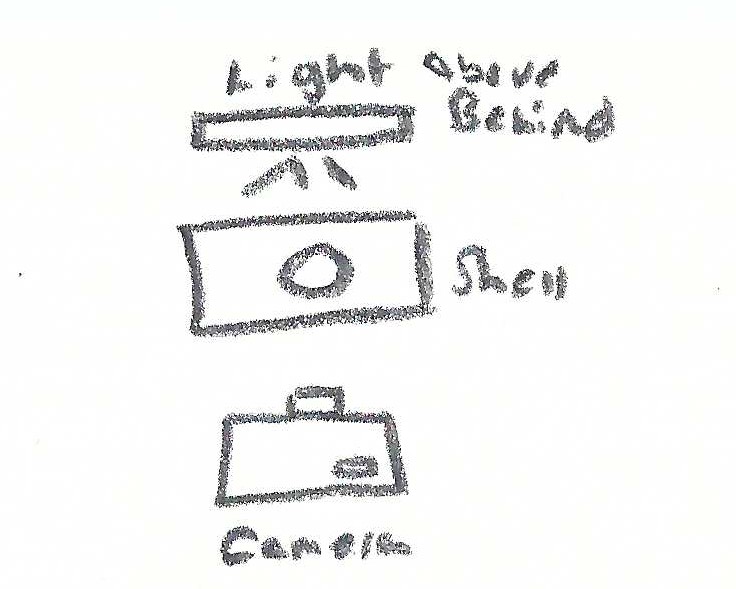
2- I lifted the LED light above and behind the shell to see what results I would get if it were down-lit, rather than the typical front or side position. The contrast between the highlights and shadows are much more even than the previous shot, without being flat. Lighting the shell from behind defined the textures and shapes within without being too bright or too dark. The image isn’t a flat silhouette due to the height of the light, forming a slightly stronger shadow that provides depth from the front of the shell, indicating the direction of light.
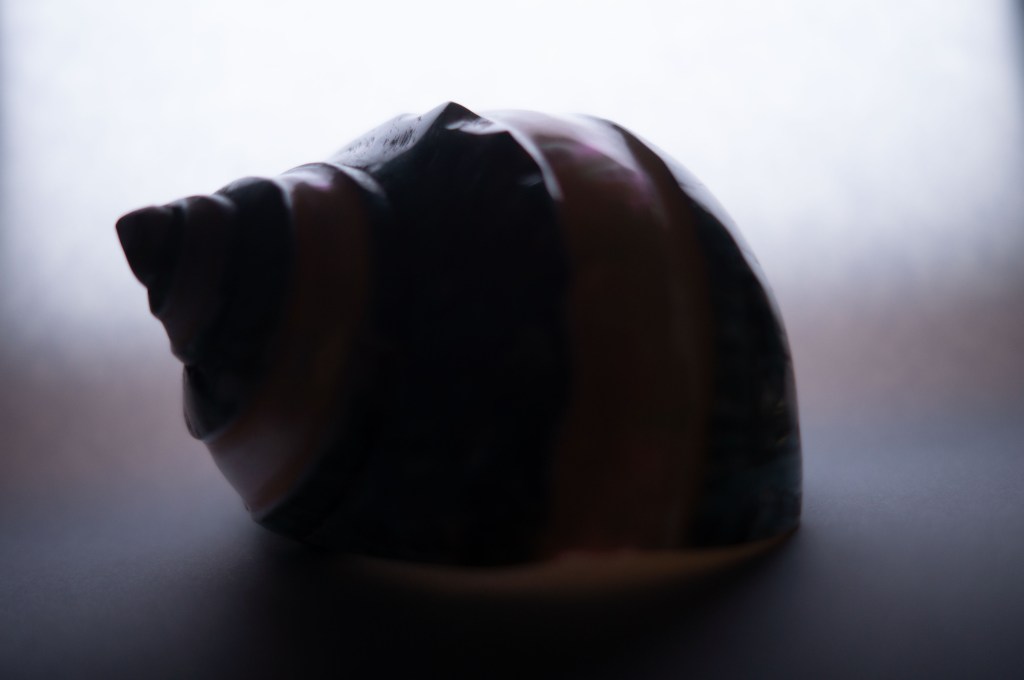
3- A bolder approach was used for this picture by lighting the shell entirely from behind. I covered the LED light with the white sheet of paper and shot the image directly from the front to capture a silhouette of the shell. The shell is not a full silhouette because we can see the grooves and textures of the surface; due to the light falling on top and through the thin walls of its body. The highlights and shadows are still heavily contrasted as the whites are extremely bright, while the blacks are dark, capturing a harsher outline of the subject.
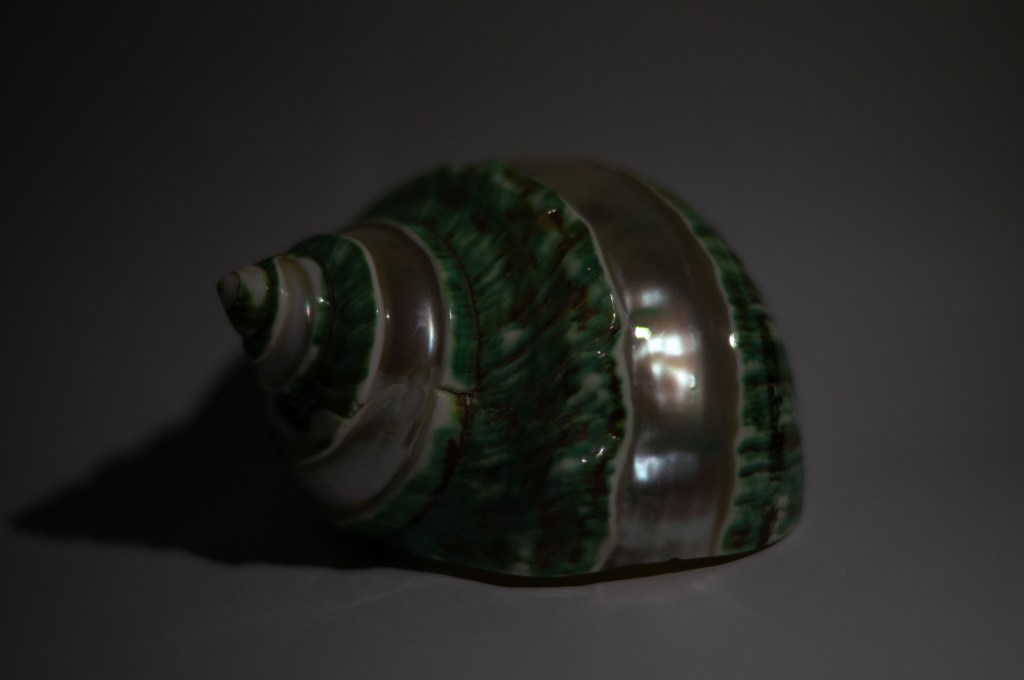
4- The light source for the following images is from an iPhone 6, which is less intense and much smaller than the LED box. Compared to image 1, this light is a lot duller, while the shadows are harsher due to the size and proximity to the subject. The swirls within the shell are heavily defined in this shot due to the darker nature of these images.
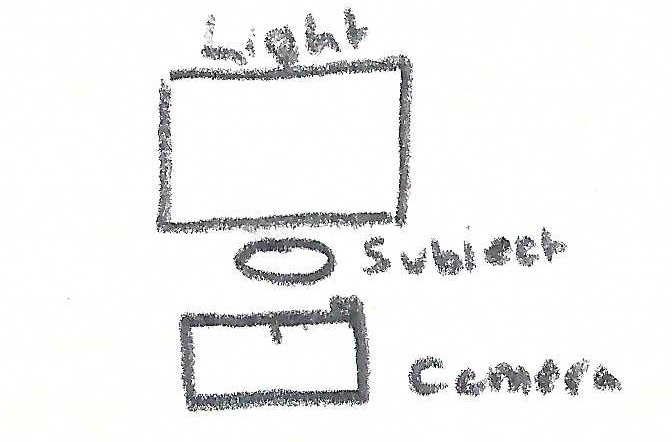
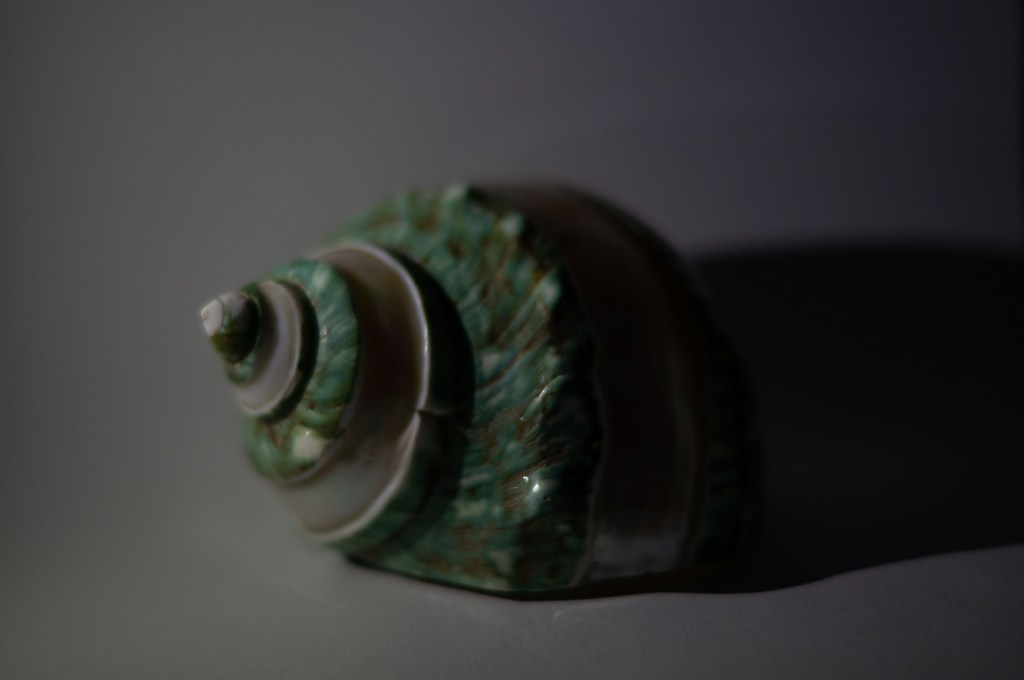
5- Lighting from a front angle has allowed the highlights to reflect off its shiny surface and show off the pearlescent colours of the body. Meanwhile, the shadows are enhancing the natural swirls within the point of the shell and defining the sharpness of the point via a hard shadow to the left of the paper. Despite the light being slightly further away from the shell, the tones and overall balance of the image if fairly similar to the 4th image.
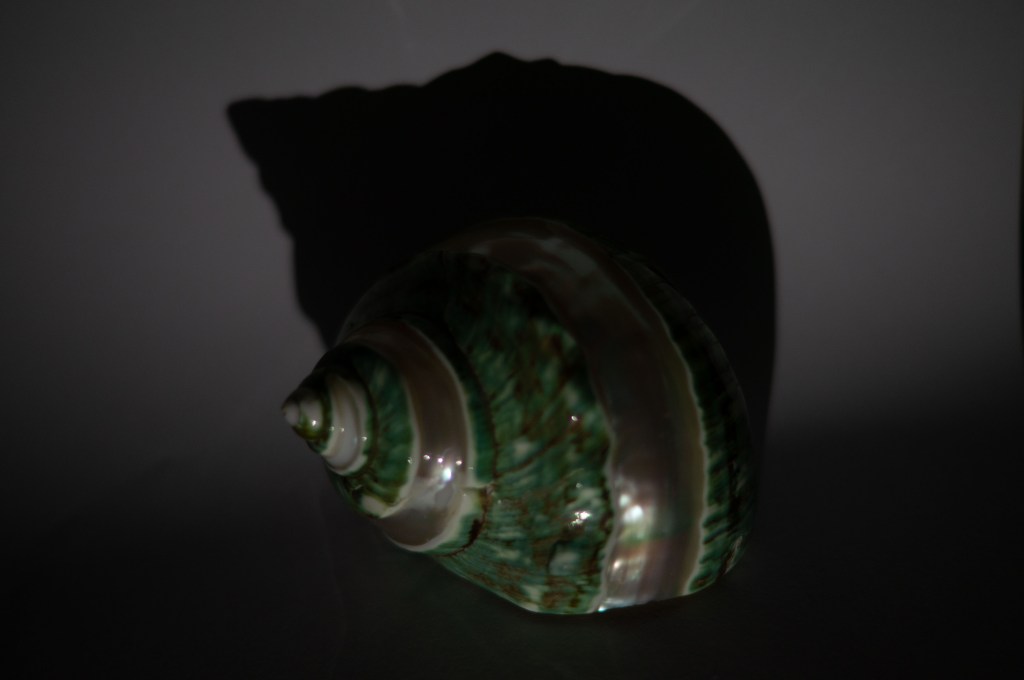
6- For the final image, I lit the image from the front but shot from an angle above the shell, capturing the shadow that fell behind it. The front of the shell is evenly lit, reflecting off of the body as the light hits it, while the back half of the shell is dark and less defined due to the lack of light. Despite the white sheet of paper, the light wasn’t strong enough to act as a fill light. Shooting from above allows us to see the intense, dark and extended shadow, rather than a tiny shadow at the bottom if we were to place the camera directly in front of the shell.
Reflection:
Studio lighting can dramatically change the result of composition. Having complete control over the distance of the light to the subject, the angle, the temperature or the colour of the light can decide how contrasted or defined the image is. Lighting a person or object from the front and having the camera at the same position would result in a flatter image with few shadows to help with definition. Lighting from the side or at an angle and shooting from the front allows for more textural details to be shown and brings more depth to the shot. Backlighting on a small scale was quite challenging as the light didn’t fill the paper, but I could’ve taken more time to frame the image a little closer in.
I didn’t explore contrast and metering much in this exercise, however, it’s helped me understand how balancing highlights and shadows, or doing the complete opposite by pushing one or the other to the extreme can help change the mood or finish of the piece.
– Researched Sato Shintaro and Rut Blees Luxemberg’s work before analysing one image of theirs very briefly.
– Provided a small description about my camera and shoot preparation
– Before including the contact sheets for this particular exercise.
– I then chose 5 images from the shoot and analyses each one in terms of technique and the quality of light within them
– And finished the post with a short reflection of the exercise as a whole.
‘Capture ‘the beauty of artificial light’ in a short sequence of shots (‘beauty’ is, of course, a subjective term). The correct white balance setting will be important; this can get tricky but interesting – if there are mixed light sources of different colour temperatures in the same shot. You can shoot indoors or outside and the light can be ambient or handheld flash‘ (Bloomfield, 2018).
Sato Shintaro – (1969- )
Sato Shintaro is a Japanese freelance photographer who graduated from Tokyo College of Photography (1992) and Waseda University, School of Letters, Arts and Sciences (1995). Shintaro is well known for his brightly lit Tokyo cityscapes, Night Lights (1997-9), one of many photo series (Shintaro, 2020).
Shooting during dusk allows any surroundings lit by artificial light to stand out in ways daylight cannot. The tones are much crisper, while shadows are significantly darker and highlights are glaring. While this is possible with direct sunlight, the colours are usually more washed out and have a greater risk of overexposure, causing the images to blow out. The main difference between day and night photography is that daytime images are usually warmer in temperature and contrast.
Shintaro’s work is well balanced so that the viewer has much to look at in detail. Light bounces off all of the subjects around without becoming a black block due to underexposure. The colours are vibrant, busy and fill the frame, which encapsulates the hustle and bustle of city life without including people in the shots. Asian culture is beautiful and striking; seeing such elements and the traditional decorations throughout these images is delightful.
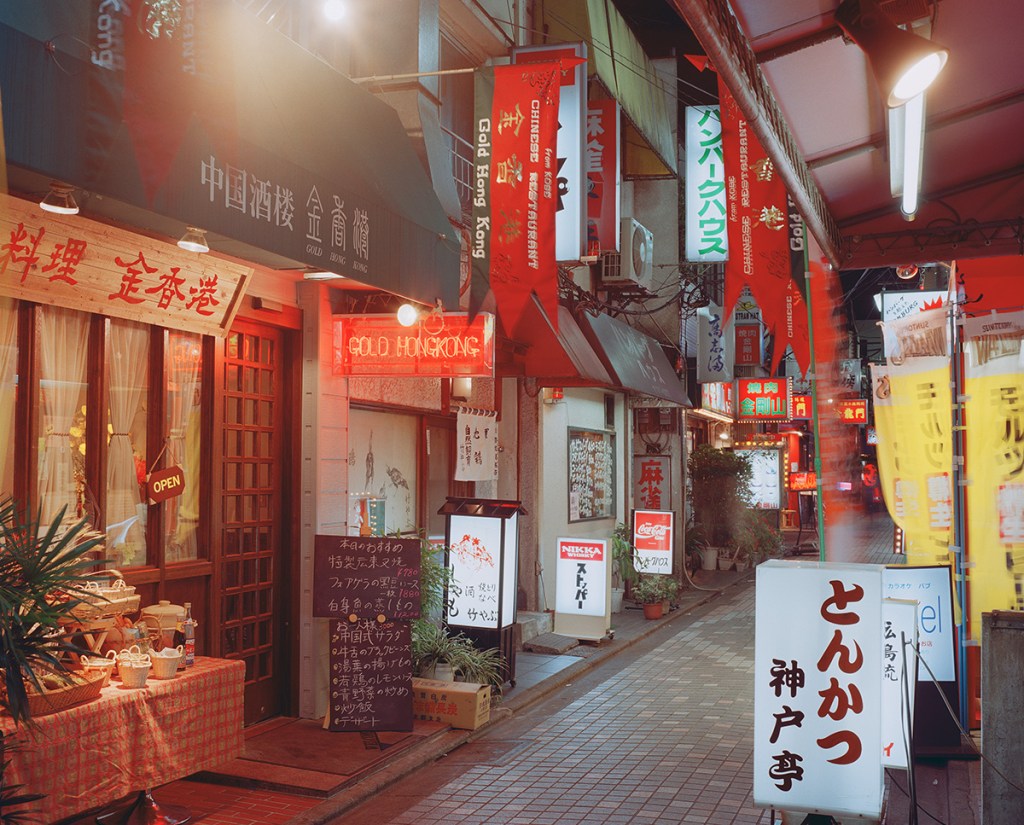
Fig. 1. Nakano, Tokyo (Shintaro, 1997-9)
Nakano (1997-9) is possibly one of my favourite images from Shintaro, as the composition is warm and cosy as the bright yellows and reds help the white lights be less harsh on the eyes. The alleyway feels close, compact and welcoming, much like the restaurant on the left. The photograph is balanced, full of geometry from the rectangular signs and buildings, a mixture of vibrant colours and cool nighttime tones on the pavement below. Some of the bulbs higher up have created lens flares but emit softer rays than crisp glaring ones. In my opinion, this shot represents the many Asian people who welcome others into their culture and communities through their friendly, enthusiastic personalities and traditions.
Rut Blees Luxemberg (1967 – )
Rut Blees Luxemberg is a German-born photographer based in the UK, well known for her urban photography work (Artimage, 2017). Much like Shintaro, Blees Luxemberg shoots at night when capturing urban landscapes as, ‘The night is a space of freedom, where certain demands of the day are temporarily suspended’ (Blees Luxemberg, 2018).
The reduction of movement captures different energies in comparison to busy high streets or buildings lit by daylight. Instead, evidence of life features throughout illuminated buildings, lit streets and items/natural elements left behind ‘But photographs are not just a record of a moment passed, they can also be an imagination or visual premonition of possible futures’ (Blees Luxemberg, 2018).
Her aesthetic is consistent throughout the images, ranging from greens to greys to cool hues, warm yellows and oranges. The combination of colours emits an eerie and grungy mood through her works which seems quite fitting for the series titled Liebeslied, My Suicides.
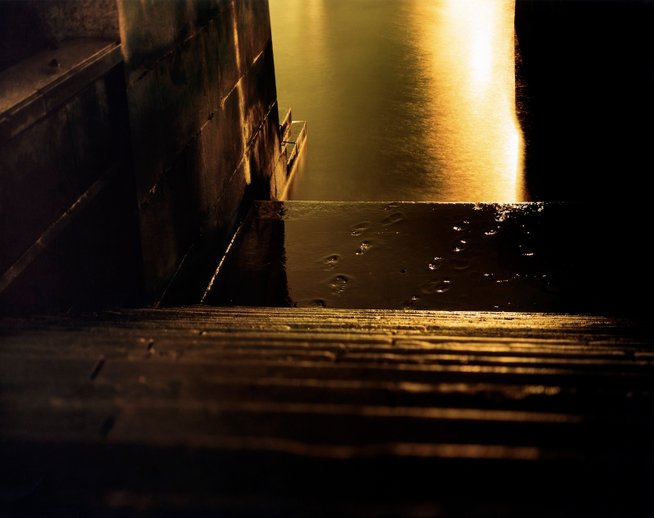
Fig. 2. Nach Innen / In Deeper (Blees Luxemberg, 1999)
In Deeper (1999) was shot from what looks like multiple sets of stairs but could also be a few small steps towards a small platform. We are unaware of the location due to the lack of context within the black shadows of this photograph. Reflections in the frame imply that it has rained or flooded due to the water in the background. The texture is prominent throughout this work, from the stone steps, ageing walls or brickwork from the building on the left, the water and ripples we can see in the yellow light shining in from the right of the frame. Leading lines, a slightly shallow depth of field in the foreground, draw the eyes downstairs towards the lights and water in the background. ‘In Deeper‘ may suggest that this is a picture of a river, sea or flood, purely because of how deep the water looks and how far the reflection of light continues.
Compared to Shintaro, Blees Luxemberg’s work is much warmer in white balance than the white bulbs and LED’s featured in Shintaro’s Night Lights (1997-9). The photographs featured in My Suicides (1997-2000)are much darker and higher in contrast. With these different aesthetics in mind, this helped make my shoot for this exercise even more exciting, as I was able to explore a range of photographic techniques in one swoop.
Camera preparation
As it is now springtime, I had to wait until around half past eight at night to head out and take photographs for this particular exercise. My Sony A57 was already preset to manual mode, but I had to reset the white balance to auto to prevent any unwanted colour casts in the images taken during blue hour. An ISO of 200 enhanced the brightness without causing too much grain in the darkest areas. A large aperture of F1.8, allows for more light to enter the camera, ideal for night photography as it reduces the need for too slow a shutter speed if the camera isn’t on a tripod.
The shoot plan was simple as I took a short walk around my local area, observed the light from artificial light sources and how it shone on its surroundings and effects had on any subjects in the frame.
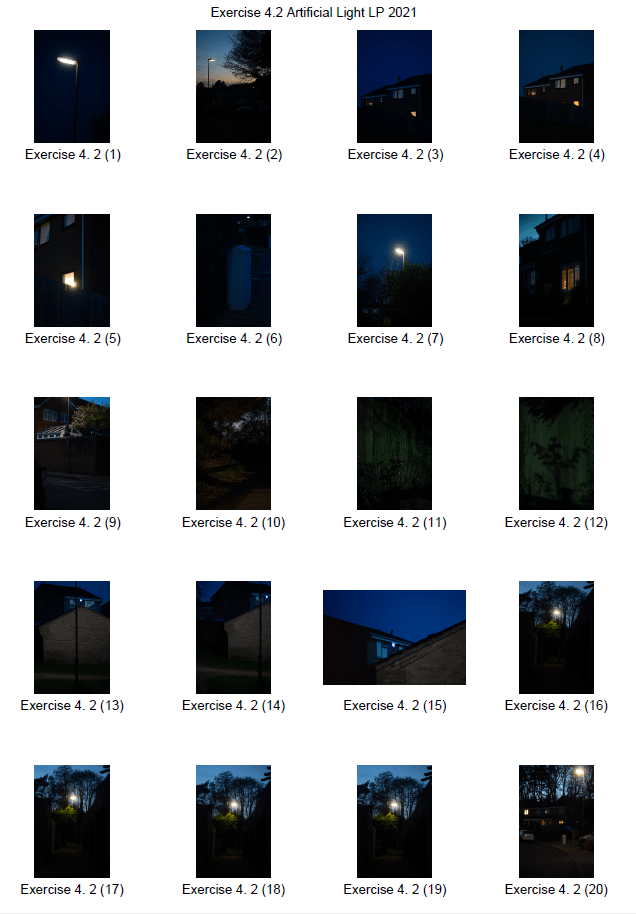
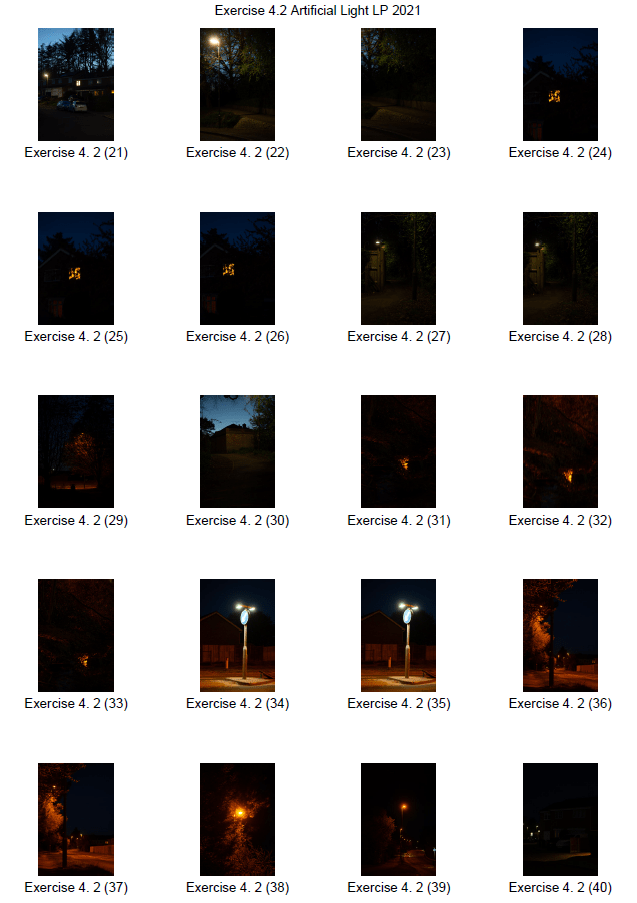
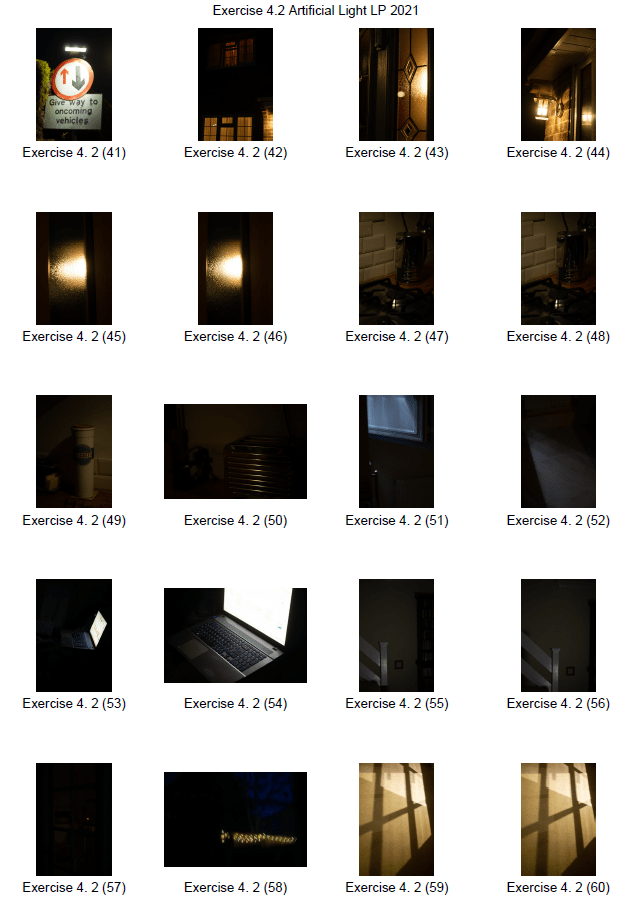
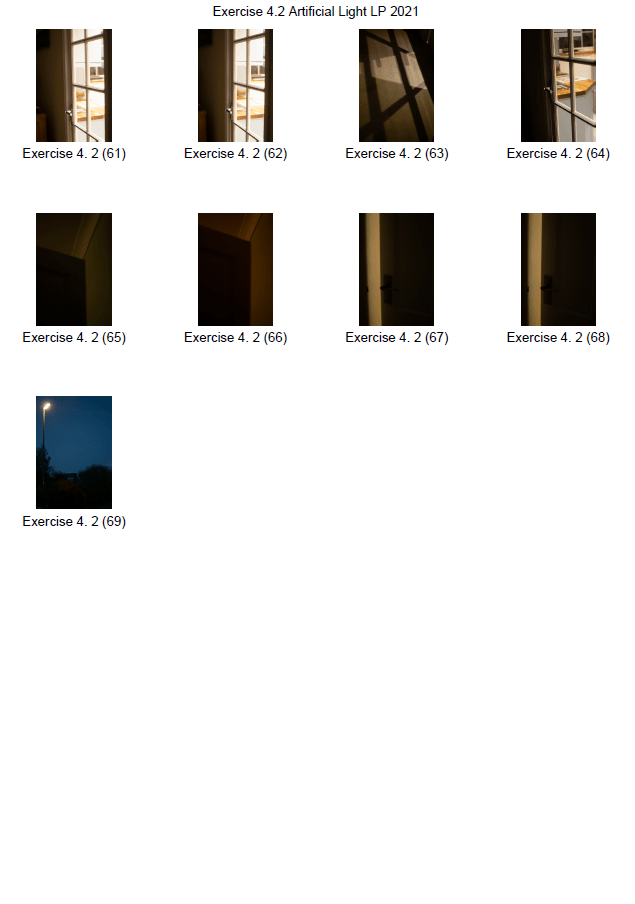
Fig. 3. Contact sheet 1 (2021)
Fig. 4. Contact sheet 2 (2021)
Fig. 5. Contact sheet 3 (2021)
Fig. 6. Contact sheet 4 (2021)
Images for analysis
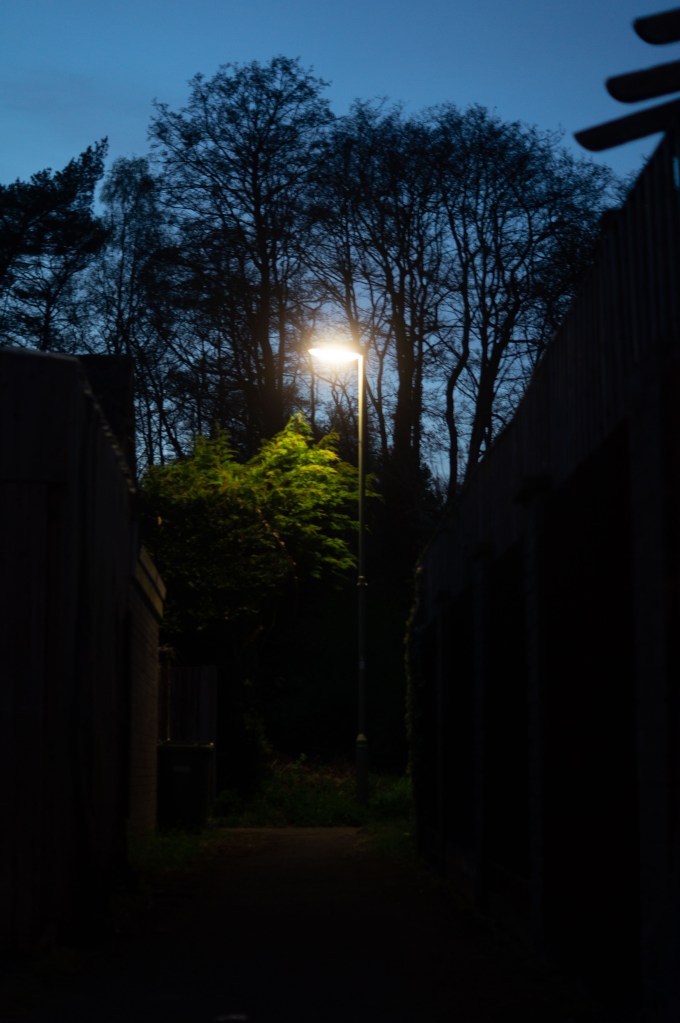
Fig. 7. 1 (2021)
Fig. 8. 2 (2021)
Fig. 9. 3 (2021)
Fig. 10. 4 (2021)
Fig. 11. 5 (2021)
1 – Despite taking the image during the blue hour, the period after sunset or just before sunrise, there is very minimal light to illuminate the buildings in the foreground. Secluded areas struggle to be lit during the evening regardless of artificial light due to the obstacles blocking most light sources. If I were to take the image during the day with a more powerful light level, we would see the buildings in their entirety. The sky brings a burst of colour to the composition, emphasising the shape of the buildings in the alleyway. Houses have helped frame the image nicely and document the lack of space that is in the shot. Focal pointwise, the bright white bulb from the streetlamp and the top of the tree leaves towards the background stand out before the eyes are drawn towards the soft spotlight below, lighting the pathway. The mood is mysterious and allows the brain to wonder was is around the corner or where this is.
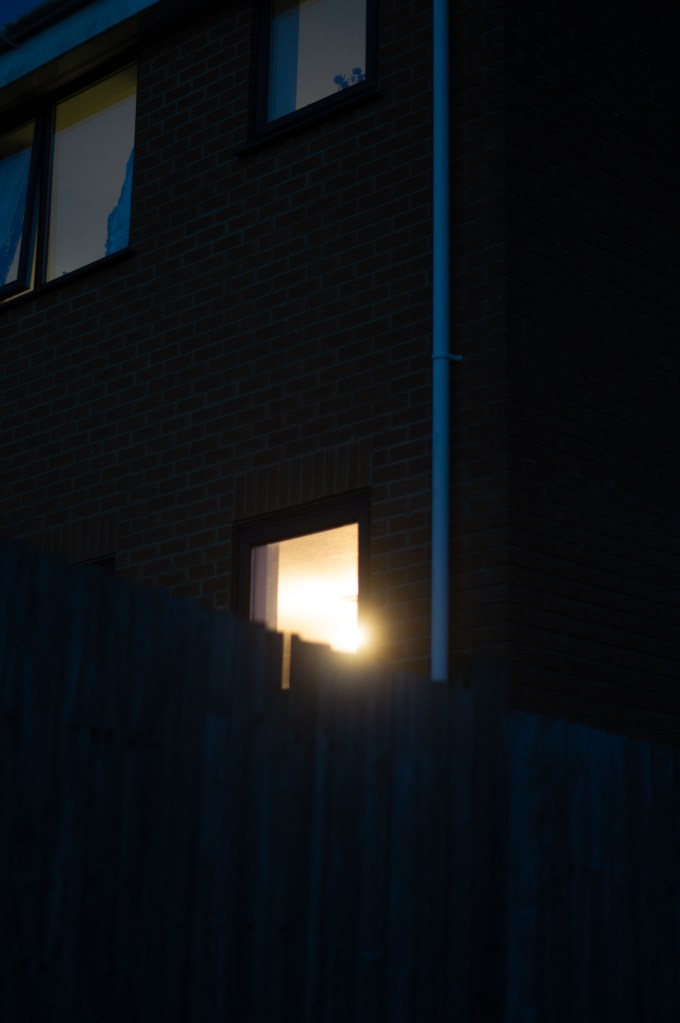
2 – This building is in an open space, so the remaining light just after sunset was able to light the brickwork of the flats in the frame, as well as the fencing surrounding it. Added details such as these provide a context of location, type of building, how long it’s been there for; e.g. a partly broken fence implies it’s been up for a long time and endured some wear and tear. Reflections add both texture and depth to the composition, rather than it being a flat 2D image. A warm light source from the window just below the mid-frame brings a sense of home to the photograph and welcomes the viewer into a comforting space. The camera’s position compared to the fence and light source caused a lens flare to occur. As a result, it looks as if there were a torch pointing directly towards us. The tonal range is cold and suits the crisp spring evening while documenting blue hour well.
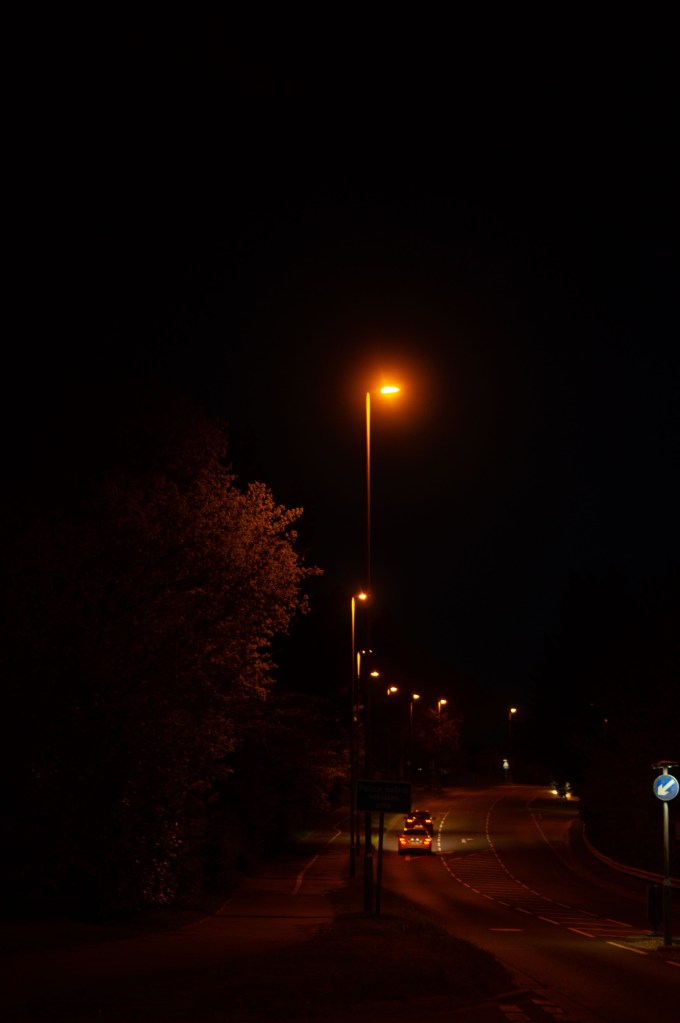
3 – With the blue hour long gone, the warmer streetlights can fully light the main road for the cars and pedestrians walking past, as seen in the far background. The white balance was changed to daylight for these shots to enhance the temperature of the bulbs and reflect Blees Luxemberg’s yellow/orange hues. Streetlights may be higher from the ground than most light sources, but they’re powerful enough to light the paths below like daylight would, just a lot softer in appearance. Headlights from cars are blinding for a good reason. Not only do they assist drivers to see where they’re going and if there are any obstacles ahead, but for the safety of other drivers so they’re aware of cars surrounding them. The contrast between the white light patch midframe and the yellow light brings balance to the frame, preventing it from looking like a sepia image, which I dislike as a photographic technique. The images leading lines draw the viewers eyes from the softly lit tree on the left, up and around the curves of the road swallowed by the black night sky.
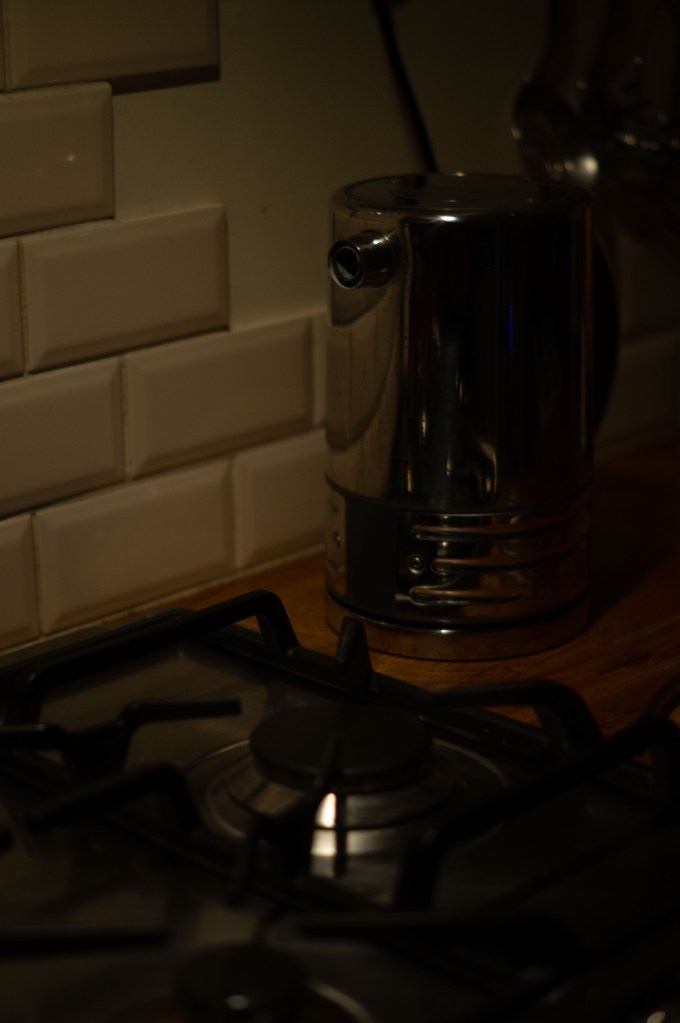
4 – For image number 4 the light source comes from the cooker hood that is purposely brighter where the oven hobs are but much softer to the sides. Reflections from the kettle and oven top provide texture and context to the materials and shape of these objects. For example, the curves of the tiles reflect in the round kettle body. A small patch of the wooden worktop has warmed the frame up and made it feel more homely like a cottage kitchen would. Light coming from the left has created a soft shadow on the right-hand side of the frame, gently illuminating the utensils on the wall, making the kettle the main focus of the composition.
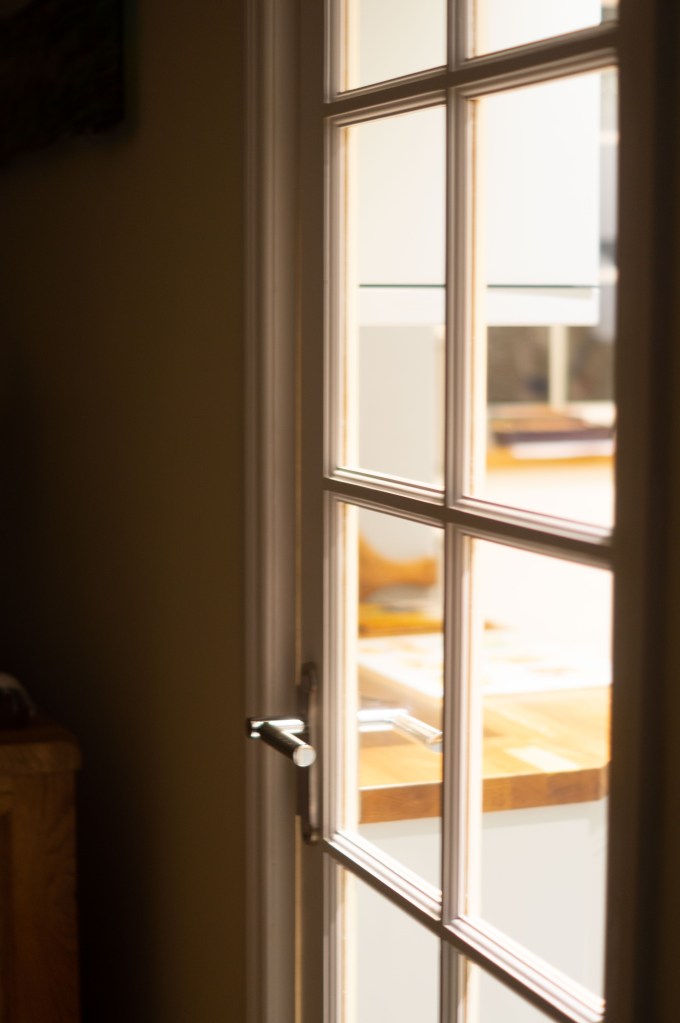
5 – This area has been fully lit by the light from the ceiling, allowing us to see the worktops, cupboards, windows and other items on the side. The door has light shining through, so we can see the cold metal handle and carved details in the window frames, which is a subtle detail to see. More context allows the viewer to understand a bit more about the subjects, where it is and the lifestyle of the people living there, much like Sato Shintaro’s works. Due to the light source coming from the right and straight out the door, means that the walls to the left are just out of range, full of shadows, bringing depth to the image. The composition is full of shapes, geometric or otherwise, as well as being warm and welcoming.
Reflection
Artificial and natural light can range from intense to soft depending on the light source, its position and the location, however, the majority of the images taken during this exercise have been dimly lit, creating softer and mysterious compositions compared to a brightly lit photograph taken in daylight where we have further context. No source of light is more superior to the other, as each is important. Without artificial light, we wouldn’t have the privilege of travelling at night or navigate around our homes in the dark. I prefer to work with natural light as I enjoy the softly lit compositions rather than harsh highlights and shadows from studio lights. This exercise, however, has made me appreciate artificial light much more and the kinds of images you can capture. Sato Shintaro’s work is a prime example of breathtakingly beautiful night photographs, full of life and detail.
– Mentioned the brief for this exercise. – Briefly explained my process for choosing Eugene Atget as my starting point for these images. – Gave a short description about Atget’s work and what he was well known for, plus his approaches. – Briefly covered where I was taking my images and why. – Listed my camera settings and the reasoning behind these choices. – Included contact sheets of all the images shot for this exercise and picked out 5 to analyse. – Gave a short analysis for each chosen image, exploring the light and how it effected the compositions. – Reflected on this exercise as a whole and what it taught me.
‘Taking the photography of Mann, Atget or Schmidt or a photographer of your own choosing as your starting point, shoot a number of photographs exploring the quality of natural light. The exercise should be done in manual mode and the important thing is to observe the light, not just photograph it. In your learning log, and using the descriptions above as your starting point, try to describe the quality of the light in your photographs in own words‘ (Bloomfield, 2018).
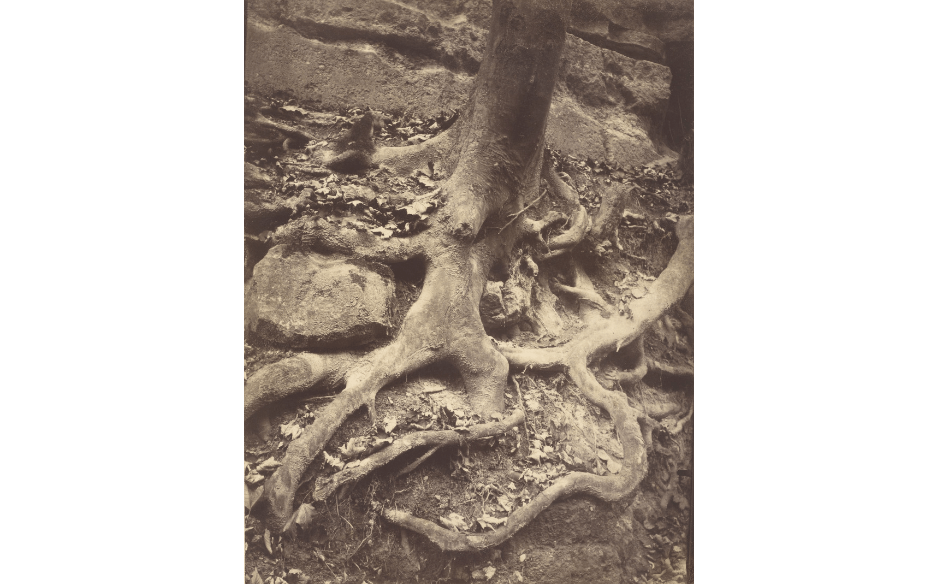
To avoid overthinking the practitioner in which I would gain inspiration, I searched each one via Google and scanned through a few images to see which one stood out most to me. By doing this, I was drawn towards Eugène Atget, as his work contains a variety of approaches as mentioned in the EYV coursebook; ‘He usually made such images – see, for example, Environs, Amiens – in the middle of the day, when shadows were minimal. Atget’s late photographs, however, are frequently marked by subjective light and deep shadows’ ([Artist description], n.d).
Atget was a French photographer who is well known for his imagery of the architecture and streets within Paris. Keeping the idea of outdoor photography in mind, I took the opportunity to complete the exercise while out on a walk around the woods. Quite a few of his works included nature, trees especially (see Fig. 1) so my images were still taking influence even without architecture or street imagery.
Fig. 1. Saint-Cloud, Tree Roots, Saint Cloud Park (Atget, 1906)
While most of his works featured diffused light, in turn capturing a clear and detailed composition, there were also the occasional shots that included heavy shadows or highlights to provide depth and show silhouettes of the surroundings or subjects. The dynamic approach is what I took on board while exploring my surroundings, allowing me to capture a range of images that fell into both of these categories.
Contact Sheets:
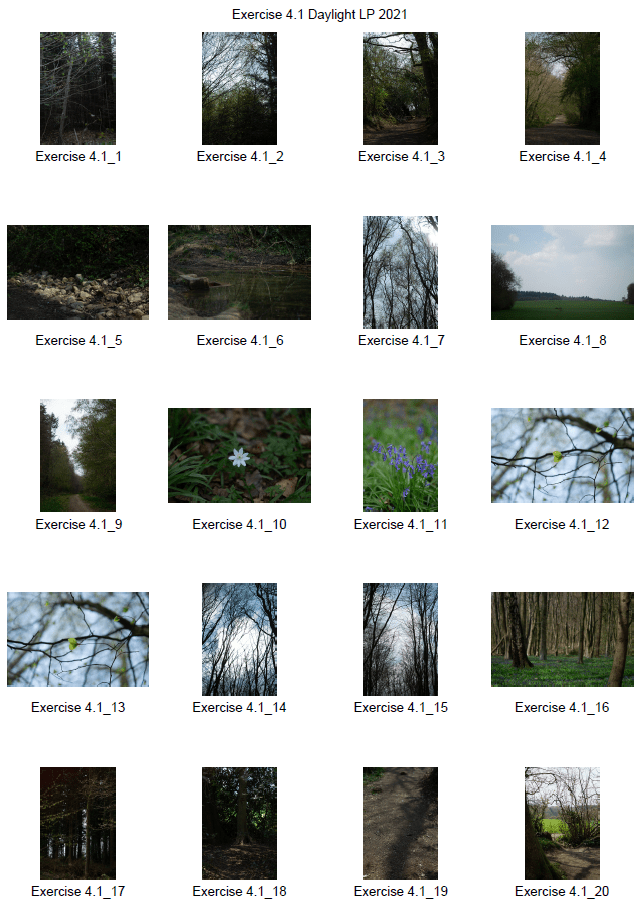
Fig. 2. Contact sheet 1 (2021)
Fig. 3. Contact sheet 2 (2021)
Before shooting images, I set the white balance to auto mode to avoid any artificial temperature changes within the camera. The aperture was set to F1.8 for no other reason than personal preference and set the camera mode back to manual following a mini light meter exercise. My 75mm lens was also set to manual mode, allowing me to take time to observe the light and actively be aware of the depth of field for each area I shot.
Images for analysis:
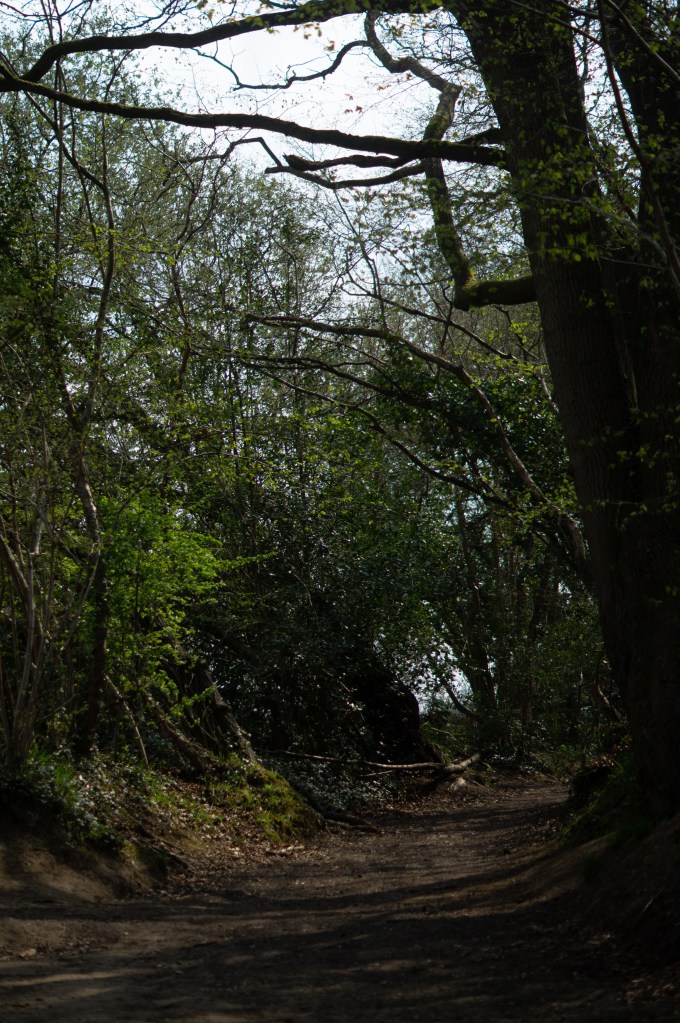
Fig. 4. 1 (2021)
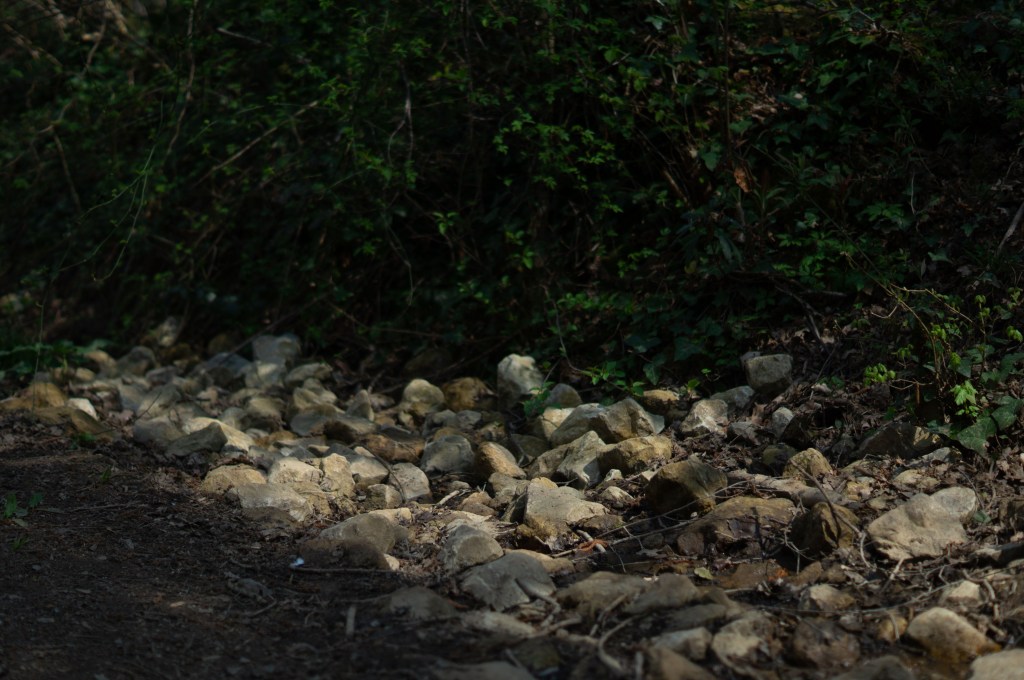
Fig. 5. 2 (2021)
Fig. 6. 3 (2021)
Fig. 7. 4 (2021)
Fig. 8. 5 (2021)
1 – The light shining through the trees from the east caused shadows to fall on the sunrays below. The sky is bright but not so much that it has blown out the composition. The leaves on the left show warmth from the sun, juxtaposing the cool and shadier shadows. Shooting this image as a portrait has allowed the tall trees to frame the top, providing context to what is blocking the light and how closed in this location is.
2 – The small patches of light that shone through the gaps within the leaves of bushes and trees create a focal point for this photograph by enhancing the darker areas within the frame. The size and textures of the rocks are enhanced by the contrast of highlights and shadows, preventing them from looking flat and smooth. Light can be used as a spotlight for the subject, leading the viewer towards the significant elements within the composition.
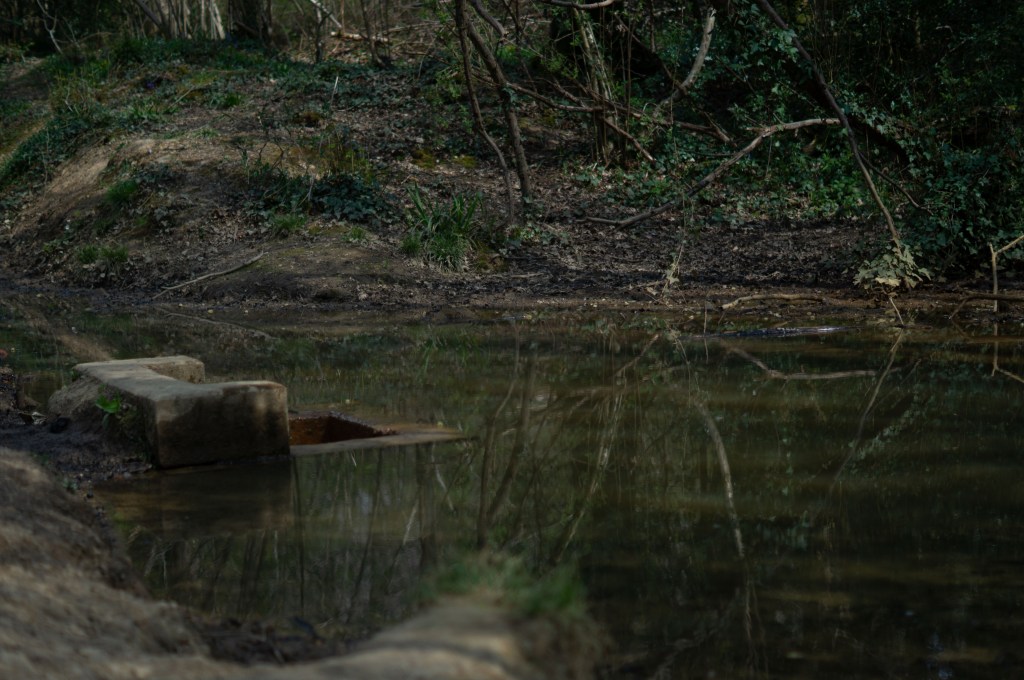
3 – Unlike the previous photographs, this one is more diffused and lacks much depth. Despite the lack of shadows and highlights, there are still reflections and shapes within the water that provides movement and texture to the composition. In my opinion, it feels less exciting as the colours are neutral. Nonetheless, exploring the importance of natural light and its effect on a subject is what this exercise is all about, whether we like the result or not.
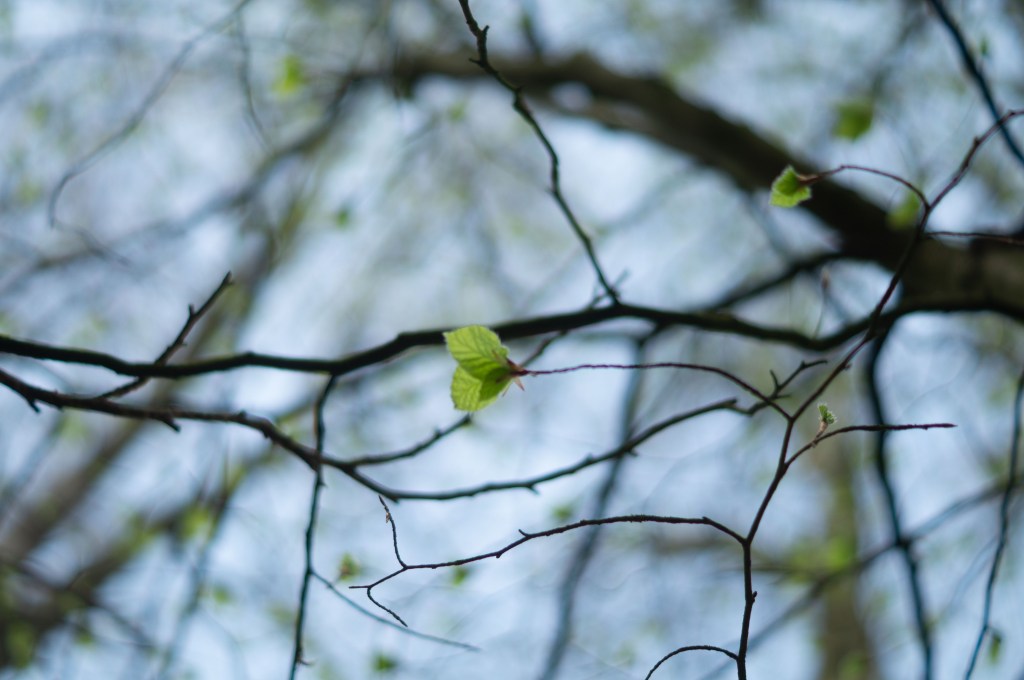
4 – The light came from behind the camera, as opposed to the sides or directly in front of the lens. As a result, instead of capturing the silhouette of the leaves and branches, we can see the light green and veins of the leaves. Other images in this collection lack a deep depth of field because of the enclosed areas, so to capture such a soft, diffused image that is also full of depth shows how light and location can affect the mood or overall result of a piece of work.
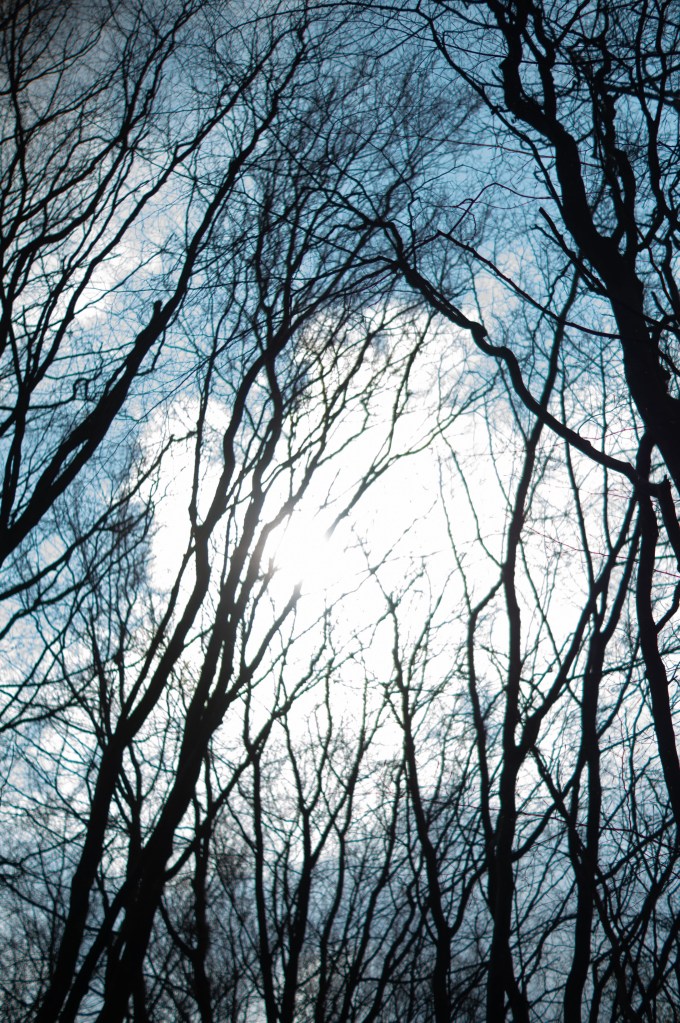
5 -Shooting directly at the sun has caused the camera to capture the skeleton silhouettes of the group of trees in the frame. There is no light from behind to shine on the branches to illuminate the textures of the wood, so they become spindly lines that are cutting through the sunrays. Due to a clear sky, we can see small patches of blue that bring a pop of colour to an eerie photograph. The sun glare in this shot creates a juxtaposition between images 2 and 4, where the light is bright but not enough to cause the lens to be overwhelmed.
Reflection:
This exercise helped me understand the power of light and the significance that it has within photography. Without it, capturing images would be impossible, but playing around with light and observing how it falls can be the difference between a good and bad image. I have learnt that I prefer using more dynamic and contrasting light rather than diffused when it comes to outdoor photography due to the enhanced shapes, textures and colours within the composition. My favourites from this image set are 2 and 5 (see Fig. 5., and Fig. 8), for that very reason. Diffused natural light feels better suited for indoor photography from a personal standpoint. Ultimately, however, it depends on the picture and what effect you want to create, as seen in image 4 (see Fig. 7).
– Expressed the difficulties faced during this task due to the continuing UK lock down and inability to travel far, therefore having to find a work around to achieve an image that fit the brief. – Explained how I executed the exercise, the camera used, as well as the settings before, – Documenting what I saw during each layer of the viewpoint and the details within them that I may not have noticed had I just raised my camera and clicked. – Inserted the end result with the technical details and reflected on the exercise as a whole, the importance of looking and the impact it can have on the composition.
Brief:
‘Find a good viewpoint, perhaps fairly high up (an upstairs window might do) where you can see a wide view or panorama. Start by looking at the things closest to you in the foreground. Then pay attention to the details in the middle distance and then the things towards the horizon. Now try and see the whole view together, from the foreground to horizon (you can move your eyes). Include the sky in your observation and try to see the whole visual field together, all in movement. When you’ve got it, raise your camera and release the shutter. Add the picture and a description of the process to your learning log‘
(Bloomfield, 2018).
Due to the UK being on lockdown for the time being, I had to find a workaround for this exercise as my upstairs windows do not open wide enough for me to get an unobtrusive shot of the garden, therefore wasn’t a possible option. While I would’ve liked to shoot from a high-rise building to get a broader view, my only alternative was shooting from the hilltop near home.
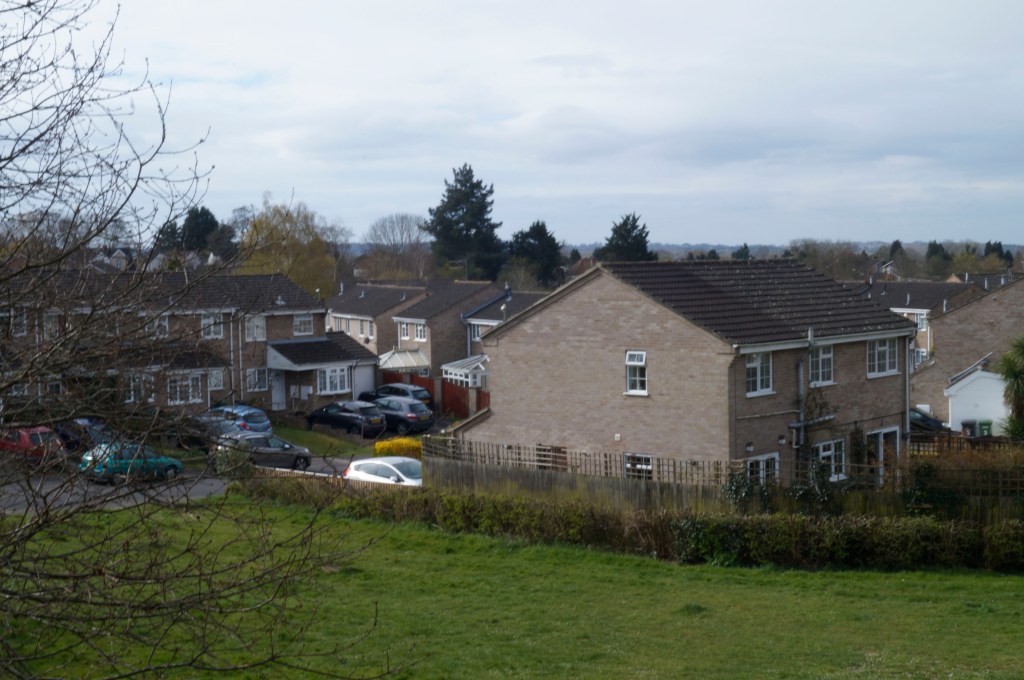
Before taking this shot (see Fig. 1), I set my SONY A57 to shutter priority mode, used auto-focus to ensure that the image would be entirely focused, as well as adjusting the shutter speed to level out the exposure before raising my camera and shooting.
While observing this viewpoint, I first became aware of the bare tree branches in the foreground creeping into view and blocking the houses to the left of me, shortly before my eyes followed the descent of the hill leading towards the hedges and large bricked house in the middle distance. The houses behind look tiny in comparison as they get further away from the foreground, framed by the variety of evergreen and deciduous trees along the horizon and a faint foggy silhouette of woodland far aware in the background. A blanket of clouds blocked the previously sunny sky, a few grey clouds spread across before it started to rain.
Once I’d looked at all of the elements in their sections, I then sat and viewed the scene as a whole without using my viewfinder in camera. This exercise was slightly challenging as I usually look at what is in front of me through the camera before shooting, so to step back and discover in real-life was an eye-opener. I took a brief look at the LED screen to make sure the sky was in my composition, then returned my eyes to the view while pressing the shutter button.
Fig. 1. Look (2020) 1/25 sec; f/32; ISO 200
Reflection
These past few exercises and research points have helped my understand the importance of being aware of your surroundings, to look before you shoot instead of raising your camera and taking a snapshot, hoping for the best. By spending more time to observe and understand what is in front of you, makes the shot a lot more meaningful, not only for you as the photographer, but for the viewer as more effort has gone in to make sure the composition looks ‘right’. While it is difficult to refrain from just raising the camera and looking, it is a task worth doing to spend a few extra moments taking in the scene and what you’re about to capture.






 Lauren Powell OCA