Research for ‘Photography is simple’ + Mindmap

Assignment 5, Online Research, Practitioner Research, Thoughts & Ideas

Summary:

In this post I

– Inserted my mind-map exploring the ideas Opposites and Minimalism with a paragraph reflecting on the results

– Discussed the concepts I want to explore and research in further detail in this post

– Wrote a paragraph on the Minimalism art movement and what it consists of

– Provided a short paragraph about the photographer Paloma Parrot, along with an image which I briefly analysed

– Studied the history of the polaroid camera, the interest behind it and the benefits

– Researched Ziqian Liu and analysed one of her images in detail before reflecting on the post as a whole

– Decided to explore the combination of a minimal composition with a complex subject, to explore the ‘simple’ statement while arguing my belief that photography is anything but simple.
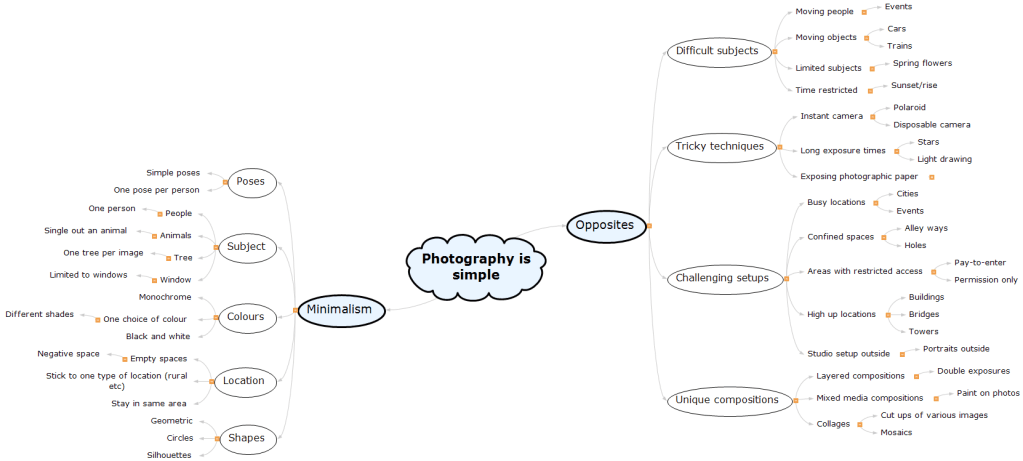
Fig. 1. Photography is simple (2021)

My mind-map (see Fig. 1) explores various branches of ideas underneath the Opposites and Minimalism concepts briefly discussed in my initial thoughts post (2021). Experimenting with difficult subjects would bring a challenge to the project as I would have to get the shutter speeds correct, plan accordingly to fit within specific time scales and events. Bearing that in mind, it wouldn’t be the most ideal choice due to restrictions with travel and gatherings. I like the idea of using an instant camera whether that be a polaroid camera or disposable, as that restricts me to a set amount of shots, not an easy task. Mixed media or collages would be interesting to combine with the use of physical photographic prints.

Simple poses would be perfect to use in unison with a single person for my subject choice, this takes the pressure off of the individual to get into positions they’re not comfortable with. A ‘candid’ aesthetic could be achieved if I explored this route. Negative space and restrictions in colour would provide a clear focal point for the viewer and could influence the particular mood the composition is trying to portray as a whole.

Limiting the type of subject of interest could become quite challenging depending on what is chosen, for example, capturing various styles of windows in a built-up area may not be as easy as it sounds due to a set blueprint for the buildings.

Further research on a few of these concepts needs to take place so that I can decide on a final idea for this assignment.

I will look at minimalism in more detail, explore the history of polaroid photography, portraits and artists who subtly portray complex ideas.

Minimalism:

‘Minimalism is an extreme form of abstract art developed in the USA in the 1960s and typified by artworks composed of simple geometric shapes based on the square and the rectangle’ (Tate, 2017).

Minimalist art pushes the boundaries of abstract art and what it is, by removing the elements that could encourage the viewer to see a piece of art in a particular way. A ‘typical’ form of abstract art could contain a variety of colours that mix to depict a certain mood, action or a sequence of shapes and lines that form a bigger subject. This approach goes back to basics by using simple shapes, a minimal selection of colours if any, pushing the viewer to “just see what you see” (Frank Stella 1966, cited in ARTnews, 2015:2) without much information at all.

The movement began in the late ’50s before continuing to grow in the ’60s and ’70s with the likes of Donald Judd and Robert Morris. It is compared with the conceptual art movement due to the similarities between the ‘unusual and its ability to challenge the stereotypes of what art is, usually only appreciated by a specific audience (Tate, 2017).

Simplicity can be beautiful, as it strips back any unnecessary details that may otherwise clutter or influence the final result of the art.

Paloma Parrot

Paloma Parrot is a minimalist photographer based in Ruhr, Germany. She has over 20 years of photographic experience, encourages that people take a camera wherever they go and sticks to a colour palette of grey/white with a burst of colour to draw attention. Her toolkit consists of a tripod, remote trigger to help capture self-portraits without the additional help of others or a timer (Parrot, n.d.).

Parrot is minimal in every sense of the word from the tonal choice, subject, titles and such, an inspiring way to work, to say the least. As photographers, we can get carried away with an abundance of different lens, lights and cameras, that it’s not always ideal when shooting on the go. Keeping everything manageable and light must make the photographic experience more enjoyable and smooth.
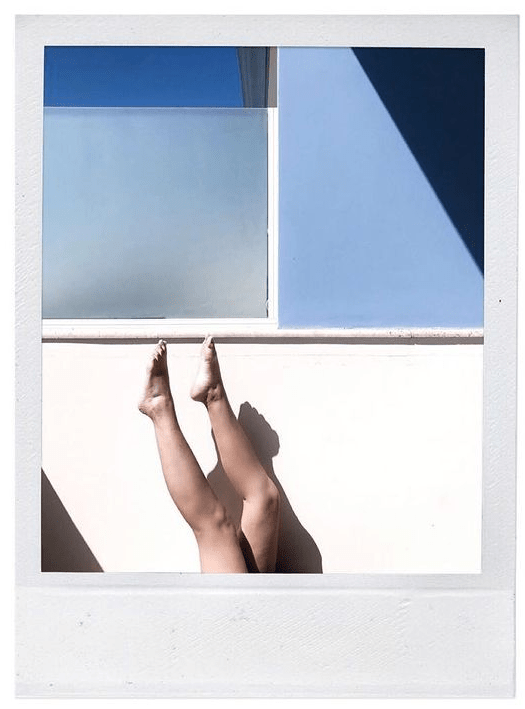
Fig. 1. Upside down (2018)

One of my favourite images from her Instagram page is Upside down (see. Fig. 1) as it features little colour, besides a few different shades of blue and the standard white, greys with the occasional dark shadow to add depth to the composition. While it may look like an effortless image the framing will have taken time to perfect, it seems to have been taken on a polaroid implying a limited amount of attempts and the subject in question had to pose in the most abstract way for the image. Nothing about this is that simple besides the shapes and colour palette. Geometric shapes bring complexity to the photograph, cutting the frame into sections and encouraging the eyes to explore the piece in its entirety. Using the legs as the focal point is an interesting choice, as the audience is left wondering who the person is, why they’re in that position in the first place and what else is outside of the frame. Conceptually the portrait may be referencing the action of falling down a rabbit hole like Alice in Wonderland, adding a layer of humour to the piece and fleshing out what could be seen as quite a ‘boring’ picture. The context for this art isn’t given so despite the arrangement being minimal there are many messages and possible references this shot could explore, in turn, forming a juxtaposition within itself.

‘Instant Photography – Polaroid photography

The polaroid was created by Dr Edwin Land, a scientist and CEO of the Polaroid company following a conversation with his young daughter who asked why she couldn’t see the picture following its capture. When Land started the company in the 1930s Kodak bought his first product — the polarizing filter. And for most of the ’50s and ’60s, it manufactured negatives that Polaroid used in its film packs (Legacy User, 2012).

Polaroid cameras do everything that a dark room would have to do, the film is exposed to create a negative image before it is developed within the camera to create a positive print that becomes permanent once it develops in its entirety. The company hired a selection of famous artists to use the cameras and film, as a way to advertise the product and draw attention to it through the eyes of the most prominent creators at the time (Legacy User, 2012).

Watching an image come to life right in front of you is exciting to experience, as you feel as if you are part of the entire process from pressing the shutter to development, without the additional chemicals and time-consuming process. Over recent years, the camera has become increasingly popular with a younger modern audience. Instax has created models that are less expensive and more accessible to those who are on a budget but still want to experience the magic of polaroid photography.

Due to the limited number of film sheets in a pack, the lack of self-timers and the ability to delete the image once it’s been taken makes the photographs taken more unique and challenging to prepare for. Each picture counts, so thinking about your composition is important if you’re unable to have a backlog of films to hand.

Unlike disposable cameras, prints are available instantly beside the developing time, this allows the creator to enjoy the photographs without having to pay or wait for the film to be developed in a lab.

Ziqian Liu

Ziqian Liu, a Shanghai-based photographer, specialises in self-portraiture. Similar to Paloma Parrot her approach is minimal and subtle with the colour palettes chosen for the subject. A lot of her pieces explore the relationship between flowers, fruit and us as humans much like Carol Sharp, a macro photographer who connects with plants as a way to capture their beauty.

‘In her work, the image in the mirror represents the idealized world she wishes to live in,’ (ARTPIL, 2019). Taking a picture of a reflection shows it from a different perspective and angle to what would initially be seen if it were taken with the subject directly in front of the camera. For example, the reflection of a palm shows the opposing side of the back of a hand.

Documenting the body in such a simplistic manner brings intimacy and privacy to the composition, targeting a singular area to be the focal point puts it at the forefront of the photograph. As a result, the audience can appreciate and connect with the body in the frame a lot more than a full-body image. We are given less opportunity to look for what we want, instead of being lead to analyse what is provided and understand it.
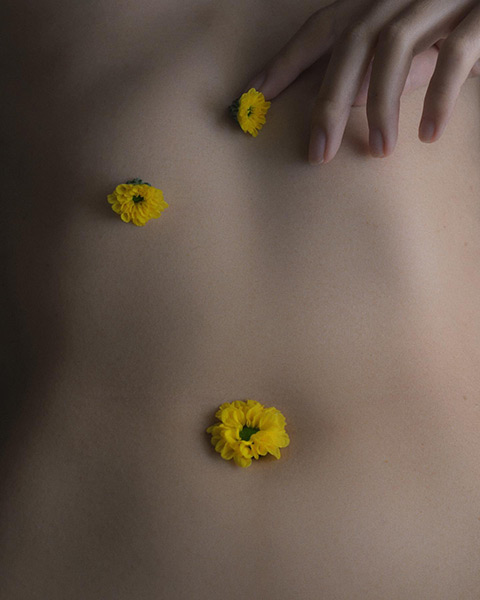
Fig. 2. Skin (n.d.)

The example I have picked from Liu’s Skin album (see. Fig. 2) is delicate. From the soft diffused light to the smooth texture of the skin in the frame. A pop of colour brings life to composition, possibly referencing the beauty of life’s process within nature and for us as human beings, we all have a life and death cycle that is fragile as one another. A gentle placement of the hand at the top, adds intimacy to the piece by touching and connecting with the human body. The pose isn’t tense or obnoxious, everything about it is calm and warm. Cropped framing brings you closer to the subject, enhancing the textures and shapes that the body has, something we all have so is a source of relatability. The tones are fairly neutral, but compliment the photograph as harsher colours, highlights and shadows would’ve created a jarring, intense image rather than a welcoming one. There is a subtle leading line throughout due to the placement of the flowers. Starting from the top and curving slightly round towards the bigger flower head on the belly button or back. The context for this composition is quite blurred as it’s unclear as to which part of the body this is, which I touched on in the previous sentence.

Art such as this feels personal, creating a story for the audience whether they know the context or concept beforehand. The human body is an incredibly relatable subject, the ‘flaws’ and marks that each of us have that show a journey or make us unique. It’s simple from an aesthetic standpoint, however, if you look deeper there is much more to be explored.

Intimacy in film and TV

Normal People has been considered one of the best television productions in the modern age, due to its handling of young love, the hardships and beauty of it all. It includes many intimate scenes which is unusual for BBC productions, however, they were directed beautifully, respectfully and it comes across through the camera extraordinarily. The shallow depth of field softens the environment around the characters, enhancing the delicate nature of the skin on show, lighting is warm and inviting, rather than cold and uncomfortable. Close framing respects the actor’s privacy as well as focusing on the parts of the body that make us human or add personality (see Fig. 3). This approach brings the viewers into a place that may be familiar, challenging or easing their feelings surrounding intimacy and image. Many sexual scenes are over the top, extreme and unrealistic to most viewers, so to have a variety of scenes that perfectly portray the reality of opening up and showing yourself to another or a mirror is powerful. It’s human.
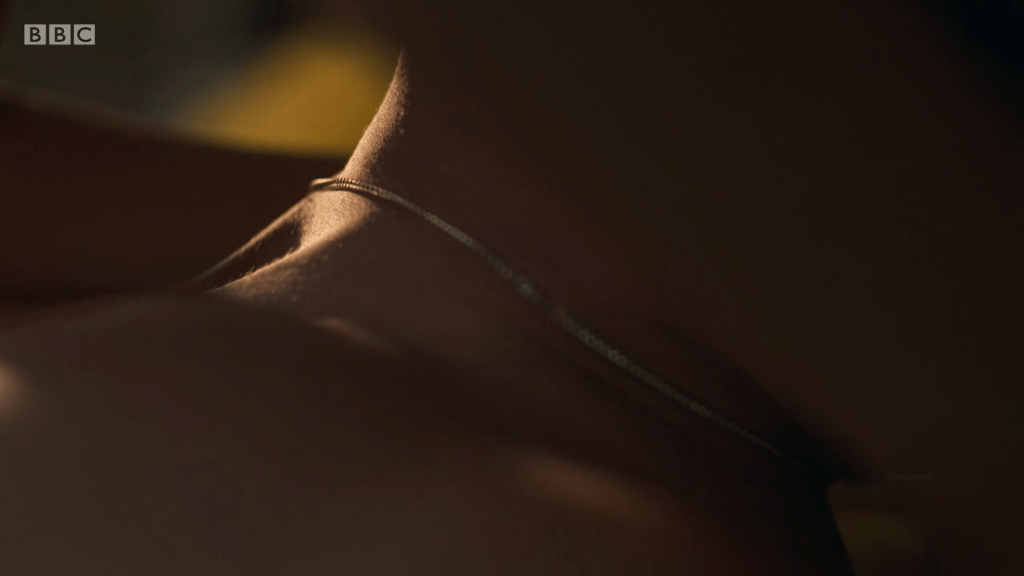
Fig. 3. Normal People (2020)


Reflection:

The open nature of this brief allows for a flexible brief without too many restrictions, it is up to us as the students to decide what we think the project should be about and how we’re going to portray that idea.

Taking the word ‘simple’ and exploring the minimalist art movement has been one way for me to inject the concept of photography being as such. However, gathering examples from minimalist photographers further supports my belief that despite a ‘basic’ composition, subject or theme, the background and makeup of the pieces are less than straightforward. Photography is full of thoughts, planning and meanings that flesh out the art, allowing the audience to connect with it more deeply.

Combining a minimalist art style, with the use of an instant camera and a complex subject such as the human body, a system full of organs, cells, DNA creates a juxtaposition between the aesthetic and concept. I would be able to fulfil the statement ‘Photography is simple’ while proving my point at the same time, creating a ‘for and against the type of project.

Going forward I intend to take a few test shots with my Instax instant camera to see how achievable this project will be.


References:

ARTPIL. (2019) Ziqian Liu [online] Available at: https://artpil.com/ziqian-liu/ [Accessed 14 June 2021].

Legacy User. (2012) History of Polaroid and Edwin Land [online] Available at: https://www.boston.com/uncategorized/noprimarytagmatch/2012/10/03/history-of-polaroid-and-edwin-land/ [Accessed 14 June 2021].

Parrot, P. (n.d.) 5 Minutes With a Photographer : Paloma Parrot [online] Available at: https://www.artifactuprising.com/photographer-interview-paloma-parrot [Accessed 13 June].

Powell, L. (2021) Initial thoughts on ‘Photography is simple’ [online] Available at: https://laurenpowelloca.photo.blog/2021/06/14/initial-thoughts-on-photography-is-simple/ [Accessed 14 June 2021].

Tate. (2017) Minimalism – Art Term [online] Available at: https://www.tate.org.uk/art/art-terms/m/minimalism [Accessed 14 June 2021].

Stella, F. (1966) ‘Questions to Stella and Judd’ In: What You See Is What You See p. 2. Available at: https://www.artnews.com/art-news/retrospective/what-you-see-is-what-you-see-donald-judd-and-frank-stella-on-the-end-of-painting-in-1966-4497/ [Accessed 13 June 2021].

List of images:

Figure. 1. Parrot, P. (2018) Upside Down [Instagram, screenshot] Available at: https://www.instagram.com/palomaparrot/
[Accessed 13 June 2021].

Figure. 2. Liu, Ziqian (n.d.) Skin [image] Available at: https://www.ziqianqian.net/skin [Accessed 14 June 2021].

Figure. 3. Abrahamson, L. (2020) Normal People: Episode 5 [BBC iPlayer, screenshot] Available at: https://www.bbc.co.uk/iplayer/episode/p089j889/normal-people-series-1-episode-5?seriesId=p089g8vv (Accessed 24th August 2021).

Exercise 5.3 – Looking at photography

Notes, Online Research, Part 5, Practitioner Research, Reflection on coursework, Thoughts & Ideas

Summary:

In this post I
– Included the exercise brief to re-visit Henri Cartier-Bresson’s photograph Behind the Gare Saint-Lazare (1982)
– Before inserting the image and explaining the point within the image I felt was the most signification and why.
– Referenced one of my own images to give context to the use of a focal point and the rule of thirds.
– Included a short reflection on the importance of understanding the pivotal points within a piece of art.

Brief:

If photography is an event then looking at photography should also be an event.
Look again at Henri Cartier-Bresson’s photograph Behind the Gare Saint-Lazare in Part Three.
(If you can get to the Victoria & Albert Museum in London you can see an original print
on permanent display in the Photography Gallery.) Is there a single element in the image
that you could say is the pivotal ‘point’ to which the eye returns again and again? What
information does this ‘point’ contain? Remember that a point is not a shape. It may be a
place, or even a ‘discontinuity’ – a gap. The most important thing though is not to try to
guess the ‘right answer’ but to make a creative response, to articulate your ‘personal voice’.

Include a short response to Behind the Gare Saint-Lazare in your learning log. You can be as
imaginative as you like. In order to contextualise your discussion, you might want to include
one or two of your own shots, and you may wish to refer to Rinko Kawauchi’s photograph
mentioned above or the Theatres series by Hiroshi Sugimoto discussed in Part Three. Write
about 300 words.
‘ (Bloomfield, 2018).

Behind the Gare Saint-Lazare re-visit:

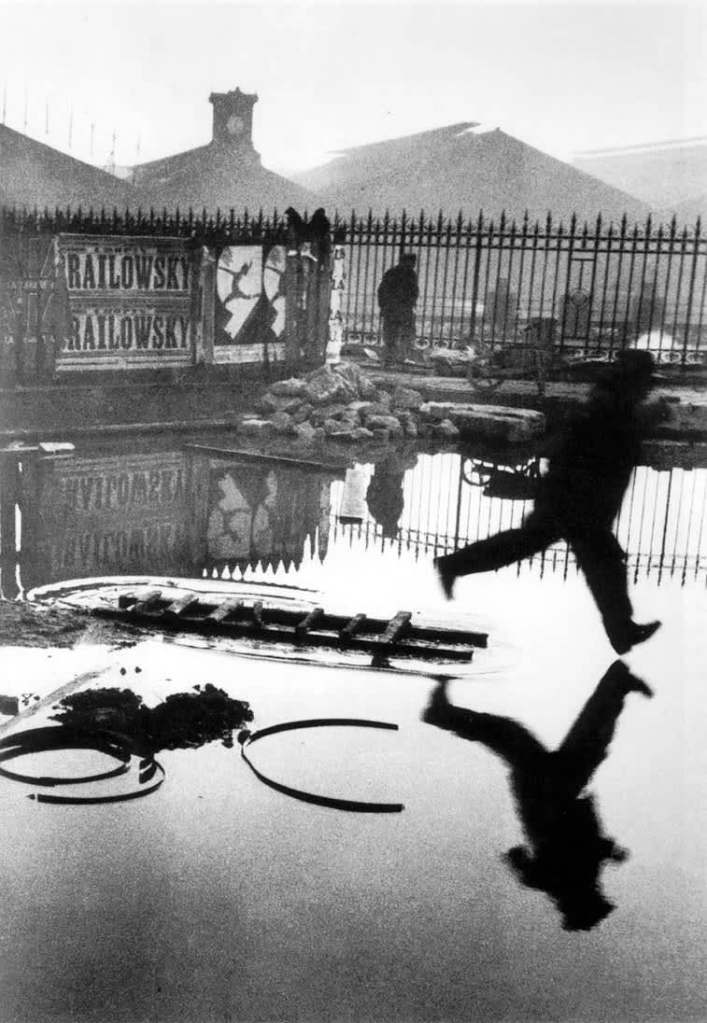
Fig. 1. Behind the Gare Saint-Lazare (1982)

Behind the Gare Saint-Lazare is extraordinary as Cartier-Bresson shot it through a small gap in the wall, unaware of the activity going on behind it. The pivotal point for this shot is the movement. Despite the composition being full of details, textures and shapes becoming a playground for the viewer to explore, the eyes are always drawn back to the blur within the shot. It stands out from the rest, a frozen backdrop in black and white while the mysterious shape to the right flies through the frame.

You are made aware of the direction of movement and the travel speed without being there in the moment. It’s an image that tells its own story, a moment of urgency on a wet day as they jumped over or through the puddles below. You want to know where they are going, why they are running and if something exciting or disastrous happened outside the frame.

The tonal balance within this picture is mixed, with the majority of them being light greys and white. Meanwhile, the silhouette and items nearby are heavily contrasted, making it difficult to ignore.

There is life within the frame, a definitive moment that took place and was unique in photographic execution. Not many images can document a piece of history intriguing enough for the audience to stay and observe it for a length of time over and over. While there may not be a clear leading line, there is an obvious focal point pushing the eyes to look and appreciate it whether they want to or not. It’s so powerful.

An example of drawing the eyes towards a particular point without a leading line features in one of my product images (see Fig. 1) through the use of the rule of thirds.

Fig. 2. Sloth (2021)

Reflection

Re-visiting an image can help you appreciate the piece of work, especially if you have more knowledge to hand. Understanding what ‘makes’ an image and shapes it, encouraging the viewer to look deeper and sit with the art for longer solidifies the importance of composition, balance and intent.

References:

Bloomfield, R., 2018. Photography 1: Expressing your Vision. 4th ed. [pdf] Barnsley: OCA, p. 109. Available at: https://www.oca-student.com/course/photography-1-expressing-your-vision [Accessed 13 June 2021].

List of images:

Figure. 1. Cartier-Bresson, H. (1932) Behind the Gare Saint-Lazare [image] Available at: https://en.wikipedia.org/wiki/Behind_the_Gare_Saint-Lazare#/media/File:Henri_Cartier-Bresson_-_Behind_the_Gare_Saint-Lazare,_1932.jpg [Accessed 13 June 2021].

Figure. 2. Powell, L. (2021) Sloth [image] In possession of: Lauren Powell: Eastleigh.

Exercise 5.2 Homage – Research point

Notes, Online Research, Part 5, Practitioner Research, Reflection on coursework

Summary:

In this post I;

– Included the research point brief and my response to it by referencing the text throughout.

– Inserted the exercise brief for ‘Homage’.

– Wrote a short paragraph about Carol Sharp and how she connects with her subjects while photographing

– Before comparing one of her images with my own as a homage

– Alongside a brief analysis of my response and the context

– Inserted a couple of extra images to show how I paid homage to Sharp’s work

– Included a past image from my archive, with a short analysis of the message and context behind it

– Before reflecting on what this exercise taught me

Research

For a short introduction to how context operates in relation to photographs, read Terry Barrett’s essay ‘Photographs and Context’: terrybarrettosu.com/wp-content/uploads/2017/08/B_PhotAndCont_97.pdf [accessed 25/01/18]. Barrett suggests that we interpret pictures according to three different types of information: information in the picture, information surrounding the picture and information about the way the picture was made. He calls these the internal context, the external context and the original context‘ (Bloomfield, 2018).

Images can be incredibly flexible in terms of context, based on the environment, the subjects within the frame, the colours or lack thereof. However, the context of a photograph can alter depending on whom it reaches. For example, in Terry Barrett’s Photographs and Contexts (Barrett, 1985) a photograph of a pair sat outside a bar taken by Robert Doisneau was given different contexts; to Gisele Freund’s knowledge, up to five times by various magazines, brochures and galleries. A few examples of this consist of accusations of sex work, alcohol abuse and seduction (Barrett, 1985).

The initial context behind Doisneau’s shot was simply a moment of charm as he enjoyed cafe’s and seeing the couple together was enjoyable.

‘Texts that surround the photograph eliminate any residual ambiguity’ (Barrett, 1985). If we were to put a picture of a beef burger on the front of a vegan magazine, it would probably cause some shock before going on to talk about the environmental effects and immoral behaviour of the industry, however, on the front of a restaurant menu, people would be enticed and seduced by how good it looked.

Images are used for other things, different to their initial intent. Pictures of lungs on a cigarette packet are used to encourage smokers to stop smoking before too much damage occurs but are initially used for scientific and medical research.

The placement of an image is another factor to consider for context. The display of a picture of people in poverty may glorify the situation for the benefit of art and a famous gallery rather than portraying the horrific effect on lives in a place you would expect to see such circumstances.

No matter where you are in the world or what language you speak, photography can be a source of communication for some people (Sander, 1978 referenced in Barrett, 1985:114), whether an artist is documenting their mental state or an audience expressing feeling by sending a photographic meme. Despite the global interaction with these photographs, they may not provide the same message to one person in the way it did to another. Context is still subjective depending on the viewer.

Internal context includes the image, title, date and maker. External context would be the presentational environment, so where it’s displayed. The original context is the ‘causal environment’, in other terms, the physical and psychological elements available to the photographer at the time of capture (Barrett, 1985).

To understand the context as an audience, we need to look deeper and consider everything, including what the photographer may have been doing or thinking at the time. These things combined will help us appreciate the make-up of the image a lot more.

Brief:

Select an image by any photographer of your choice and take a photograph in response to it. You can respond in any way you like to the whole image or to just a part of it, but you must make explicit in your notes what it is that you’re responding to. Is it a stylistic device such as John Davies’ high viewpoint, or Chris Steele Perkins’ juxtapositions? Is it an idea, such as the decisive moment? Is it an approach, such as intention – creating a fully authored image rather than discovering the world through the viewfinder? Add the original photograph together with your response to your learning log. Which of the three types of information discussed by Barrett provides the context in this case? Take your time over writing your response because you’ll submit the relevant part of your learning log as part of Assignment Five.‘ (Bloomfield, 2018).

Carol Sharp

“Carol Sharp is an award winning photographer and fine artist, renowned for her lyrical composition, attention to detail and her delicate touch with light.” (Carol Sharp, n.d.)

Sharp is UK based photographer who has over 20+ years of professional photographic experience, has featured in Chelsea Flower Show posters in the past. Her exploration of the world and its plants is a way to encourage society to reconnect with nature and empathise with it.

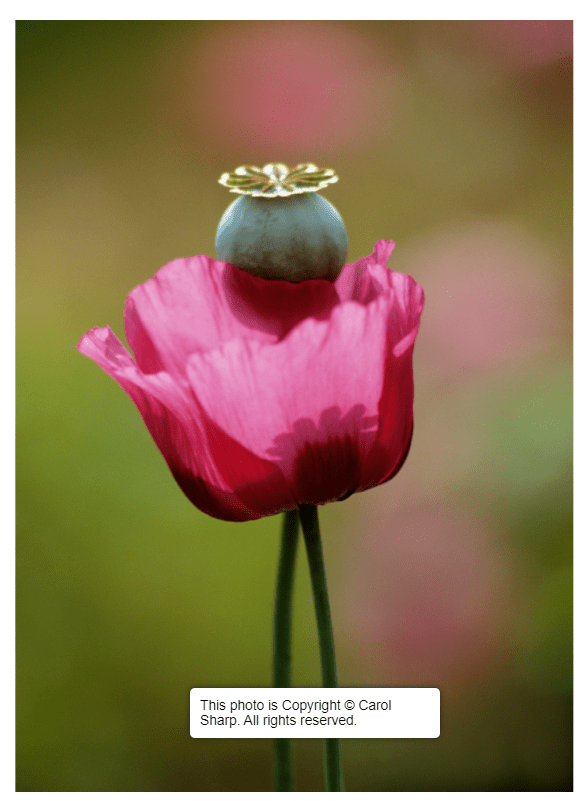
“I use different types of perception to not only see their form, but to understand the meaning of the form and to reveal its ‘gesture’. which means having a communion with my subjects and a desire to feel their very life force.” (Sharp, n.d.). Unlike the majority who may pass by a flower or tree without much notice, Sharp truly connects with her subjects to understand them and appreciate them. I think this shines through in her work as the framing is cropped and intimate as shallow depth of field emphasises the soft petals and delicacy of the foliage and flowers in the composition. Vibrant colours bring life to the images, subtly getting the viewer to realise that this life source is living, thriving and a powerful part of our world. Flowers, trees, moss and other forms of plants keep this world functioning, helping us live and grow. It’s important to be grateful for what is around us, something Sharp does very well.

Due to how Sharp talks about her work and the passion for her subjects, I would say that the original context is the most prominent context type in these images. Bearing in mind the importance to the maker, it heavily influences how the viewer sees the subject, making it feel more personal and ripe with life. The images are not just another simple set of shots of a bunch of flora and fauna as time and energy have been taken by the creator to capture the beauty.

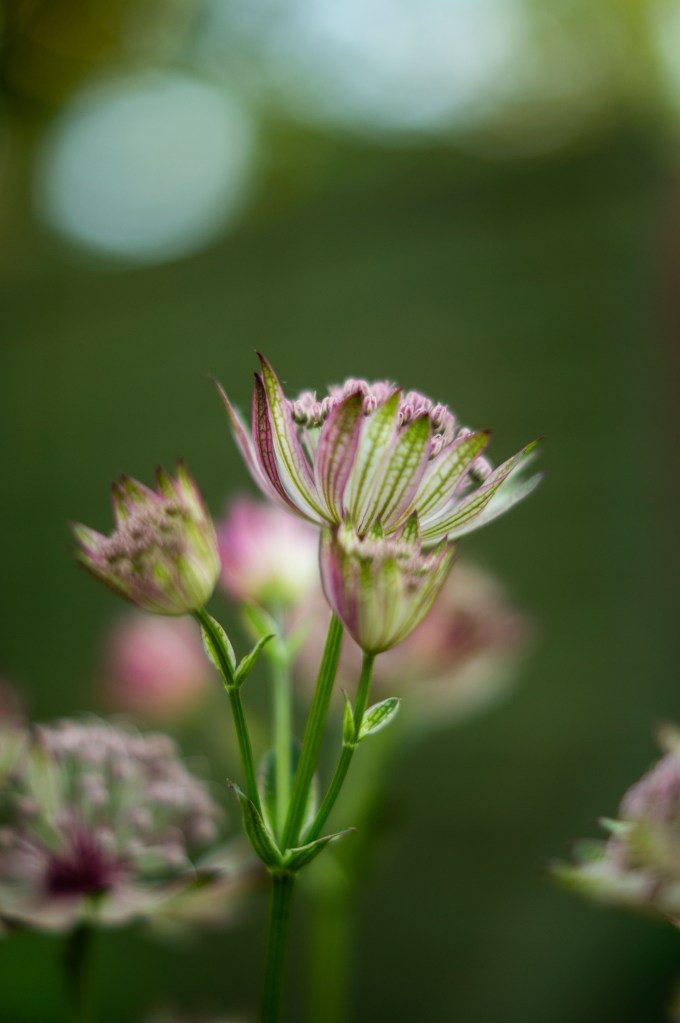
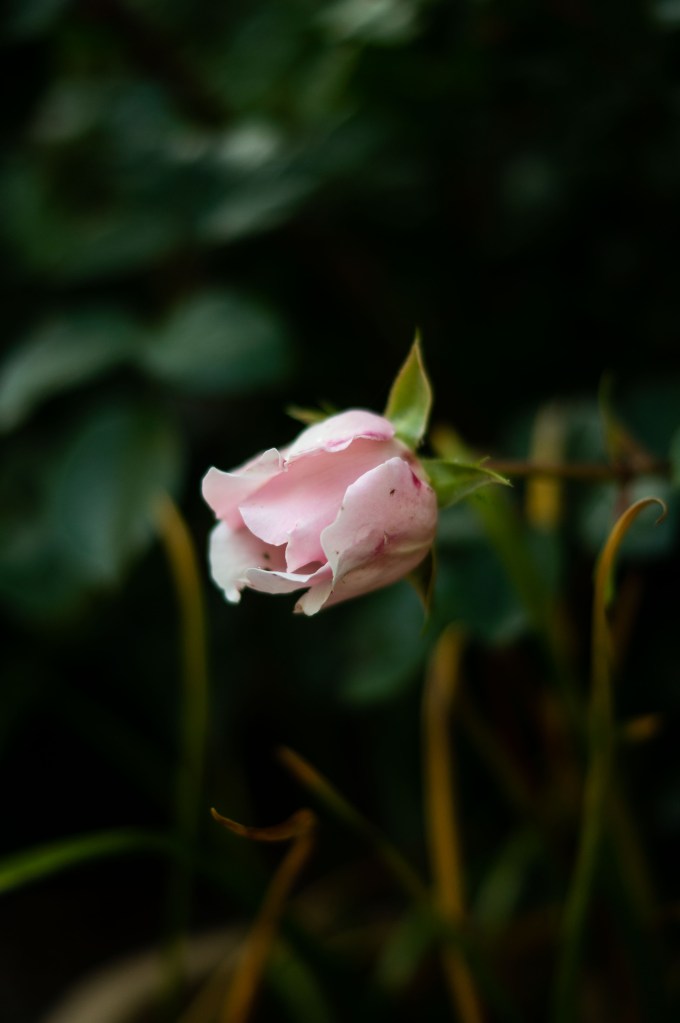
The selection of images I paid homage to for this exercise came from the Plant Portraits (n.d.) album.

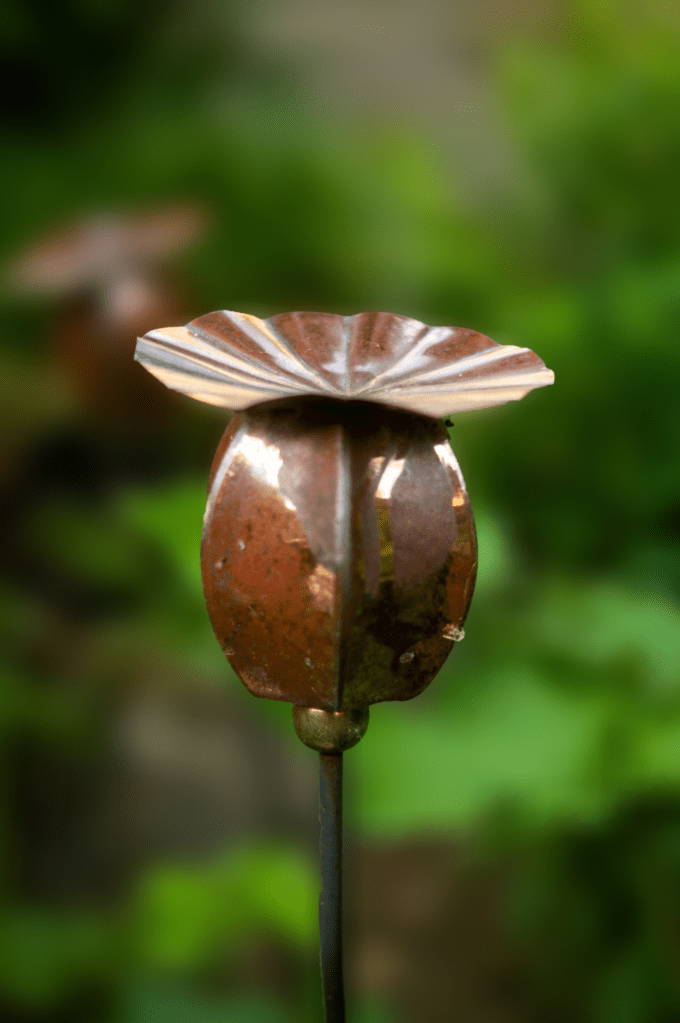
My SONY A57 camera was on manual mode, the aperture was at F/1.8, the shutter speed was 1/250 and ISO was set to 100. The shooting process was simple as I took a walk around my garden during dusk, capturing a few of the flowers available to me. The response to this exercise was to keeping original context at the forefront of my mind by analysing the subjects and connecting with them before pressing the shutter. A creamy shallow depth of field and cropped framing were two of the most important visual and technical elements to include during this shoot.

Homage 3 (see Fig. 2) referenced the feature of a poppy seed head in Sharp’s image (see Fig. 1.) by capturing the metal sculpture in my garden, a permanent piece of art, unlike an actual poppy. Using an aperture of F/1.8 enabled me to get the creamy bokeh effect that flows throughout Sharp’s work so beautifully; focal points draw the eyes of the audience to the subject, all of its details, the textures and colours. Cropping the frame brings the object closer to the camera lens, allowing the viewer to observe it more intimately and connect with what is going on within the composition. Contextually, this metal poppy head was a gift to my dad from my mum for his birthday, so holds a deeper meaning for me, much like Sharp attaches to her subjects to appreciate it more. The colours within Plant portraits are vibrant, warm and full of life, while tones within my homage are earthy, so despite it being artificial, the subtle connection to nature and its rich soil is a clever addition to my piece. From a conceptual point of view, the relationship between the two shots juxtaposes despite a few similarities. Sharp embraces the life and death of plants, reconnecting to their importance for our survival as living beings. On the other hand, I have captured a replica of a pollinating plant that will never pollinate, an unintentional parody of how humans keep making things that do not benefit the world environmentally.

Original context brings more personality to photographs as you understand why it was taken, how it made the creator feel, what was going on at the time and the image that was achieved as a result. It pushes the audience to explore it to understand it as a whole composition rather than a simple picture. The work I shot may be unoriginal visually, but the extra level of information lifts it and makes it a rich piece of art.

The internal and external context is just as important but feels less characteristic for some artworks in my opinion as it allows the viewer to come up with their own story as to what the photograph contains and what it may be portraying. Some photographs need that extra bit of information to steer the observer in the right direction.

Here are a few other images I took for this exercise:


Homage example from past archive:

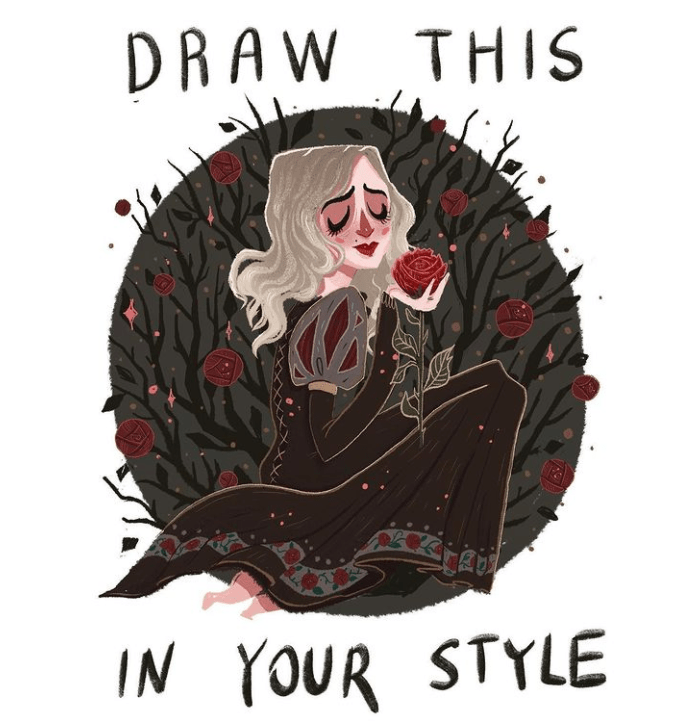
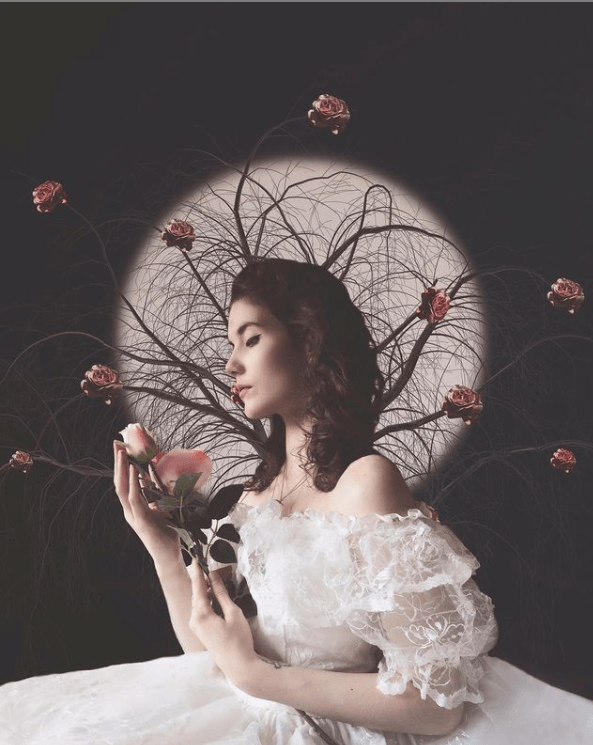
While this isn’t a homage inspired by a photographer, it was an image I created as a tribute to the Draw this in your style (2019) drawing by Ellie Goldwine on Instagram. My response to this piece was approached with intent, having complete control over the props used, outfits and makeup worn, as well as the background, pose and editing. It became a reversed image of the original piece (see Fig. 5), the dress chosen for my composition (see Fig. 6) was the opposite colour creating a juxtaposition between the two. Rather than red roses, light pink roses were used and the circular framing around the drawing in my piece represented the full moon. Everything about the photograph I created was intentional, as the brief was to create something in your style from the reference given.

The context for this piece was internal, as it was inspired by the Draw in your style title and image. Without this information, I may not have been encouraged to replicate it at all.

Reflection

This research point and exercise helped me understand the importance of context, the different types and how the portrayal of images original intent can be influenced. An images original message can be changed through the way it is displayed, the environment in which it’s found, the title and other such information. The original context is a type that features heavily in my work when given the chance, as personality and background mean a lot to me when it comes to creating a piece of work.

References:

Barrett, T., 1985. Photographs and Contexts. [pdf] pp. 110-116. Available at: http://terrybarrettosu.com/wp-content/uploads/2017/08/B_PhotAndCont_97.pdf [Accessed 13 June 2021].

Bloomfield, R., 2018. Photography 1: Expressing your Vision. 4th ed. [pdf] Barnsley: OCA, p. 106. Available at: https://www.oca-student.com/course/photography-1-expressing-your-vision [Accessed 13 June 2021].

Elliegoldwine. (2019) Draw this in your own style [online] Available at: https://www.instagram.com/elliegoldwine/ [Accessed 13 June 2021).
Sanders, A. (1978) ‘Photography as a Universal Language’ In: Photographs and Contexts. [pdf] p. 114. Available at: http://terrybarrettosu.com/wp-content/uploads/2017/08/B_PhotAndCont_97.pdf [Accessed 13 June 2021].

Sharp, C. (n.d.). Biography – Carol Sharp [online] Available at: https://www.carolsharp.co.uk/biography [Accessed 13 June 2021].

Sharp, C. (n.d.). Plant portraits – Carol Sharp [image] Available at: https://www.carolsharp.co.uk/biography [Accessed 13 June 2021].

List of images:

Figure. 1. Sharp, C. (n.d.) Plant portraits [Carol Sharp, screenshot] Available at: https://www.carolsharp.co.uk/plant-portraits [Accessed 13 June 2021).
Figure. 2. Powell, L. (2021) Homage 3 [image] In possession of: Lauren Powell: Eastleigh.

Figure. 3. Powell, L. (2021) Homage 1 [image] In possession of: Lauren Powell: Eastleigh.

Figure. 4. Powell, L. (2021) Homage 5 [image] In possession of: Lauren Powell: Eastleigh.

Figure. 5. Elliegoldwine. (2019) Draw this in your own style [Instagram, screenshot] Available at: https://www.instagram.com/elliegoldwine/ [Accessed 13 June 2021].

Figure. 6. Powell, L. (2019) Rose [image] In possession of: Lauren Powell: Eastleigh.


Exercise 4.4 – Personal Voice

Online Research, Part 4, Practitioner Research, Reflection on coursework, Thoughts & Ideas

In this post I have:

– Provided the brief for this exercise,
– As well as writing a short research point about Ernst Haas and his photograph Geranium, USA 1961.
– Inserted a screenshot from google, having searched “Green leaves” as my subject,
– Before explaining my shoot plan in brief, along with camera settings.
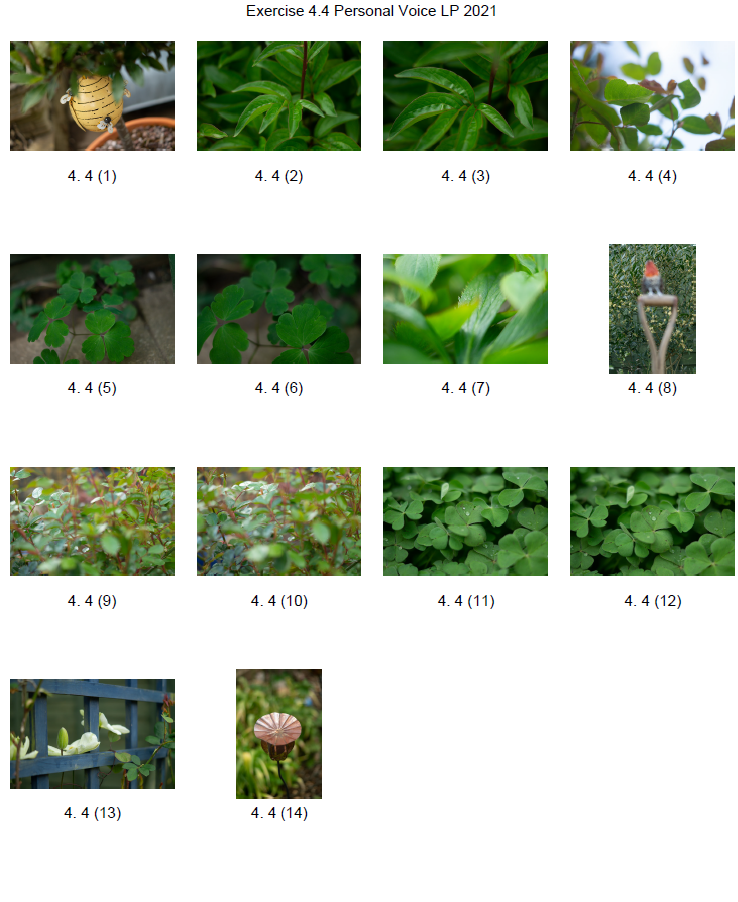
– My contact sheets for this exercise are attached to show a variety of shots,
– But only one final image was chosen and analysed in further detail.
– A short reflection at the end explains how this exercise has confirmed to me that each image is different and unique, regardless of subject.

Brief

Make a Google Images search for ‘landscape’, ‘portrait’, or any ordinary subject such as ‘apple’
or ‘sunset’. Add a screengrab of a representative page to your learning log and note down
the similarities you find between the images.
Now take a number of your own photographs of the same subject, paying special attention
to the ‘Creativity’ criteria at the end of Part One. You might like to make the subject appear
‘incidental’, for instance by using focus or framing. Or you might begin with the observation
of Ernst Haas, or the ‘camera vision’ of Bill Brandt. Or if you’re feeling bold you might forget
about your camera completely and think about the tricky question of originality in a
different way – http://penelopeumbrico.net/index.php/project/suns/
Add a final image to your learning log, together with a selection of preparatory shots. In
your notes describe how your photograph or representation differs from your Google
Images source images of the same subject
‘ (Bloomfield, 2018:96).

Research:

Ernst Haas (1921 – 1986)

Ernst Haas was a well known European photographer, born in Vienna, Austria; mostly celebrated for his involvement in colour photography and his work documenting the Austrian prisoners of war returning home. Haas moved to the United States in his 30’s where he began exploring Kodachrome Colour Film, in turn, making him one of the first to have a colour photo feature in LIFE magazine (Ernst Haas Estate, 2018). A few years later, his work was exhibited in New York’s MoMA and again was one of the first colour photography exhibitions.

The Ernst Haas Estate website has a wide range of Haas’ photographic works from across the years, exploring both his B&W pieces, portraiture, coloured compositions using multiple techniques and subjects such as flora, rubbish, people and architectural elements. 

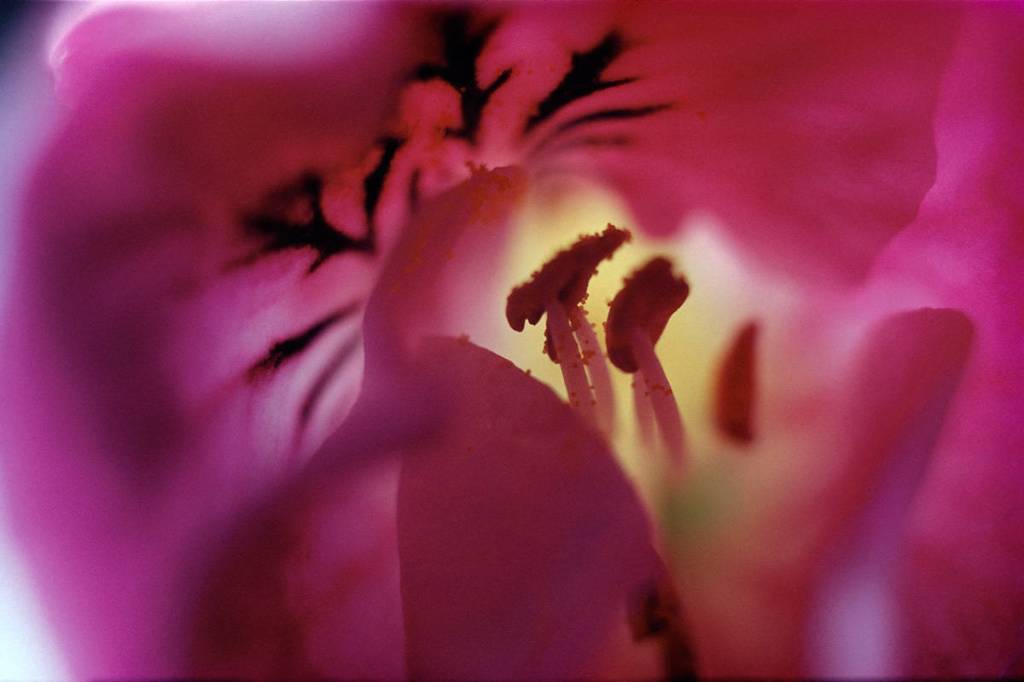
Haas’ New Color Collection: Creation (1959-85) is more neutral in its colour palette, enhancing the earthy colours within the earth’s desert locations and the animals that inhabit them, whereas his Classic Color Collection: Creation (1960-81) is vibrant, full of flora, snow and water. Geranium, USA 1961 (see fig.1) is one of my favourites from the Classic Color Creation collection, as the use of what seems to be a macro lens, captures the minute vein details within the flower petals, the ‘hairs’ of the stamen as it’s surrounded by a warm yellow glow in amongst a sea of pinks.

Shallow depth of field allows the subject that isn’t in the frame to be out of focus and soft, in this case, enhancing the delicate nature of the flower petals and how silky they feel to the touch. Haas captures his subjects in a more detailed and intimate way, rather than shooting them from a distance to get the whole object in the frame. This helps us understand the beauty of nature much more and gives us the ability to explore what some of us may not have taken the time to examine.

Fig. 1. Geranium, USA (1961)

Shoot plan:

Fig. 2. Green Leaves (2021)

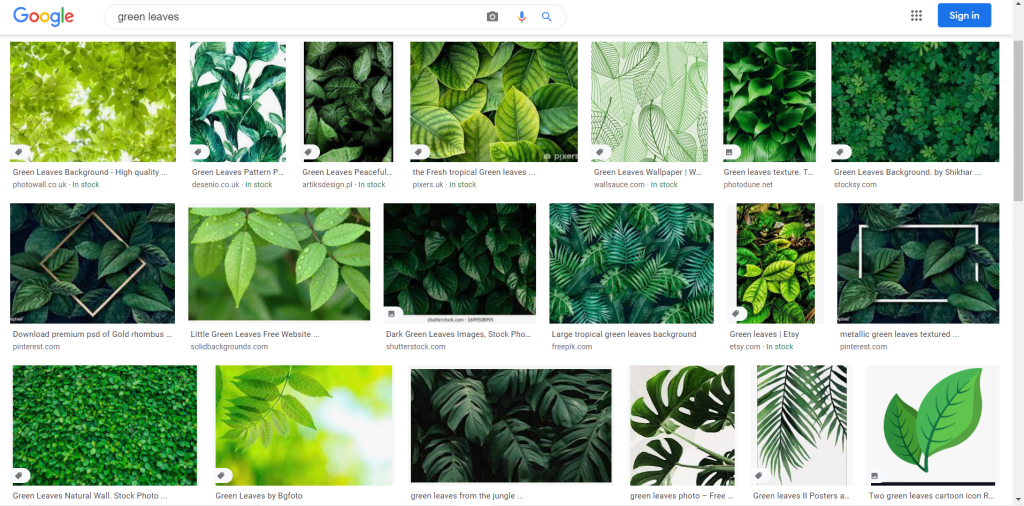
For this exercise, I googled “Green Leaves” (see Fig. 2) to see the variety of images that would come up and how I could explore this subject in my photography. Thankfully there was enough of a range that I could take inspiration and look around my garden to see what I could find in correlation to this search.

My SONY A57 was on manual mode, as was the Sony DT 50mm F1.8 SAM lens, this was so I could have more control over the focus and shutter speed for the exposure. The ISO was at 100, while the aperture was set to f/1.8 to achieve a shallow depth of field when capturing the leaves in a group or in front of other objects. The exercise was quick and easy as it took place in my garden, but despite the ease it beneficial as well as successful.


Contact Sheet:

Fig. 3. Contact sheet (2021)

Final image for analysis:

Fig. 4. 4.4 8 (2021)

By observing and looking further into the subject at hand (see fig. 2), I was able to capture the fine, wrinkled veins of the leaves through the shallow depth of field in the foreground. They look similar to the wrinkles we find on the palm of our hands, which go in all sorts of directions, are different depths and shapes. The natural light bounces off of the leaves from the left, giving texture to the image and helping the viewer understand that this is a smooth and shiny leaf, as opposed to a rough, matte leaf. The focal point being in the midframe pushes the eyes to be drawn into the image, rather than the subject being in the foreground and giving the audience a direct path to reach. It’s more like rummaging through the leaves yourself via a photograph, which is a fun concept to me. Shooting this in landscape was a reference to the majority of the images found via google, however, the differences between this composition and the ones in the screenshot make it my own. 

None of the images in the screengrab includes the focal point being midframe or behind a group of other leaves, creating a ‘blockage’ in the foreground. The use of shallow depth of field is used, but the subjects are directly in the foreground, creating a blurred background instead. Most of the green leaf shots seen above are darker and more tropical, whereas the exposure for mine is light, airy and a more typical form of leaf you would find in the garden. Lighting in the google searches is usually either coming from behind the leaves or lit from above minus a few exceptions in the middle row. The final image I have chosen feels like an adventure that you feel involved in, to understand the details, whereas the photographs above provide a clear frame of leaves, in focus, detailed and pretty direct.

Reflection:

While images may be the same in terms of subject matter, orientation or colour, it depends on how it is captured that makes the difference. For example, Ernst Haas’ choice to shoot images of flora up close and personal, allows the viewer to understand the parts that make up a flower, rather than the subject as a whole. 

Taking the time to observe, explore and look at what you are capturing, brings a whole new depth into the photograph as you connect with it more, you’ve planned it and taken the time to understand the composition more. Every image is unique, no matter whether it’s framed the same way or not, they are taken at different times, by different people, with a variety of equipment, weather changes, life circumstances and so much more. Sometimes you may not even intend to shoot a particular subject, but it makes its way into the frame anyway which is wonderful.

Each photograph is always different and personal to each individual, no matter how many times it’s documented.


References:

Bloomfield, R., 2018. Photography 1: Expressing your Vision. 4th ed. [pdf] Barnsley: OCA, p. 96. Available at: https://www.oca-student.com/course/photography-1-expressing-your-vision [Accessed 10 May 2021].

Ernst Haas Estate. (2018) Biography | Ernst Haas [online] Available at: http://ernst-haas.com/biography/ (Accessed 10 May 2021).
List of images:

Figure. 1. Haas, E. (1961) Geranium, USA 1961 [image] Available at: http://ernst-haas.com/classic-color-creation/ (Accessed 10 May 2021).

Figure. 2. Powell, L. (2021) Green leaves [Google, screenshot] In possession of: Lauren Powell: Eastleigh.

Figure. 3. Powell, L. (2021) Contact sheet [pdf, screenshot] In possession of: Lauren Powell: Eastleigh.

Figure. 4. Powell, L. (2021) 4.4 8 [image] In possession of: Lauren Powell: Eastleigh.

Exercise 4.1 – Daylight

Online Research, Part 4, Practitioner Research, Reflection on coursework

Summary:

In this post I have

– Mentioned the brief for this exercise.
– Briefly explained my process for choosing Eugene Atget as my starting point for these images.
– Gave a short description about Atget’s work and what he was well known for, plus his approaches.
– Briefly covered where I was taking my images and why.
– Listed my camera settings and the reasoning behind these choices.
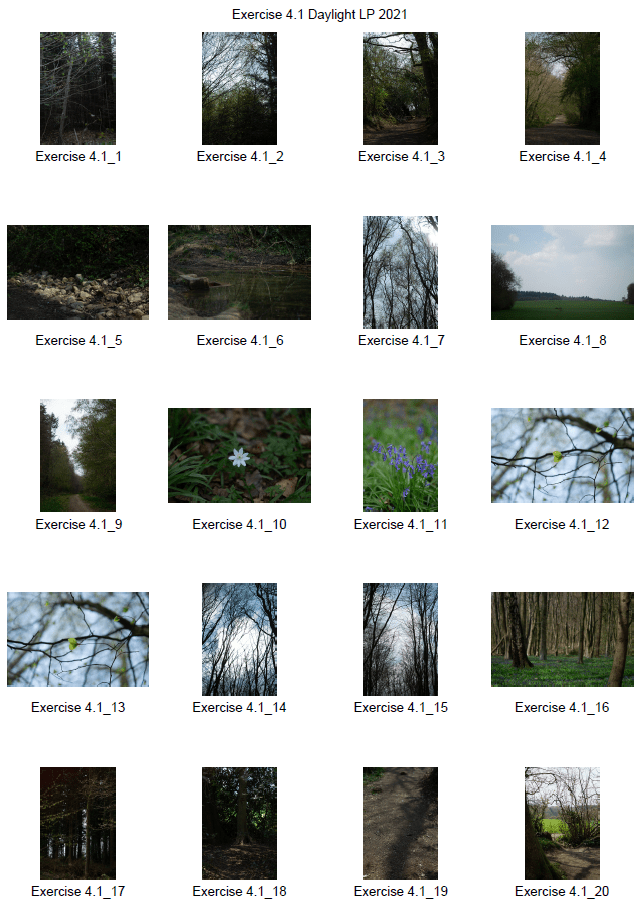
– Included contact sheets of all the images shot for this exercise and picked out 5 to analyse.
– Gave a short analysis for each chosen image, exploring the light and how it effected the compositions.
– Reflected on this exercise as a whole and what it taught me.

Taking the photography of Mann, Atget or Schmidt or a photographer of your own
choosing as your starting point, shoot a number of photographs exploring the quality of
natural light. The exercise should be done in manual mode and the important thing is to
observe the light, not just photograph it. In your learning log, and using the descriptions
above as your starting point, try to describe the quality of the light in your photographs in
own words
‘ (Bloomfield, 2018).

To avoid overthinking the practitioner in which I would gain inspiration, I searched each one via Google and scanned through a few images to see which one stood out most to me. By doing this, I was drawn towards Eugène Atget, as his work contains a variety of approaches as mentioned in the EYV coursebook; ‘He usually made such images – see, for example, Environs, Amiens – in the middle of the day, when shadows were minimal. Atget’s late photographs, however, are frequently marked by subjective light and deep shadows’ ([Artist description], n.d).

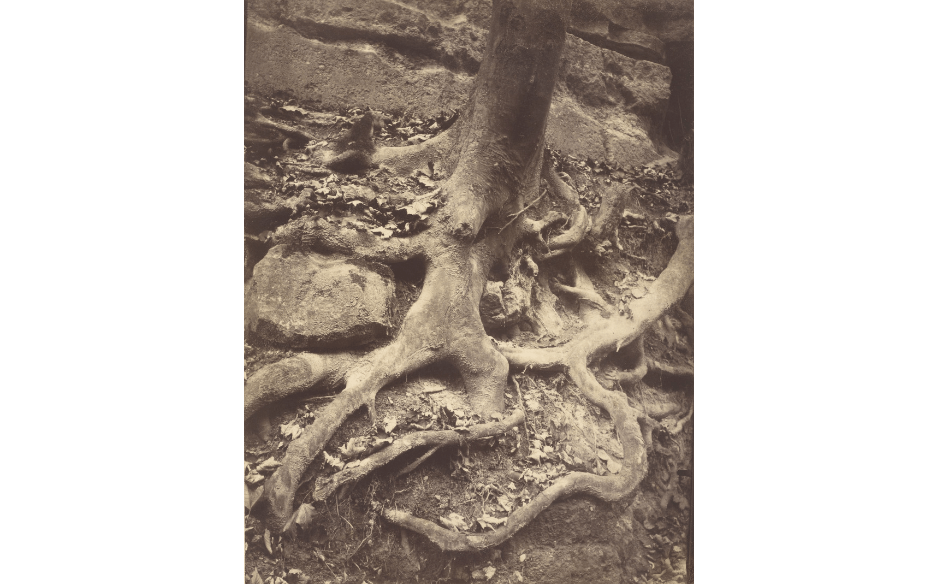
Atget was a French photographer who is well known for his imagery of the architecture and streets within Paris. Keeping the idea of outdoor photography in mind, I took the opportunity to complete the exercise while out on a walk around the woods. Quite a few of his works included nature, trees especially (see Fig. 1) so my images were still taking influence even without architecture or street imagery.

Fig. 1. Saint-Cloud, Tree Roots, Saint Cloud Park (Atget, 1906)

While most of his works featured diffused light, in turn capturing a clear and detailed composition, there were also the occasional shots that included heavy shadows or highlights to provide depth and show silhouettes of the surroundings or subjects. The dynamic approach is what I took on board while exploring my surroundings, allowing me to capture a range of images that fell into both of these categories.

Contact Sheets:

Before shooting images, I set the white balance to auto mode to avoid any artificial temperature changes within the camera. The aperture was set to F1.8 for no other reason than personal preference and set the camera mode back to manual following a mini light meter exercise. My 75mm lens was also set to manual mode, allowing me to take time to observe the light and actively be aware of the depth of field for each area I shot.

Images for analysis:

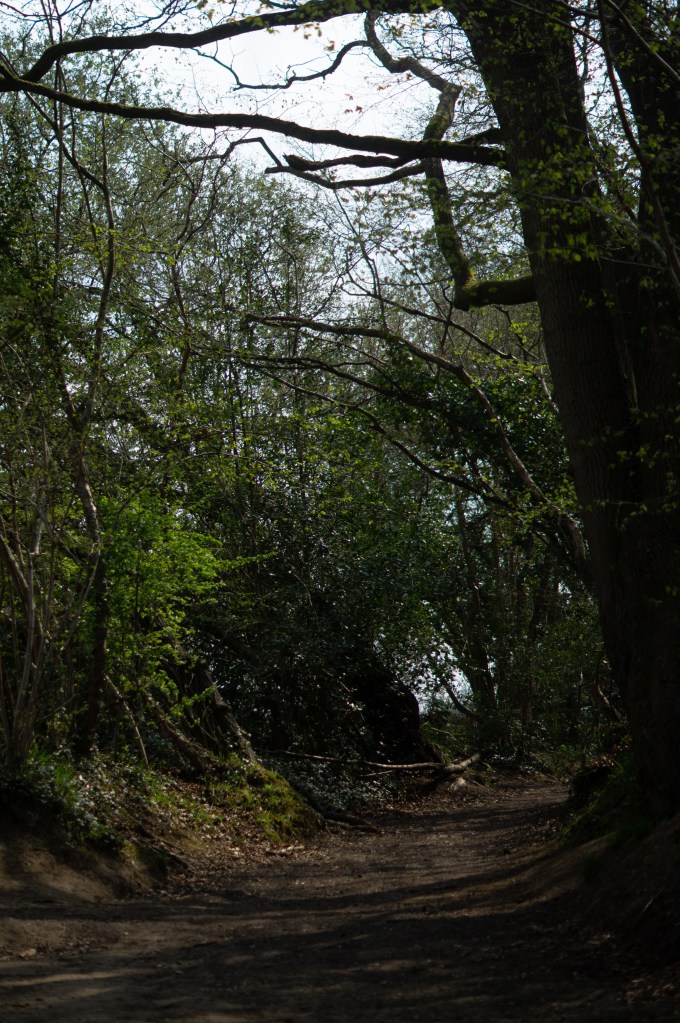
1 – The light shining through the trees from the east caused shadows to fall on the sunrays below. The sky is bright but not so much that it has blown out the composition. The leaves on the left show warmth from the sun, juxtaposing the cool and shadier shadows. Shooting this image as a portrait has allowed the tall trees to frame the top, providing context to what is blocking the light and how closed in this location is.

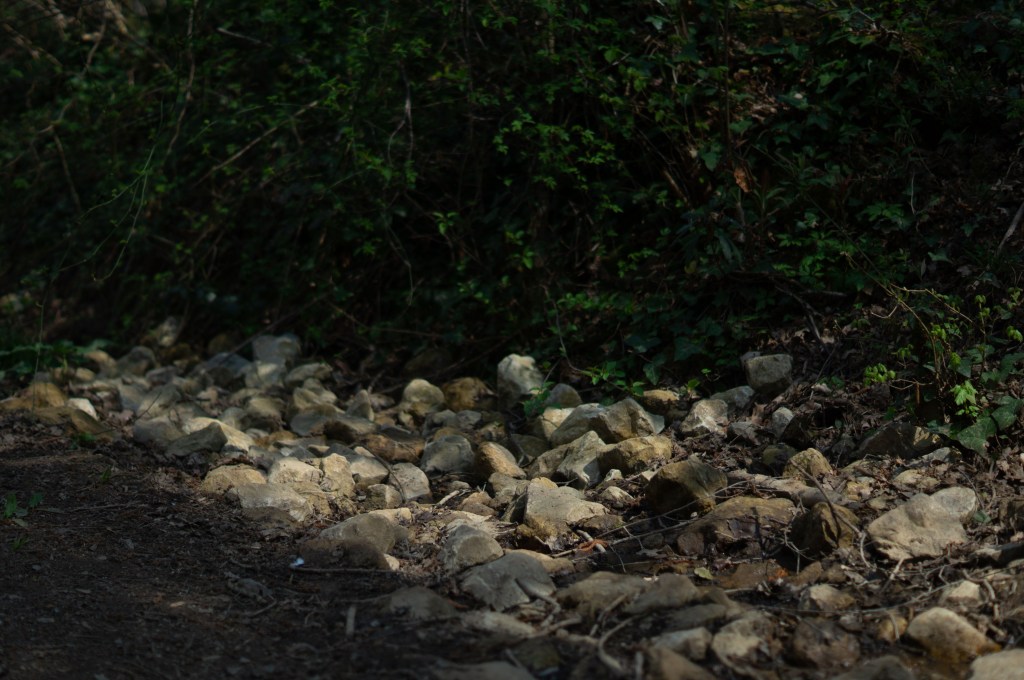
2 – The small patches of light that shone through the gaps within the leaves of bushes and trees create a focal point for this photograph by enhancing the darker areas within the frame. The size and textures of the rocks are enhanced by the contrast of highlights and shadows, preventing them from looking flat and smooth. Light can be used as a spotlight for the subject, leading the viewer towards the significant elements within the composition.

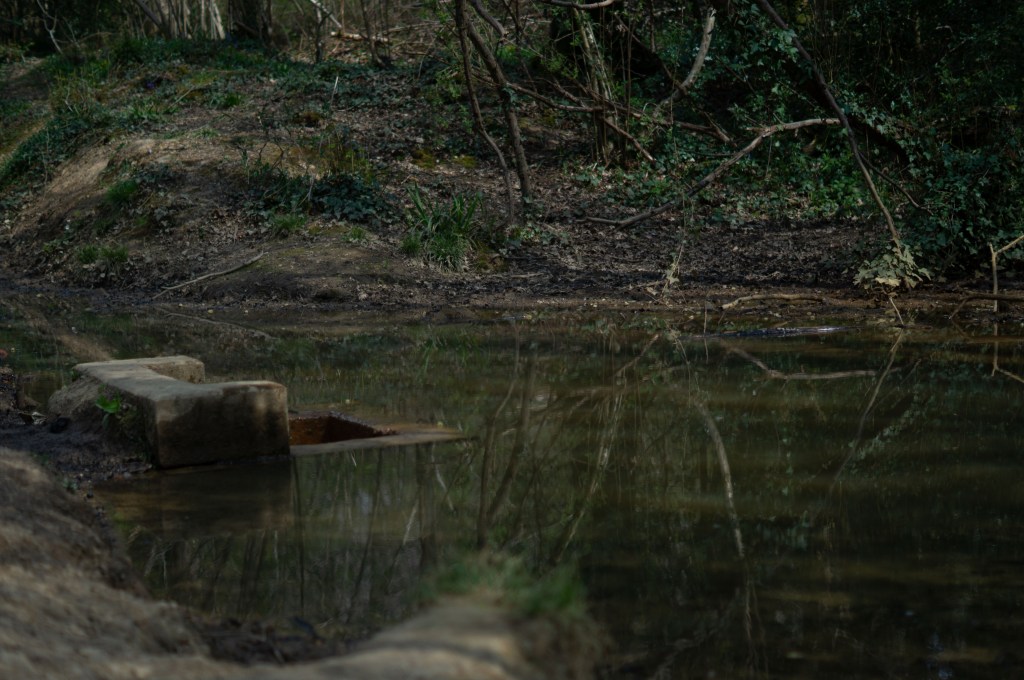
3 – Unlike the previous photographs, this one is more diffused and lacks much depth. Despite the lack of shadows and highlights, there are still reflections and shapes within the water that provides movement and texture to the composition. In my opinion, it feels less exciting as the colours are neutral. Nonetheless, exploring the importance of natural light and its effect on a subject is what this exercise is all about, whether we like the result or not.

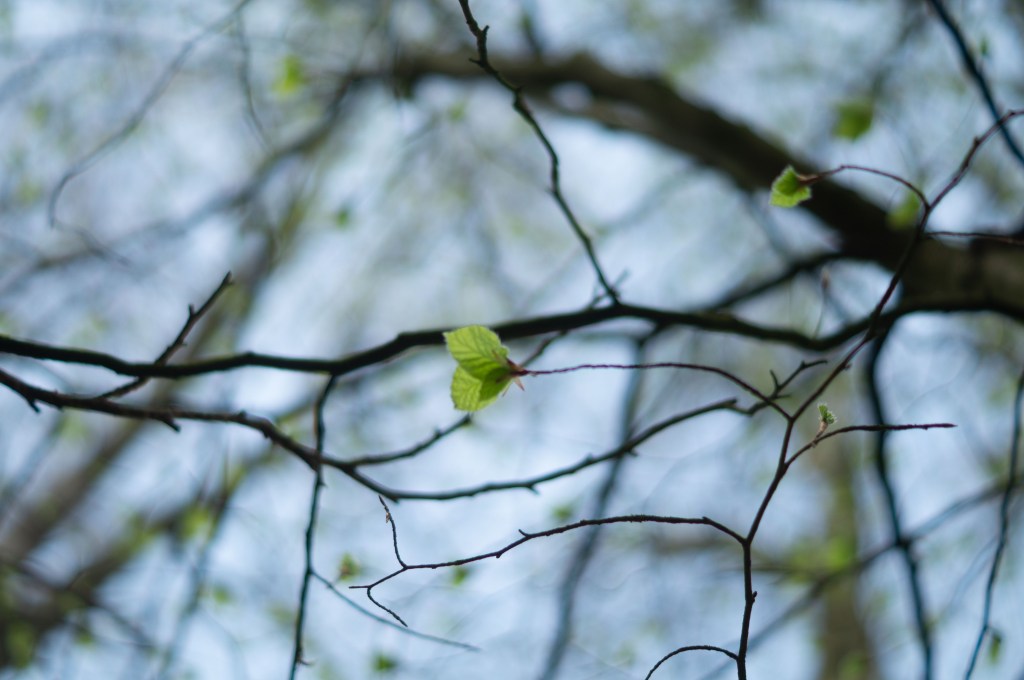
4 – The light came from behind the camera, as opposed to the sides or directly in front of the lens. As a result, instead of capturing the silhouette of the leaves and branches, we can see the light green and veins of the leaves. Other images in this collection lack a deep depth of field because of the enclosed areas, so to capture such a soft, diffused image that is also full of depth shows how light and location can affect the mood or overall result of a piece of work.

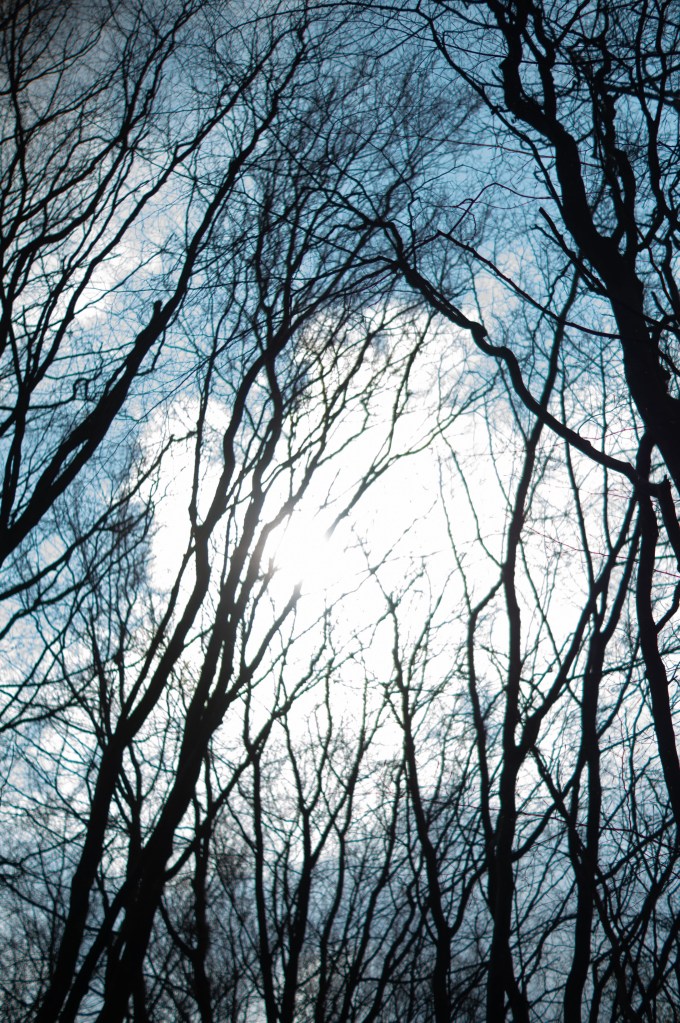
5 -Shooting directly at the sun has caused the camera to capture the skeleton silhouettes of the group of trees in the frame. There is no light from behind to shine on the branches to illuminate the textures of the wood, so they become spindly lines that are cutting through the sunrays. Due to a clear sky, we can see small patches of blue that bring a pop of colour to an eerie photograph. The sun glare in this shot creates a juxtaposition between images 2 and 4, where the light is bright but not enough to cause the lens to be overwhelmed.

Reflection:

This exercise helped me understand the power of light and the significance that it has within photography. Without it, capturing images would be impossible, but playing around with light and observing how it falls can be the difference between a good and bad image. I have learnt that I prefer using more dynamic and contrasting light rather than diffused when it comes to outdoor photography due to the enhanced shapes, textures and colours within the composition. My favourites from this image set are 2 and 5 (see Fig. 5., and Fig. 8), for that very reason. Diffused natural light feels better suited for indoor photography from a personal standpoint. Ultimately, however, it depends on the picture and what effect you want to create, as seen in image 4 (see Fig. 7).

References:

[Artist description]. (n.d) Photography 1 Expressing Your Vision Barnsley : OCA.

Bloomfield, R., 2018. Photography 1: Expressing your Vision. 4th ed. [pdf] Barnsley: OCA, p.84. Available at: https://www.oca-student.com/course/photography-1-expressing-your-vision [Accessed 22 April 2021].

List of images:

Figure. 1. Atget, E. (1906) Saint-Cloud, Tree Roots, Saint Cloud Park [Photograph] Available at: https://www.getty.edu/art/collection/objects/63460/eugene-atget-saint-cloud-tree-roots-saint-cloud-park-french-negative-1906-print-1920s/ (Accessed 22nd April 2021).
Figure. 2. Powell, L. (2021) Contact sheet 1 [pdf, screenshot] In possession of: Lauren Powell: Eastleigh.

Figure. 3. Powell, L. (2021) Contact sheet 2 [pdf, screenshot] In possession of: Lauren Powell: Eastleigh.

Figure. 4. Powell, L. (2021) 1 [image] In possession of: Lauren Powell: Eastleigh.

Figure. 5. Powell, L. (2021) 2 [image] In possession of: Lauren Powell: Eastleigh.

Figure. 6. Powell, L. (2021) 3 [image] In possession of: Lauren Powell: Eastleigh.

Figure. 7. Powell, L. (2021) 4 [image] In possession of: Lauren Powell: Eastleigh.

Figure. 8. Powell, L. (2021) 5 [image] In possession of: Lauren Powell: Eastleigh.


Further research on the Decisive Moment + practitioner research

Assignment 3, Notes, Online Research, Practitioner Research

Summary:

For this post I have;

– Researched the ‘Inspired’ moment, written by Olivier Duong, to further understand the Decisive Moment in a slightly simpler form.

– Written three detailed paragraphs about Henry Cartier-Bresson, Garry Winogrand, Bruce Davidson and KayLynn Deveney, exploring their career history, what they capture and why.

– As well as writing a short analysis for one or two images from each practitioner, stating what I enjoyed about their work and what I took from it.

– Before reflecting on the post as a whole.

The ‘Inspired’ Moment

The Decisive Moment for me is one of those topics that I believe is clear to understand at first until I find myself questioning it once more, therefore I have found a definition that strips the technique down to the bare basics.

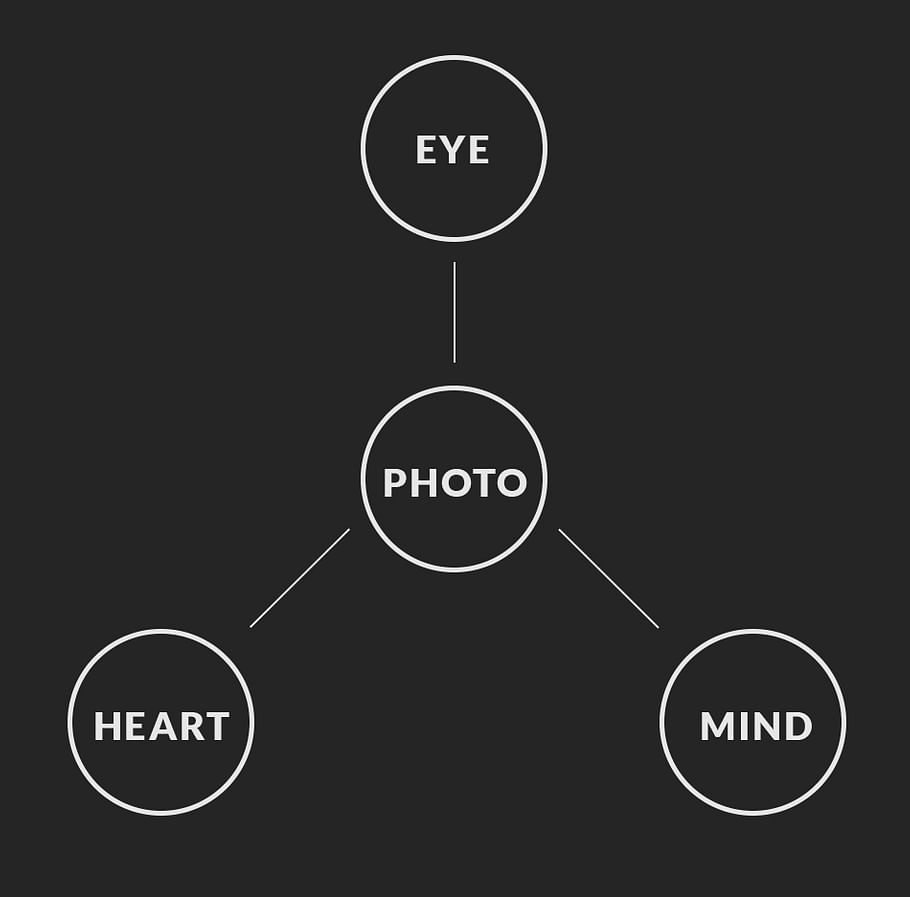
Olivier Duong also struggled to piece together the elements that make up a Decisive Moment, so took it upon themselves to break it down into their own words, or as they call it ‘The Inspired Moment’ (Duong, 2013). A diagram of the Inspired Moment (see Fig. 1.) shows the alignment of the photographer’s eye, the photograph, the heart and the mind, a combination of compositions, emotions and thoughts that pull together to create that ‘perfect’ moment (Duong, 2013).

Fig. 1. Decisive Moment (2013)

Duong continues to describe the Decisive moment in terms of time; Chronos and Kairos time. Chronos being ‘linear time’ and a much more definitive view on time, whereas Kairos is opportune and varies, as is the Decisive Moment. A Decisive Moment can happen at any time, hence you have to grab it when it arises or you will miss it, ‘you could not catch him by the hair because he is bald from the back’ (Duong, 2013). You must always be responsive and ready for any given moment, see it and shoot, have your camera settings ready to avoid missing the shot.

In summary, you must see the image in your mind’s eye, be ready both physically, mentally and technically and shoot before you miss. 

Henri Cartier-Bresson (1908-2004)

Henri Cartier-Bresson was a photographer, painter, filmmaker and prisoner of war, well known for being a master of street photography and the Decisive Moment. Cartier-Bresson had a strong interest in surrealism, an art movement that inspired the direction of his photographic work. Peter Galassi explains in his book Henri Cartier-Bresson, The Early Work, that the surrealists ‘…approached the street: with a voracious appetite for the usual and unusual…’ (Galessi, 1987:33), meaning they saw more than an ordinary photograph and understood the deeper meanings and unplanned situations.

In 1952, upon his return to Europe after a three-year stream of travelling, Cartier-Bresson published Images à la Sauvette or as we know it, The Decisive Moment. This book provides the viewer with a collection of images that were taken in an instant, with intuition and ‘in visual terms, questions and decides simultaneously’ (Cartier-Bresson, n.d.). 

‘Cartier-Bresson did not “point and shoot” to achieve this effect. He often framed a picture in the viewfinder of his Leica, and then waited for the perfect event to occur, normally a person passing through the scene’ (Huxley Parlour, 2017). 

Huxley Parlour provides a perfect example of this approach, shown in Behind the Gare Saint-Lazare (1932), a frozen yet slightly blurred silhouette of a figure leaping over what seems to be a rain-sodden ground, a result of ‘luck’ as Cartier-Bresson calls it in the documentary L’amour Tout Court. It was almost a matter of fate due to the fact he slotted his camera in between the planks, just barely managing to fit the lens through, meaning he could not see the composition (L’amour Tout Court, 2001). The image is beautifully balanced and perfectly timed, the feet of the person just inches from the ground before splashing into the water below. We know what is going to happen without the documentation of the result, this is achieved by intuition. Ripples surrounding what looks like a wooden ladder implies that it may have fallen or at least been disturbed recently. The dark pile of rubble next to the hoops on the floor, brings further texture to the image, contrasting the wet, shiny water. Cartier-Bresson placed a lot of emphasis on the ‘geometry’ of an image, an element that will enable the composition to be proportionate (L’amour Tout Court, 2001). Despite his lack of sight for this piece, the balance was still maintained as the silhouette is framed within the far right of the frame and as a result achieves the rule of thirds. A small figure in the background of the shot may pose a few questions for the viewer. Are they in front or behind the railings? Is that a police officer or a civilian looking at them? Or are they even looking? The motion blur implies a fast movement, however, we are unaware as to why they are leaping, or whether they are running from or to something. The tensions throughout this artwork create intrigue and have helped me understand the true power of a decisive moment, intuition and awareness. 

Garry Winogrand (1928-1984)

Garry Winogrand was a New York based photographer who captured the hustle and bustle of busy streets, airports, people at rodeos and animals in the zoo (Fraenkel Gallery, 2012).

A number of his works have been exhibited in museums and galleries across the world, as well as being published to accompany the exhibitions. Winogrand’s work is considered highly influential in the street photography genre, having provided slices ‘… of 20th-century American culture, replete with all the nightlife, excitement, heartbreak, trauma, and banality…’ (artnet, 2011) that makes up the foundations of life. 

Documenting monumental events that have taken place due to the social issues in the U.S., enabled Winogrand to excel and become one of very few artists that stand out in the world of street photography.

Winogrand worked as a freelance photojournalist, as well as exploring the world of advertising in the 50s and 60s, before teaching the subject in the ’70s. Following his death it was discovered that a huge majority of his older works had been left undeveloped, no proofed exposures or only got as far as being made into contact sheets (MoMA, 2009).

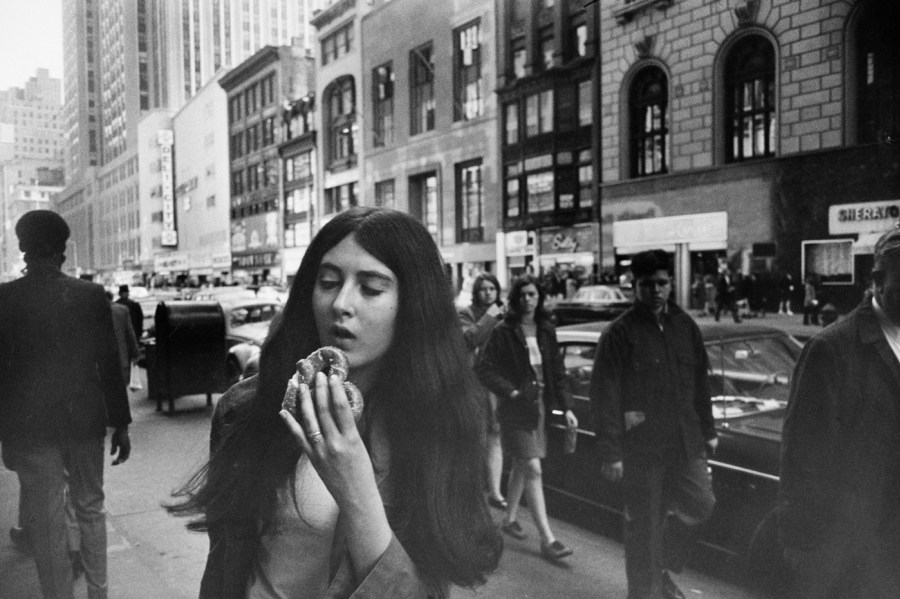
One image that stands out for me is New York1969, (see Fig. 2.) part of the Women are Beautiful series, a collection of images taken in various locations of women in their natural state, observing, partying or otherwise occupied in some way. In the foreground we are presented with a woman in her early 20’s perhaps, her thick hair is down, resting naturally against her shoulders, seemingly unaware of the photographer taking her picture just a distance away. The shot has been taken just before the pretzel in her hand reaches her mouth, freezing time and showing the process of a decisive moment, showing the neutral emotion of eating while on the move in a busy environment with no time to savour the event. In the background we see multiple darker figures of people passing by, the natural light not quite reaching them like the woman closest to the camera. They’re noticeable of course, adding movement and providing context for the location, as well as their acknowledgement of the camera, potentially questioning what is happening. That being said, they don’t stand out because they are not the subject in question, the woman in front is, she is the focal point of this composition. A variety of tones run through the photograph, adding depth to the shot, enhancing the brickwork in the architecture and the natural marking of the lighter buildings, dirtied by pollution, animals or other such elements. The horizontal and vertical structures, create leading lines for the viewer to explore the street behind the bustling pavements and roads, drawing the eyes further into the background towards the left before leading out of the image. Balance is maintained by the use of the rule of thirds, as the woman in question is placed perfectly within the lines of the left intersections of a camera grid, complimented by the shallow depth of field that further encourages the eyes to focus. As previously mentioned, the Women are Beautiful series documents women in various situations, dressed to the nines or in her casual wear. Conceptually this may be exploring the pressure that women have been put under for centuries. Using the decisive moment to photograph women without any makeup on, their hair flowing naturally, eating what may be considered ‘junk food’, showing the true nature of women in the comfort and without the mask of societal norms influencing the moment. A compelling statement and a chance to empower women, quirks and all. 


Fig. 2. New York (1969)

Bruce Davidson (1933 – )

Bruce Davidson is an American photographer based in New York, a member and contributor to Henri Cartier-Bresson’s Magnum Photos. Davidson began taking photos from the age of 10, the catalyst for studying and furthering his knowledge on the subject at Rochester Institute of Technology and Yale University (Magnum Photos, 2008). 

After returning from the army in 1957, Davidson began doing freelance work for LIFE magazine before creating a variety of influential works such as The Dwarf, Brooklyn Gang and Freedom Rides (Magnum Photos, 2008).

Davidson has exhibited in many museums and galleries over the years, one of them being the Museum of Modern Art, New York, where East 100th Street was displayed following its publication at Harvard University and St. Ann’s press in 1970. Most of the work produced by Davidson documents events or situations within society, capturing the different walks of life through the lens of a camera, much like his friend Henri Cartier-Bresson did years before him. Many pieces of work from the past 50 years have been published in monographs and reside in both public and private fine art collections worldwide (Magnum Photos, 2008). 

“If I am looking for a story at all, it is in my relationship to the subject — the story that tells me, rather than that I tell” (Bruce Davidson, n.d.).

One example that explores the above statement, is Woman on tube holding flowers, London, 1960 (Davidson, 1960) a photograph that seems to show no sense of the relationship between Davidson and the people on the train. Of course, the connection between the members of the public is unknown, however, the fact we know that the photographer is outside of the train, most likely positioned on the station’s platform while the woman looks onward down the cabin, implies that she is unaware anyone is watching her. The woman has a fairly neutral face however, a slight hint of anger or confusion shines through with her subtle furrowed brow and puckering of the lips. We are unaware of what this person is thinking, what is in front of her as the scene is tightly framed, creating a mystery for the viewer. Is she in deep thought? Has someone said something to make her angry? Is she even angry or is this how her expression naturally falls? Her posture seems relaxed, hands overlapping each other gently while holding the bunch of flowers, so perhaps she is just in deep thought. Who are the flowers for? Again we don’t know and have to piece our own story together with our imagination due to this lack of information. The cabin is brightly lit and contrasts with the dark body of the train creating balance in the composition, as well as drawing our attention to others on the tube. The man to the left is leaning forward with a confused or shocked face, as if he’s missed his stop, while the man to the right grabs his head in his hands, maybe from stress or despair? Meanwhile, the woman next to him seems blissfully unaware as to what is going on, as her head bows down over a book or a newspaper? 

There are a lot of stories that can be told throughout this image, not necessarily accurate to the facts of what happened when this was shot, but a story none-the-less. All of the elements within this photograph, create intrigue, keep the viewer interested, forms tension and captures the natural state of people within seconds, a recipe for a successful decisive moment. 

As Davidson stated in the quote above, he has let the story tell itself, rather than placing it into our hands. 

KayLynn Deveney (1967- )

KayLynn Deveney, born in Albuquerque, New Mexico is a photographer and lecturer now based in Belfast, Northern Ireland. 

Deveney studied and earned a bachelor’s degree for journalism while living in Albuquerque, before becoming a staff photographer for the Albuquerque Tribune for 9 years, covering a wide range of topics across that period (KayLynn Deveney Photography, 2015). 

In 1999, Deveney and her boyfriend travelled to the UK where she furthered her education by going to graduate school and going on the earn a masters degree in documentary photography at the University of Wales, Newport in the early 2000s. In 2009, she completed her Ph. D. in Photography, exploring how ‘contemporary and historical photographic diaries and self-books address myths of domesticity’ (KayLynn Deveney Photography, 2015). 

Since her many years of education, Deveney’s work has been exhibited across the world, as well as being held in permanent exhibitions at The Museum of Contemporary Photography in Chicago, Illinois, Light Work in Syracuse, New York and the Portland Art Museum in Oregon (KayLynn Deveney Photography, 2015). 

Deveney’s first photography book was released in 2007, capturing the life of an elderly man called Albert Hastings within his home and local area in Wales. Following their first meeting in 2001, she began to learn about Bert’s history, his memories of WWII and his many interests, albeit simple. This encouraged Deveney to document the mundane aspects of daily life, the familiar items or routines that make life what it is and what makes a home, a home.

When the images were presented to Bert, Deveney began to realise that they had differing opinions regarding their perspectives. Art is subjective after all. The captions that are written throughout the series, come from Bert Hastings himself, some of which match the photographer’s intentions for the image, while others contribute a more ‘critical second perspective’ (Deveney, 2015).

While this series is only a small window into someone’s life, it is still incredibly powerful. Documenting someone’s life, no matter how brief, provides a little bit of context as to how they live, how they act, how they respond to the banalest of things. It shows intimacy and peels back the privacy barrier we all have; whether it’s intentional or not, which allows us or at least try to understand the life of others. 

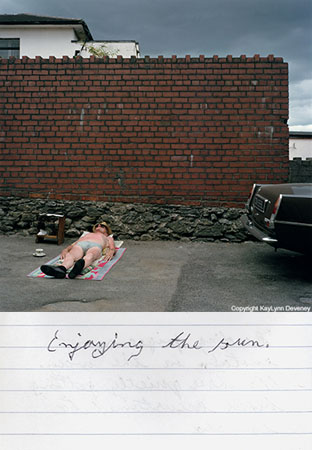
Fig. 3. Far Sun (n.d.)

One image that stood out for me was Far Sun, n.d. (see Fig. 3.) as it feels so out of place, humorous and not something you see every day, something I believe the concept of the decisive moment encourages. Regarding the balance of the composition, Bert’s body is positioned perfectly within the bottom left box and his head directly on the 1st vertical line of the grid. Not only does this draw the eyes to the left from the start, but it also follows Cartier-Bresson’s ‘rule’ of maintaining balance and being aware of the geometry within the frame. The first point of interest for myself is Bert; which makes complete sense as the series is about him, however, in comparison to the dark tarmac and brick wall in the background, he stands out like a sore thumb with a bright blue and pink towel to support him. You can’t miss him. Moving on to the second point of interest, the black car; that is positioned in between the middle right and bottom right of the grid, provides a little bit of context as to where this may be taking place. Is this in a car park? Why is he in a car park? Also, why is he sunbathing on the tarmac when it looks like it is about to rain? Juxtaposition; as previously mentioned in my post The Decisive and (In)decisive moment, 2020, is another strong element to consider when documenting decisive moments. It creates a conversation and a list of questions for the viewer, making them think about what is in front of them for a little bit longer. The moment seems so unique and whacky, that it feels staged, but I don’t think it was due to the fun personality that comes through in the candid shots of Albert. As an outsider looking in, with very little knowledge of this person, it feels like a very Bert thing to do, especially if he didn’t have a garden or local beach to visit. 

The captions make the images a touch more personal, something I feel brings the collection together and may help the audience understand the photographs more, or at least learn about Bert’s thought process.

Reflection: 

– The Decisive moment doesn’t necessarily mean dropping everything, to capture the perfect moment.

– As long as you are aware of your surroundings and what is happening around you, that is what matters.

– You can set up your camera to get the composition you want, to provide balance and understanding of what is in front of you, then wait for the moment to come to you at the right time. 

– Be intuitive and be ready for the ‘perfect’ moment to come, before you miss it.

– The subject may be aware of your presence, but as long as you make them feel comfortable or blend into the background, you can document some incredibly candid and personal moments that may have otherwise been missed.

– Don’t just focus on one subject, be observant about EVERYTHING.

– Street photography allows for some very unique moments, however, they aren’t restricted to this form of photography or location type.

References:

Artnet. (2011) Garry Winogrand | artnet [online] Available at : http://www.artnet.com/artists/garry-winogrand/ (Accessed 23rd November 2020).

Cartier-Bresson, H. (n.d) Henri Cartier-Bresson – Fondation [online] Available at : https://www.henricartierbresson.org/en/hcb/ (Accessed 23rd November 2020).

Davidson, B. (n.d.) Bruce Davidson . Photographer Profile . Magnum Photos [online] Available at: https://www.magnumphotos.com/photographer/bruce-davidson/ (Accessed 23rd November 2020).

Davidson, B. (1960) Woman on Tube Holding Flowers, London, England, 1960 [image] Available at: https://huxleyparlour.com/works/woman-on-tube-holding-flowers-london-england-1960/ (Accessed 23rd November 2020).

Deveney, K. (2015) The Day to Day Life of Albert Hastings [online] Available at: https://kaylynndeveney.com/the-day-to-day-life-of-albert-hastings (Accessed 23rd November 2020).

Duong, O. (2013) How to understand the Decisive Moment | INSPIRED EYE [online] Available at: https://www.theinspiredeye.net/street-photography-tips/decisive-moment/ (Accessed 23rd November 2020).

Galassi, P. (1987) Henry Cartier-Bresson: The Early Work [pdf] (Accessed 23rd November 2020).

H. Cartier-Bresson: l’amour tout court (2001) Directed by O’Byrne, R. [online video] Available at: https://vimeo.com/106009378 |(Accessed 25 March 2020).

Huxley Parlour. (2017) Henry Cartier-Bresson [online] Available at: https://huxleyparlour.com/artists/henri-cartier-bresson/ (Accessed 23rd November 2020).

Fraenkel Gallery. (2012) Garry Winogrand | Fraenkel Gallery [online] Available at: https://fraenkelgallery.com/artists/garry-winogrand (Accessed 23rd November 2020).

KayLynn Deveney Photography. (2015) Bio – KayLynn Deveney Photographer [online] Available at: https://kaylynndeveney.com/bio (Accessed 23rd November 2020).

Magnum Photos. (2008) Bruce Davidson . Photographer Profile. Magnum Photos [online] Available at: https://www.magnumphotos.com/photographer/bruce-davidson/ (Accessed 23rd November 2020).

MoMA. (2009) Garry Winogrand | MoMA [online] Available at: https://www.moma.org/artists/6399 (Accessed 23rd November 2020).

Cartier-Bresson, H. (2015) Henri Cartier-Bresson. Behind the Gare St. Lazare. 1932 [image] Available at: https://www.moma.org/collection/works/98333 (Accessed 23rd November 2020).

Winogrand, G. (2013) Women are Beautiful | Fraenkel Gallery [image] Available at: https://fraenkelgallery.com/portfolios/women-are-beautiful (Accessed 23rd November 2020).

List of Images:

Figure 1. Duong. O. (2013) Decisive Moment [image] Available at: https://www.theinspiredeye.net/street-photography-tips/decisive-moment/ (Accessed 23rd November 2020).

Figure 2. Winogrand, G. (1969) New York [image] Available at: https://fraenkelgallery.com/portfolios/women-are-beautiful (Accessed 23rd November 2020).

Figure 3. Deveney, K. (n.d.) Far Sun [image] Available at: https://kaylynndeveney.com/bert-grid (Accessed 23rd November 2020).


Project 1 – The frozen moment – Research

Online Research, Part 3, Practitioner Research

Summary:

For this research I have;

– Drawn on the work of Eadweard Muybridge, one of the pioneers of the frozen image, most famous for his ability to prove that a horse can indeed lift 4 hooves off the ground at the same time.
– Muybridge’s work was shown via slides, that showed the individual phases of movement that provided a huge step for science and photography.
– As well as improving his camera equipment by developing a motorised shutter that didn’t rely on the subjects movement, before inventing the zoopraxiscope. A machine that projected the moving image and inspired the development of the cinema.
– Explored the work of Harold Edgerton, the inventor of the ‘strobe’ flash, a photographer who froze time and provided images of motion that the naked eye couldn’t see, such as a crown of milk.
– Drawn on the work of Jeff Wall, a conceptual artist who captures everyday occurrences, or ‘micro gestures’, before
– Re-enacting in a different location, allowing him to take control of the composition, while providing tension in the imagery via the lines, gestures or other such elements.
– Reflected on the work of Philip-Lorca diCorcia, a photographer who meticulously plans his compositions by combining elements that don’t necessarily go together
– Challenging the traditions of photography and creates tension between the candid and posed. So while his work may look natural, with further inspection you understand they are not, due to obvious lighting or odd positioning of subjects.
– Reviewed whether I feel the camera captures or fragments time, giving examples of my opinion by harking back to the imagery of the listed artists.

Photographic exposure times developed massively since the early days of photography when exposures used to take hours to produce since reduced to mere points of a second with the evolution of technology. 

We have been able to go from hours of standing/sitting still to avoid motion blur, to capturing movement as a still image with no traces whatsoever. 

Some of the earliest photographers to experiment with the new, improved film speeds and shutters, are as follows.

Eadweard Muybridge (1830-1904):

Eadweard Muybridge, formally known as Edward James Muggeridge was one of ‘ … the great photographic thinkers and technical pioneers of all time …’ (Huxley Parlour, 2017), who thought way beyond the walls of still photography and was passionate about the evolution of the moving picture.

Leland Standford, a racehorse owner and former governor, hired Muybridge in 1872 to capture photographs of his horse to confirm whether all four hooves can be off the floor at the same time. To achieve this, Muybridge set up multiple cameras and a tripwire which would be activated upon the horse’s movement to capture each stage. After five years full of court trials, travelling and death, he returned to Standford. After producing conclusive results about the horses galloping abilities, this led newspapers to reproduce these images as drawings and artists such as Edgar Degas and Thomas Eakins, referencing them to produce art that was more realistic to life.

After his relationship with Leyland had ended due to lack of recognition following the publication of The Horse in Motion (Muybridge, 1878) , Muybridge began a new set of work for the University of Pennsylvania called Animal Locomotion which became one of his most influential pieces of work. The project allowed the study of movement through a variety of animals and the human form, which was a massive step for both science and photography by capturing each phase of a single action. 

Muybridge significantly improved his camera equipment by developing a clockwork motor, meaning he could capture the minutest of movements without relying on the subject to trigger the shutter. 

Muybridge’s work has helped contribute towards physiology, biomechanics and a range of artists such as Marcel Duchamp and Jasper Johns. Not only that, but he was the first to invent the machine called the “zoopraxiscope” which projected the moving image and animated a selection of photographs, potentially inspiring the development of cinema.

Harold Edgerton (1903-1990)

Dr Harold Edgerton was born in Nebraska, raised in Aurora and began a career as a professor at the Massachusetts Institute of Technology, which was the reasoning behind his invention of the ‘strobe’ flash and dedication to documenting what the naked eye couldn’t see. 

Edgerton shaped the world of photography by freezing time and capturing results such as liquid on liquid forming a symmetrical crown of milk, as well as the ghostly arch that is formed by a golfer swinging their arm as the torso is ‘superimposed on itself 50 times’ (Michael Hoppen Gallery, 2015).

Due to his invention of flash cameras, his influence inspires photographers, journalists and many others today albeit the cameras are much smaller, which shows his impact on the photographic world and how we can capture the subjects around us. Being able to document what cannot be seen and controlling how a moment can be frozen in time, can help people understand how certain events occur and the result of them.

Jeff Wall (1946 – )

Jeff Wall was born in Vancouver and went on to study art history at the University of British Columbia in the 1960s, which is where he discovered Vancouver’s experimental art scene and used this as inspiration to teach himself photography to portray his conceptual ideas. 
After many years of studying and receiving his BA and MA degrees at UBC, Wall went on to teach at Nova Scotia College of Art and Design, Halifax, Simon Fraser University, Vancouver and has since been a teacher at UBC where his journey first began (Riggs, 1997).

Having been inspired by the paintings of Goya and Velázquez, Wall wanted to find a way to depict everyday life through the medium of photography following his thought that ‘it was no longer possible for modern artists to paint like the great masters’ (Riggs, 1997). He decided upon creating backlit transparencies, which are large-scale photographs mounted in lightboxes to combine both cinema and sculpture, therefore a successful contemporary approach. 

The inspiration for Wall’s pictures is everyday occurrences that he has personally witnessed, as well as his interest in ‘micro-gestures’ which are essentially actions that take place without much previous thought, portraying the tensions within society.
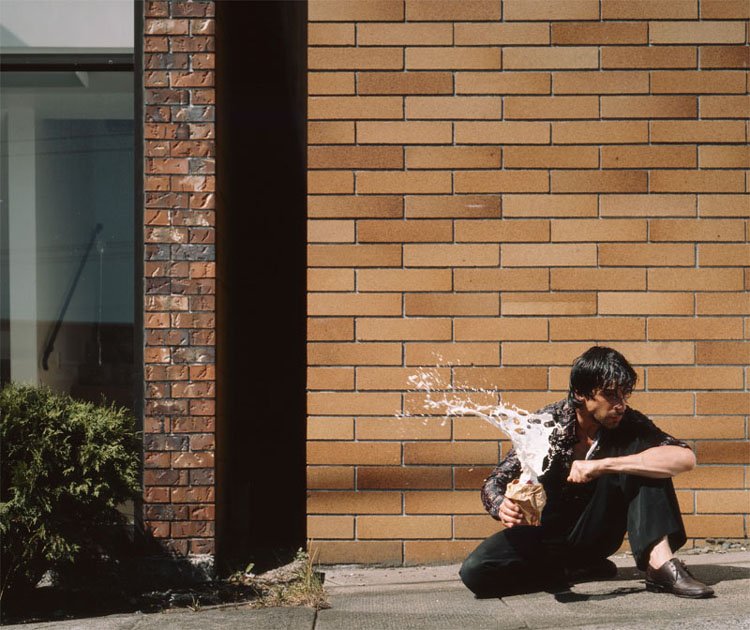
Milk (see fig. 1.) reflects the current state of mind the man in frame is in, portrayed by the explosion of liquid and clenched fists; however, the moments leading up to this moment are unknown. As a result of this, the viewer may wonder what caused such a reaction, creating tension between the two (Tate, 2017).

Wall tends to reconstruct the events he sees, to allow himself to gain control of the composition, which is why he relocated for this particular situation while keeping the formal elements in mind. 
‘The grid-like order of the brick wall background, and strong vertical bands that stripe the left side of the image contrast sharply with the tension in the man’s arms and the uncontrolled arc of milk’ (Tate, 2017). 

Fig. 1. Milk (1984)

Philip-Lorca diCorcia (1951 – )

Philip-Lorca diCorcia studied at the School of the Museum of Fine Arts, Boston, the University of Hartford, Connecticut and received his Master of Fine Arts from Yale University in 1979. He didn’t initially set out to become a photographer; however, Jan Groover suggested that ‘a photograph should result from careful planning and orchestration’ (Sidley, 2016), which diCorcia may have used as inspiration when he began identifying as a photographer. 

DiCorcia’s work challenges and pushes the traditional boundaries of photography by meticulous planning and composing. So, while they may look natural and accidental, they’re not due to the combination of people and places that don’t necessarily go together. This approach creates a tension between random and controlled, directs the imagery towards various paths without a definite conclusion or direction, therefore suggesting a narrative more so than telling a story (Sidley, 2016).

One of the ways DiCorcia executed his shots, for example, Mario (DiCorcia, 1978) was by setting the camera up on a tripod, putting a flash in the fridge and readjusting each element while testing the composition with a Polaroid camera, keeping the desired result in mind. So, while the subject looked completely natural, in deep thought as they observe the contents of the refrigerator, everything was precisely planned at each step (Sidley, 2016).

The use of harsh artificial light is a recurring technique through his work which could be street lighting, however, on closer inspection, the contrasts between the shadows and highlights are almost too intense to be considered accidental. An example of this is the spotlight that hits the subject in Edward Earle Windsor; 20 years old; Atlanta, Georgia; $30 (DiCorcia, 1990-92). 

Reflection

‘There is a pleasure and beauty in this fragmenting of time that had little to do with what was happening. It had to do, rather, with seeing the momentary patterning of lines and shapes that had been previously concealed within the flux of movement.’ (Szarkowski, 2007, p.5).

Upon completing some artist research, I would consider that the camera captures time in these images, as well as fragmenting it, it’s isn’t necessarily mutually exclusive. 

Muybridge’s images I believe do capture time, by documenting each phase of a singular movement, in turn, supplying context to each photographic plate. While Edgerton’s work also freezes moments in time and form an opinion in the viewers head as to what happened moments before, what we assume happened before shooting the apple may not be correct. As a result, I consider these images to be both a captured moment in time and a fragment.

Wall and diCorcia, on the other hand, fragment time with meticulous planning and creating tension throughout the composition, either through technical decisions or formal. While they are pre-meditated, the body language and locations cleverly help create intrigue for the viewer, making them wonder how the events shot occurred and what caused the particular gestures in that specific place. The imagery doesn’t necessarily look staged at first glance without prior knowledge; therefore, you would believe they are just a brief moment in history frozen forever; however, are not. A fragment of time provides just a slice of the story, not the whole product.

This research has made me question whether the street photography I have seen in the past is just a capture of time, whether there is more the story than initially thought or if it has been pre-planned to convey a particular narrative, controlled by the artist. 

References: 

Huxley Parlour. (2017) Eadweard Muybridge | Photographer’s Biography & Art. [online] Available at: https://huxleyparlour.com/artists/eadweard-muybridge/ (Accessed 4 March 2020)

Michael Hoppen Gallery. (2015) Dr Harold Edgerton | Michael Hoppen Gallery. [online] Available at: https://www.michaelhoppengallery.com/artists/54-dr-harold-edgerton/overview/#/artworks/9778 (Accessed 4 March 2020)

MoMA. (2019) Philip-Lorca diCorcia. Mario. 1978 | MoMA. [image] Available at: https://www.moma.org/collection/works/46273?artist_id=7027&locale=en&page=1&sov_referrer=artist (Accessed 4 March 2020)

MoMA. (2019) Philip-Lorca diCorcia. Edward Earle Windsor; 20 years old; Atlanta; Georgia; $30. 1990-92. [image] Available at: https://www.moma.org/collection/works/57854?artist_id=7027&locale=en&page=1&sov_referrer=artist (Accessed 4 March 2020)

Riggs, T. (1997) Jeff Wall born 1946 | Tate. [online] Available at: https://www.tate.org.uk/art/artists/jeff-wall-2359 (Accessed 4 March 2020)

Sidley, K. (2016) Philip-Lorca diCorcia | MoMA. [image] Available at: https://www.moma.org/artists/7027 (Accessed 4 March 2020)

Szarkowski, J. (2007) The Photographer’s Eye. New York: MoMA Thompson, K. &

Tate. (2017) Jeff Wall : room guide, room 3 | Tate. [online] Available at: https://www.tate.org.uk/whats-on/tate-modern/exhibition/jeff-wall/jeff-wall-room-guide/jeff-wall-room-guide-room-3 (Accessed 4 March 2020)

Time. (2016) The Horse in Motion |100 Photographs. [image] Available at: http://100photos.time.com/photos/eadweard-muybridge-horse-in-motion (Accessed 2 April 2020)

List of Images:

Figure 1. Wall, J. (1984) Milk [image] Available at: https://www.tate.org.uk/whats-on/tate-modern/exhibition/jeff-wall/jeff-wall-room-guide/jeff-wall-room-guide-room-3 (Accessed 5 March 2020)

Collections in photography – Artist research + test shoot plan

Assignment 2, Online Research, Practitioner Research, Thoughts & Ideas

Summary:

For my practitioner research I;

– Stated Walter Benjamin’s view on what a collection is for future reference to see if I agree with this after researching various artists.

– Drew on the work of Barry Rosenthal, a fine art photographer and sculptor who collects rubbish found on the shore before organising them into groups and bringing them back to life in the studio. 

– Briefly analysed Rosenthal’s work to explore what concepts I could find within his imagery and the techniques I felt he used, such as deep depth of field and studio lighting.

– Explored the work of Sam Oster, who uses medium black and white film to shoot typologies (inspired by the Becher’s) of abandoned electrical equipment to emphasise the relationship between humans and their electronic consumption. 

– Analysed both her typologies and moving images to gather inspiration from her visual and technical approaches, such as the use of form, texture and various depths of field.

– Studied the work of Jim Golden, a still life photographer who shoots for commercial companies by stripping the products down to their most natural forms.

– Analysed his bold compositions to understand his use of bold colours, organised arrangements and studio lighting to enhance the collections he is shooting.

– Reflected on each artist and how they both compare or differ, visually, technically and conceptually.

– Stated whether I believe these artists reflect the views of Walter Benjamin, as well as

– Summarising my test shoot plan and how I’d like to implement the inspiration gathered by the chosen photographers.

‘Fragments of a vessel which are to be glued together must match one another in the smallest details although they need not be like one another.’ (Walter Benjamin, [1936] 1999, p.79).

Walter Benjamin expresses that although a collection should link in concept and small details, they don’t have to be identical. Therefore making sure there are differences throughout, subtle or keep a collection exciting and engaging. 

Using this idea as a guideline, I have decided to research a selection of photographers who have shot a collection of various items to see how they have executed it to see whether their artistic approach differs from the view of Benjamin. Taking influence from these artists will help me decide on how this assignment develops.

Barry Rosenthal 

Barry Rosenthal is a fine art photographer and sculptor who has become well known globally for his “Found in Nature” work. The project began in 2007 as a side-project to his Botanical series. It has since developed from a small collection of objects found on the ocean shore into a series of large scale images that capture and display the impact littering has on the planet (Rosenthal, 2012). 

After collecting trash from the shore of New York Harbour, Rosenthal separates the items into groups, determined by colour, theme, type, or otherwise, bringing objects that have been beaten out of shape and have lost their purpose back to life in his studio. Using a combination of photography and sculpting, he can form a narrative that confronts the viewer with ‘the way humanity is managing its relationship with nature and the oceans in particular’ (Rosenthal, 2012).

Rosenthal appears to use a deep depth of field as the objects are crisp, and there is no focal point to direct the viewer around the frame. The use of a plain background helps the textures, shapes, colours stand out on their own. The reflections and shadows on the items suggest side lighting by artificial lighting such as studio lights. A birds-eye view flattens the object’s form allowing the viewer to focus on the narrative told via the arrangement, something that may not have been achieved if shot at an angle. The shapes and sizes of each item complement one another without the collection becoming cluttered and unorganised. Subtle changes are made throughout his series, keeping the images fresh, unique yet consistent in concept.

Sam Oster

Sam Oster is an Australian based photo-media artist who has experience in stills photography, moving images, lecturing, film and documentaries. 

Oster has exhibited in both solo and group shows across the years including Art Images Gallery, Adelaide (2014); Shimmer Photographic Biennale, Southern Australia (2012) and Duckspool Photographic Centre, England (2001). 

Short Circuit‘ was created in 2009 to investigate the consumption of electrical items and the ever-growing issue of consumerism and competition between companies, which can create a conflict between what is ‘trash and treasure’ (Oster, 2019). 

Bernd and Hilla Becher’s typologies of industrial buildings and structures heavily inspired her; however, Oster used portable electrical items as her subject instead of permanent structures. 

Oster captured electrical items found in rubbish dumps, neatly arranged in individual cabinets to examine the form and function of the objects in the grid. However, the moving image time-lapses represent the idea of electrical dependency and its impact on the environment, for example, a fan placed in a sea of metal in front of an ocean’s horizon (Oster, 2019). 

The work shot on a medium format black and white film are hand processed and printed. These pieces have the same grainy post-industrial effect the Becher’s achieved.

A collection of discarded irons (see Fig. 3.) are framed centrally in a square cabinet, forming a grid of 9. This composition cleverly splits the image into sections without having to take individual photographs. There is an even contrast between light and dark, shown through the metal, scratches, age marks, shape of the subject and the plugs. The lighter irons are aligned down the middle of the collection, framed by different tones of grey and black. While they are the same in function, their forms, the impact of time and usage make them unique, providing the viewer with change. A deep depth of field may have been used for this image, as the items, geometric lines, and the extent of the cabinets are clear.

Unlike the typologies, these moving-image time-lapses feature one item each, however, once paired they form a collection of discarded electrical items in various landscapes. A shallow depth of field may have been used in Cooling Down (see Fig. 4.) due to the subtle blur in the foreground directing the viewer’s eyes to the fan. Deep depth of field seems to have been used to shoot Boiling Over (see Fig. 5.); however, the kettle placed slightly off centre on a rock in the muddy water creates a focal point and direction. These small details call back to the idea of electrical dependency impacting the earth, global warming and the loss of lush green growth, clear waters and land.

Jim Golden

Jim Golden is a still-life and product photographer based in Portland and shoots subjects in their purest forms to avoid applying artificial beauty. Golden is artistic and stylistic in his photography, capturing inanimate objects in a bold or quirky way while keeping the subject accurate to what it is.

He learnt photography by joining the fast-paced world of New York advertising, specialising in high-end retouching and visual effects (Jim Golden Studio, n.d.).

Golden’s enthusiasm and ‘sense of humour’ (Jim Golden Studio, n.d.) reflects throughout via bright colours, exciting subjects, and thorough planning.

Golden may use deep depth of field in his work due to the sharp, crisp and geometric forms created by the arrangement of the items. There are many leading lines throughout the imagery, the spaces between the subjects outline the shapes and sizes of each item, allowing the viewer’s eyes to follow around the composition with no end to the line. Like Rosenthal, Golden shoots his subjects from above from a height or using a wide-angle lens, using studio lighting to light the items. A soft halo in the middle of collection of sewing stuff  (see Fig. 6.) and the few harsh shadows in both images caused by taller items may imply lighting from above or behind. Creating shapes that relate to the collected items, using the products and making the image pop with intense colour may represent happiness, playfulness, love or other positive emotions. 

Overall thoughts:

All of the artists above vary from one another visually. Oster uses a mixture of B&W film and coloured imagery, using the background to frame the items. Rosenthal uses monochrome backgrounds and uses the collection to add colour and depth. In contrast, Golden uses bold colours, leading lines and negative space to enhance the objects. 

However, they are alike technically as their images are crisp and in focus, suggesting a deep depth of field. Sharp shadows and bright highlights imply artificial lighting, and they all share a meticulous approach to the composition and framing of their subjects. 

Contextually Rosenthal and Oster focus on political issues, such as the impact of human nature and consumerism on the planet. The way they execute this is by collecting disposed electrical products, plastic from the ocean and dumps. Oster’s choice to shoot with B&W film creates a raw emotion by enhancing the aged and shiny, textural details on the metal irons, while the rusty browns and muddy waters evoke thoughts of decay and neglect. Her choice of discarded electrical items reflects the waste caused by a lack of appropriate recycling resources. Rosenthal’s use of a black background creates a contrast between the colourful plastics and their battered forms, helping them stand out; this shows how time has affected the product’s shape but is mostly still intact and beautiful. The way items form shapes such as a man on a boat, link back to humanity’s relationship with the ocean. These elements, when combined, form a narrative about the negative correlation between land and ocean pollution, and human activity. 

On the other hand, Golden shoots a selection of brand new goods and electronics, documenting products that show human progress, and a positive, appealing side to consumerism. The use of vibrant colours and shapes brings playfulness, contrast the vintage products, implying how style and inventions have evolved. Arranging individual components when put together become a working product, for example, the gaming cartridges wouldn’t be playable without the console, which wouldn’t be functional without the wiring, celebrates human creativity and growth.

Each artist has formed a cohesive series by keeping visual changes to a minimum or at least make sure they are complimentary to avoid jarring the viewer and being consistent with the overall concept, and in turn support Walter Benjamin’s view on collections very well.

After researching these practitioners and the concepts behind their work I have decided to explore what ‘necessity’ means. I will develop on this by collecting various items based on the responses gathered in my online survey and personal list group them by theme, form or function if possible, before looking for juxtapositions or similarities within the collection.

Keeping the framing and position of the subject consistent, as Oster does in Apparatus Electralia Planus, is something I will apply when composing my shoot to avoid breaking the fluidity. The choice of black and white or colour can impact the overall mood of the images; therefore I will experiment with the use of colour to decide how I want to evoke emotion or enhance details in the shot. Shadows and highlights can affect the form of a subject as well as the depth so I will consider using artificial light during my test shoot to decide whether I’d like to achieve a soft or sharp visual style. Shooting from a birds-eye view isn’t something I do very often and is something I would like to try out for this assignment, taking influence from Rosenthal and Golden as a guide for creating successful compositions. Deep depth of field assures that everything in the frame is crisp and in focus, so even though I would like the items to stand out, the rest of the composition will be just as essential to provide context; therefore, I will use a narrow aperture. 

The final selection of images can make or break the set and how they knit together, so I will be meticulous when it comes to formulating the collection as a whole. During my test shoots, I would like to take influence from Oster and experiment with grid work and typologies; this may determine how I present my final selection.

Summary of the shoot plan :

– Experiment with B&W and colour.

– Vary the lighting used to see what works best.

– Test different angles, focal lengths and apertures.

– Consider the framing and positioning of the selected items.

– Play around with cropping and grid work.

– Be thorough when choosing final camera settings.

– Consider the relationship between each image when it comes to the final selection.


References: 

Benjamin, W. ([1936]1999) Illuminations. London: Pimlico

Jim Golden Studio. (n.d.) ‘About Jim’. [Online] Available at: https://www.jimgoldenstudio.com/INFO-AND-CONTACT/ABOUT-JIM/1 (Accessed 13 February 2020).

Oster, S. (2019) ‘Short Circuit – Sam Oster Portfolio – The Loop’. [Online] Available at: https://www.theloop.com.au/project/silvertrace/portfolio/short-circuit/17421 (Accessed 13 February 2020).

Rosenthal, B. (2012) ‘BARRY ROSENTHAL PHOTOGRAPHY – Info’. [Online] Available at: http://barryrosenthal.com/info/ (Accessed 12 February 2020).

List of Images: 

Figure 1. Rosenthal, B. (2013) Blue Ocean [image] Available at: http://barryrosenthal.com/found-in-nature/single-gallery/16729872 (Accessed 12 February 2020).

Figure 2. Rosenthal, B. (2012) Clear Glass Jars and Bottles [image] Available at: http://barryrosenthal.com/found-in-nature/single-gallery/13950856 (Accessed 12 February 2020).

Figure 3. Oster, S. (2009) Apparatus Electralia Planus [image] Available at: https://www.theloop.com.au/project/silvertrace/portfolio/short-circuit/17421 (Accessed 13 February 2020).

Figure 4. Oster, S. (2009) Cooling Down [image] Available at: https://www.theloop.com.au/project/silvertrace/portfolio/short-circuit/17421 (Accessed 13 February 2020).

Figure 5. Oster, S. (2009) Boiling Over [image] Available at: https://www.theloop.com.au/project/silvertrace/portfolio/short-circuit/17421 (Accessed 13 February 2020).

Figure 6. Golden, J. (2019) collection of sewing stuff in shape of a sewing machine [image] Available at: https://www.jimgoldenstudio.com/IMAGERY/STILL-LIFE/7 (Accessed 13 February 2020).

Figure 7. Golden, J. (n.d.) vintage video game consoles and cartridges on a yellow background [image] Available at: https://www.jimgoldenstudio.com/OVERVIEW/COLLECTIONS/1 (Accessed 13 February 2020).

Project 2 – Lens Work – Research Point

Online Research, Part 2, Practitioner Research

Summary:

For this research point I;

– Draw on the work of Wim Wenders, who shoots dynamic imagery to document history and signs of civilisation by using a deep depth of field to capture fully focused shots.
– Challenge the view that deep depth of field prevents the viewer from focusing on one point, by providing evidence of specific focal points in Wenders work.
– Analyse how the specific aesthetic codes may affect how the image is interpreted as well their ability to enhance the work.
– Draw on the work of Mona Kuhn, who uses shallow depth of field to provide a sense of intimacy within her imagery.
– Analyse how her compositions reflect her ability to connect with the subject and create a comfortable atmosphere, that even the viewer can feel through her delicate series of photographs.
– Draw on the work of Guy Bourdin who creates images that are sexual and shocking in nature, to grab the viewers attention and make them question the concept of an advertisement.
– Reflect on his use of deep depth of field and meticulous planning of compositions, what they may portray and why.
– Selected an image from my personal archives to show the aesthetic code of intimacy, much like Mona Kuhn, an aesthetic choice I made at the time to enhance the warmth of the fire and coziness of being wrapped up on a winters night.

Brief:

Read around the photographers above and try to track down some of the quotations. Write up your research in your learning log‘ (Bloomfield, 2018)

This research point explores how the different depths of field can influence how an image is perceived. For example, a photographer may choose to shoot a portrait in a busy town with a shallow depth of field to direct the viewers eyes to the focal point and provide tension between the subject and blurry background, or instead use a deep depth of field to prevent the eyes from focusing on one specific point in the image and allowing the viewer to take control of their journey through the image.

These different aesthetic codes could be used to explore the idea of memory, politics, imagination for the viewer, intimacy and history, whether the artist is aware of that at the time or not.

Photographer research:

Wim Wenders

Wim Wenders, born August 14, 1945, was one of the first to venture into New German Cinema and is one of the most well-known figures for contemporary German film. Wenders specialities consist of scriptwriting, directing, producing, photography and being an author, which has led to a substantial collection of work in the form of ‘documentaries, photo exhibitions, monographs, films and books’ (Royal Academy, 2018).

A broad collection of Wenders’ photographic works have been exhibited in multiple galleries across the world such as the Ronald and Rita McAulay Gallery, London (2019); the Museum of Contemporary Art, Sydney (2003); Museum of Contemporary Photography, Thessaloniki, Greece (2006); and in his birth city, Museum Kunstpalast, Düsseldorf, Germany 2015.

A recurring concept throughout the photography Wenders shoots, is a sense of journey, memory and life, either through the subjects captured in the frame or the composition of imagery.
For example, a summary of the time capsules. by the side of the road (Wenders, 2015) exhibition Germany suggests, the imagery ‘alludes to the relationship between memory and photography’ (Blain Southern, 2015), therefore showing how photography is a powerful medium that can capture a moment in time and keep it preserved for the future.

America and Germany are locations that are important to Wenders due to how much time he has spent between the two for both work and living. Being able to document the changes, events and effects of human nature seem to be something that drives Wenders in his work as he claims ‘in those landscapes, German or American, I’m still looking for the traces of civilization, of history, or people’ (Wenders, 2015). A great example of Wenders capturing traces of history and the effects of human activity is shown below (see Fig. 1.)

Fig. 1. time capsules. by the side of the road (2015).

As quoted by Broomberg and Chanarin in 2008, directly from the book The Act of Seeing: Essays and Conversations, Wenders states that ‘The most political decision you make is where you direct people’s eyes.’ (Wenders, 1997).

While he doesn’t use a shallow depth of field to direct the viewer’s eyes to a focal point, the centralisation of the fallen aircraft enhances it’s prominence in the foreground, almost teasing the viewer as to what the most important part of the image is, similar to politics. Another visual element that draws the eyes towards the centre, is the contrast between the deep red of the desert land and the bright whites in the paintwork, highlighting the clean and aerodynamic shapes of the plane in amongst the dirt and dust, helping it stand out from the rest.
Wenders’ choice to shoot this image as a panorama expands the shot and provides the viewer with more context by being able to explore the environment behind the aircraft. The dry clumps of grass, the empty road curved by the panorama, the vast plains and rocky mountains in the background, emphasise how abandoned the area may be. We as the viewer don’t know how this crash occurred, or what happened to the remains after this shot was taken which goes back to the idea that the relationship between memory and photography can be very important when it comes to preserving the past and showing signs of civilisation or lack thereof.

Despite his use of deep depth of field, there is seems to be a clear focal point, which challenges the idea that fully focused and sharp images ‘remove that direction.’ (Bloomfield, 2018).

Mona Kuhn

‘I like to cherish the body as a source of inspiration, as a platform for metaphors, for intimacy and complexities of human nature, hoping to use the visual impact of provoking the viewer’s imagination to encourage thoughts beyond what is revealed. – MK’ (Kuhn, 2013).

Mona Kuhn was born in São Paulo, Brazil, 1969 and is of German descent. Currently residing in the US, having moved in 1989 to start her higher education at The Ohio State University and the San Francisco Art Institute.

Kuhn is well known for her large-scale photographs of the human body, capturing people in their most natural state and presenting the nude as a ‘contemporary canon of art’ (Kuhn, 2013).
A consistency throughout her work is the reflection and encapsulation of the need for human connection and being united, which is beautifully achieved due to Kuhn’s close relationships with the subjects. This allows them to be intimate and comfortable in their skin, which is incredibly inspiring due to the negativity that has surrounded nudity.

Using a shallow depth of field and translucency as a visual choice, challenges the viewer’s ability to connect to the environment, those within it and what is happening (Kuhn, 2013). However, due to how soft and comfortable the compositions are, the tension doesn’t feel uncomfortable in any way, portraying Kuhn’s strong ability to respect and form an attachment with the subject and present that throughout her work.

A wide collection of Kuhn’s work is displayed both publicly and privately across the world such as the Flowers Gallery, New York; Jackson Fine Art, Atlanta, Georgia; Camerawork, Berlin, Germany; Elkis Gallery, São Paulo, Brazil and many more.

Kuhn not only forms a connection between the people in her series but also with the environment, the colours, different elements of nature and in turn creating metaphors from the imagery. This can be seen in her Native series, shot in Brazil.

By using a shallow depth of field, the focal point is brought forward in the frame and the case of Spring (see Fig. 2.). It shows the delicacy of the curling leaves and thin twigs, gently lit by the natural light in what looks like a tropical forest, however, slightly unsure due to the blurred background. This forms a tension between the subject, background and viewer and forces a little bit of imagination to be able to connect with the image. The pale greens are subtle and fresh, signifying the lushness of nature and potentially a metaphor for the start of new beginnings. The inconsistencies in the leaves and direction of the growth exhibit how different and unique nature can be. Much like the model in Marina (see Fig.3.) who we may assume, however, cannot confirm, is an indigenous person whose facial features and complexion differ from those of a different ethnicity or race, which is a beautiful thing. Her bare torso stands out and warms what is a crisp and cold background, the blur created by a wide aperture compliment the fragility and softness of the skin.

While intimacy isn’t shown through the appearance of breasts and genitals, instead it is presented by the lack of makeup and clean skin, therefore showing vulnerability and openness. The model’s gentle gaze and deep brown eyes almost draw the viewer in to connect with her soul, more so than her appearance, which is a whole different level of human understanding.

As previously mentioned, not all images show a connection between a group of people, but the similarities between the natural growth of plants and humans. They share imperfections, there are different shapes, sizes and textures throughout. The compatibility of greens, whites, golds and browns, mix and pair up so naturally. Both images are simple, draw the eyes directly to a focal point to help you form a relationship with the subject.

The series as a whole is comforting and celebrates the beauty of people of colour, their home and the importance of connecting with those from all walks of life regardless of our differences.

Guy Bourdin

French fashion photographer Guy Louis Banarès, widely known as Guy Bourdin was born in Paris, in 1928 and was one of the most ‘radical and influential fashion photographers of the twentieth century’ (Michael Hoppen Gallery, 2015).

Bourdin pushed the boundaries of standard advertisements by creating sexual and shocking imagery, to draw the viewer in, steering away from the common product shot and instead exploring surrealism to create discomfort and intrigue.
He understood that fashion seduces people, as does the fantasy of it, which I believe refers to the ability to turn into someone or something completely new through the clothes worn (Michael Hoppen Gallery, 2015). Therefore his provocative compositions marry together with the feeling fashion creates.

Due to the lack of digital advances we have today, Bourdin had to plan in great depth to make sure his work fit the format of the printed page, as well as pushing the models and himself to the limits to capture the desired effect (Michael Hoppen Gallery, 2015).

He was one of the first to tell stories through imagery, putting more emphasis on the importance of the image than the product being advertised. The thoroughly planned compositions, interesting cropped elements, both in black & white and bold colour sometimes made it difficult for the viewer to understand and distinguish what the narrative was trying to say, which made Bourdin’s work even more ludicrous (Louise Alexander Gallery, 2014).

Fig. 4. Vogue Paris, August 1975 (1975)

“Thanks to depth of field, at times augmented by action taking place simultaneously on several plane, the viewer is at least given the opportunity in the end to edit the scene himself, to select the aspects of it to which he will attend” (Bazin (1948) quoted in Thompson & Bordwell, 2007).

At first glance, it seems as if the image has a particular direction set in place due to the bright red dress, therefore providing a potential focal point. However, the white graffiti to the right of the models creates some sort of distraction and breaks the direction, causing the eye to start exploring the various leading lines in the composition such as the pathway, the white pole to the left, the edges of the brickwork and the framing of the windows. Due to the way the camera has been positioned, there are subtle angle differences that can be seen between the path and the top of the wall causing an uncomfortable illusion for the eye and forms questions. Are the models going uphill, downhill or neither?

The unsettling feeling Bourdin wanted to create, stands out through the motion blur of the two models, in comparison to the sharp surroundings. The viewer is unaware as to why they are moving, whether they’re running, being pushed or what they look like as their faces cannot be seen clearly which can be anxiety-inducing or confusing for some. Red is the colour of danger and lust, so this scene could potentially represent two lovers either parting ways or reuniting, making a nod to the use of sexual imagery, or representative of the danger that can occur when you’re not looking.

Bourdin’s use of deep depth of field allows the viewer to explore the whole image as they wish, in detail and gather their own story from it. For example, I got distracted by the graffiti and started looking around the image from there, however, this may be different for the next viewer. The image isn’t too busy, which can be an issue with some images shot with a narrow aperture, however, enough is going on to keep the eyes from being drawn to one area.

Research point continued :

Now look back at your personal archive of photography and try to find a photograph to
illustrate one of the aesthetic codes discussed in Project 2. Whether or not you had a similar
idea when you took the photograph isn’t important; find a photo with a depth of field that ‘fits’
the code you’ve selected. Add a playful word or title that ‘anchors’ the new meaning
‘ (Bloomfield, 2018).

When it comes to personal work, I use a shallow depth of field very often, therefore, have begun to understand how the aesthetic code of intimacy can be applied, whether that is presented through the people in the shot, the pose, clothing, surroundings or by the deeper message.

The image of choice from my archives, now named Fireside (see Fig. 5.) was shot a few years ago during Christmas which for most, but not all, is a comforting time of year to reconnect with loved ones, as well as looking after oneself. The shallow depth of field directs the viewer to the thick winter socks on the feet of the subject, complemented by the soft outline of a fire in the background. While you don’t see the subjects face, the dimmed lighting, haziness of the background and cropped framing provides that sense of sleepiness, intimacy and warmth, which a lot of people can associate with.

Fig. 5. Fireside (2017)
1/8 sec; f/1.8; ISO 200


References :

Bazin, A. (1948) ‘Observations on film art : Do filmmakers deserve the last word?’. [online] Available at : http://www.davidbordwell.net/blog/2007/10/10/do-filmmakers-deserve-the-last-word/ (Accessed February 5 2020).

Blain Southern. (2015) ‘Exhibitions, Blain|Southern’. [online] Available at : https://www.blainsouthern.com/exhibitions/time-capsules-by-the-side-of-the-road (Accessed February 3 2020).

Bloomfield, R., 2018. Photography 1: Expressing your Vision. 4th ed. [pdf] Barnsley: OCA, pp. 47, 55. Available at: https://www.oca-student.com/course/photography-1-expressing-your-vision [Accessed 7 February 2020].

Kuhn, M. (2013) ‘Bio/CV | MONA KUHN‘. [online] Available at : https://www.monakuhn.com/pages/bio (Accessed February 5 2020).

Louise Alexander Gallery. (2014) ‘Guy Bourdin – Louise Alexander Gallery’. [online] Available at : https://www.louise-alexander.com/artist/guy-bourdin/ (Accessed March 16 2020).

Michael Hoppen Gallery. (2015) ‘Guy Bourdin | Michael Hoppen Gallery‘. [online] Available at : https://www.michaelhoppengallery.com/artists/30-guy-bourdin/overview/ (Accessed February 5 2020).

Royal Academy. (2018) ‘Wim Wenders | Artist | Royal Academy of Arts’. [online] Available at : https://www.royalacademy.org.uk/art-artists/name/wim-wenders-hon-ra (Accessed February 3 2020).

Wenders, W. (2015) ‘Wim Wenders | time capsules. by the side of the road. Wim Wenders’ recent photographs‘. [online] Available at : https://www.wim-wenders.com/photo/time-capsules-by-the-side-of-the-road-wim-wenders-recent-photographs/ (Accessed February 3 2020).

Wenders, W. (1997) ‘Text – Unconcerned But Not Indifferent – Broomberg and Chanarin’. [online] Available : http://www.broombergchanarin.com/text-unconcerned-but-not-indifferent (Accessed February 3 2020).


List of Images :

Figure 1. Wenders, W. (2015) time capsules. by the side of the road [image] Available at : https://www.wim-wenders.com/photo/time-capsules-by-the-side-of-the-road-wim-wenders-recent-photographs/ (Accessed February 3 2020).

Figure 2. Kuhn, M. (2009) Spring [image] Available at : https://www.monakuhn.com/portfolio/works/detail/1809/ (Accessed February 5 2020).

Figure 3. Kuhn, M. (2009) Marina [image] Available at : https://www.monakuhn.com/portfolio/works/detail/1785 (Accessed February 5 2020).

Figure 4. Bourdin, G. (1975) Vogue Paris, August 1975 [image] Available at : https://www.louise-alexander.com/artist/guy-bourdin/ (Accessed February 5 2020).

Figure 5. Powell, L. (2017) Fireside [image] In possession of : Lauren Powell : Eastleigh.

Keith Arnatt Research

Assignment 1, Online Research, Practitioner Research, Thoughts & Ideas

Summary:

For this research section I have;

– Challenged the critics theories about Arnatt’s level of influence in the conceptual art movement.
– Briefly explored the definition of conceptual art.
– Drawn upon Arnatt’s planning and technical approaches to his work.
– Analysed a selection of Arnatt’s artwork and
– Stated which techniques I would like to use in my own work, such as pre-planning my camera settings, concepts and compositions to gather a cohesive set of images
– To reflect on my understanding of how Arnatt works and how this can be implemented in my own work.

Keith Arnatt

Keith Arnatt (1930-2008) was primarily known as a British conceptual artist, however, his work was also spoken about concerning land art, minimalism, and photography.

Arnatt was born in Oxford in 1930, where he continued to reside to study at Oxford School of Art in the early 1950s, however, he furthered his education at the Royal Academy Schools in London later on in life. From 1962 he taught in Liverpool and up until 1969, Arnatt taught in Manchester.

Settings for his work we’re as follows, Liverpool (The beach at Formby); the moors around his farmhouse in Todmorden, Yorkshire; and his garden in Tintern which was surrounded by woodland.

Arnatt’s work was associated with the new conceptual art movement by the late 1960s, during which he took part in various exhibitions for conceptual art such as the following; ‘Konzeption-Conception, Städtichen Museum, Leverkusen’, 1969; ‘Information’, MoMA, New York, 1970; ‘Umwelt-Akzente / Die Expansion der Kunst’, Kunstkreis Monschau, 1970 and ‘Art as Idea in England’, CAYC (Centro de Arte y Comunicación), Buenos Aires, 1971′, (Wikipedia, 2019). 

There was plenty of theorising over the amount of influence Arnatt may have had within the contemporary art practice of that time, mainly due to his realistic style of shooting.

Having looked at some of his work such as ‘Miss Grace’s Lane’ (Arnatt, 1986-7) and ‘Pictures from a Rubbish Tip’ (Arnatt, 1988-9) I can understand how critics or other artists may have gone back and forth about his impact on the practice because he does indeed show the subject in frame as it is without ‘manipulating’ it if you will.

However, after researching further about conceptual art and what it means (see Fig. 1.), it’s not as black and white as people may believe. Just because an artwork isn’t abstract or experimental, doesn’t mean that it isn’t conceptual or contemporary.

Screenshot (31)
Fig. 1. Conceptual Art (2017)

A summary of ‘Pictures from a Rubbish Tip’ (Arnatt, 1988-9) provides us with the idea that Arnatt may have planned his approach, due to the way he composed the series and stayed consistent with his choice of natural lighting and fixed camera distance. ‘Although the types of rubbish shown and their exact position within the compositions varies slightly, each is presented at a fixed distance from the camera and this, as well as the similar lighting effects used across the five works, creates a sense of cohesion in the series’ (Tate, 2014).

Therefore, with this information, I feel as if Arnatt had quite a significant influence on the contemporary movement by challenging what people assumed experimental looked like.

‘a conceptual artist uses whatever materials and whatever form is most appropriate to putting their idea across’ (Tate, 2017) which I feel as if Arnatt did, as his work has made me think about how long it had been there, who it belonged to before and see beyond the fact that it is just a pile of rubbish in a tip.

The clear plastic bags in the background of the objects in the frame allow for the colours to pop and draw your eyes towards the bottom right corner where the focal point is. One of the works from the series features a collection of meat ridden bones and a brightly coloured pool of ketchup in the top right-hand corner. In my eyes this is thought provoking, mainly because to some it could just be seen as a condiment for a meat eater’s dinner, but could it also represent the blood of the animal it used to be?

Highlights and shadows help bring depth into a piece of art, defining the shapes in the composition, leading your eyes around the work and giving texture to the subject.

I like how the edges are lighter in the work with the loaf of bread, slowly getting darker as you look further towards the middle, showing that the bread is cushioned by the rubbish underneath and triggers the mind into thinking that the items below were possibly quite soft, like dough almost?

Someone made that bread with their own hands, with love and care, yet it’s ended up in the bin? This leads me to the idea that despite how beautiful, how healthy or useful things are, it may not matter to some, it can be thrown aside. Although, that being said, maybe our perception of a rubbish tip should change from trash to treasure. Items that can be found there have provided life, nutrition, memories and happiness to some, as well as the various negatives.

This reflects the idea previously mentioned that artwork doesn’t have to be viewed so simply, even if you think it is just a realist piece.

Upon researching and reading Arnatt’s work, I see a lot of similarities within our thought/creative processes. I tend to plan what I want to shoot beforehand, think about why an image has been shot that way and whether others will see the work in the way it was intended. Shallow depth of field and natural light is my preferred style too as you get a much softer background while maintaining a clear and sharp focus on the subject.

One of the techniques I would like to bring into my work, however, is creating a series of images that are cohesive and make sense alongside one another, whether that is through the concept or in literal terms e.g. Similar compositions, shapes, colours e.t.c.

Another piece of work I find intriguing is the black and white variant of ‘Portrait of the Artist as a Shadow of his Former Self’ (Arnatt, 1969-72). It is not only a self-portrait shot in a unique way, but it is also once again challenging people’s views about his influence on contemporary art practice. This is a much more obvious conceptual piece, as the medium of chalk and paint have also been used within the work, making it rather experimental by combining more than one medium.

The shadows from the street which are falling around Arnatt’s form creates a spotlight effect and almost emphasises what the work is about. The artist.

Looking further into the image and noticing the graffiti sprayed, dirt-covered brick walls in the background provide a little bit of character to the building by aging it and showing the wear and tear it been through over the years. It shows history.

‘Arnatt has commented: ‘I was beginning to become aware of the unreliability of photographic evidence and began to play with that feature. I felt that what a photograph could not tell or show might be just as significant as what it could.’ (Quoted in John Roberts, The Impossible Document: Photography and Conceptual Art in Britain 1966–1976, London 1997, p.47.)’ (Tate, 2014).

As Arnatt has stated himself, this piece of work is playing around with what a photograph can be. Initially, I thought the dark area within the chalk lines, were indeed his shadow, but with further research, I now know it was painted. The lines are distorted and exaggerated, but you understand what he was trying to portray even though it wasn’t his shadow in the image, instead, it was an outline of what once was there before he disappeared out of frame. A very clever way to work with a concept.

Once again, there are similarities between my work and Arnatt’s. We both think out of the box, play with words and what could be. I also like to exaggerate ideas within my work through props, outfits, makeup or expressions, much like the distorted shadow. However, one thing I would like to explore more is the use of black and white photography. It takes the element of colour away but helps the viewer be a little more intimate with the different tones and textures within a piece of work which you may not have noticed in a colour image.

In ‘The Square Mile’ assignment, I would like to use my style, however, implement the various techniques Arnatt has used in his work so I can create a successful series of images that mold with one another.

List of works, materials, and proposals that are held at various galleries, collections from the late 60s-80s;

Self Burial – the version documenting the WDR televised Self-Burial (Television Interference Project) (1969), and Trouser-Word Piece (1972-89 version) are held in the Tate collection.
Examples of early materials are held at The Henry Moore Institute in Yorkshire, including slides of early works. Leeds City Art Gallery holds drawings from the early 1960’s.
Examples of proposals are held at the V&A Museum in London.
Documentation of proposals that Arnatt gave to Robert Smithson were donated to LACMA, Los Angeles by Nancy Holt.
Tate Archive has proposal related materials by Arnatt including correspondence with the writer Barbara Reise.

References:

Arnatt, K., 1986. Miss Grace’s Lane. [image] Available at: https://www.tate.org.uk/art/artworks/arnatt-miss-graces-lane-t13166 [Accessed 13 August 2019].

Arnatt, K., 1969. Portrait of the artist as a shadow of his former self. [image] Available at: https://www.tate.org.uk/art/artworks/arnatt-portrait-of-the-artist-as-a-shadow-of-his-former-self-p13143 [Accessed 13 August 2019].

Arnatt, K., 1998. Pictures from a Rubbish Tip. [image] Available at: https://www.tate.org.uk/art/artworks/arnatt-pictures-from-a-rubbish-tip-t13170 [Accessed 13 August 2019].

Tate. 2014. ‘Portrait of the artist as a shadow of his former self’, Keith Arnatt, 1969–72 | Tate. [online] Available at: https://www.tate.org.uk/art/artworks/arnatt-portrait-of-the-artist-as-a-shadow-of-his-former-self-p13143 [Accessed 13 August 2019].

Tate. 2017. Conceptual art – Art Term | Tate. [online] Available at: https://www.tate.org.uk/art/art-terms/c/conceptual-art [Accessed 13 August 2019].

Tate. 2014. ‘Pictures from a Rubbish Tip’, Keith Arnatt, 1988 | Tate. [online] Available at: https://www.tate.org.uk/art/artworks/arnatt-pictures-from-a-rubbish-tip-t13170 [Accessed 13 August 2019].

Wikipedia. 2019. Keith Arnatt – Wikipedia. [online] Available at: https://en.wikipedia.org/wiki/Keith_Arnatt [Accessed 13 August 2019].

List of images:

Figure 1. ‘Conceptual art – Art Term | Tate’. (2017) [Tate, screenshot] Available at: https://www.tate.org.uk/art/art-terms/c/conceptual-art [Accessed 13 August 2019].