
As agreed with my tutor, I sent my first assignment off for feedback via email. This made it a lot easier for me to process any constructive criticism as it was in writing, rather than making quick notes from a phone or video call.
A summary of the areas for development and my strengths are as follows:
Strengths
– The blog shows a clear development process and presented well for the assessor (backward to linear logic).
– Well researched and applied walk around Square Mile.
– Some well-written image evaluations.
– Analysing images and how the interpretation emerges.
Areas for development
– Let context emerge and avoid illustrative photos.
– Show references, definitions and where you got them from.
– Avoid personal ‘feelings’ the viewer won’t have.
– Summarise research in blog, then reference in the assignment.
– Reference practical and technical tests in the write up.
Pointers for the next assignment
– Adopt a critical methodology to study images.
– Consider traditions: objectivity, ‘strait’ approach etc. informed by research/ photographers.
Reflection
Receiving written feedback has allowed me to sit down and review their advice properly, highlighting areas of improvement and strength, which in turn helped with the re-editing process and approaching the critique in small stages. The most common critique was to develop and expand on the points made in the text, as well as steering away from personal statements and focus on how the image is made formally. Getting straight to the point and avoid rambling, is another helpful point for clarity of the text.
Understanding what areas I am strong at is encouraging and settles some anxieties regarding my ability to succeed in this course. However, to be aware of the elements that need to be pushed and improved upon is just as important as the positive feedback, which I have discovered fairly quickly having reviewed my work after feedback. I have since made the necessary alterations to make sure I have a good chance of succeeding at the assessment which my tutor feels will be possible if the advice given is taken on board.
Assignment 1
Assignment 1 – The Square Mile
Assignment 1Having finished my Square Mile assignment, the first port of call was to review my initial thoughts on this particular brief which can be found here and here. It is pretty clear to me how the original ideas evolved through each step of the project, just by looking at my final images. Instead of revisiting a town which held significant memories, emotions and specific buildings which meant a lot to me alone, I ended up including family too.
While I covered most areas I originally wanted to explore, the project was shaped by my grandmother without realising, as I subconsciously retraced our recent visit to Winchester, helping me see the town in a completely different way.
Considering this assignment was somewhat of an introduction to my tutor, I wanted to avoid receiving too much influence from others, to stay true to how I create, hopefully making it easier for my tutor to understand my creative process at current, hence my decision to study one practitioner in depth.
However, having studied Keith Arnatt and his various works, I began to understand how much of an impact your work can have if you create a cohesive series. Choosing to be consistent with your camera settings, lighting and framing can help tell a story, without it being too jarring.
I took this knowledge and used it in my work, by becoming more aware of what I was shooting, how images linked together through subject matter, composition and lighting which I feel I was successful with. Framing and distance was a struggle due to the available space, as well as the angles subjects were captured at which can hopefully be improved in the future. Examples of this can be found in Nature vs Man Made and Home Sweet Home. While they aren’t bad, I would’ve preferred that I captured the window head-on instead of below and the houses were less tightly framed.
Despite my struggle with space, the use of depth of field is one of my favourite techniques, which I feel I was reasonably strong at showing throughout, albeit the depth was more obvious in some and subtler in others, such as Work vs Life and Walking in the rain.
Another thing I noticed while analysing my imagery, is my ability to juxtapose. For example, Perspective and Hymns by the bench don’t necessarily pair up at first glance, but the story of my grandparents link them together beautifully.
I’m really happy with how this project turned out as my strengths aren’t found in street photography or architecture, however pushing myself out of my comfort zone and trying a few different techniques, made me realise that my horizons can be broadened and be successful. If I were to develop this in the future, I think I would be a little bit kinder to myself in terms of failed concepts and images. Not everything is going to work, but you will find some gems amongst the dirt.
References :
Powell, L. (2019) ‘Initial thoughts about ‘The Square Mile’ + Mindmap’. [online] Available at: https://laurenpowelloca.photo.blog/2019/08/12/initial-thoughts-about-the-square-mile-mindmap/uare-mile-mindmap/ (Accessed 23 September 2019).
Powell, L. (2019) ‘Plan for ‘The Square Mile’. [online] Available at: https://laurenpowelloca.photo.blog/2019/08/20/plan-for-the-square-mile/ (Accessed 23 September 2019).
Powell, L. (2019) ‘Keith Arnatt Research’. [online] Available at: https://laurenpowelloca.photo.blog/2019/08/13/keith-arnatt-research/ ( Accessed 23 September 2019).
Final images and analysis
Assignment 1, Notes, Reflection on assignments, Thoughts & IdeasSummary:
In this post I will be
– Analysing the 8 images I have chosen for my final set
– Explaining why they were paired together, visually, technically and conceptually if applicable
– Sharing my overall thoughts on how the assignment has evolved, the visual techniques I enjoyed using such as colour, shapes and texture
– As well as my understanding of the importance of looking around you, to find something new.
Pair #1
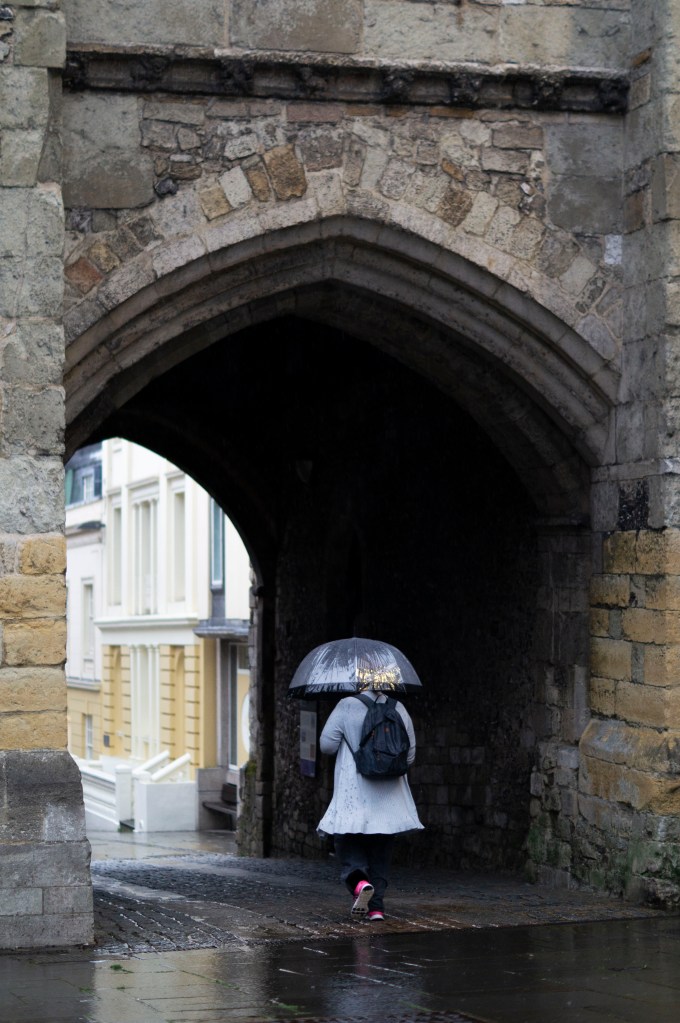
Fig. 1. Winchester 2019 03 (2019)
1/250 sec; f/1.8; ISO 400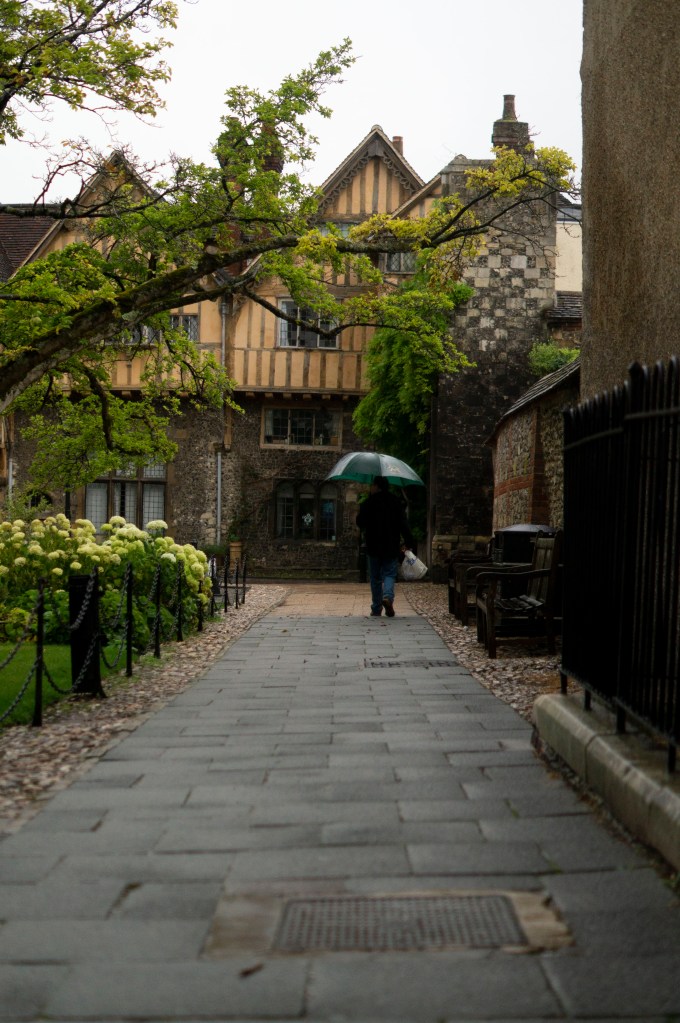
Fig. 2. Winchester 2019 18 (2019)
1/2500 sec; f/1.8; ISO 400
This pair contrast in tonality, colour, and space. While ‘Winchester 2019 18‘ (see Fig. 2) shares the cool and gloomy tones of ‘Winchester 2019 03‘ (see Fig. 1), the colours are much more saturated and warm due to the tanned wooden architecture in the background and vibrancy of the leaves framing the person in the shot. There is plenty of negative space in ‘Winchester 2019 18‘, displaying how open and free the surrounding area is, unlike the claustrophobic composition of its partner. The use of daylight, emphasises the highlights and shadows bouncing off the wet paths and textured areas in a much more natural way, preventing too many harsh lines and shapes. In terms of the subject, they are almost identical, both include umbrellas, bags, and coats, however, the focal points are the complete opposite. One person is positioned in the foreground at the top of a path, the shallow depth of field appearing in the background and the other is located in the background at the end of a path, the shallow depth of field creating a much softer foreground. Their positions in frame and the clear differences in location could symbolise the start and the end of a journey.
Pair #2
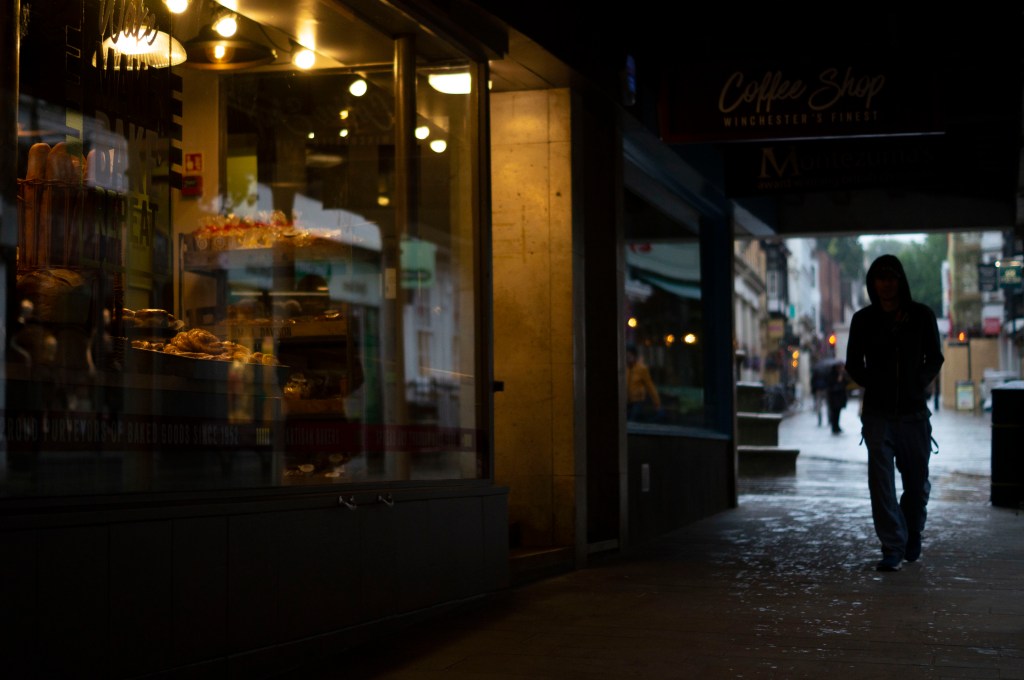
Fig. 3. Winchester 2019 11 (2019)
1/400 sec; f/1.8; ISO 400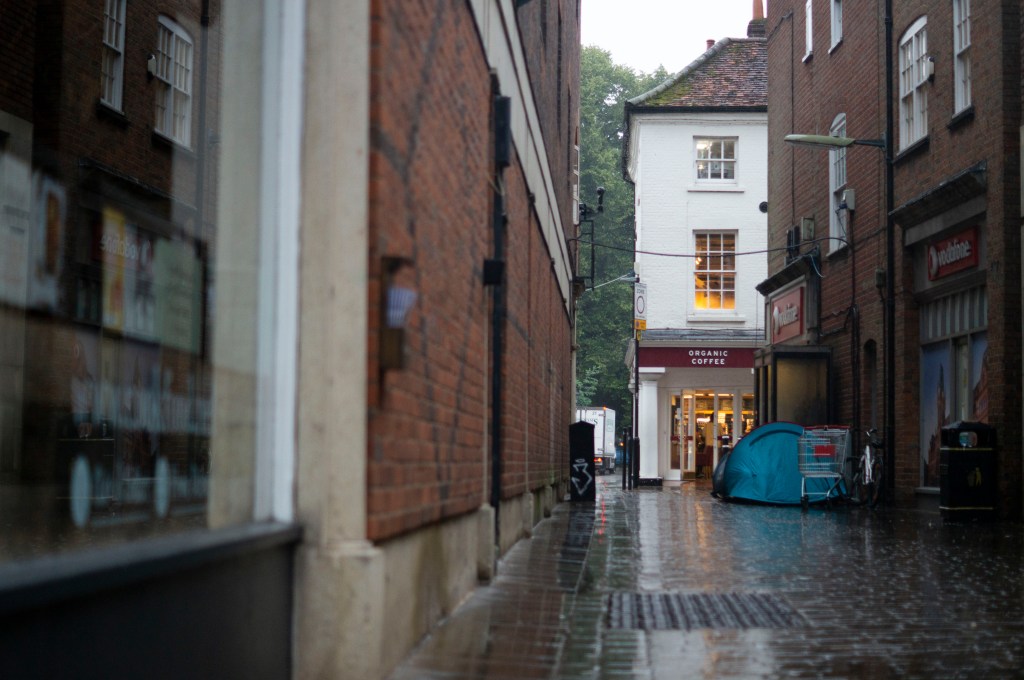
Fig. 4. Winchester 2019 12 (2019)
1/400 sec; f/1.8; ISO 400
This pair share a lot of similarities. The composition is exact which provides a repetition of the geometric buildings, the leading lines are heavier on the left-hand side, drawing the eye from the left and across to the right which in turn naturally follows the paths in the shots. The artificial lights mixing with natural light, add warmth and tension between man-made inventions and the nature of weather affecting light and temperature levels. Even though the shutter speed, aperture, and ISO were the same for each shot, the highlights and shadows completely contradict one another. Silhouettes, reflections, and intense blacks are more dominant in ‘Winchester 2019 11‘(see Fig. 3), whereas textures, colours and bright whites stand out in ‘Winchester 2019 12‘ (see Fig. 4). Signs of life are featured throughout the two via full high street shop windows, members of the public, temporary shelters and graffiti, all of which portray different elements of modern life and how certain issues such as homelessness continue to exist in the 21st century.
Pair #3
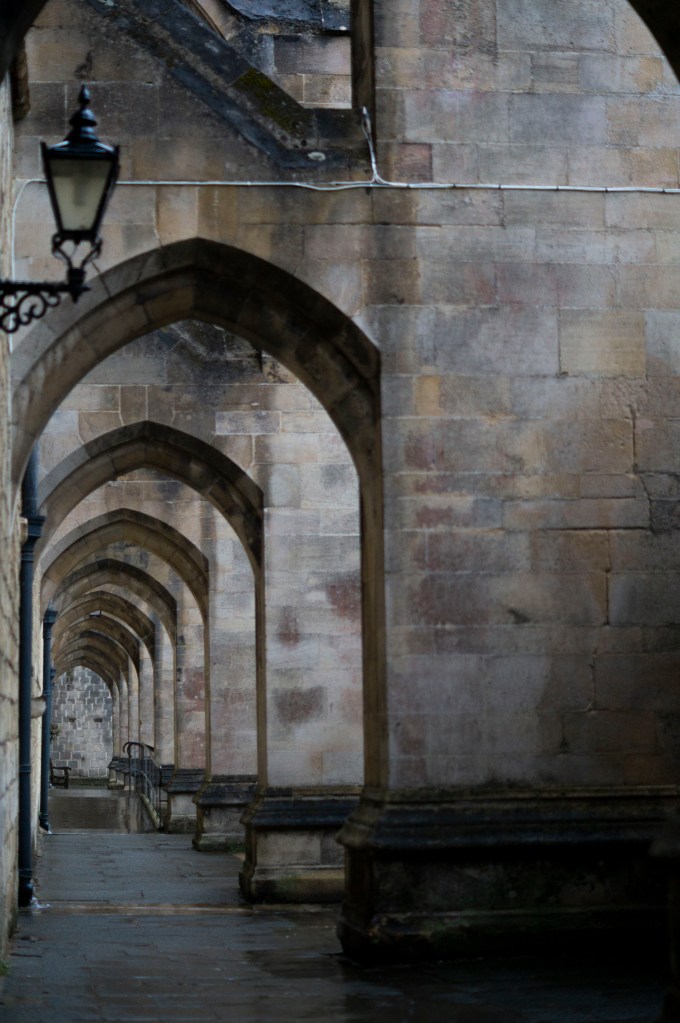
Fig. 5. Winchester 2019 14 (2019)
1/500 sec; f/1.8; ISO 400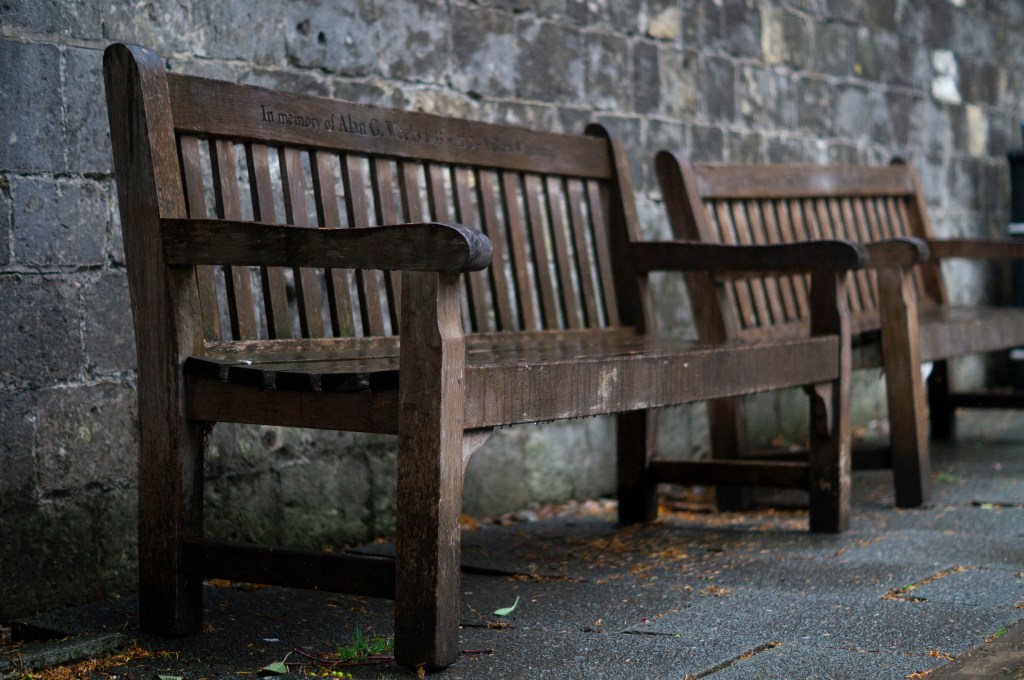
Fig. 6. Winchester 2019 19 (2019)
1/640 sec; f/1.8; ISO 400
Visually this pair works best in terms of the similarities in tones and textures. The smooth grey brickwork of the cathedral and surrounding areas create a very cold and gloomy atmosphere with the help of the wet floor and raindrops on the bench. However, the daylight bouncing off the lighter areas of the stone brightens up the image, drawing out and accentuating the natural shadows created by the archways and cracks in the walls. While repetition is very obvious in ‘Winchester 2019 14‘ (see Fig. 5) due to the archways over the path, if you follow the natural line of the walkway and look closely, you can see the wooden bench featured in ‘Winchester 2019 19‘ (see Fig. 6). So, while it may seem that these two images don’t link together beyond the fact they are similar due to location, temperature, and tones, if more time is spent looking into the image, more connections may be found than at first glance. The emptiness of the walkway and bench forms a very lonely feeling as if what was once there many times, has vanished since.
Pair #4
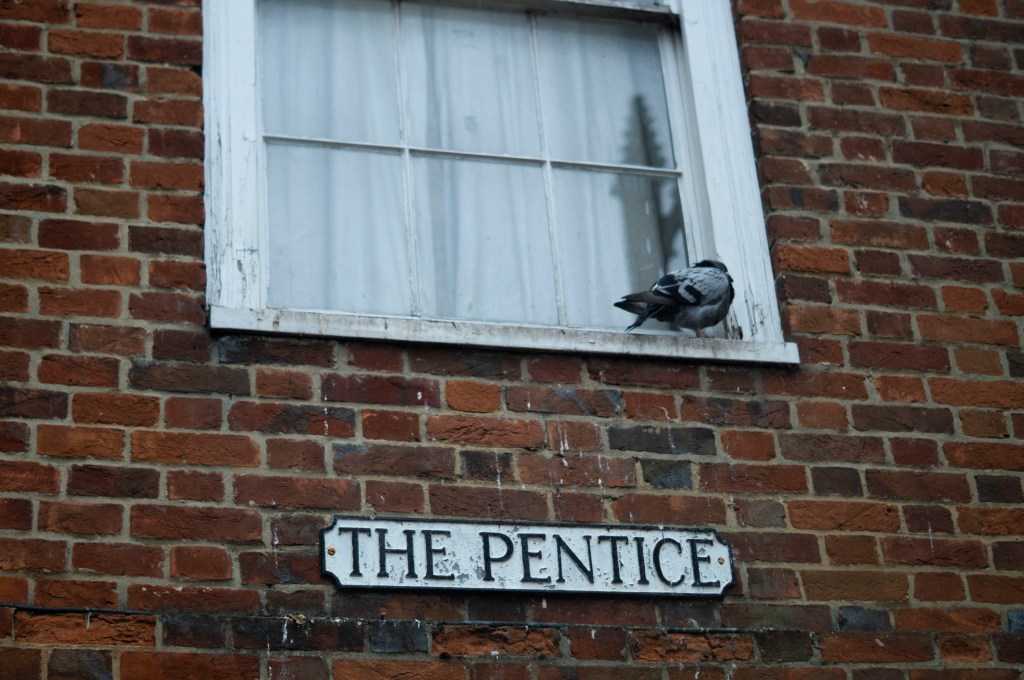
Fig. 7 Winchester 2019 10 (2019)
1/400 sec; f/1.8; ISO 400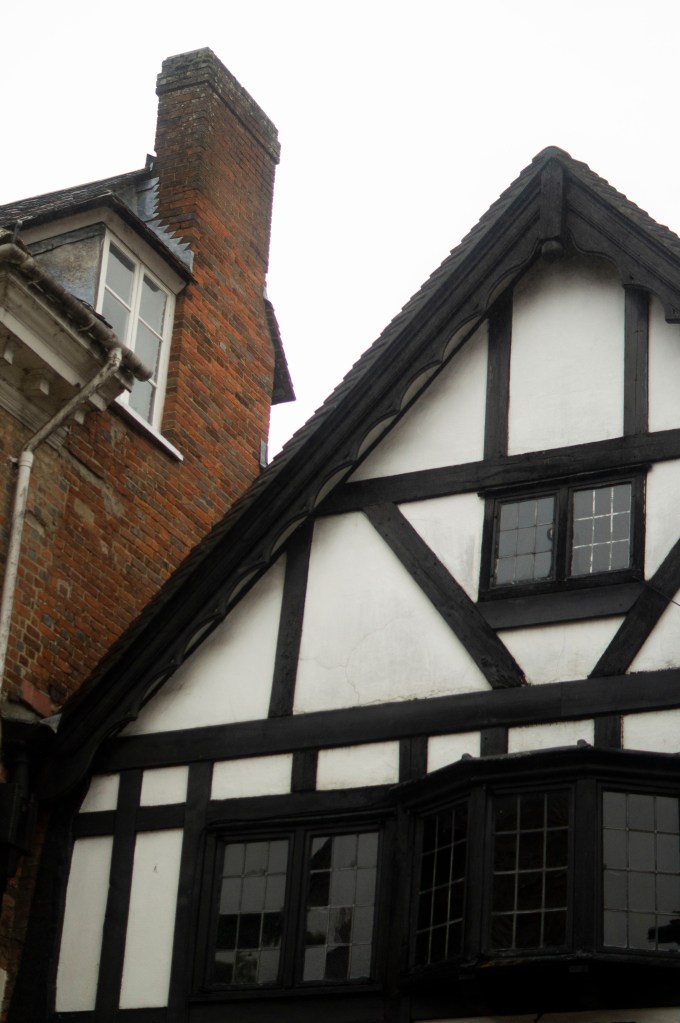
Fig. 8. Winchester 2019 26 (2019)
1/2500 sec; f/1.8; ISO 400
While the two images juxtapose in terms of the architectural elements in question, the colours, window styles, and dirty marks from nature, pull the pair together. Black and Whites are more prominent in ‘Winchester 2019 26‘ (see Fig. 8), with the geometric wooden beams, painted stone walls, and dark-tinted windows, only appearing very subtly on the road sign in ‘Winchester 2019 10‘ (see Fig. 7). However, the rusty colours and textured bricks stand out more at The Pentice than it does in the other shot, creating an even balance between the two. The framing is cropped in both, in turn helping the viewer focus on the details in the image, rather than the surroundings. Viewpoint wise, they are both shots from below and are at a slight angle, implying that the subjects weren’t at eye level or as easy to photograph due to the height of the building. While the aperture was wide, the shallow depth of field cannot be seen as clearly or at all due to how close the camera was to the buildings, creating a very sharp focus that works beautifully with the precise angles of the beams and grouting in the brickwork. Animals unfortunately now have to find their place, around what man has built over time, so the appearance of the pigeon atop a windowsill sheltering from the rain may communicate the impact humans have on nature.
Overall, I am pleased with these images as it pushed me to view this town in a more detailed and clear way, rather than focusing purely on the personal connections it holds. While I was initially driven by a personal view when I first read the brief, being able to explore the architecture, shapes, colours, textures and how places have changed over time, really helped me understand that we need to look at our surroundings much closer. You may think you know a place like the back of your hand, but a bit more time and a different perspective can help you explore in more depth and find a whole new area within.
List of images:
Figure. 1. Powell, L. (2019) Winchester 2019 03 [image] In possession of: Lauren Powell: Eastleigh.
Figure. 2. Powell, L. (2019) Winchester 2019 18 [image] In possession of: Lauren Powell: Eastleigh.
Figure. 3. Powell, L. (2019) Winchester 2019 11 [image] In possession of: Lauren Powell: Eastleigh.
Figure. 4. Powell, L. (2019) Winchester 2019 12 [image] In possession of: Lauren Powell: Eastleigh.
Figure. 5. Powell, L. (2019) Winchester 2019 14 [image] In possession of: Lauren Powell: Eastleigh.
Figure. 6. Powell, L. (2019) Winchester 2019 19 [image] In possession of: Lauren Powell: Eastleigh.
Figure. 7. Powell, L. (2019) Winchester 2019 10 [image] In possession of: Lauren Powell: Eastleigh.
Figure. 8. Powell, L. (2019) Winchester 2019 26 [image] In possession of: Lauren Powell: Eastleigh.
Selection process for final images.
Assignment 1, Notes, Reflection on assignments, Thoughts & IdeasSummary:
– I have analysed the contact sheets provided in the previous post, selected the strongest images and edited them slightly by adjusting the highlights/shadows, cropping and straightening.
– The edited images are provided below in a gallery
– Before the selection was cut down once more to help with the final selection process
– Stating why some images weren’t included, for instance, they weren’t strong enough conceptually or technically
– Unlike the photographs shown in the scanned document, that is highlighted and numbered to show the two attempts at image pairing, the numbers being the final choice.
– Brief bullet points have been listed to cover the strong variety of elements within the final collection and why they were paired together.
I decided to select what I feel we’re the best images from the shoot and edited them very slightly. The only photo manipulation that took place was correcting the highlights and shadows, cropping them down and straightening a few of them out where needed, without completely changing what was captured in the camera which was requested in the ‘Expressing Your Vision’ course material.
The edited images are as follows :
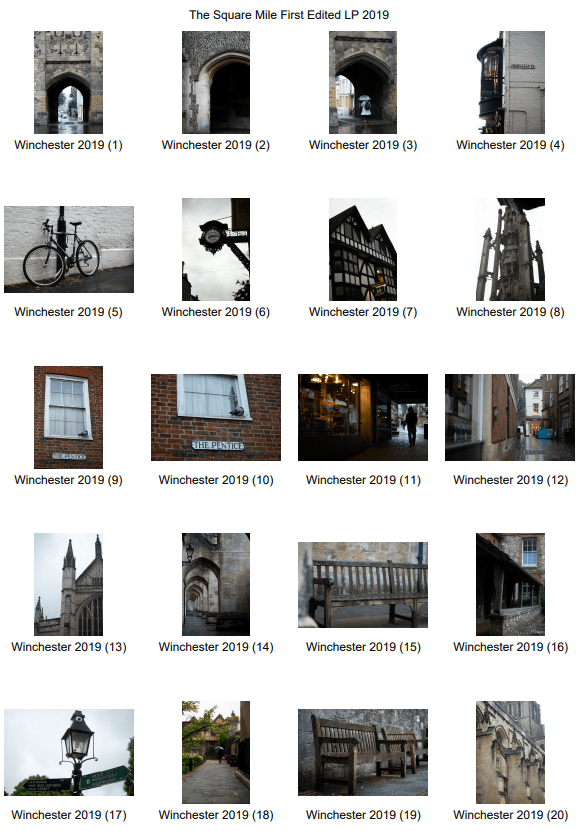
Fig. 1. Page 1 (2019) 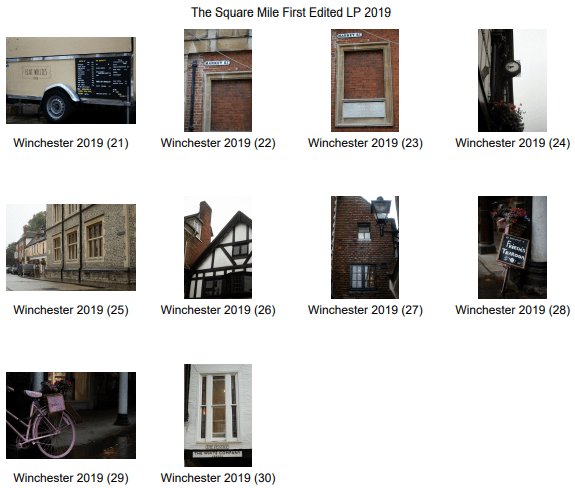
Fig. 2. Page 2 (2019)
After editing these images, I cut down the selection once more to make it easier to choose my final images for the ‘Square Mile’ assignment.
While there were quite a few images that I liked, some of them just didn’t ‘fit’ or have a strong enough link to the project plan, where I stated that ‘I would like to explore various childhood memories, see how the areas may have changed throughout the years and if they are as I remember them’ (Powell, 2019).
For example, ‘Winchester 2019 28′ (see Fig. 2.) is strong due to composition, the relaxed position of the bike, the highlights and shadows, as well as the shallow depth of field, however, it didn’t compliment the collection. Considering the majority of the images explored architecture, the differences between each building and the effects time has had on them, it became an odd one out.
The following images are a part of my second selection process. The scans below show my initial pairings in colour and the final image pairings with numbers. I will provide a brief list as to why I decided to pair up these specific images, to refer back to in my image analysis.
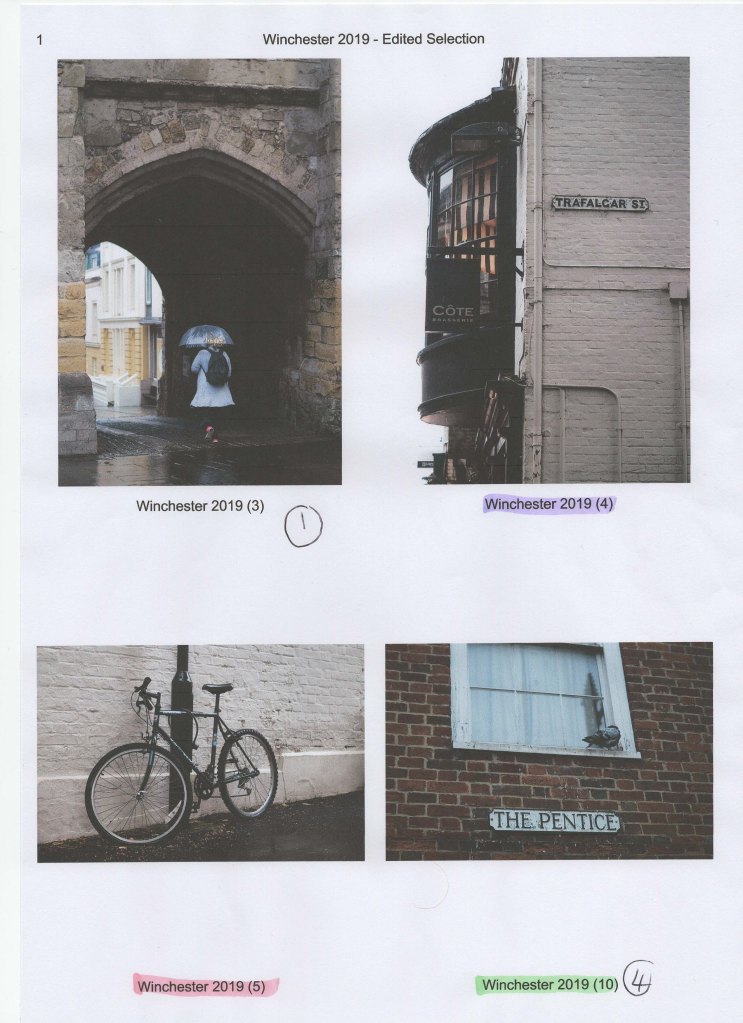
Fig. 3. Contact Sheet (2019) 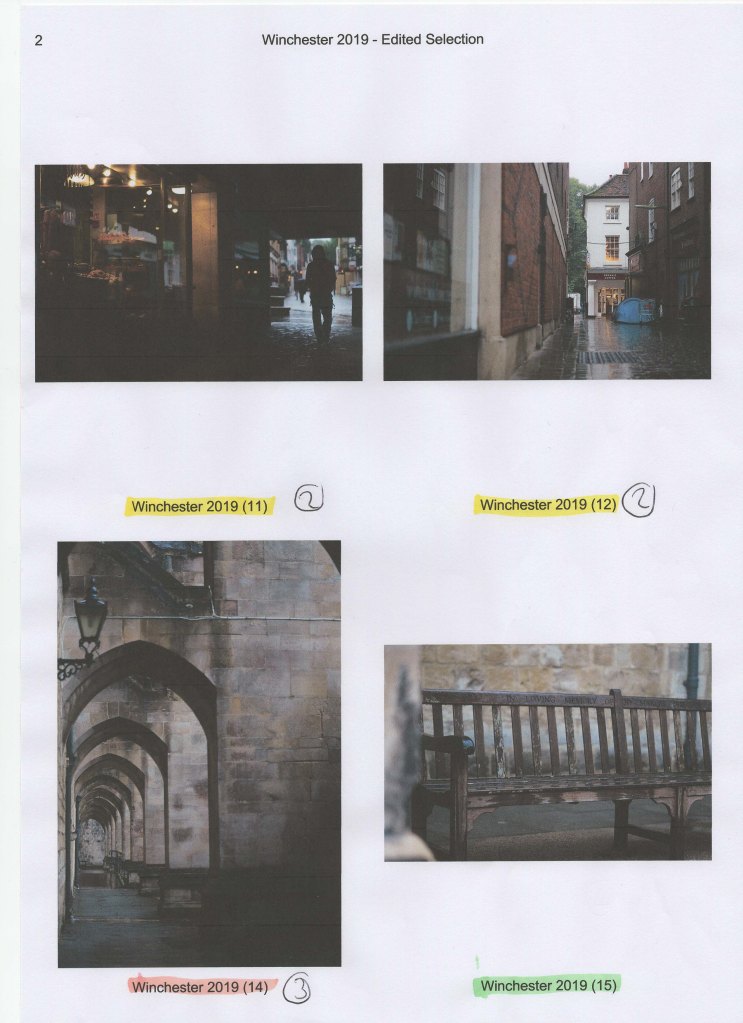
Fig. 4. Contact Sheet 2 (2019) 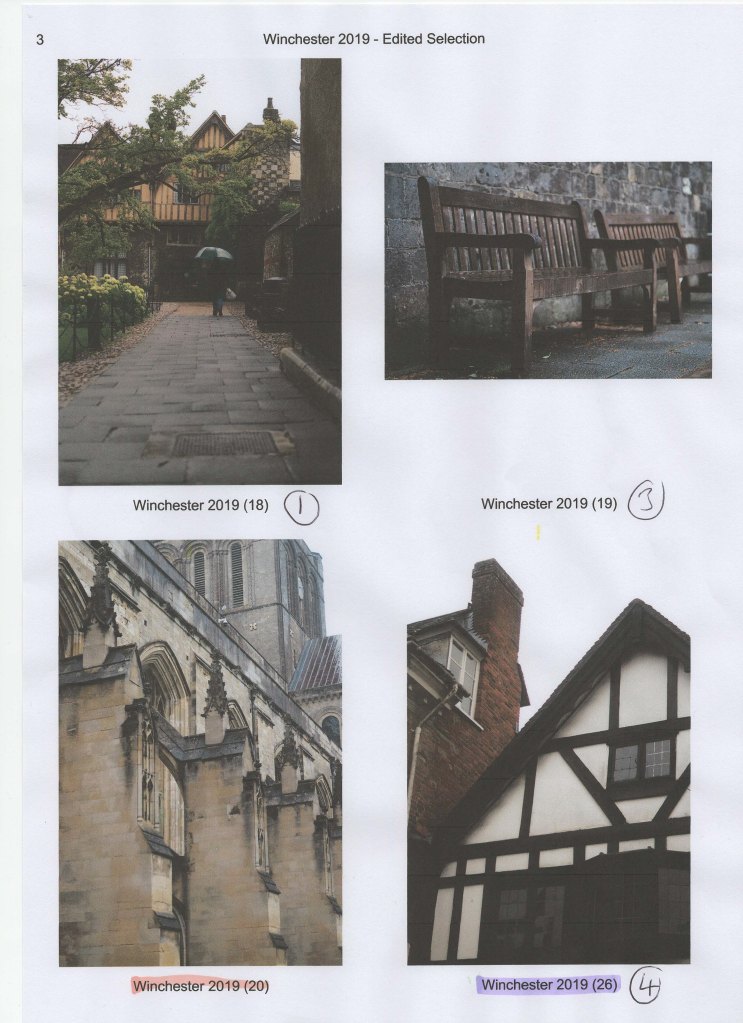
Fig. 5. Contact Sheet 3 (2019) 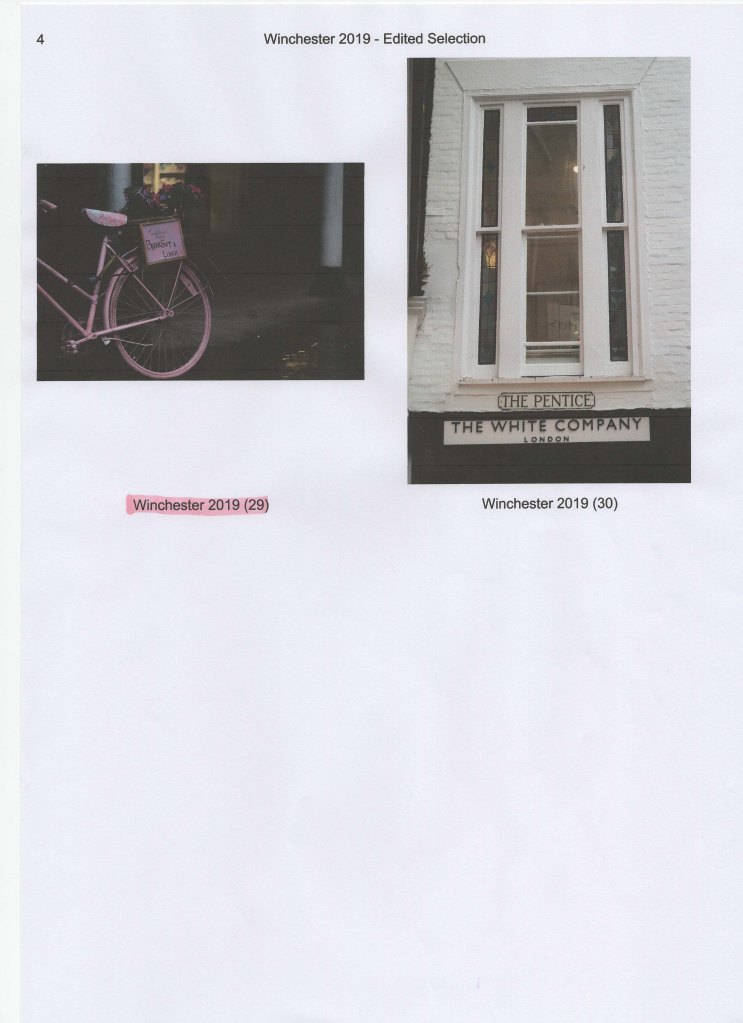
Fig. 6. Contact Sheet 4 (2019)
Reasons for pairing up:
While I am aware I didn’t have to pair these images up, to create a cohesive series I felt that it was the best option for me to make sure I achieved what I set out to do, which was to explore Winchester by retracing steps, capturing what had changed, the similarities and presenting a personal view in a different way to which I’m used to. Pairing the photos up has helped me form a short journey through the town, as well as a complementary collection.
Winchester 11 and 12
– Similar compositions.
– Contrasts between light and dark.
– Contrasts between natural and artificial light.
– References to work and daily life.
– Shows human interaction.
– Both significant places I visited with family.
Winchester 14 and 19
– Similar tones.
– Repetition.
– The juxtaposition between architecture and public seating.
– Both in the same area and have a significant connection.
Winchester 3 and 18
– Person framed by architecture and nature.
– Umbrellas.
– Shows daily life.
– Monochrome.
– Pathways.
– Start and end of my journey.
– Special areas vs new.
Winchester 10 and 26
– Similar brickwork.
– Nature vs man-made.
– Similar tones.
– Contrasts in colour.
– Reflection of a significant statue.
– Depth.
– Dirty buildings.
– Buildings are behind one another.
– Family links.
References :
Powell, L. (2019) Plan for ‘The Square Mile’. [online] Available at: https://laurenpowelloca.photo.blog/2019/08/20/plan-for-the-square-mile/ [Accessed 12 September 2019].
List of images:
Figure 1. Powell, L. (2019) Page 1 [PDF, Screenshot] In possession of: Lauren Powell: Eastleigh.
Figure 2. Powell, L. (2019) Page 2 [PDF, Screenshot] In possession of: Lauren Powell: Eastleigh.
Figure 3. Powell, L. (2019) Contact sheet 1 [Scanned Document] In possession of: Lauren Powell: Eastleigh.
Figure 4. Powell, L. (2019) Contact sheet 2 [Scanned Document] In possession of: Lauren Powell: Eastleigh.
Figure 5. Powell, L. (2019) Contact sheet 3 [Scanned Document] In possession of: Lauren Powell: Eastleigh.
Figure 6. Powell, L. (2019) Contact sheet 4 [Scanned Document] In possession of: Lauren Powell: Eastleigh.
Contact Sheets for ‘The Square Mile’ + reflection.
Assignment 1, Notes, Reflection on assignments, Thoughts & IdeasSummary:
In this post I have;
– Provided annotated contact sheets of my shoot around Winchester, noting the strengths and weaknesses of a variety of shots
– As well as a PDF version for a clearer view of the sheets.
– Noted what images worked well and drew on the techniques used, such as consistent framing, natural lighting and such.
– Covered what went well during the shoot, for instance my ability to think about my surroundings to gather a cohesive series much like Keith Arnatt, reflecting on his influence.
– Explored how the shoot went despite an unexpected burst of bad weather, enabling me to achieve the ’empty’ town shots I was looking for and supplying an added interesting atmosphere, as well as
– Stating what could be improved in the future, for example being aware of the angles images are shot at and reducing the amount of duplicate images I capture, in turn being more selective.
Contact sheets:
The following contact sheets include all of the images shot during the ‘Square Mile’ photo-shoot in Winchester, Hampshire. They’ve been annotated and scanned onto my computer, providing suggestions of how the images could’ve been stronger and/or the various elements I enjoyed.
All images were shot in RAW on my Sony A57, so I could then make the basic corrections in post-production without losing too much detail.
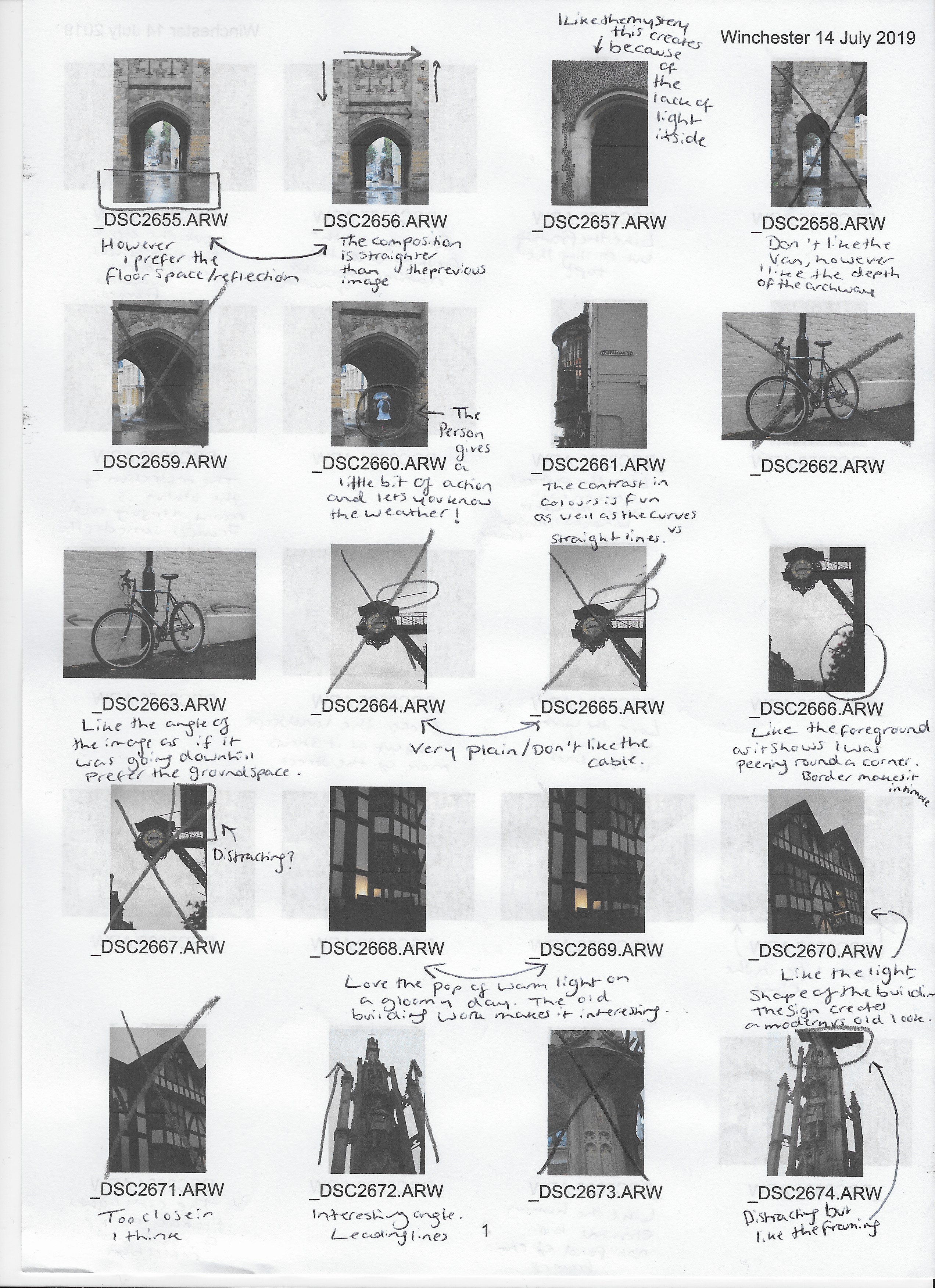
Fig. 1. Page 1 (2019) 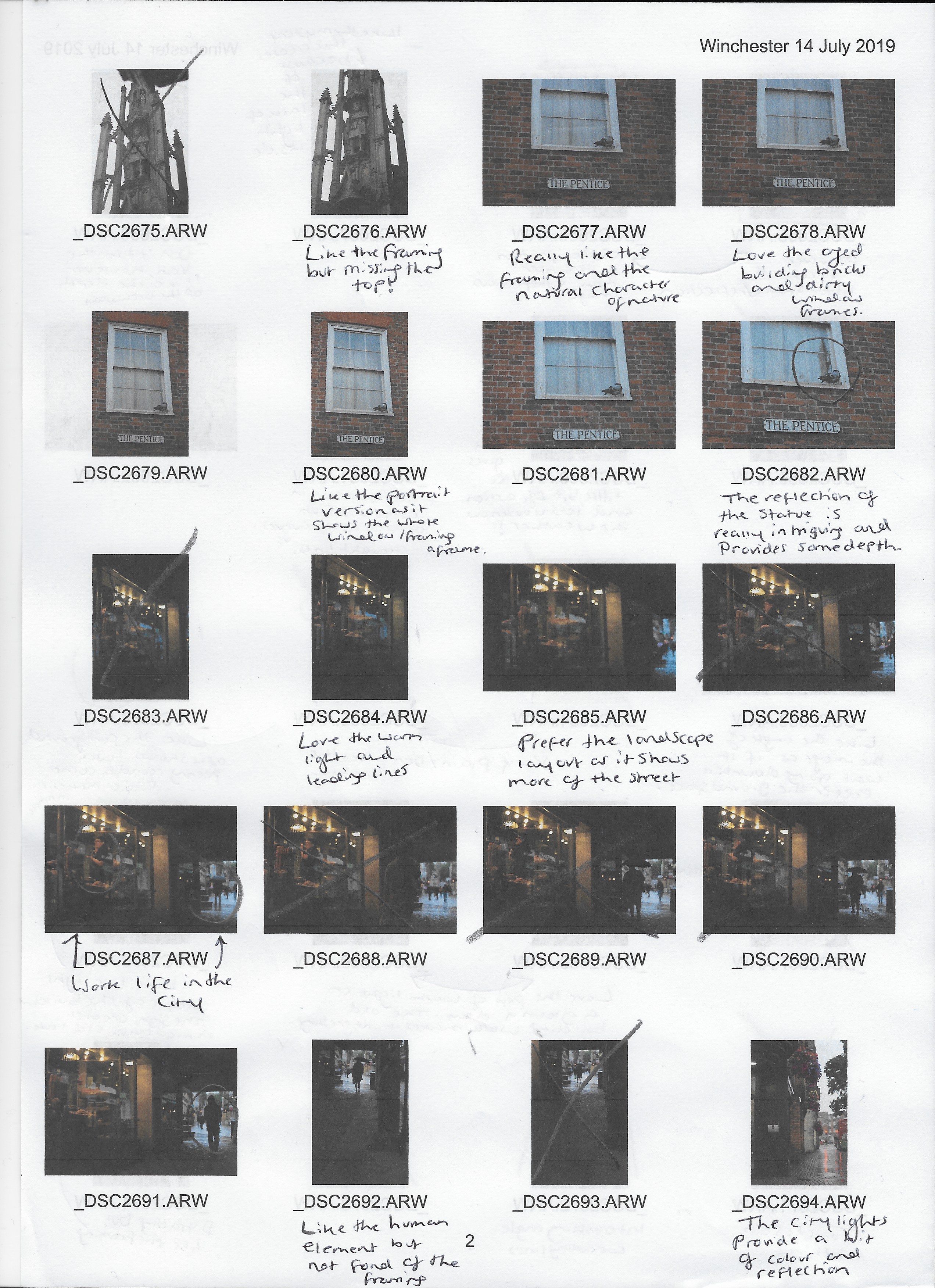
Fig. 2. Page 2 (2019) 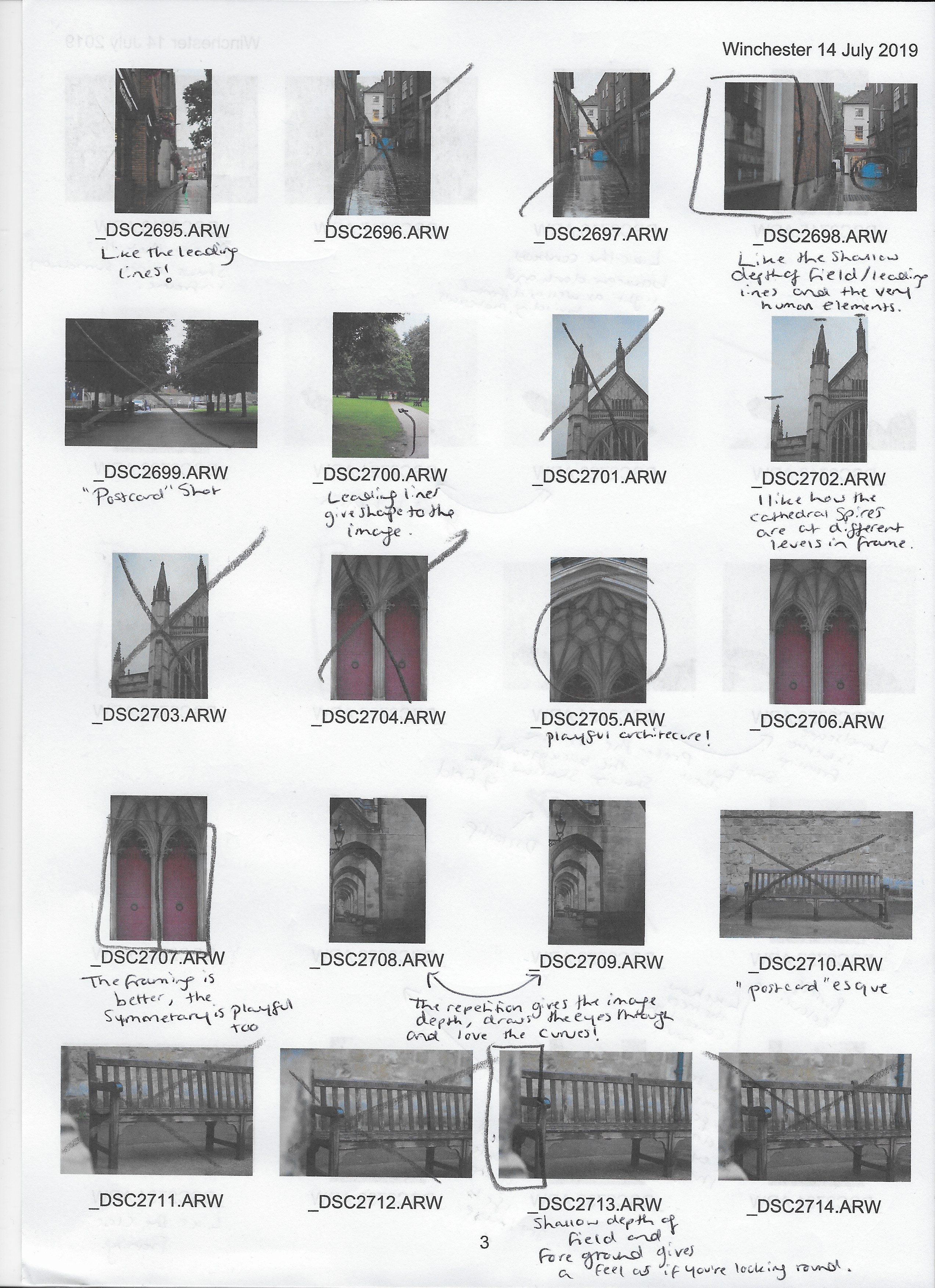
Fig. 3. Page 3 (2019) 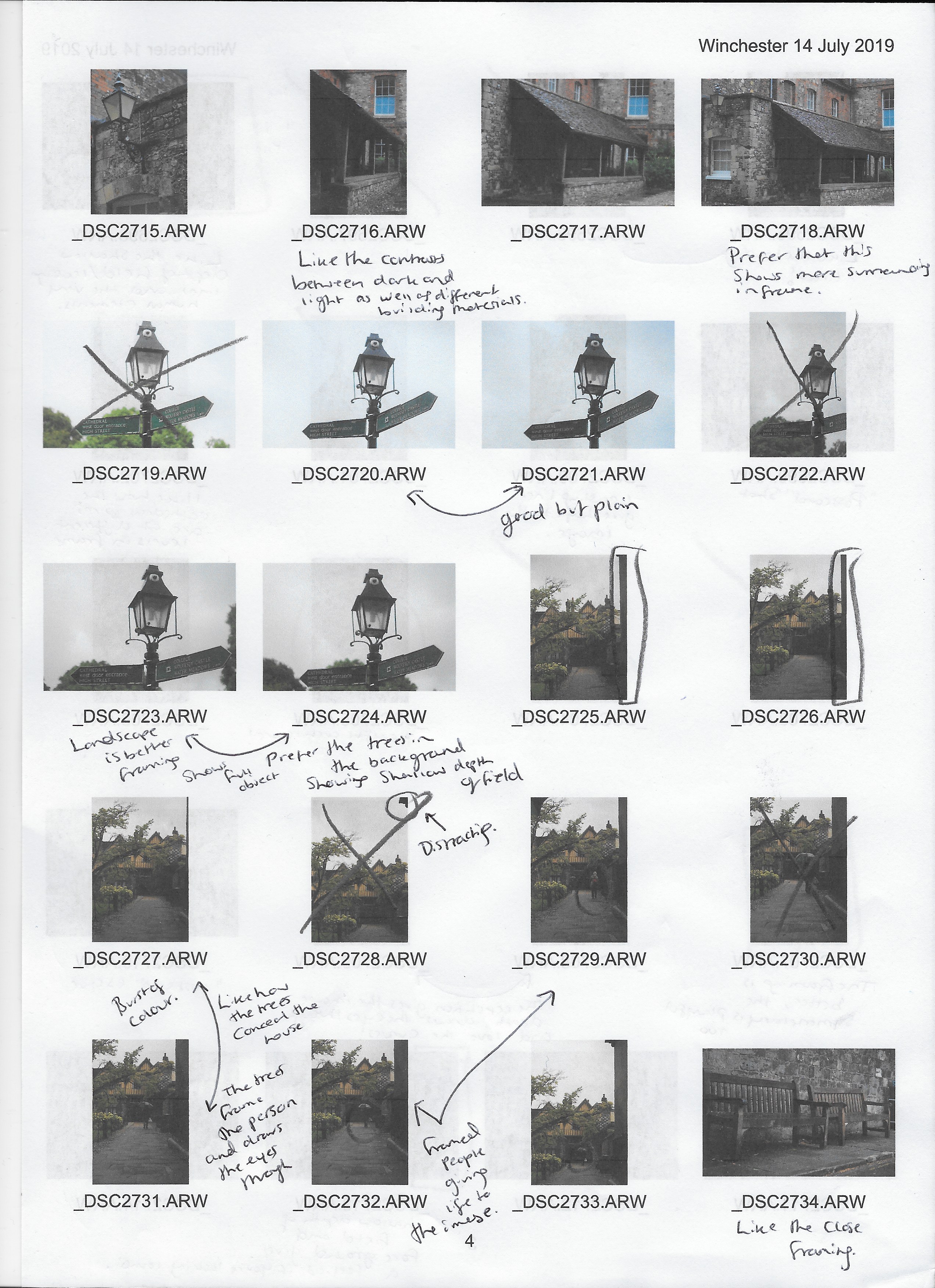
Fig. 4. Page 4 (2019) 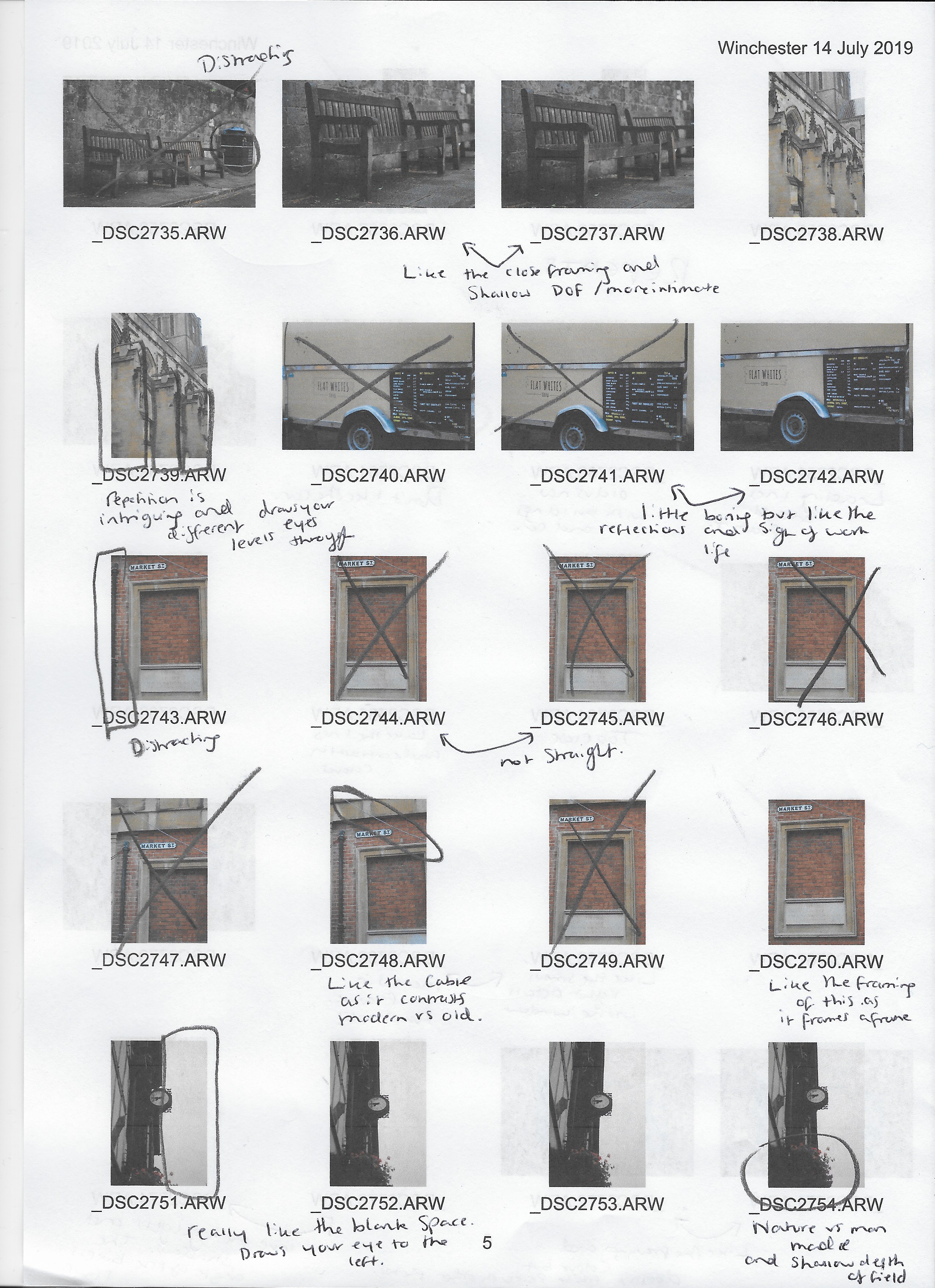
Fig. 5. Page 5 (2019) 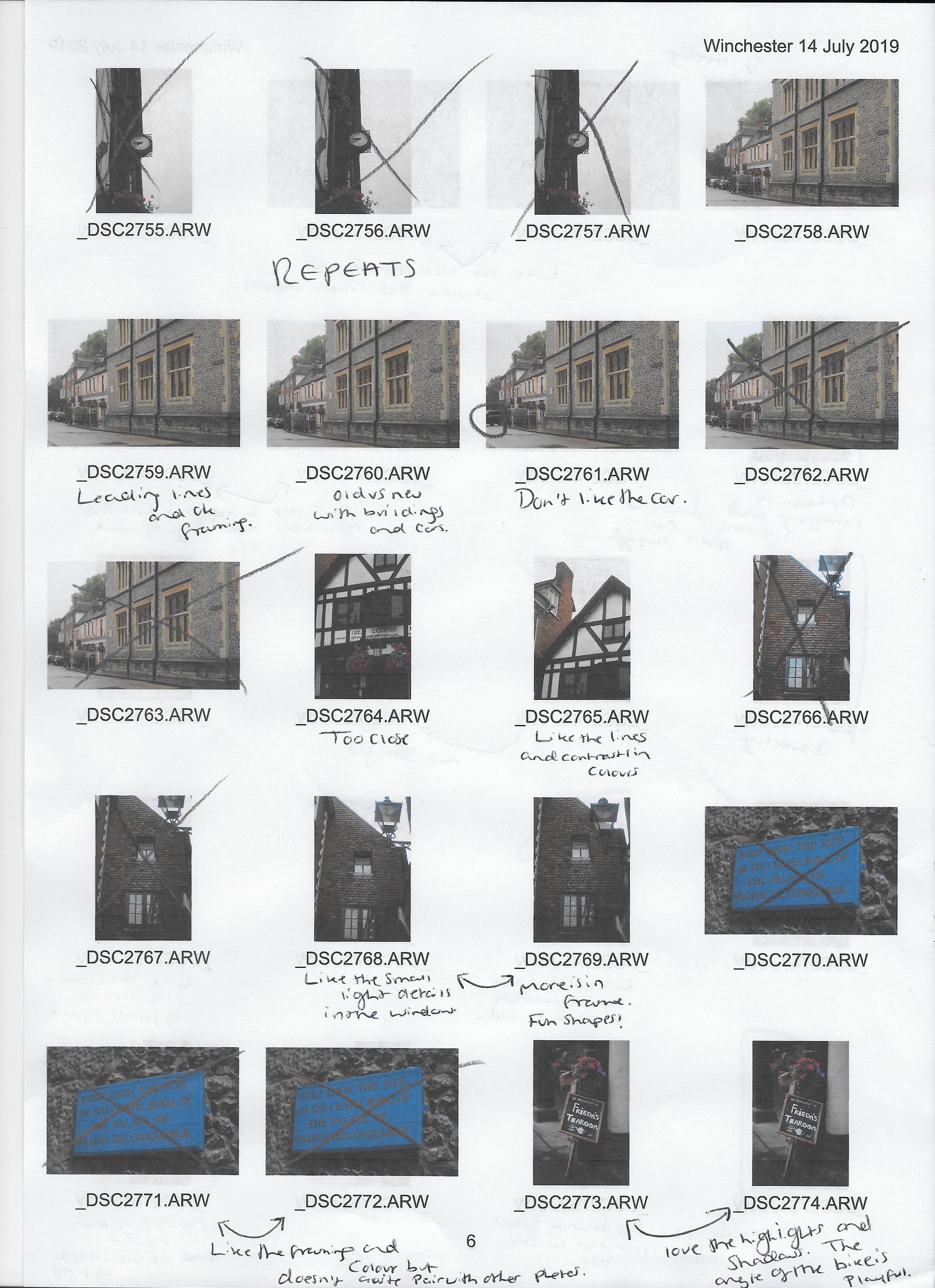
Fig. 6. Page 6 (2019) 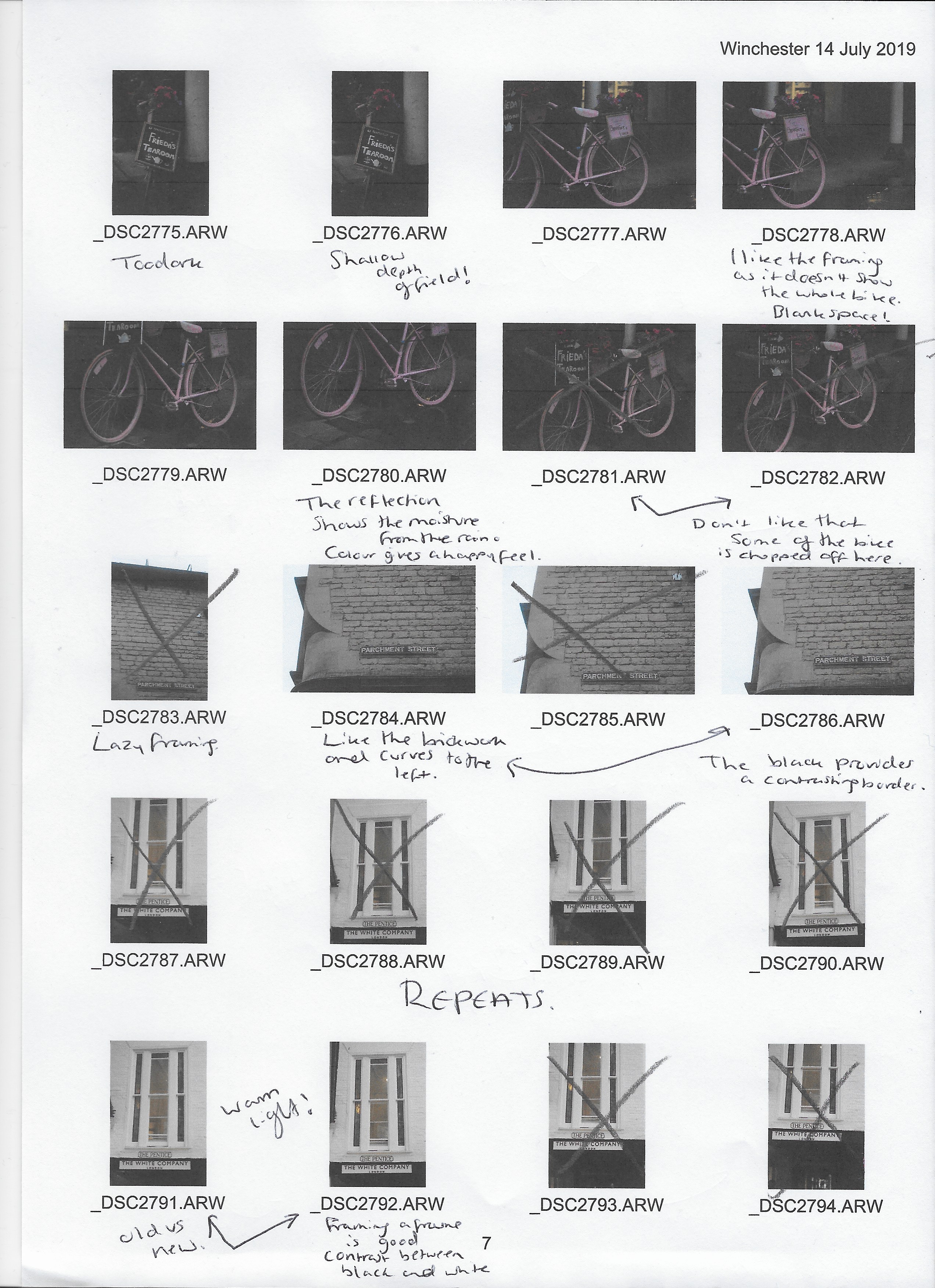
Fig. 7. Page 7 (2019)
Notes :
What do I think of my images?
I’m pleased with how my images turned out, considering that street photography isn’t my usual area of focus and isn’t something I have explored very much. I tried my best to consider similar framing techniques and be aware of the light in my surroundings, to take inspiration from Keith Arnatt who has been part of my practitioner research. Summaries of Arnatt’s work suggest that he ‘may have planned his approach, due to the way he composed the series and stayed consistent with his choice of natural lighting and fixed camera distance’ (Powell, 2019).
What are some of my favourite images?
One of my favourite technical elements from the images shot in the high street (see Fig. 2.) is the contrast between cool, natural light from the gloomy, rainy weather and warm artificial light from the shops and cafes.
Another shot that stands out is the pigeon resting on the window ledge (see Fig. 2.), with the reflection in the glass, very subtly adding tension to the image as you don’t know at first glance what that silhouette may be.
What went well?
The variation of subjects I shot and being able to form a cohesive series purely from my surroundings, successfully achieving my aim to be flexible with what I captured in-camera while keeping the final selection process in mind so I’m not going to be left with a group of random ‘snapshots’ that don’t compliment each other.
What could be improved?
I need to work on my framing and angles a little bit more when shooting. Sometimes my photographs are intentionally taken at an unusual angle, but I also understand that some subjects are better suited with a straight horizon line, which creates more work in post-production if I don’t think about it or can’t get it right the first time round in camera.
Also, I have a habit of taking multiple images which aren’t necessarily an issue, but a few duplicates would be better than half a dozen especially when it comes to producing contact sheets. This is something I will discuss with my tutor to get their opinion on whether I need to work on this or not.
How did the shoot go?
When the shoot was planned, I stated that ‘I would like to go early in the morning so that it isn’t too crowded. This way it’ll allow me to focus on what is around me, what is happening and how I feel about it as a whole’ (Powell, 2019). However, one element not considered was unexpected weather conditions. Thankfully the rain worked in my favour as it was even quieter than expected while creating a moody, dark atmosphere which challenged me to work in conditions that I wouldn’t usually choose to shoot in, due to the inconsistency of light levels, much like direct sunlight at midday.
It was interesting to see how I worked with what I had and how the quality of the images wasn’t necessarily hindered by the weather.
What am I going to do with these images now?
After going through my images as a whole on my computer, I am going to select a few of my best images and apply very basic corrections to them, such as highlight/shadows alterations e.t.c. They will then be cut down again and paired together for the final series of photographs needed for the assignment.
References :
Powell, L. (2019) Keith Arnatt Research. [online] Available at: https://laurenpowelloca.photo.blog/2019/08/13/keith-arnatt-research/ [Accessed 20 July 2019].
Powell, L. (2019) Plan for ‘The Square Mile’. [online] Available at: https://laurenpowelloca.photo.blog/2019/08/20/plan-for-the-square-mile/ [Accessed on 20 July 2019].
List of images:
Powell, L. (2019) Page 1 (Scanned document) In possession of: Lauren Powell: Eastleigh.
Powell, L. (2019) Page 2 (Scanned document) In possession of: Lauren Powell: Eastleigh.
Powell, L. (2019) Page 3 (Scanned document) In possession of: Lauren Powell: Eastleigh.
Powell, L. (2019) Page 4 (Scanned document) In possession of: Lauren Powell: Eastleigh.
Powell, L. (2019) Page 5 (Scanned document) In possession of: Lauren Powell: Eastleigh.
Powell, L. (2019) Page 6 (Scanned document) In possession of: Lauren Powell: Eastleigh.
Powell, L. (2019) Page 7 (Scanned document) In possession of: Lauren Powell: Eastleigh.
Plan for ‘The Square Mile’
Assignment 1, Notes, Thoughts & IdeasSummary:
In this post I
– Explained how I planned my shoot using the 5 W’s, H and why
– Listed my plan in bullet points
Plan
I planned my shoot using the 5W’s and H so I could think about my goals and ideas properly, instead of just formulating a list of various aims that were inspired by the mind-map I created.
Area of choice – Where? : Winchester High Street and the surrounding areas
Why? : It holds significant memories with my grandparents, cousins and direct family, so I would like to explore various childhood memories, see how the areas may have changed throughout the years and if they are as I remember them. For example, new buildings vs old architecture, as well as modern-day life within an aging town.
When? I would like to go early in the morning so that it isn’t too crowded. This way it’ll allow me to focus on what is around me, what is happening and how I feel about it as a whole. We also used to go to town fairly early in the day to avoid the rush of people, so it is quite fitting with the routine I followed as a child.
Who? : Depending on whether Winchester is as quiet as I am expecting it to be in the morning, I may include members of the public in my imagery to give a bit of life and action to my photographs. For example, people going about their day, unaware of what significance the town holds for me and vice versa if the town means anything to them. We all share the same space, but we’re not always aware of what people are doing there, how it makes them feel or where they’re headed.
What? : As noted in my post ‘Initial Thoughts About ‘The Square Mile’ + Mindmap’ (Powell, 2019), I will be revisiting some areas I visited or spent significant time with close family. That way I can capture what they look like now, the people/objects surrounding them that may have changed, are consistent or may only be temporary.
How? :
– Go to town early in the morning via train.
– Start from the top of town from the station and work your way down.
– Notice and capture whatever captures your eye as you observe, while keeping original ideas in mind.
– Set the aperture and keep it constant, only change the shutter speed to fit the light settings on the day. SET CAMERA TO MANUAL.
– Have the chosen ideas in mind, but be flexible too. E.G. If something doesn’t work, it’s fine. If you notice something you didn’t think about beforehand, then work with it.
– Think about making a cohesive series – can images/areas be paired up in your final selection process?
– Have fun and go out of your comfort zone.
– Shoot multiple images so you have a reasonable selection.
References :
Powell, L. (2019) Initial Thoughts About ‘The Square Mile’ + Mindmap. [online] Available at : https://laurenpowelloca.photo.blog/2019/08/15/initial-thoughts-about-the-square-mile-mindmap/ [Accessed 20 August 2019].
Keith Arnatt Research
Assignment 1, Online Research, Practitioner Research, Thoughts & IdeasSummary:
For this research section I have;
– Challenged the critics theories about Arnatt’s level of influence in the conceptual art movement.
– Briefly explored the definition of conceptual art.
– Drawn upon Arnatt’s planning and technical approaches to his work.
– Analysed a selection of Arnatt’s artwork and
– Stated which techniques I would like to use in my own work, such as pre-planning my camera settings, concepts and compositions to gather a cohesive set of images
– To reflect on my understanding of how Arnatt works and how this can be implemented in my own work.
Keith Arnatt
Keith Arnatt (1930-2008) was primarily known as a British conceptual artist, however, his work was also spoken about concerning land art, minimalism, and photography.
Arnatt was born in Oxford in 1930, where he continued to reside to study at Oxford School of Art in the early 1950s, however, he furthered his education at the Royal Academy Schools in London later on in life. From 1962 he taught in Liverpool and up until 1969, Arnatt taught in Manchester.
Settings for his work we’re as follows, Liverpool (The beach at Formby); the moors around his farmhouse in Todmorden, Yorkshire; and his garden in Tintern which was surrounded by woodland.
Arnatt’s work was associated with the new conceptual art movement by the late 1960s, during which he took part in various exhibitions for conceptual art such as the following; ‘Konzeption-Conception, Städtichen Museum, Leverkusen’, 1969; ‘Information’, MoMA, New York, 1970; ‘Umwelt-Akzente / Die Expansion der Kunst’, Kunstkreis Monschau, 1970 and ‘Art as Idea in England’, CAYC (Centro de Arte y Comunicación), Buenos Aires, 1971′, (Wikipedia, 2019).
There was plenty of theorising over the amount of influence Arnatt may have had within the contemporary art practice of that time, mainly due to his realistic style of shooting.
Having looked at some of his work such as ‘Miss Grace’s Lane’ (Arnatt, 1986-7) and ‘Pictures from a Rubbish Tip’ (Arnatt, 1988-9) I can understand how critics or other artists may have gone back and forth about his impact on the practice because he does indeed show the subject in frame as it is without ‘manipulating’ it if you will.
However, after researching further about conceptual art and what it means (see Fig. 1.), it’s not as black and white as people may believe. Just because an artwork isn’t abstract or experimental, doesn’t mean that it isn’t conceptual or contemporary.
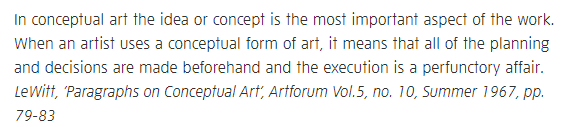
A summary of ‘Pictures from a Rubbish Tip’ (Arnatt, 1988-9) provides us with the idea that Arnatt may have planned his approach, due to the way he composed the series and stayed consistent with his choice of natural lighting and fixed camera distance. ‘Although the types of rubbish shown and their exact position within the compositions varies slightly, each is presented at a fixed distance from the camera and this, as well as the similar lighting effects used across the five works, creates a sense of cohesion in the series’ (Tate, 2014).
Therefore, with this information, I feel as if Arnatt had quite a significant influence on the contemporary movement by challenging what people assumed experimental looked like.
‘a conceptual artist uses whatever materials and whatever form is most appropriate to putting their idea across’ (Tate, 2017) which I feel as if Arnatt did, as his work has made me think about how long it had been there, who it belonged to before and see beyond the fact that it is just a pile of rubbish in a tip.
The clear plastic bags in the background of the objects in the frame allow for the colours to pop and draw your eyes towards the bottom right corner where the focal point is. One of the works from the series features a collection of meat ridden bones and a brightly coloured pool of ketchup in the top right-hand corner. In my eyes this is thought provoking, mainly because to some it could just be seen as a condiment for a meat eater’s dinner, but could it also represent the blood of the animal it used to be?
Highlights and shadows help bring depth into a piece of art, defining the shapes in the composition, leading your eyes around the work and giving texture to the subject.
I like how the edges are lighter in the work with the loaf of bread, slowly getting darker as you look further towards the middle, showing that the bread is cushioned by the rubbish underneath and triggers the mind into thinking that the items below were possibly quite soft, like dough almost?
Someone made that bread with their own hands, with love and care, yet it’s ended up in the bin? This leads me to the idea that despite how beautiful, how healthy or useful things are, it may not matter to some, it can be thrown aside. Although, that being said, maybe our perception of a rubbish tip should change from trash to treasure. Items that can be found there have provided life, nutrition, memories and happiness to some, as well as the various negatives.
This reflects the idea previously mentioned that artwork doesn’t have to be viewed so simply, even if you think it is just a realist piece.
Upon researching and reading Arnatt’s work, I see a lot of similarities within our thought/creative processes. I tend to plan what I want to shoot beforehand, think about why an image has been shot that way and whether others will see the work in the way it was intended. Shallow depth of field and natural light is my preferred style too as you get a much softer background while maintaining a clear and sharp focus on the subject.
One of the techniques I would like to bring into my work, however, is creating a series of images that are cohesive and make sense alongside one another, whether that is through the concept or in literal terms e.g. Similar compositions, shapes, colours e.t.c.
Another piece of work I find intriguing is the black and white variant of ‘Portrait of the Artist as a Shadow of his Former Self’ (Arnatt, 1969-72). It is not only a self-portrait shot in a unique way, but it is also once again challenging people’s views about his influence on contemporary art practice. This is a much more obvious conceptual piece, as the medium of chalk and paint have also been used within the work, making it rather experimental by combining more than one medium.
The shadows from the street which are falling around Arnatt’s form creates a spotlight effect and almost emphasises what the work is about. The artist.
Looking further into the image and noticing the graffiti sprayed, dirt-covered brick walls in the background provide a little bit of character to the building by aging it and showing the wear and tear it been through over the years. It shows history.
‘Arnatt has commented: ‘I was beginning to become aware of the unreliability of photographic evidence and began to play with that feature. I felt that what a photograph could not tell or show might be just as significant as what it could.’ (Quoted in John Roberts, The Impossible Document: Photography and Conceptual Art in Britain 1966–1976, London 1997, p.47.)’ (Tate, 2014).
As Arnatt has stated himself, this piece of work is playing around with what a photograph can be. Initially, I thought the dark area within the chalk lines, were indeed his shadow, but with further research, I now know it was painted. The lines are distorted and exaggerated, but you understand what he was trying to portray even though it wasn’t his shadow in the image, instead, it was an outline of what once was there before he disappeared out of frame. A very clever way to work with a concept.
Once again, there are similarities between my work and Arnatt’s. We both think out of the box, play with words and what could be. I also like to exaggerate ideas within my work through props, outfits, makeup or expressions, much like the distorted shadow. However, one thing I would like to explore more is the use of black and white photography. It takes the element of colour away but helps the viewer be a little more intimate with the different tones and textures within a piece of work which you may not have noticed in a colour image.
In ‘The Square Mile’ assignment, I would like to use my style, however, implement the various techniques Arnatt has used in his work so I can create a successful series of images that mold with one another.
List of works, materials, and proposals that are held at various galleries, collections from the late 60s-80s;
Self Burial – the version documenting the WDR televised Self-Burial (Television Interference Project) (1969), and Trouser-Word Piece (1972-89 version) are held in the Tate collection.
Examples of early materials are held at The Henry Moore Institute in Yorkshire, including slides of early works. Leeds City Art Gallery holds drawings from the early 1960’s.
Examples of proposals are held at the V&A Museum in London.
Documentation of proposals that Arnatt gave to Robert Smithson were donated to LACMA, Los Angeles by Nancy Holt.
Tate Archive has proposal related materials by Arnatt including correspondence with the writer Barbara Reise.
References:
Arnatt, K., 1986. Miss Grace’s Lane. [image] Available at: https://www.tate.org.uk/art/artworks/arnatt-miss-graces-lane-t13166 [Accessed 13 August 2019].
Arnatt, K., 1969. Portrait of the artist as a shadow of his former self. [image] Available at: https://www.tate.org.uk/art/artworks/arnatt-portrait-of-the-artist-as-a-shadow-of-his-former-self-p13143 [Accessed 13 August 2019].
Arnatt, K., 1998. Pictures from a Rubbish Tip. [image] Available at: https://www.tate.org.uk/art/artworks/arnatt-pictures-from-a-rubbish-tip-t13170 [Accessed 13 August 2019].
Tate. 2014. ‘Portrait of the artist as a shadow of his former self’, Keith Arnatt, 1969–72 | Tate. [online] Available at: https://www.tate.org.uk/art/artworks/arnatt-portrait-of-the-artist-as-a-shadow-of-his-former-self-p13143 [Accessed 13 August 2019].
Tate. 2017. Conceptual art – Art Term | Tate. [online] Available at: https://www.tate.org.uk/art/art-terms/c/conceptual-art [Accessed 13 August 2019].
Tate. 2014. ‘Pictures from a Rubbish Tip’, Keith Arnatt, 1988 | Tate. [online] Available at: https://www.tate.org.uk/art/artworks/arnatt-pictures-from-a-rubbish-tip-t13170 [Accessed 13 August 2019].
Wikipedia. 2019. Keith Arnatt – Wikipedia. [online] Available at: https://en.wikipedia.org/wiki/Keith_Arnatt [Accessed 13 August 2019].
List of images:
Figure 1. ‘Conceptual art – Art Term | Tate’. (2017) [Tate, screenshot] Available at: https://www.tate.org.uk/art/art-terms/c/conceptual-art [Accessed 13 August 2019].
Initial Thoughts About ‘The Square Mile’ + Mindmap
Assignment 1, Notes, Reflection on assignments, Thoughts & IdeasSummary :
In this post I have;
– Referred to the brief.
– Noted down my initial thoughts and concerns for this assignment.
– Provided a mind-map of ideas for the Square Mile.
– My chosen subject area and the reasoning as to why it was selected.
‘The Square Mile’:
‘In our earliest years we know a patch of ground in detail we will never know anywhere again – a site of discovery and putting names to things – people and places – working with difference and similitude – favourite places, places to avoid – neighbours and their habits, gestures and stories – textures, smells – also of play, imagination, experiment – finding the best location for doing things – creating worlds under our own control, fantasy landscapes.’ (Professor Mike Pearson)‘
‘Photographers and artists have always found inspiration in their immediate location. There is a concept within Welsh culture called Y Filltir Sgwar (The Square Mile), described above by Professor Mike Pearson. It is the intimate connection between people and their childhood ‘home’ surroundings. Use this ‘sense of place’ as the starting place for your assignment.‘ (Bloomfield, 2018)
Brief:
‘Make a series of six to twelve photographs in response to the concept of ‘The Square Mile’. Use this as an opportunity to take a fresh and experimental look at your surroundings. You may wish to re-trace places you know very well, examining how they might have changed; or, particularly if you’re in a new environment, you may wish to use photography to explore your new surroundings and meet some of the people around you.’ (Bloomfield, 2018).
Initial thoughts about the concept:
– So far I am very intrigued about this concept, as my photography is usually inspired by personal experiences, past and present.
– It will be interesting to see how I can explore these ideas, as well as pushing myself to portray them in a different manner and style to what I am used to.
– Quite anxious to start, but also eager to learn and grow.
Initial plans for the brief:
– Will expand with a mind-map/mood-board? (See Fig. 1)
– Refer to past college project – ‘My Britain’ which explored my childhood. Potentially take ideas from this and work on them differently?
– Explore childhood memories/areas/people?
– Significant buildings/objects/symbols?
– Explore the family tree?
– Photos of people in my chosen area that aren’t linked with my memories or are related to me?
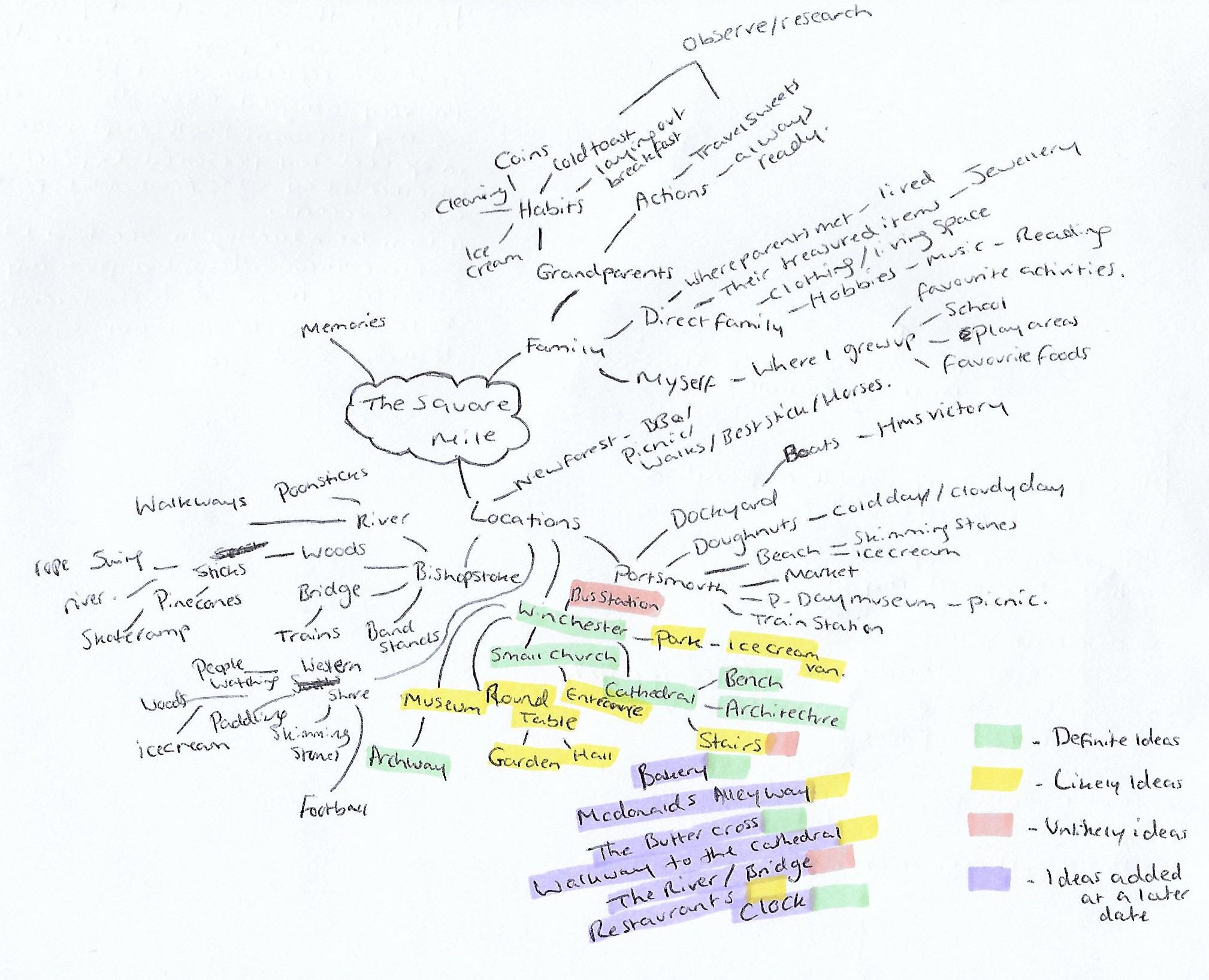
Reflection on mind-map
– Pleased with initial ideas and think I already know the route I want to go down.
– The route will be decided after further research and shoot planning.
– Mind-map could be tidier and clearer in the future.
– Maybe use different coloured pens for different areas or subject arms?
I’ve decided to choose ‘Winchester’ as my area of choice mainly due to the family links it holds and the memories experienced here. It isn’t my immediate location as I wasn’t born there, nor do I live there, however, it is a local city that I am fairly familiar with and have grown up visiting multiple times, therefore I felt as if it was significant.
The buildings/locations/objects have been listed, instead of the memories linked with them, hopefully allowing me to view the town with a fresh set of eyes.
Highlighting the chosen area and the things I want to visit while I’m there, make it a lot clearer for those viewing it as well as myself, so I will continue to do this in the future.
Making a key for different colours helps me prioritise what I want to explore in more detail and the less important ideas.
*Purple ideas were added on the 12th August for future reference.
References :
Bloomfield, R., 2018. Photography 1: Expressing your Vision. 4th ed. [pdf] Barnsley: OCA, p.14. Available at: https://www.oca-student.com/course/photography-1-expressing-your-vision [Accessed 12 August 2019].
List of images :
Figure. 1. Powell, L. (2019) Mindmap [scanned document] In possession of: Lauren Powell: Eastleigh.
 Lauren Powell OCA