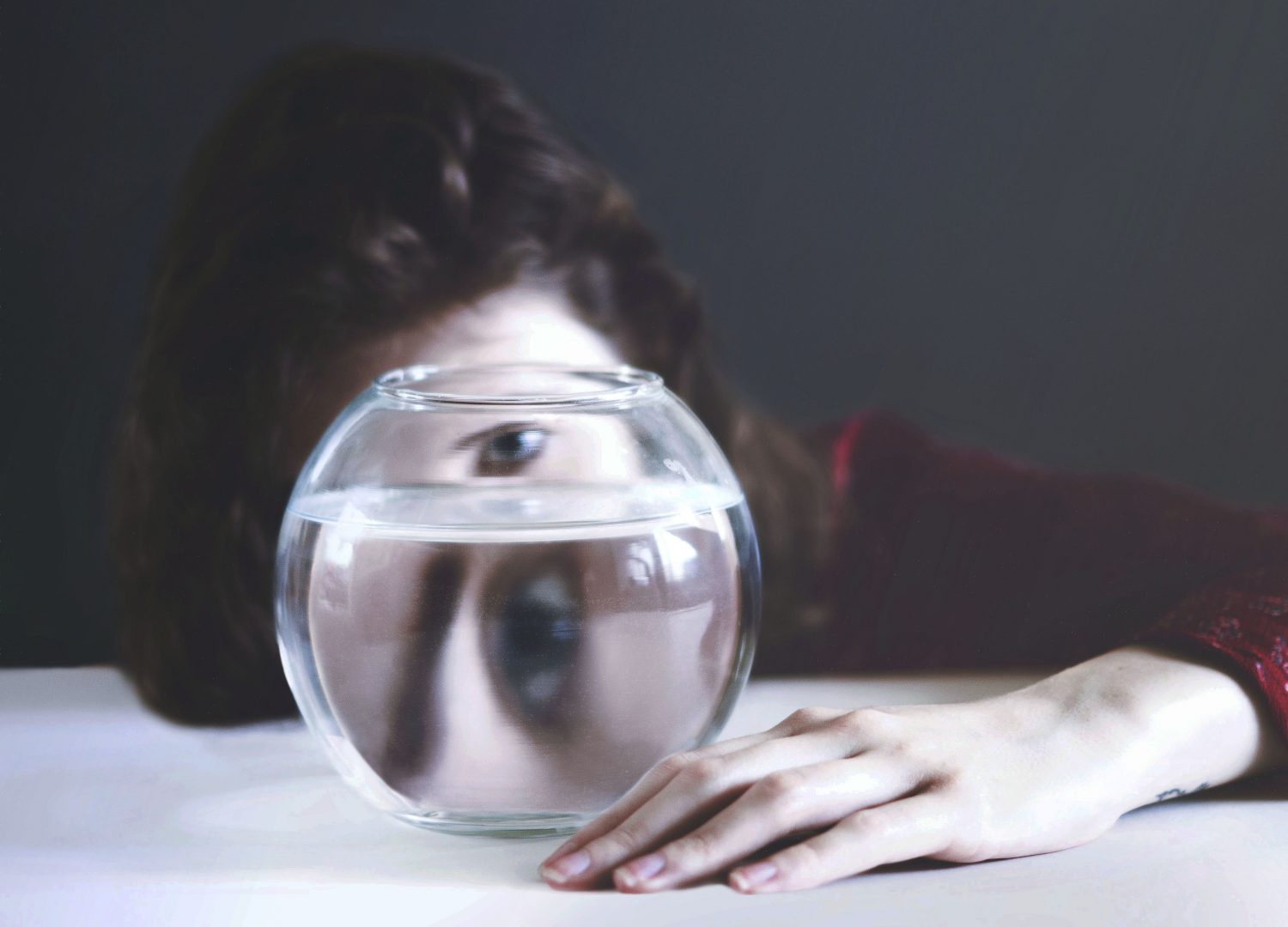
To recognize the assignments with the most compelling outcomes I had to re-visit and review each from a cold viewpoint. Detaching from your work and looking at it as a critic isn’t an easy task, but I am aware this is necessary to select the best examples for assessment. It was fascinating to do as it has helped me see how I’ve developed across this unit, both creatively and analytically.
Assignment 2 – ‘Collection’.
‘Collection’ felt like the first proper assignment for this unit as there were exercises that took place beforehand, providing me with more knowledge and research to take forward.
The brief required us to choose one of three topics, build on that chosen word and produce a set of harmonious images in terms of concept but visually different. Deciding upon the ‘things’ route allowed me to explore items we use daily, similar to Sam Oster and Barry Rosenthal that used electrical and plastic objects in their works.
Assignment 2 was the first time I gathered inspiration from practitioners from a technical, visual and presentational standpoint, making my work effective.
Gathering information from the general public and collecting the items mentioned enabled me to produce a coherent typology of images exploring the everyday necessities we use. While the subjects were different, shooting in black and white, using square framing and a plain background, enabled consistency to flow through the set.
I have reworked some elements of the assignment to reflect upon my tutor’s feedback: https://laurenpowelloca.photo.blog/category/assignments/assignment-2/
Assignment 4 – ‘Languages of light’.
Following a troublesome experience with my third assignment, ‘Languages of light’ was my favourite project out of this unit. Testing the different choices of light used within the photographic world, building knowledge on how to use them effectively enabled me to push myself beyond my comfort zone by using controlled studio lighting.
Branching out from natural light and producing powerful images while using an LED light pad helped me appreciate studio lighting and the artist’s ability to manipulate it to your benefit.
Taking influence from film negatives, lightbox photography, and Andy Ellisons MRI scans of fruits and vegetables helped build my technical knowledge within the camera and photoshop. My compositions are coherent, full of contrast, detail and are innovative in nature.
Assignment 4 outcome rework: https://laurenpowelloca.photo.blog/category/assignments/assignment-4/
Assignment 5 – ‘Photography is simple’.
I am glad that my final assignment is one that I feel could be listed as one of my three best outcomes, as should be expected after a whole unit of learning and growing.
‘Photography is simple’ enabled me to be flexible in terms of topic and approach; something that I enjoy as a photographer is challenging a subject rather than backing the statement up kept this brief exciting. Discovering Ziqian Liu encouraged me to shoot self-portraits with an instant camera to present how difficult photography can be from a compositional point or technical angle.
Conceptually my images are intriguing as they subtly link back to the argument that photography is far from simple, nor is the human body. Mixing media, using post-production to show the evolution of photography and how quickly images take to capture in the modern-day assisted me in discussing how easy it can be to believe photography is simple.
My reworked outcome for assignment 5 is here: https://laurenpowelloca.photo.blog/category/assignments/assignment-5/.
References:
Powell, L. (2021) Collection [online] Available at: https://laurenpowelloca.photo.blog/category/assignments/assignment-2/ [Accessed 24th August 2021].
Powell, L. (2021) Languages of Light [online] Available at: https://laurenpowelloca.photo.blog/category/assignments/assignment-4/ [Accessed 24 August 2021].
Powell, L. (2021) Photography is simple [online] Available at: https://laurenpowelloca.photo.blog/category/assignments/assignment-5/ [Accessed 24 August 2021].
Author: rennnna
Assignment 5 – Photography is simple – Reworked
Assignment 5‘Photography is simple’ was an open brief that allowed me to explore this title in any way I wanted across ten images that combined the complexity of an instant camera, flexibility within digital art and the intricate nature of a human body. Photography is as simple as the human body and its elements, so I wanted to challenge this statement.
The final images for this assignment were ten digital photographs of 9 Instax mini prints I shot and chose for this project. I combined the limitation of light choices available on the Instax Mini-8 with the wide range of shutter speeds offered by my Sony A57. Correct exposure helped me document crisp, clear digital images to show how important lighting is in art. Framing the prints correctly so that they were clear to view online was another technique to consider.
Mixing digital and tactile media has evolved over the years, making photography seem more straightforward than it is. ‘It can be so easy to edit our work in the modern-day in comparison to the more traditional film photography that can take hours or days’ (Powell, 2021). Keeping most of the shots unedited was a way to show that filters or post-processing is not always needed or necessary to create a strong image. If the subject is powerful enough with the composition, lighting and concept, that may be sufficient. I edited ‘Photography is as simple as the human body’ with a smoke overlay to juxtapose the previous nine images and change something that could have been left alone.
Presenting the collection as a set of 9 individual images in addition to a group helped me explain how pairing and selection can shape a photographic project or art piece. The responsibility is much higher for the photographer or editor to make the right choice when suggesting contexts and concepts to an audience.
Ziqian Liu is a Shanghai-based self-portrait photographer who integrates nature and the human body to show the close connection with other organisms. ‘In her work, the image in the mirror represents the idealized world she wishes to live in,’ (ARTPIL, 2019), cropping an object warps expectations. Photographing the human body in such an intimate way helps us understand how beautiful the body is and how private we keep it from others.
I took inspiration from Liu by taking closely framed images of my own body in a bed to inject the sense of familiarity, soft aesthetic and personal touch she shows throughout her work. This intimate approach is also explored in ‘Normal People’ (2020), ‘focusing on the parts of the body that make us human or add personality, something many of us can relate to’ (Powell, 2021). Another visual technique I took influence from Liu was her choice of monochrome colour palettes. Fewer colours prevent distraction, drawing focus towards the subject chosen by the photographer.
Taking pictures of various body parts while removing social codes such as facial expressions or identity helped me focus on the skin, flaws and poses used. We as human beings are highly critical of our bodies, so photographing it in such a close, intimate way offers the viewer to observe what is in front of them in more detail without previous judgement. An approach such as that may influence others to connect with their bodies and admire its versatility.
Being minimalist with the details, tones and subjects used kept the images coherent and ‘simple’ in terms of composition. This technique allows an audience to connect with one other human over the period they view the work, instead of being preoccupied with many people, objects or other influences as we tend to be across media. ‘With minimalism, no attempt is made to represent an outside reality, the artist wants the viewer to respond only to what is in front of them’ (Tate, 2017). Whether the viewer sees themselves, someone they love or hate in these pieces, it is getting them to think about the concept.
Physical prints wear down over time if they are not taken care of properly; they can gather scratches, fade through intense sunlight or gather dust, so the grainy overlay used in Photography is as simple as the human body aided in reflecting that too. Digital images are not affected by the physical elements but by viruses or accidental deletion. Everything about photography seems so simple in modern times; the process is the same technical wise, despite the fact the images look crisp and take less time to capture than traditional approaches.
Photography is simple 1 was not easy to shoot despite the process being as simple as turning the light dial to Hi-Key and clicking the shutter button. I could not see what the viewfinder was picking up, nor did I know how close the lens was to my body beyond judging with the naked eye. How the flash would affect the final image was not something I would know until after the image was developed, similarly with the framing and positioning of the camera. All of the images taken without the help of the viewfinder made the photographing process much more complicated and riskier but exciting at the same time. Photography is simple 7 is an example of how unexpected images can be a fine line between a great and a failed image. The whites of the eyes and reflection from the cheekbone created a sense of mystery and imagination for viewers in what could have been a plain, underexposed print.
The assignment was challenging yet exciting. I was able to show how photography consists of many elements that could not possibly be classed as simple once you learn how a photograph manifests. Instant photography is a risk as you are limited to a few films and little information about the end product before development. Digital photography is more straightforward as we can delete and edit, but the correct techniques are needed to capture a successful piece.
References
ARTPIL. (2019) Ziqian Liu [online] Available at: https://artpil.com/ziqian-liu/ [Accessed 25 June 2021].
Normal People: Episode 5 (2020) [Television programme] BBC iPlayer 26/04/2020. At: https://www.bbc.co.uk/iplayer/episode/p089j889/normal-people-series-1-episode-5?seriesId=p089g8vv (Accessed 24/08/2021).
Powell, L. (2021) Final shoot plan + images [online] Available at: https://laurenpowelloca.photo.blog/2021/06/21/final-shoot-plan-images/ [Accessed 25 June 2021].
Powell, L. (2021) Research for ‘Photography is simple’ + Mindmap [online] Available at: https://laurenpowelloca.photo.blog/2021/06/14/research-for-photography-is-simple-mindmap/ [Accessed 24th August 2021).
Tate. (2017) Minimalism – Art Term [online] Available at: https://www.tate.org.uk/art/art-terms/m/minimalism [Accessed 25 June 2021].
Assignment 4 – Languages of Light – Reworked
Assignment 4For ‘Languages of Light‘ we had to revisit an exercise from part four and develop it into a formal piece. I explored natural light, artificial light or controlled light, from which I chose the last. Photographers can use the light provided to them at the time or take it into their own hands to get the shadows and highlights they require.
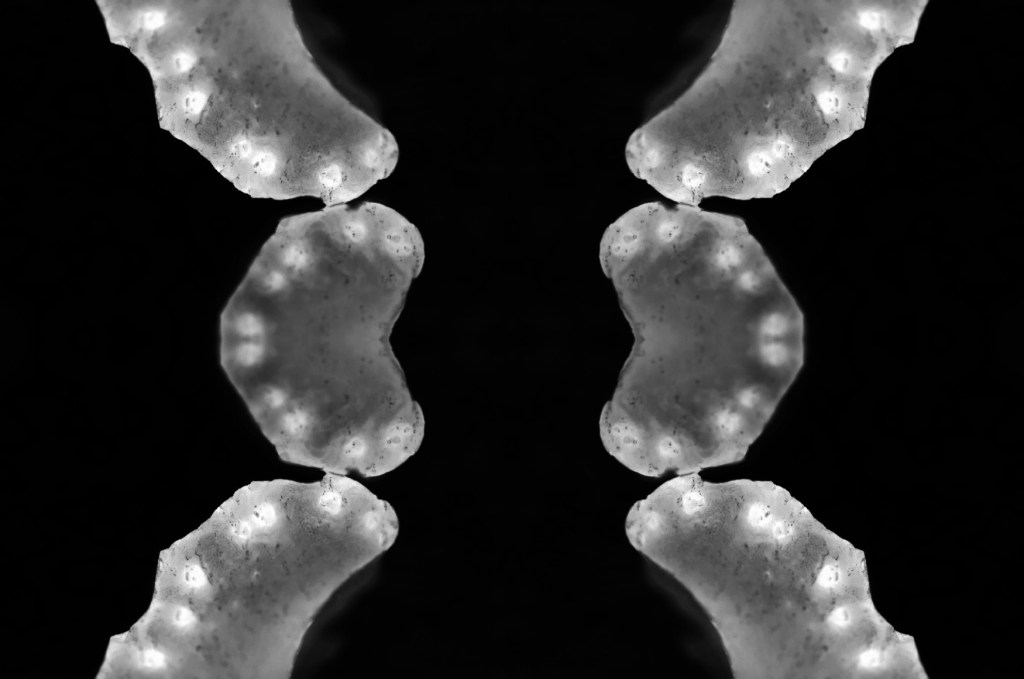
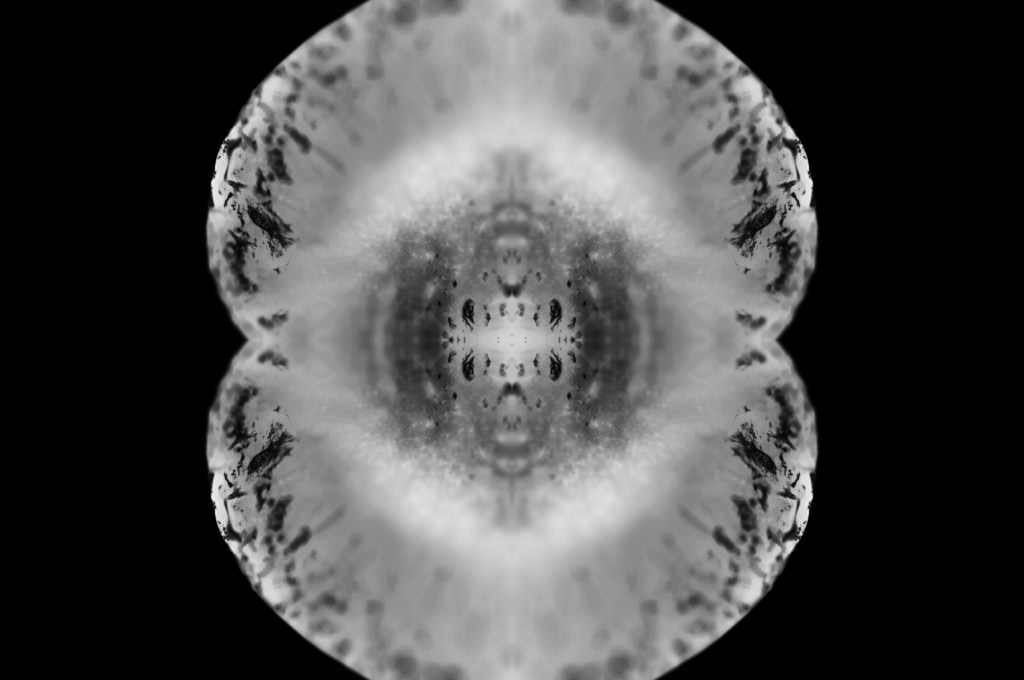
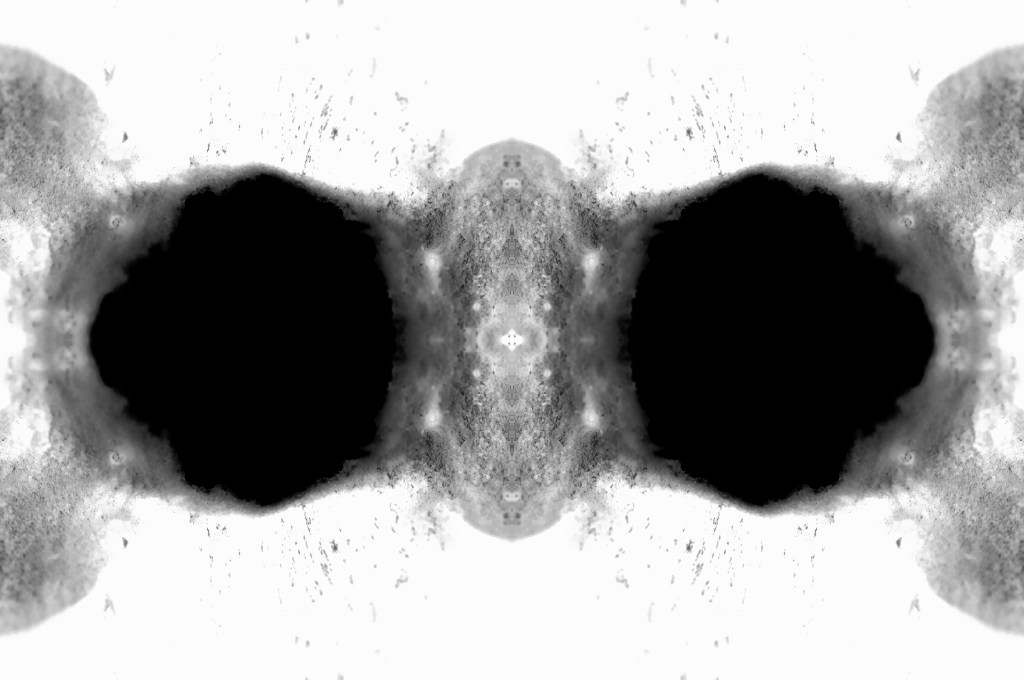
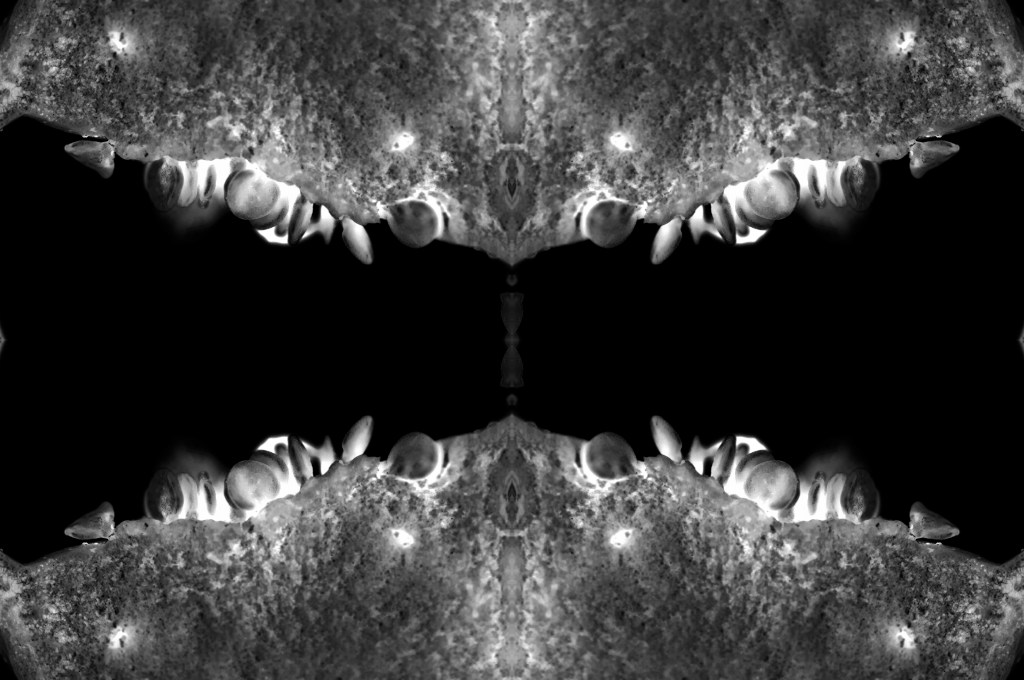
The final images for my assignment were black and white, 360-degree mirrored images of the cross-sections of fruit and vegetables. I took the techniques from exercise 4.3, ‘Egg or stone’, lit the subjects from underneath with a light pad to create a highly contrasted yet 2D image full of detail to prevent the work from being flat and lifeless.
Doug McKinlay made a tutorial on capturing slices of fruit, vegetables, flowers and other translucent items with a lightbox and macro lens. Overexposing the images by one or two stops prevents the background from being dull and grey (McKinlay, 2017), enhancing the bright whites and colours of the subject. McKinlay shot his images without a tripod by bumping the ISO up enough to allow for a fast shutter speed, avoiding camera shake. I intended to use a tripod for my photoshoot to prevent any blur, yet, the lens was not close enough to the slices, forcing me to go handheld and use the advice from the YouTube tutorial.
Andy Ellison is an MRI technician who has produced multiple scans of the cross-sections of fruit and vegetables, following an MRI machine settings test with an orange slice (Insider, 2013). He was so impressed by the results that he created an entire series of images from fruits and vegetables, both static and animated Gifs of the scans. The scans inspired me to explore the idea of black and white film negatives, but on a much larger scale. Film negatives are the opposite of a fully developed print, ghostly yet beautiful. The denser areas are white or light grey, while exposed areas are dark grey or black, like medical scans.
I combined ‘the use of lightbox and macro photography technique from McKinlay’s tutorial, Ellisons MRI scans and presenting them as individual prints like Gomez’ lumen prints; while keeping it unique’ (Powell, 2021). My SONY A57 settings were manual, with an ISO of 1600, aperture of F/2.8., a range of shutter speeds depending on the subject and the light intensity.
The light source for the photoshoot was an A4 daylight LED pad, set to the highest setting and covered by a sheet of white paper to block out the dots on the surface. Overexposing the image like McKinlay suggested prevented the background from going grey and dulling the slices of food. Shooting from above flattened the subject while keeping the shadows and highlights balanced. Using a shallow depth of field caused the camera to focus on the areas closer to the lens. As a result, it created a soft eerie effect on some of the images when converted to black and white. The macro lens allowed me to examine the fruit and vegetables more intimately, enhancing the small details within the flesh and how they are grown. Seeing the unseen is explored in Photography and the optical unconscious (Sliwinski and Smith, 2017). Walter Benjamin observes Blossfeldt’s photograph of horsetail, ‘saw ancient Greek columns; saxifrage seemed to reveal miniature cathedral windows’, a privilege we get to experience through the camera.
Using photoshop to invert the images and convert them to black and white using a B&W filter and gradient map allowed me to replicate the ‘negative film’ aesthetic of an MRI. Conceptual photographer Richard Mosse has used Aerochrome infrared film ‘to capture the grass and trees and soldiers’ uniforms in vivid hues of lavender, crimson and pink’ (Documentary Deconstruction, n.d.), enabling the viewer to see the unseen and discover something new. Enlarging the canvas and duplicating the individual shots to create a 360-degree symmetrical piece intensified the details and shapes within the photographs selected from my shoot.
The final images are complex, highly contrasted, full of texture and shapes, much like an MRI scan or x-ray would be of the body. The context for these pieces is limited, like Hermann Rorschach’s inkblot tests where people describe what they see within abstract art. Each response is different depending on the person, making the art more captivating.
Presenting the photographs as strong individuals allows each piece to be appreciated, rather than a pair of average images complementing one another to create a set. The vertical order of the pictures enables the collection to become an impactful typology of ‘scans’ from head to toe.
The most compelling images for me are Scan 1 and Scan 3, ripe with texture, contrast, shapes and details. They look like flesh, with the addition of tougher and denser areas throughout, balancing the composition as a result. Heavy black areas represent the bright white areas created by the light pad placed underneath the translucent slices. Intense white areas show the thicker and less exposed elements within the fruits and vegetable makeup. Even though the photographs are flat and two-dimensional, the artificial arrangement of the images creates a complex and exciting art piece from what were individual shots.
Taking images of the fruits and vegetables so closely filled the frame and included little background, causing some of the photographs to be too bright when inverted and providing little or no dark areas to frame the subject like most of my final pieces. Making sure the arrangements are balanced before pressing the shutter, resulting in a better finish. Taking a little more time to compose is something I would consider doing more if I were to do this shoot again.
This assignment has been fascinating to explore as I pushed myself out of a comfort zone, experimented with controlled light and discovered the incredible results it could achieve. Every light source is just as good as the other if you know how to use each one efficiently.
References:
McKinlay, D (2017) Light Box Art: Stay Focused with Doug McKinlay [Video] Available at: https://www.youtube.com/watch?v=kWiL5N-b4YM (Accessed 28th May 2021).
n.d. Documentary Deconstruction. [ebook] p.2. Available at: <https://documentcloud.adobe.com/link/track?uri=urn:aaid:scds:US:14443c9d-386f-4d73-a69a-e2cded899386> [Accessed 24 August 2021].
Powell, L (2021) Further research and shoot plan [Blog post] Available at: (Accessed 7th June 2021).
Sliwinski, S. and Smith, S., 2017. Photography and the optical unconscious. United States of America: Duke University Press, p.5.
Assignment 2 – Collection – Reworked
Assignment 2For ‘Collection’ is created a typology of the necessities of life, everyday objects used by many across the world and the items we take for granted or consider unnecessary. What may have been compulsory a few decades ago may not be the same in modern-day life.
Creating an online survey and gathering anonymous responses about ‘What everyday items do you consider are a necessity? (Something you need) ‘(Powell, 2020), enabled me to be inspired by outside opinions rather than solely relying on my thoughts. These answers meant that I could collect various items, forming groups when shooting my imagery.
Using everyday items to create art can be seen through the works of Sam Oster who used ‘medium format black and white film’ (The Loop, 2019). She defines and enhances the minute details and robust form of the irons in Apparatus Electralia Planus with the contrasting shadows and highlights. Oster’s work is inspired by Becher’s typologies, a grid of square cabinets, splitting the composition into sections without taking multiple shots. The centralisation of objects and using negative space encouraged me to create my minimalist typologies.
Taking minimalism into consideration Barry Rosenthal ‘uses monochrome backgrounds and uses the collection to add colour and depth’ (Powell, 2020), organising the collected items into various groups before shooting, such as blue in Blue Ocean. Plain backgrounds allow the viewer to focus on the subject rather than what it is placed on while enhancing the shadows cast by backlighting, allowing me to avoid flattening the composition.
Trialling a selection of techniques with my SONY A57, such as black and white filters, using long and short focal lengths, lighting temperatures solidified the direction I wanted to go in for my final shoot by analysing the strengths and weaknesses in each shot. Using colour did not enhance the details within the subjects as much as using the high contrast B&W camera setting. This filter had more of an impact when it came to the depth and texture of the composition.
A focal length of 35mm was the most suitable to allow for a reasonable amount of negative space to frame the plates and be balanced enough, so the subjects were not too small or too suffocated in the shot. Cool artificial lighting intensified the highlights and shadows, more so than neutral or warm light hence my decision to backlight with a cooler temperature to enhance the 3D forms. Tonal variation prevented the items from being lost in blocks of dark or light, influencing me to choose a light and mid-ranged blue plate and select which tone was better for each item and their details. Combining a narrow aperture of F14 and a tripod allowed the image to be sharp, reducing distraction by selective focus or motion blur and keeping the framing and angles consistent.
After analysing the final selection I can see that the typology is visually strong due to the intense highlights and shadows, along with various textures that provide the image surface with a soft, hard or rough feel. A balanced composition created by the consistent framing, choice of background and the arrangement of subjects pull the typology together as a whole, as they all bleed into one another. Deciding to use cool artificial lighting evenly lit the frame, creating definition in the shot, which I found did not work as successfully with natural or warmer lighting due to the inconsistency and softness.
I am pleased with the contextual and conceptual elements hinted at in my photographs as I have stated the ‘things’ are ‘necessary items in … daily life’ (Powell, 2020), however, everyone’s view on what is necessary is different, as a result, may tease out the idea of privilege, luxury, political opinions or no message at all. The concept is broad enough to direct the viewer in entirely different paths without being influenced by too much context that could affect how an image is perceived.
Pushing myself out of my comfort zone, taking more inspiration from artist research and experimenting with various techniques allowed me to complete this assignment successfully.
If I were to improve this assignment in the future, I would try to gather more responses to see how many unique items could be listed and be more thorough with my arrangement to avoid post-production to get rid of preventable marks. Typologies are new to me; therefore, it would be an intriguing area to explore in further detail.
References:
Bloomfield, R. (2018) Photography 1 Expressing Your Vision Barnsley : OCA
Lauren Powell OCA. (2020) ‘Initial thoughts about ‘Collection’ + mind-map’. [Online] At: https://laurenpowelloca.photo.blog/2020/02/11/initial-thoughts-about-collection-mind-map/ (Accessed on 28 February 2020).
Lauren Powell OCA. (2020) ‘Collections in photography – Artist research + test shoot plan’. [Online] At: https://laurenpowelloca.photo.blog/2020/02/17/collections-in-photography-artist-research-test-shoot-plan/ (Accessed on 28 February 2020).
Lauren Powell OCA. (2020) ‘Community Survey + Personal Research Results for ‘Things’. [Online] At: https://laurenpowelloca.photo.blog/2020/02/13/community-survey-personal-research-results-for-things/ (Accessed on 28 February 2020).Oster, S. (2009) Apparatus Electralia Planus [Photograph] At: https://www.theloop.com.au/project/silvertrace/portfolio/short-circuit/17421 (Accessed on 28 February 2020).
Powell, L. (2020) ‘Necessary Everyday Items’. [Online] At: https://www.surveymonkey.com/r/KWWFQGM (Accessed on 28 February 2020).
Rosenthal, B. (2013) Blue Ocean [Online] At: http://barryrosenthal.com/found-in-nature/single-gallery/16729872 (Accessed on 28 February 2020).
The Loop. (2019) ‘Short Circuit – Sam Oster Portfolio – The Loop’. [Online] At: https://www.theloop.com.au/project/silvertrace/portfolio/short-circuit/17421 (Accessed on 13 February 2020).
Preparing for assessment – LO2 – A selected body of work
Reflection on assignments, Reflection on coursework, Reflection on feedbackLearning outcome 2: ‘A selected body of work’.
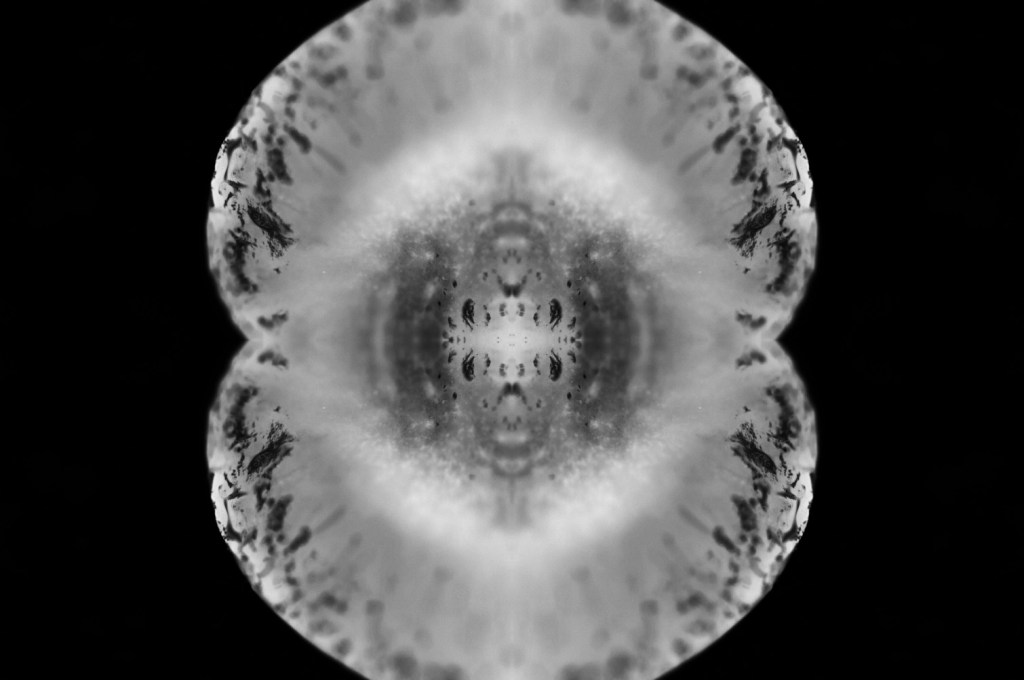
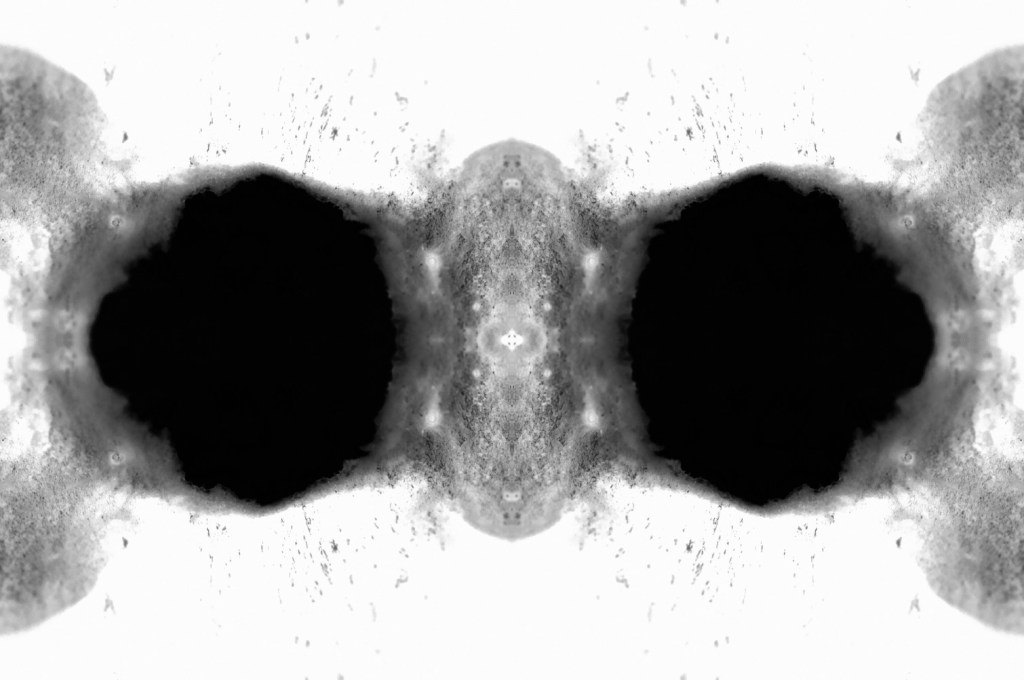
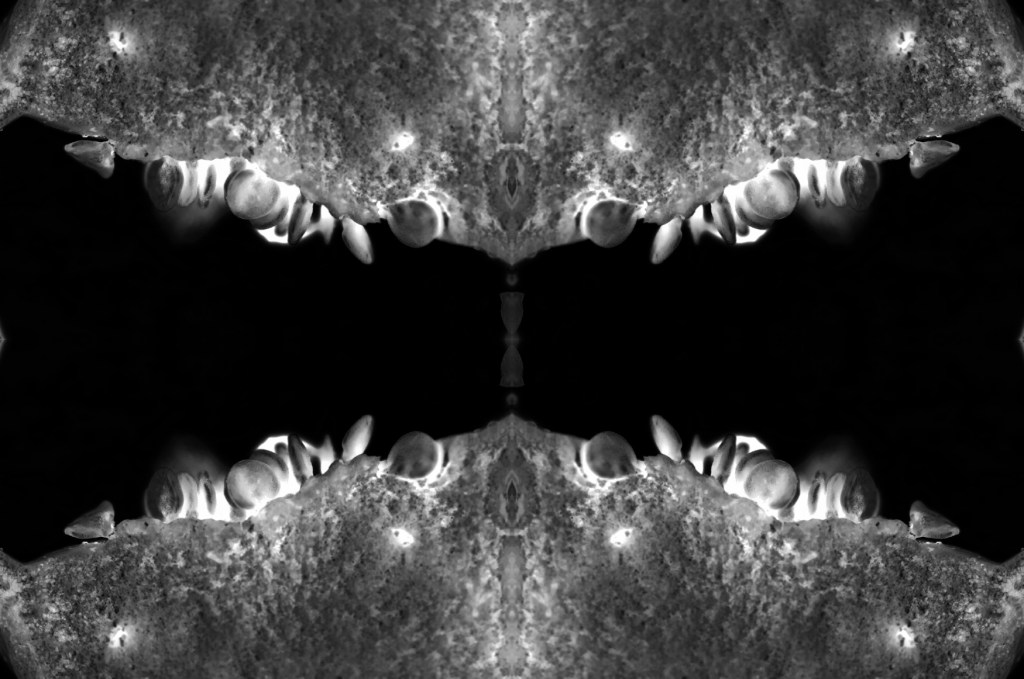
OCA’s assessment guide suggests that you choose four to six images from your strongest assignment for this particular outcome. I have decided to pick four out of the original seven pieces from ‘Languages of Light’ to present a skilful use of controlled light, post-production techniques such as ‘inverting’, the visual impact of mirrored compositions and my understanding of contrast.
To select these images, I revisited my assignment and chose the four shots that best showed variety while considering the importance of a coherent set. The pieces document a range in texture, shape, unique use of light and composition.
The Scan photographs; (see Fig. 1-4) explore intricate details found within the crops we grow, much like a human bodies veins, muscles and skin. Using an LED light pad and thin slices of various foods to document diversity enhanced the textures and densities within the subject. The shallow depth of field softened some areas within the photos, drawing the eyes towards the heavily textured, contrasted and various forms provided by the subject. Creating mirror images from the individual shots exhibited an eerie, human-like set of photos that reflect the ghostly results MRI scans can reproduce. Presenting them as separate prints allow the audience to explore each image in-depth, one by one, rather than a collective that can distract the eyes and overwhelm them with too much information all at once.
Images
List of images:
Figure. 1. Powell, L. (2021) Scan 1 [image] In possession of: Lauren Powell: Eastleigh.
Figure. 2. Powell, L. (2021) Scan 2 [image] In possession of: Lauren Powell: Eastleigh.
Figure. 3. Powell, L. (2021) Scan 3 [image] In possession of: Lauren Powell: Eastleigh.
Figure. 4. Powell, L. (2021) Scan 4 [image] In possession of: Lauren Powell: Eastleigh.
Preparing for assignment – Learning log entries
Reflection on assignments, Reflection on coursework, Reflection on feedbackAs the Course Guide for assessment of Photography units (OCA, 2021) suggests, we must acknowledge the learning outcomes listed for our unit. We must also provide evidence of our understanding of these by selecting 2-3 learning log entries for each LO; choose and submit three assignment outcomes, submit any critical reviews/essays and evaluate the unit as a whole.
The learning outcomes for PH4EYV – Photography 1: Expressing Your Vision are as follows:
LO1 – demonstrate an understanding of photographic techniques and image making.
LO2 – present a selected body of photographic work.
LO3 – develop and communicate your ideas as a photographer.
LO4 – demonstrate a critical and contextual understanding of photography and reflect on your own learning.
Learning outcome 1: ‘Understanding photographic techniques and image making’.
Exercise 1.3 Line.
The use of lines in photography can either add depth to an image or flatten the pictorial space depending on how you implement them within your work.
Exercise 1.3 Line helped me appreciate the importance of leading lines and how they can draw the eyes around or through the images you take, enhancing the overall experience of photographic viewing and compositional strength.
Learning log reference: https://laurenpowelloca.photo.blog/2019/11/12/exercise-1-3-line/
Exercise 2.2 Viewpoint.
Focal lengths can heavily influence the result of your images, dependent on how long or short it is set to, as well as your physical distance from the subject.
Exercise 2.2 Viewpoint allowed me to see and acknowledge the distorting differences between a long focal length such as 55mm and a far distance from the subject, compared to a short focal length such as 18mm and standing close to the subject who hadn’t moved.
Learning log reference: https://laurenpowelloca.photo.blog/2020/02/05/exercise-2-2-viewpoint/
Assignment 2 – ‘Collection‘.
I explored various lighting techniques, camera filters and framing to understand the process of image making. I learnt that black and white photography visually enhance your subjects by capturing heavily contrasting details, while the use of negative space draws attention to the chosen focal point.
Learning log reference: https://laurenpowelloca.photo.blog/2020/02/26/test-shoot-contact-sheets-for-collection-assignment/
Learning outcome 2: ‘A selected body of photographic work’.
Selected body of images.
This assignment encouraged me to revisit and re-evaluate all my assignments from a critical standpoint to decide upon the strongest one before explaining why.
Languages of light pushed me out of my comfort zone, encouraging me to explore controlled lighting and the possible results if used effectively. Taking inspiration from film negatives and MRI scans allowed me to create a powerful, coherent collection of images to document my understanding of the brief, light sources and develop an idea into a complete assignment.
The following learning log entry explains the reasoning behind my chosen images and how I came to decide on these shots in particular: https://laurenpowelloca.photo.blog/2021/06/25/preparing-for-assessment-lo2-a-selected-body-of-work/.
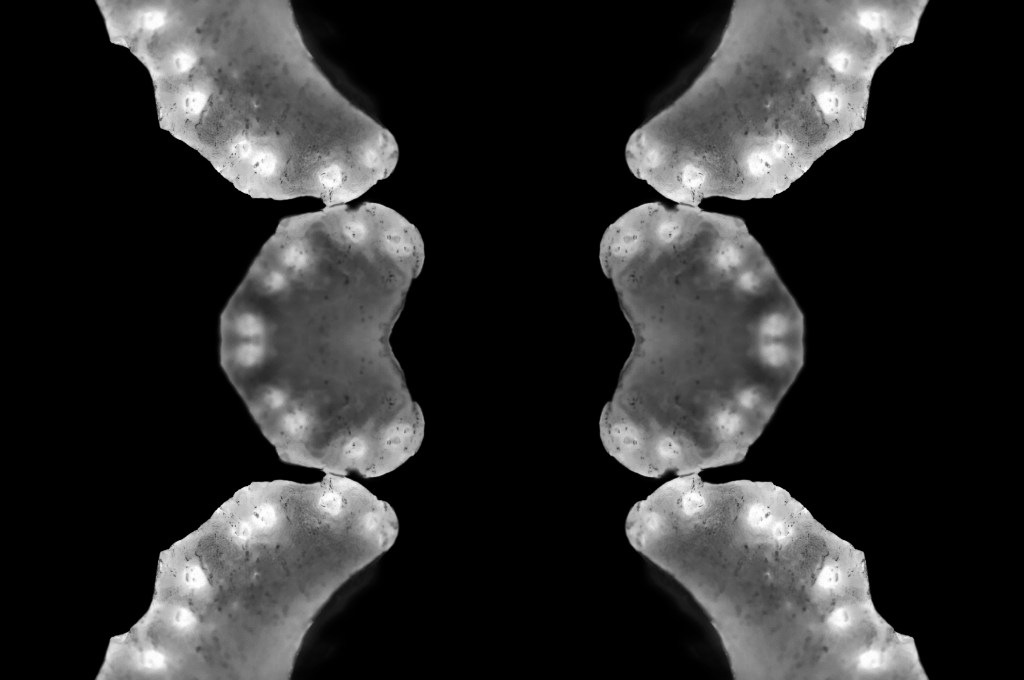
(Extra learning log entry to provide context to the development of my knowledge on controlled lighting)
Exercise 4.3 – Ex Nihilo.
This exercise helped me acknowledge how the quality, contrast, direction and colour can affect the photograph overall. It was the exercise that aided me in completing assignment four successfully.
Learning log reference: https://laurenpowelloca.photo.blog/2021/05/07/exercise-4-3-ex-nihilo/
Learning outcome 3: ‘Develop and communicate ideas as a photographer’.
Assignment 3 – ‘The decisive moment‘.
The assignment allowed me to develop the slow shutter speed knowledge I learnt from exercise 3.2 Trace and my research on Michael Wesely, a photographer who shot long exposures of fruits and flowers to show the life and death we don’t see with the naked eye. This exercise helped me understand how slow shutter speeds can record traces of time within one image.
Learning log references: Exercise: https://laurenpowelloca.photo.blog/2020/03/20/exercise-3-2-trace/
This assignment encouraged me to develop my skills with slow shutter speed and further explore double/long exposures.
Learning log reference: https://laurenpowelloca.photo.blog/2021/03/28/contact-sheet-and-final-image-selection-2/
Exercise 5.1 – The distance between us.
This exercise turned out to be a subtle reference to my first assignment, The Square Mile. I visited a local area and took images of subjects that encouraged empathy. The emotional and physical effects of deforestation and urbanisation are shown subtly and directly through the topic or the juxtapositions captured throughout.
Learning log reference: https://laurenpowelloca.photo.blog/2021/06/13/exercise-5-1-the-distance-between-us/
Learning outcome 4: ‘Demonstrate critical and contextual understanding of photography and reflect on your own learning’.
Over this unit, I have learnt how to research and understand how practitioner influences can help contextualise the work produced. Practitioner research was something I avoided in my first assignment to prevent being heavily shaped by someone else’s work. Inspiration is critical to explain your work and develop it.
Exercise 5.2 Homage – Research Point.
Studying Terry Barrett’s essay and summarising it provided me with the information I needed to contextualise the ‘Homage’ exercise and any other works following that.
By understanding the meaning and technical approaches behind Carol Sharps nature shots, I could explain the contextual type for my work. As well as this, I was able to describe why I chose specific visual techniques and camera settings to portray the delicate nature of flowers and plants. I was also able to discover the context type for an old homage example as well.
Learning log reference: https://laurenpowelloca.photo.blog/2021/06/13/exercise-5-2-homage-research-point/
Assignment 5 – ‘Photography is simple‘.
Analysing Zinqian Liu’s work, acknowledging her reasoning for combining nature and the human body, learning about instant cameras aided me in contextualising ‘Photography is simple’ and the complexity of both the human body and camera. This assignment pushed me to be more critical about image selection and presentation, acknowledging the importance of editing as a photographer.
Learning log reference: https://laurenpowelloca.photo.blog/2021/06/21/final-shoot-plan-images/
Exercise 4.2 Artificial light.
Sato Shintaro and Rut Blees Luxembergs night photography provided context for this exercise by investigating the influence light can have on photography’s overall mood and details. Looking at images from a critical point helped me further understand the technical and visual impacts lighting has within photography.
Learning log reference: https://laurenpowelloca.photo.blog/2021/04/27/exercise-4-2-artificial-light/
References:
OCA., 2021. Photography 1: Course Guide for assessment of Photography units – July 2021 onwards [pdf] Barnsley: OCA, pp. 1-3. Available at: https://learn.oca.ac.uk/pluginfile.php/24144/mod_resource/content/4/AG_Course%20Guide%20for%20assessment%20of%20Photography%20units_120421.pdf [Accessed 25 June 2021].
Powell, L. (2019) Exercise 1.3 Line [online] Available at: https://laurenpowelloca.photo.blog/2019/11/12/exercise-1-3-line/ [Accessed 22 June 2021].
Powell, L. (2020) Exercise 2.2. Viewpoint [online] Available at: https://laurenpowelloca.photo.blog/2020/02/05/exercise-2-2-viewpoint/ [Accessed 22 June 2021].
Powell, L. (2020) Test shoot contact sheets for collection assignment [online] Available at: https://laurenpowelloca.photo.blog/2020/02/26/test-shoot-contact-sheets-for-collection-assignment/ [Accessed 22 June 2021].
Powell, L. (2020) Exercise 3.2 Trace [online] Available at: https://laurenpowelloca.photo.blog/2020/03/20/exercise-3-2-trace/ [Accessed 22 June 2021].
Powell, L. (2021) Preparing for assessment – LO2 – A selected body of work [online] Available at: https://laurenpowelloca.photo.blog/2021/06/25/preparing-for-assessment-lo2-a-selected-body-of-work/[Accessed 25 June 2021].
Powell, L. (2021) Exercise 4.3 Ex Nihilo [online] Available at: https://laurenpowelloca.photo.blog/2021/05/07/exercise-4-3-ex-nihilo/ [Accessed 25 June 2021].
Powell, L. (2021) Contact sheet and final image selection [online] Available at: https://laurenpowelloca.photo.blog/2021/03/28/contact-sheet-and-final-image-selection-2/ [Accessed 22 June 2021].
Powell, L. (2021) Exercise 5.1 The Distance Between Us [online] Available at: https://laurenpowelloca.photo.blog/2021/06/13/exercise-5-1-the-distance-between-us/ [Accessed 22 June 2021].
Powell, L. (2021) Exercise 5.2 Homage – Research Point [online] Available at: https://laurenpowelloca.photo.blog/2021/06/13/exercise-5-2-homage-research-point/ [Accessed 25 June 2021].
Powell, L. (2021) Final shoot plan images [online] Available at: https://laurenpowelloca.photo.blog/2021/06/21/final-shoot-plan-images/ [Accessed 25 June 2021].
Powell, L. (2021) Exercise 4.2 Artificial Light [online] Available at: https://laurenpowelloca.photo.blog/2021/04/27/exercise-4-2-artificial-light/ [Accessed 25 June 2021].
Assignment 5 – Photography is Simple – Write Up
Assignment 5, Reflection on assignments, Thoughts & Ideas‘Photography is simple’ was an open brief that allowed me to explore this title in any way I wanted across ten images. The final pieces combined the complexity of an instant camera, flexibility within digital art and the intricate nature of a human body. Photography is as simple as the human body and its elements, so I wanted to challenge this statement.
The final images for this assignment were ten digital photographs of 9 Instax mini prints I shot and chose for this project. I combined the limitation of light choices available on the Instax Mini-8 with the wide range of shutter speeds offered by my Sony A57. Correct exposure helped me document crisp, clear digital images to show how lighting plays a huge part in photography. Framing the prints correctly so that they were clear to view online was another technique to consider.
Mixing digital and tactile media has evolved over the years, making photography seem more straightforward than it is. ‘It can be so easy to edit our work in the modern-day in comparison to the more traditional film photography that can take hours or days’ (Powell, 2021). Keeping most of the shots unedited was a way to show that filters or post-processing is not always needed or necessary to create a strong image. If the subject is powerful enough with the composition, lighting and concept, that may be sufficient. I edited ‘Photography is as simple as the human body’ with a smoke overlay to reflect the evolution in photography and our ability to change a picture with just a button.
Presenting the collection as a set of 9 individual images in addition to a group helped me explain how pairing and selection can shape a photographic project or art piece. The responsibility is much higher for the photographer or editor to make the right choice when suggesting contexts and concepts to an audience.
Ziqian Liu is a Shanghai-based self-portrait photographer who integrates nature and the human body to show the close connection we have with other organisms. ‘In her work, the image in the mirror represents the idealized world she wishes to live in,’ (ARTPIL, 2019) similar cropping an object to warp the brain’s expectations. Photographing the human body in such an intimate way helps us understand how beautiful the body is and how private we keep it from others.
I took inspiration from Liu by taking closely framed images of my own body in a bed to inject the sense of familiarity, soft aesthetic and personal touch she shows throughout her work. Another visual technique I took influence from was her choice of monochrome colour palettes. Fewer colours prevent the eyes from being easily distracted, drawing focus towards the subject chosen by the photographer.
Taking pictures of various body parts while removing contexts such as facial expressions or identity helped me push the attention towards the skin, ‘flaws’ and poses used. We as human beings are highly critical of our bodies, so photographing it in such a close, intimate way offers the viewer to analyse what is in front of them in more detail without previous judgement. An approach such as that may influence others to connect with their bodies and admire its versatility.
Being minimalist with the details, tones and subjects used kept the images coherent and ‘simple’ in terms of composition. This technique allows an audience to connect with one other human over the period they view the work, instead of being preoccupied with many people, objects or other influences as we tend to be across media. ‘With minimalism, no attempt is made to represent an outside reality, the artist wants the viewer to respond only to what is in front of them’ (Tate, 2017). Whether the viewer sees themselves, someone they love or hate in these pieces, it is at least getting them to think about the concept.
Physical prints wear down over time if they are not taken care of properly; they can gather scratches, fade through intense sunlight or gather dust, so the grainy overlay used in Photography is as simple as the human body aided in reflecting that too. Digital images are not affected by the physical elements, but more so viruses or accidental deletion of a file. Everything about photography seems so simple in modern times; the process is the same technical wise, despite the fact the images look crisp and take less time to capture than traditional approaches.
Photography is simple 1 was not easy to shoot despite the process being as simple as turning the light dial to Hi-Key and clicking the shutter button. I could not see what the viewfinder was picking up, nor did I know how close the lens was to my body beyond judging with the naked eye. How the flash would affect the final image was not something I would know until after the image was developed, similarly with the framing and positioning of the camera. All of the images taken without the help of the viewfinder made the photographing process much more complicated and riskier but exciting at the same time. Photography is simple 7 is an example of how unexpected images can be a fine line between a great and a failed image. The whites of the eyes and reflection from the cheekbone created a sense of mystery and imagination for viewers in what could have been a plain, underexposed print. The assignment was challenging yet exciting. I was able to show how photography consists of many elements that could not possibly be classed as simple once you learn how a photograph manifests. Instant photography is a risk as you are limited to a few films and little information about the end product before development. Digital photography is more straightforward as we can delete and edit, but the correct techniques still need to be used to capture a successful piece.
References
ARTPIL. (2019) Ziqian Liu [online] Available at: https://artpil.com/ziqian-liu/ [Accessed 25 June 2021].
Powell, L. (2021) Final shoot plan + images [online] Available at: https://laurenpowelloca.photo.blog/2021/06/21/final-shoot-plan-images/ [Accessed 25 June 2021].
Tate. (2017) Minimalism – Art Term [online] Available at: https://www.tate.org.uk/art/art-terms/m/minimalism [Accessed 25 June 2021].
Final shoot plan + images
Assignment 5, Notes, Reflection on assignments, Thoughts & IdeasSummary:
In this post I
– Discussed my shoot plan, the research and practitioners I have decided to gather inspiration from
– How I intend to shoot my images and the concept behind the project as a whole
– Mentioned the lighting settings I was going to use for the photoshoot and why
– Before inserting a contact sheet of the images I ended up with, along with a brief list of annotations for the images not making the final cut
– Chose my final images, presented them as individual shots, as well as a group in typology form
– With analysis for each photograph without explaining my intentions for the images
– Reflected on the shoot as a whole, exploring my intentions for the final set in further detail to explain what went right or wrong.
Shoot plan
Reflecting on the minimalist work of Ziqian Liu and past instant photography research, I chose to create a project surrounding body image via the lens of an Instax camera.
Liu’s work is so intimate and soft visually that ‘we as the audience begin to appreciate and connect with the limbs or skin’ (Powell, 2021). Body image and accepting the skin that we are in is not as simple as just loving yourself or applying self-care to your daily routine as a fix-all. The body is complex, full of intricate organs, veins and skin cells that make us what we are. Much like the camera and its lens, the light used to fill the camera once the shutter opens is complicated and detailed, so to label it ‘simple’ would be a lie.
I intend to capture close-ups of the human body, the skin and specific features to show the imperfections, the journey it has been on and how difficult it can be to document that within a set of images. Unlike Liu, I will not be using flowers or such delicate props to compliment the subjects I am taking images of; instead, I will use a bed and sheets to reference the intimacy and privacy she explores within her work.
As explored in my test shoot, the Instax Mini 8’s light settings will be set to Hi-Key as it is the ‘brightest of all lighting choices, resulting in a lighter and softer image’ (Adorama, 2021). A brighter light setting will allow me to shoot on any given day, no matter what the weather is like outside. Shooting without knowing what the composition looks like will be a challenge, which I wanted to do for this assignment to push the boundaries of ‘simple’.
After I have gathered a collection of final images, I will use my SONY A57 to convert them into a set of digital images to mix my media, combining the limited reality of instant cameras and the flexibility of digital photography.
‘Contact sheet’
This is not my typical contact sheet as the images were physical, meaning I could not import them into Adobe bridge and annotate them as I usually would. Instead, I placed all the prints I took on a white card and took a digital picture using my Sony A57 to show all of the results from my shoot before labelling them using photoshop.
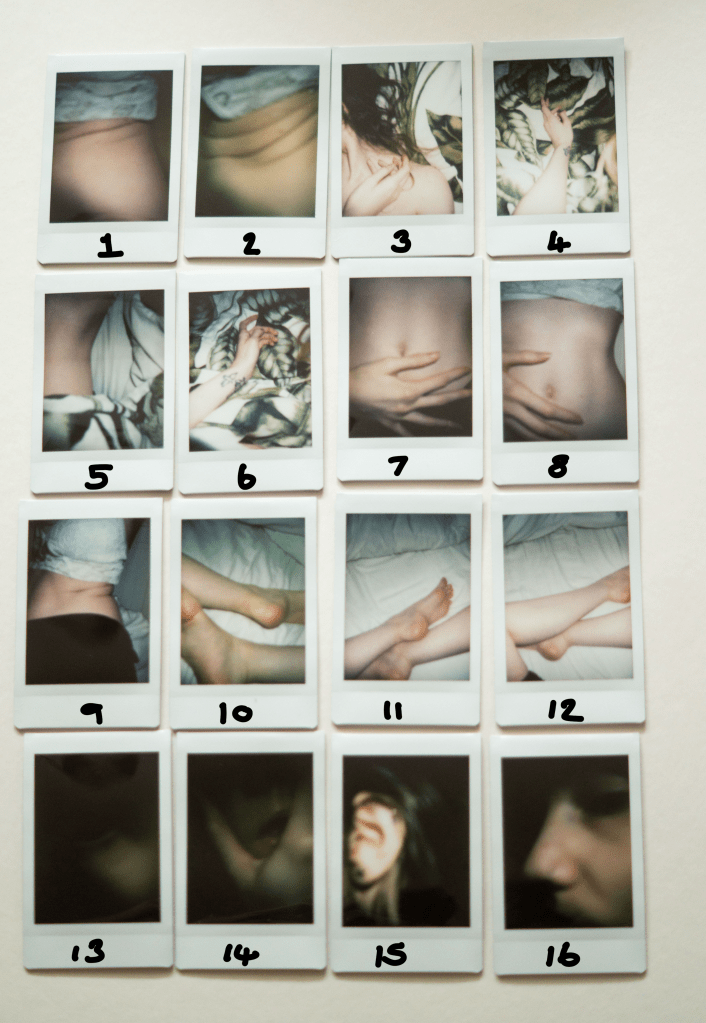
Contact sheet annotations
(See Fig. 1) for reference.
Images 1 and 2 are too tightly cropped, blurred and not what I was expecting, therefore, they will not feature in my final selection.
Image 6 is ok, but the positioning of the arm is slightly odd and was not what I intended to shoot. There is also a tiny interference at the bottom of the frame.
Image 8 is not cropped in the way I wanted, as the crop top is in the frame. It is not awful, but I would rather it was not there.
Images 11 and 12 are ok, but the black leggings in image 12 were not intentional and are distracting. I like image 11 but prefer image 10 in terms of tone much more.
Image 16 did not turn out as expected as I did not want the eye to be within the frame.
Final selection
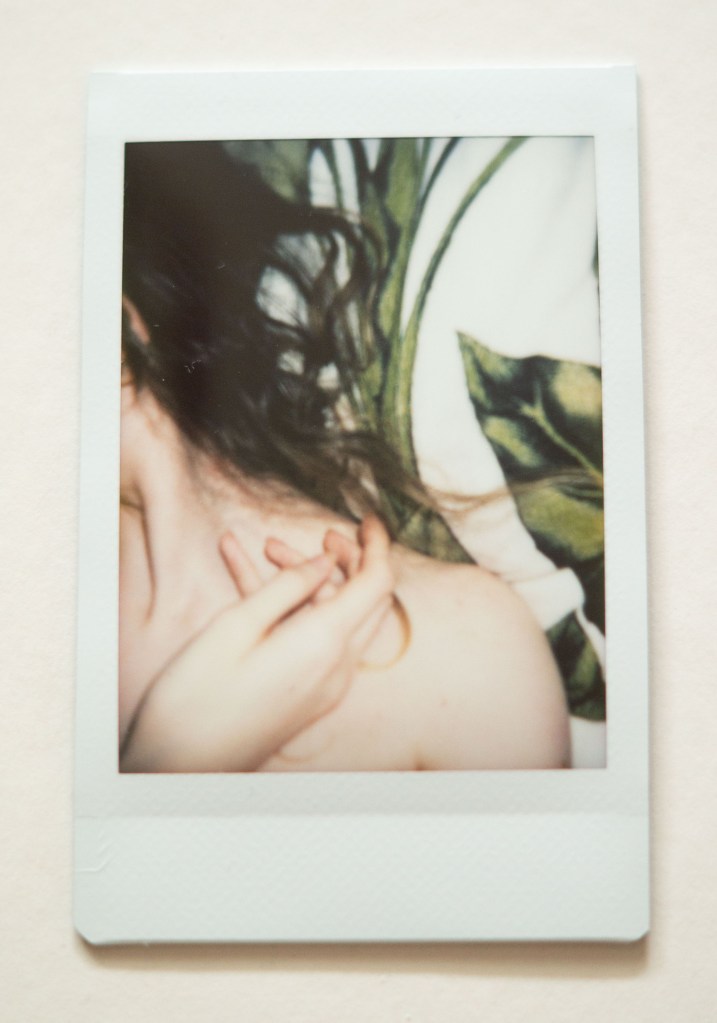
Fig. 2. Photography is simple 1 (2021) 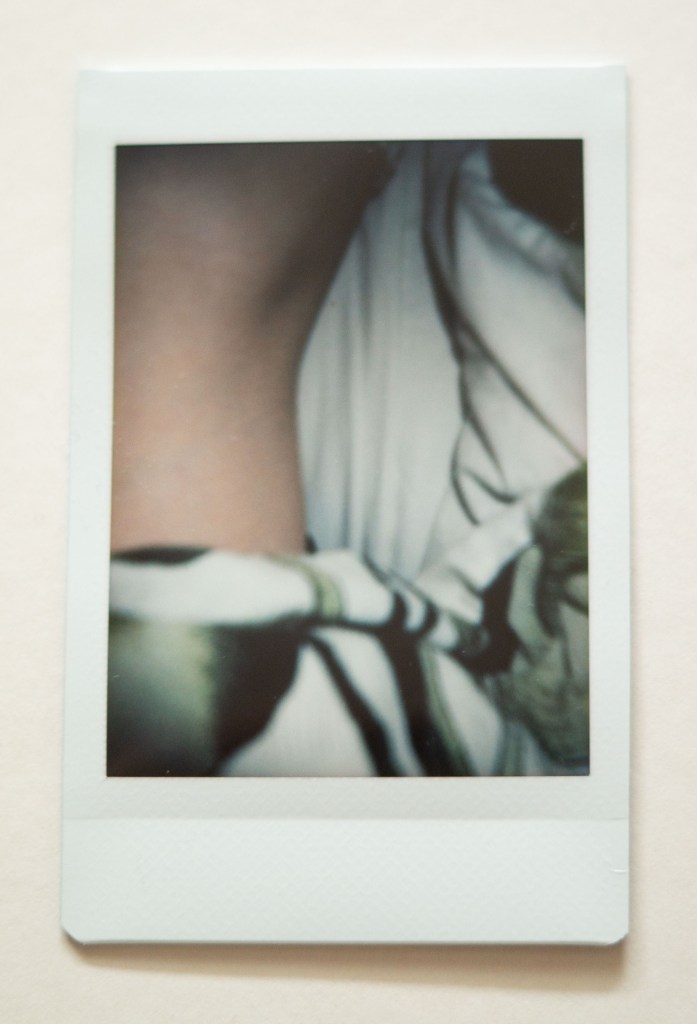
Fig. 3. Photography is simple 2 (2021) 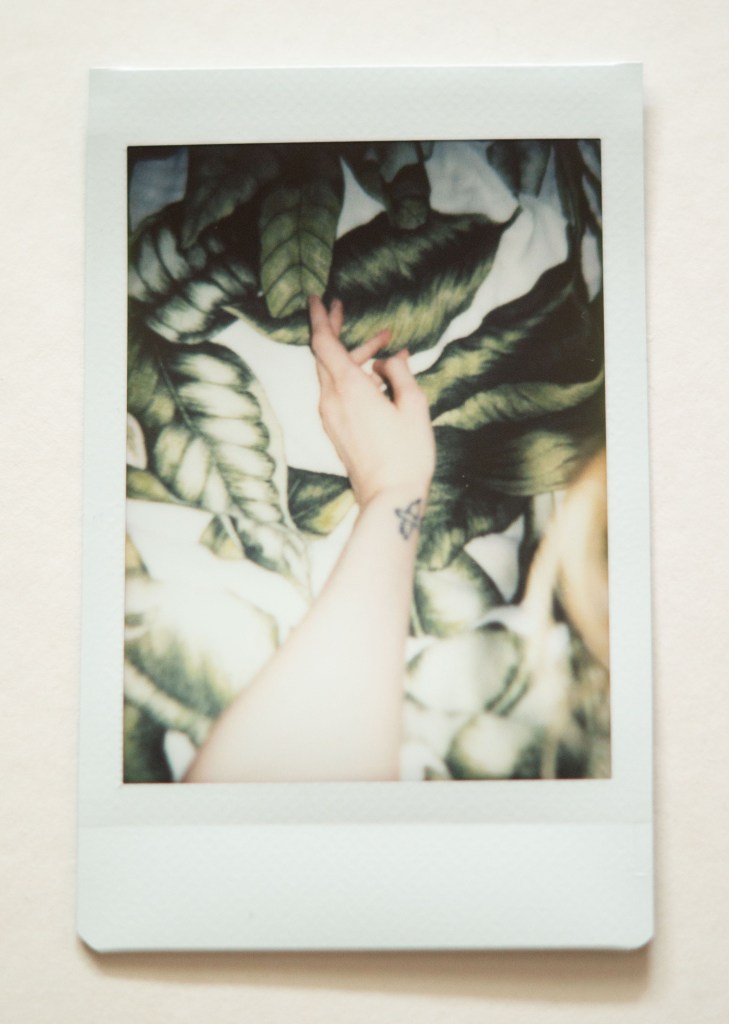
Fig. 4. Photography is simple 3 (2021) 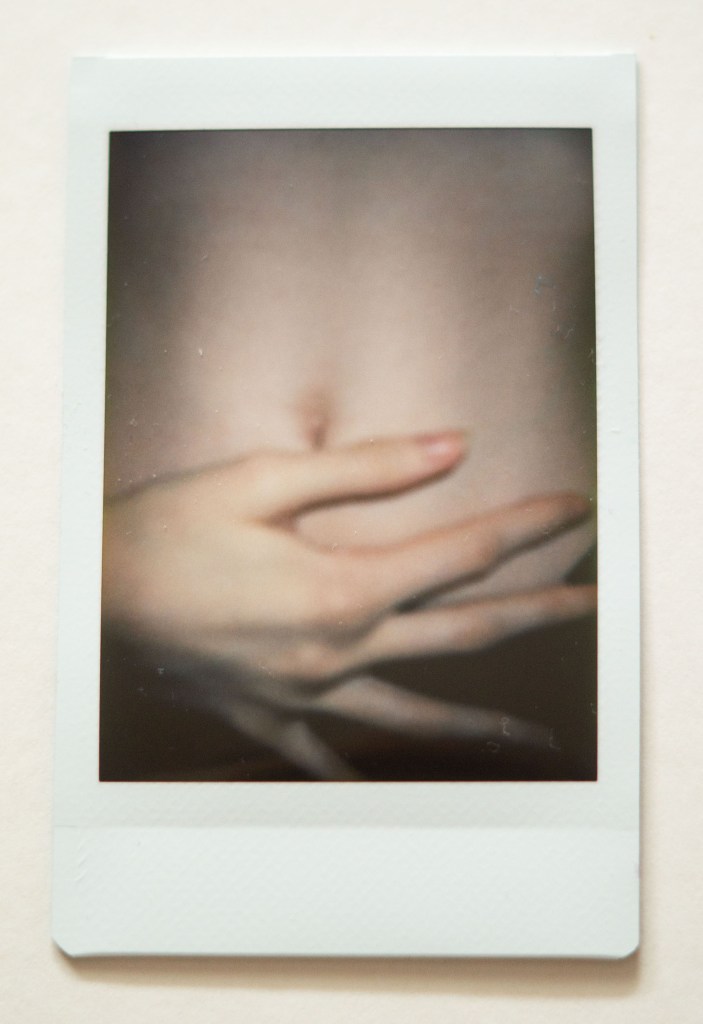
Fig. 5. Photography is simple 4 (2021) 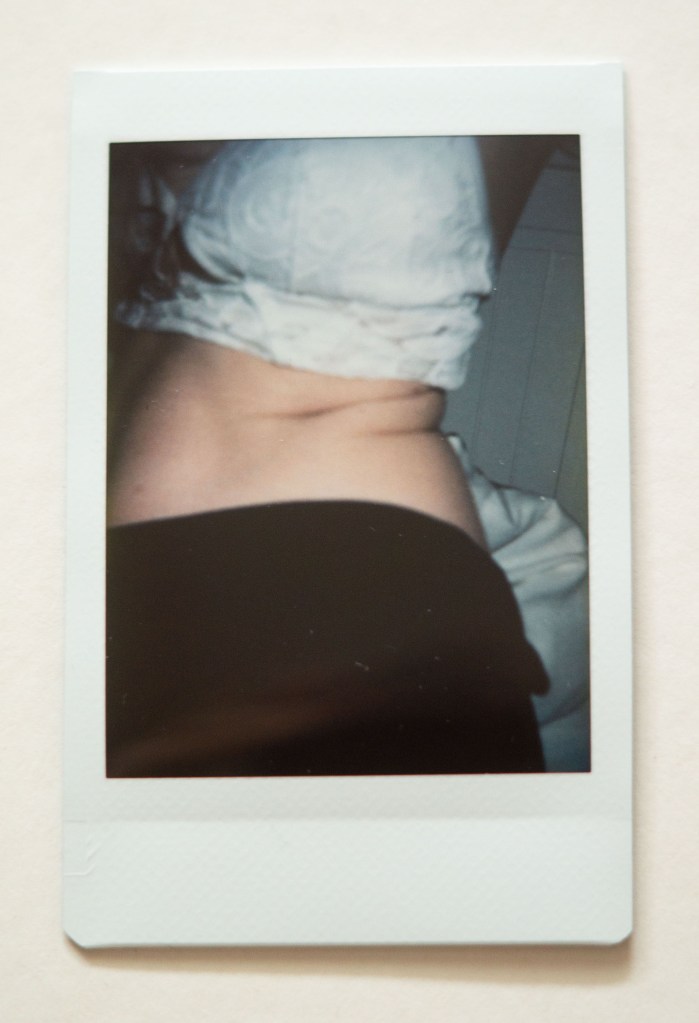
Fig. 6. Photography is simple 5 (2021) 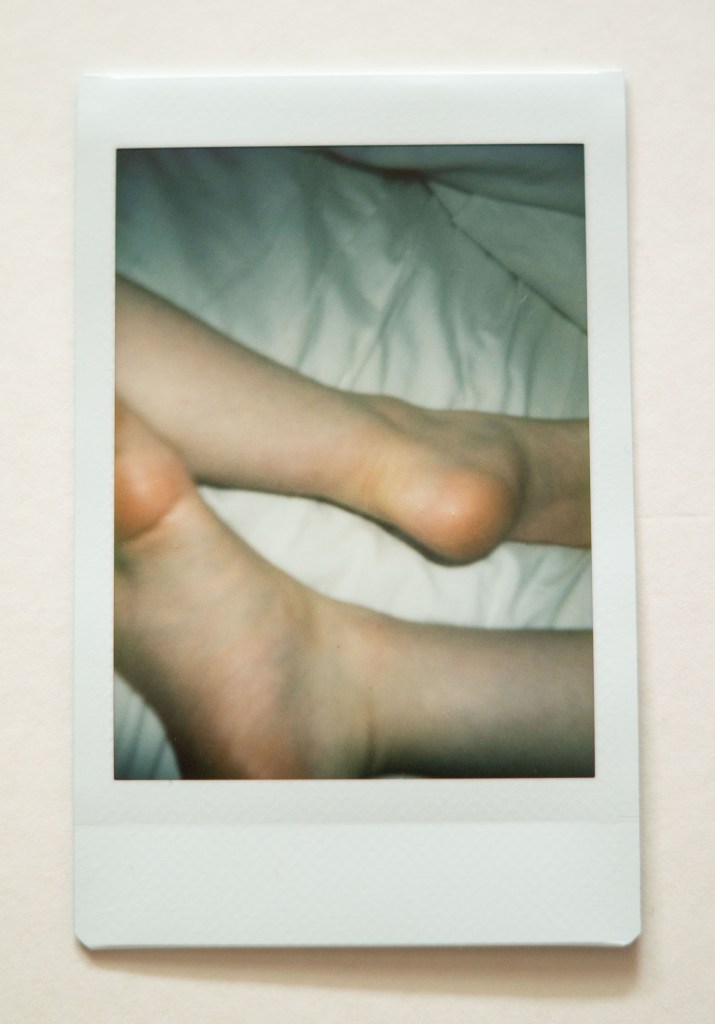
Fig. 7. Photography is simple 6 (2021) 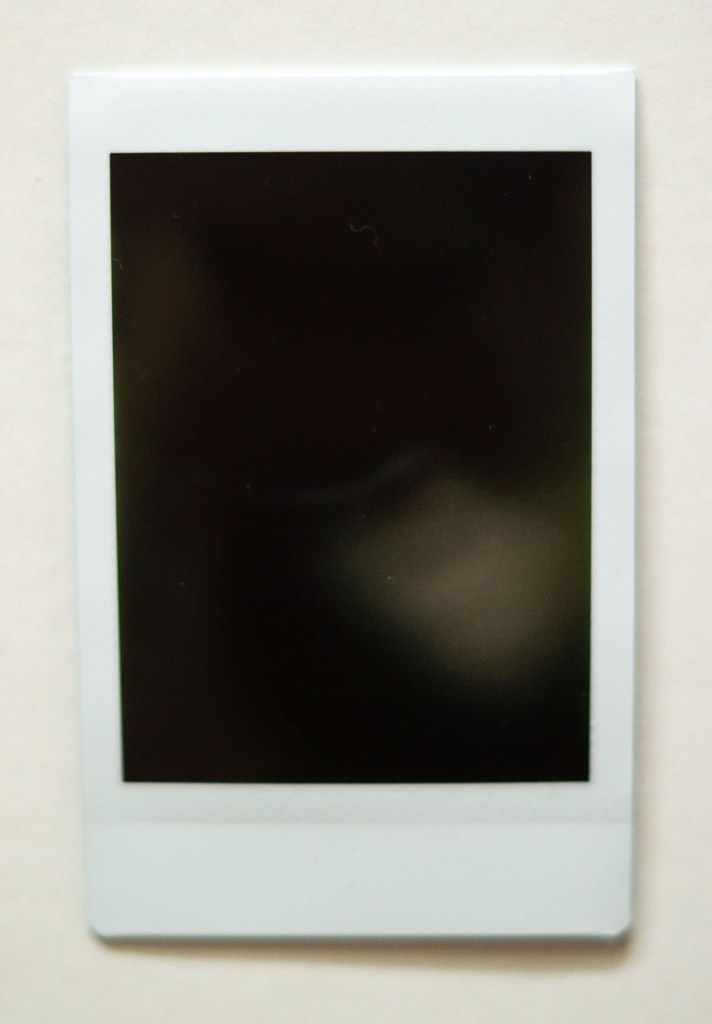
Fig. 8. Photography is simple 7 (2021) 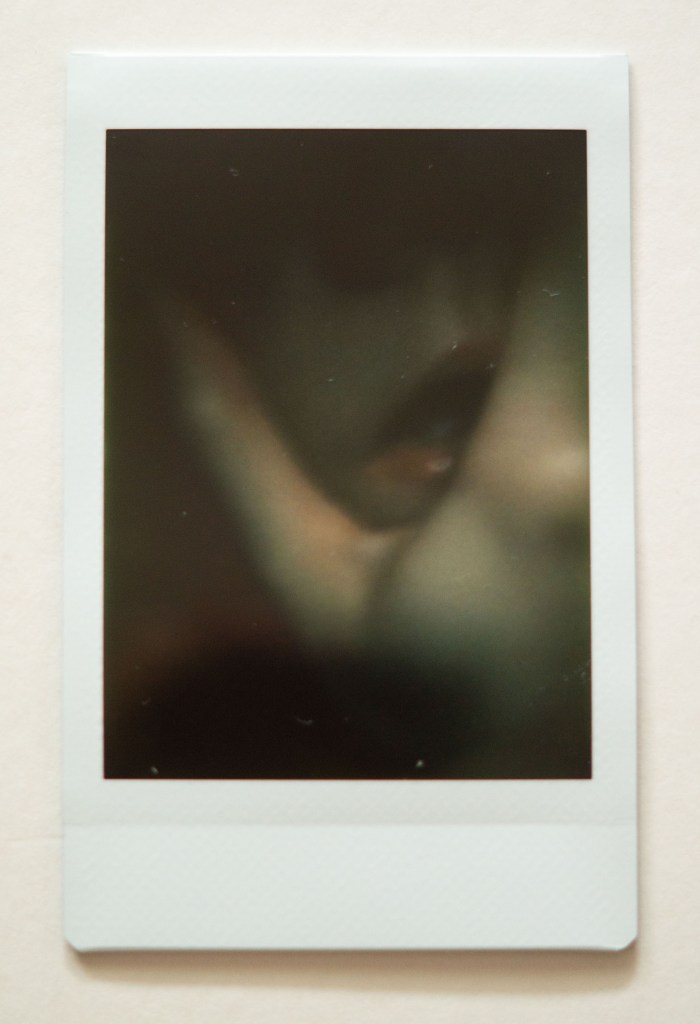
Fig. 9. Photography is simple 8 (2021) 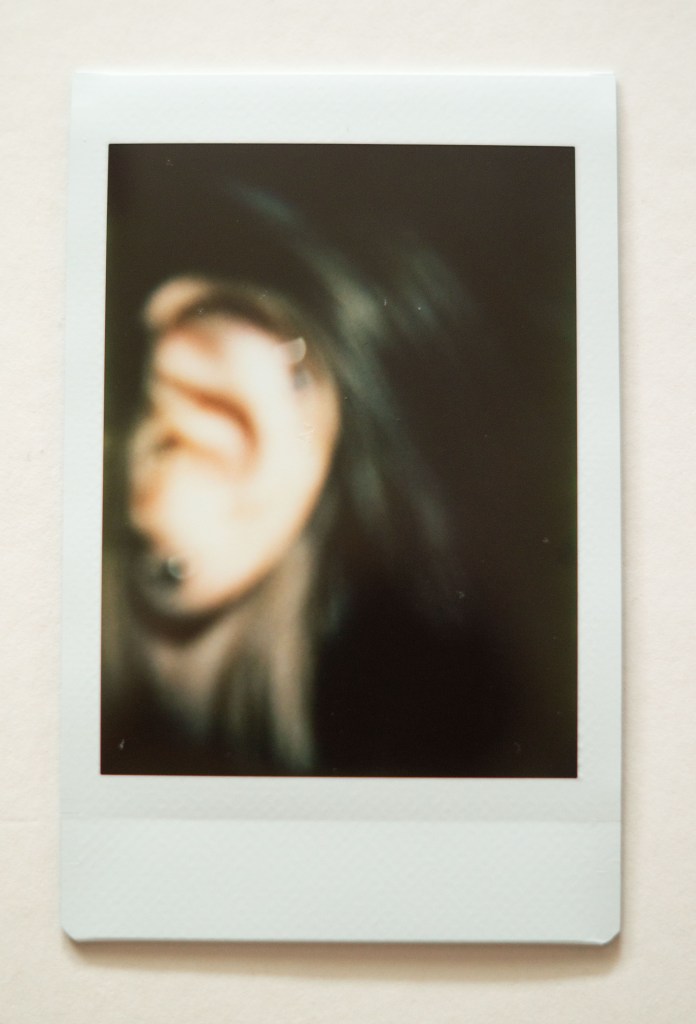
Fig. 10. Photography is simple 9 (2021) 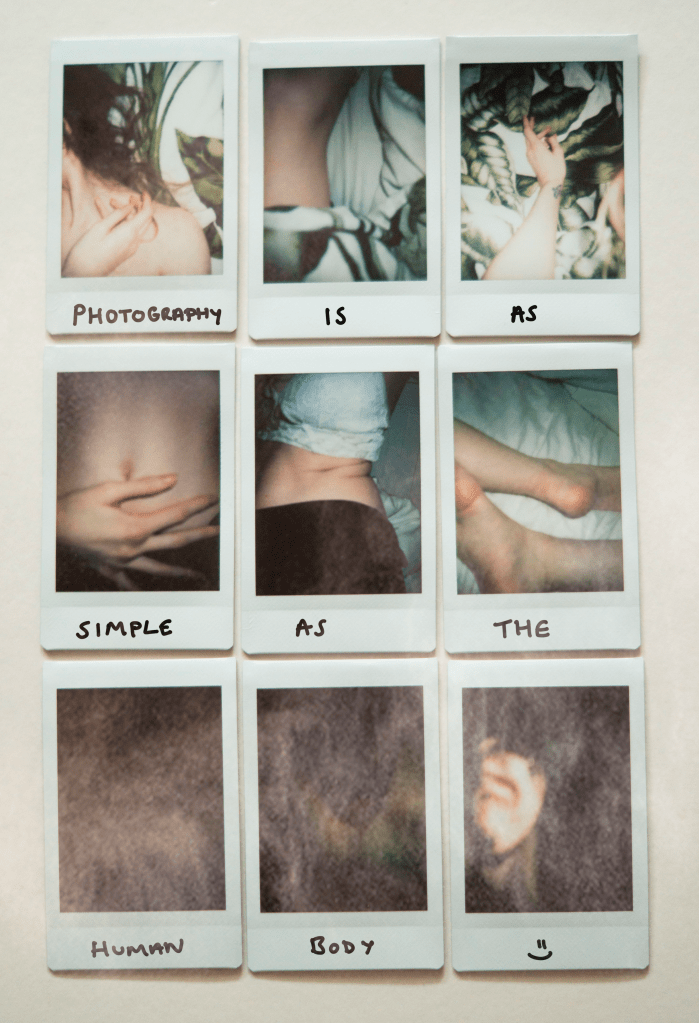
Fig. 11. Photography is as simple as the human body (2021)
Analysis
Photography is simple 1 (see Fig. 2) is minimalist in terms of tones and colour, the pop of green brings nature into the composition without controlling the emotion of the image or distracting from the main subject. The hair spread across the sheets underneath provides shape and texture to the shot as the curls twist in multiple directions away from the persons face. Are they turning their head away mid-shot, are they posed? We are unaware of any emotion shown outside the frame as the face is not visible, taking that element of context away from the audience. The focal blur adds privacy to the photograph, making it soft and less detailed than it may look if taken with a digital camera. The shot was lit by the cameras inbuilt flash brightening the skin and keeping the contrast reasonably balanced preventing any harsh highlights or shadows. Contextually were unaware of the exact location due to the framing of the shot, are there two people in the frame or just one? Removing the vital elements that could provide more knowledge for the audience makes the photograph more interesting and secretive.
Photography is simple 2 (see Fig. 3) is slightly more muted than the previous shot, as shadows have diffused the intensity of colour, lowering the exposure. The body part within the photograph framed by the material used to cover the subject emphasises the curved form and the intriguing gap in the middle of the composition. Are two people back to back? Is this a leg or an arm? Cropping the subject pushes the brain to explore the piece in further detail to figure out what is going on. The image is much softer in terms of contrast, as the lighting is not as bright and has not reflected the whiter elements in the shot. Conceptually this image explores the desire to cover ourselves up and hide away from the eyes of others rather than embrace what we have.
Photography is simple 3 (see Fig. 4) is brighter and slightly overexposed due to the flash reflecting off the skin closest to the lens. The arm cutting through the middle of the frame provides a leading line for the viewer, starting from the bright flash at the bottom towards the evenly lit and relaxed hand in the top third of the image. A monochrome colour palette of white and green brings a fresh and innocent feel to the composition. The angle of the arm adds depth as if the hand is reaching into the leaves below. Placing the subject in the centre of the frame, in full view rather than shooting it up close, juxtaposes the previous images as there is slightly more context as to what the photo is. This image feels delicate and indicative of someone reaching out towards someone or something.
Photography is simple 4 -6 (see Fig. 5-7) are cooler in temperature and more monochrome in terms of colour, with a simple colour palette of black and white. The subjects are well focussed and provide slightly more context to the viewer than the previous three images. They explore the textures within the skin, the soft elements, wrinkled areas and natural rolls of the body. Shadows and highlights are balanced, accentuating the body shape and enhancing the fragility of the skin through diffused light casts. It looks as if the images were shot in a dark room or on an overcast day due to the blue-ish grey tones surrounding the subject, however, the viewer cannot be sure without further information. These images feel the most personal and real as they explore the natural parts of the human body, the parts that we can feel ashamed of and learn to resent.
At first glance, Photography is simple 7 (see Fig. 8) looks like a failed underexposed image, however, once you take a closer look you can see the whites of an eye and the reflection of the light bouncing off of the cheekbone. The shadows are dark and contrasted causing the highlights to be more diffused and subtle to the eye, making the subject in the frame softer and hidden. Negative space surrounding the eye draws the viewer to look closer at the small area of light provided to them and explore what is going on. Context is removed completely for this shot as we are unaware of the location, who this person is and whether the shot was intentional. Instead of the eye being covered it is the only thing shown and is the opposite of privacy, perhaps implying the idea of feeling exposed and seen by others?
Photography is simple 8-9 (see Fig. 9-10) have heavy contrasted shadows with small yet strong sources of light to create a focal point for the images. The light casting on the hand in 8 frames the mouth within the shot, drawing attention to the shiny texture on the lip. Contextually the viewer is unaware of why the hand is there, whether it is the model’s hand or someone else’s, however, the close cropping and framing isolates this facial feature and highlights the delicate nature of the skin. There is little colour within these images besides the red of the lips, as a result, this makes the photographs feel mysterious and eerie compared to the brightly lit, freshly coloured shots. Out of focus shots add intimacy and prevent the eyes from understanding what is happening at first glance, pushing the audience to get up close and personal to appreciate the subject. Are these images hinting towards the way we see ourselves, the way we or others speak about us, or perhaps what we hear in the media about what is considered beautiful or not? Maybe they are reflecting the way we only show the parts of ourselves that we want others to see.
Photography is as simple as the human body (see Fig. 11) shows the range of images documented throughout the entire project. It portrays how diverse photography is, from the lighting used, to the framing, subjects chosen and colours featured throughout, that can shape an image as a whole. People may view photography as being ‘simple’ especially as we can take a decent image without much thought with our smartphones, however, composition, concepts, shapes, shadows and textures are just a slither of what makes photography complex and an adventure.
As the assignment requires 10 images, rather than presenting a strong set of nine final images as a typology, this shot finalises the set by capturing a single image that documents an entire collection in one. The writing on the picture combines digital photography and drawing to tell the story of these images as a whole. Applying a ‘smoke’ overlay over the top of the image to include post-production and photo manipulation, represents the evolution of photographic development. It also removes the element of simplicity that was a clear display of images. It can be so easy to edit digital work compared to the more traditional film photography that can take hours or days. Some images are better left untouched to allow us to enjoy what is.
Reflection
This shoot was more successful than I thought it would be. The privilege of seeing the images we are taking before we press the shutter button as well as being able to reshoot and delete any images that did not work makes you thankful for the evolution of photography and the cameras we have today.
Shooting these photographs knowing that I had a limited amount of film and the ability to see what the final result may look like once it developed, making this both exciting and challenging at the same time. As discussed in my initial thoughts for this assignment, I wanted to use ‘trickier techniques to oppose the word simple’ (Powell, 2021), so using an Instax Mini 8 camera allowed me to achieve this.
There were a few images that I did not intend to take or did not expect them to turn out the way they did, but ended up being my favourite shots. Photography is simple 7 (see Fig. 8) was one of these images, as I expected the eye to be brightly lit and the flash to bounce off of my skin, however, it did the complete opposite and captured a ‘peeping’ eye. Some may consider that image to be bad and unusable, but bearing in mind I wanted to explore minimalism, intimacy and how we view the human body, it felt like the perfect intentional shot to represent this idea. Photography is simple 2 (see Fig. 3) is another image I did not intend on capturing in the way I did. The sheets framed my body in such a way that it looked as if someone was led next to me despite the fact no one was. As someone who has struggled with body image, sharing the ‘exposed’ parts of myself is a terrifying concept. Capturing an image that could potentially reflect the ability to share yourself with others, was incredibly powerful to me as a photographer viewing my images from a cold point of view.
I feel as if I have managed to successfully show how accepting our bodies and documenting them with limited resources is not as simple as we may think it is. Nothing is simple.
References:
Adorama. (2021) How to Use the Fujifilm Instax 8 [online] Available at: https://www.adorama.com/alc/how-to-use-the-fujifilm-instax-8-everything-you-need-to-know/ [Accessed 21 June 2021].
Powell, L. (2021) RESEARCH FOR ‘PHOTOGRAPHY IS SIMPLE’ + MINDMAP [online] Available at: https://laurenpowelloca.photo.blog/2021/06/14/research-for-photography-is-simple-mindmap/ [Accessed on 21 June 2021].
Powell, L. (2021) INITIAL THOUGHTS ON ‘PHOTOGRAPHY IS SIMPLE’ [online] Available at: https://laurenpowelloca.photo.blog/2021/06/14/initial-thoughts-on-photography-is-simple/ [Accessed on 21 June].
List of images:
Figure. 1. Powell, L. (2021) Contact sheet [image] In possession of: Lauren Powell: Eastleigh.
Figure. 2. Powell, L. (2021) Photography is simple 1 [image] In possession of: Lauren Powell: Eastleigh.
Figure. 3. Powell, L. (2021) Photography is simple 2 [image] In possession of: Lauren Powell: Eastleigh.
Figure. 4. Powell, L. (2021) Photography is simple 3 [image] In possession of: Lauren Powell: Eastleigh.
Figure. 5. Powell, L. (2021) Photography is simple 4 [image] In possession of: Lauren Powell: Eastleigh.
Figure. 6. Powell, L. (2021) Photography is simple 5 [image] In possession of: Lauren Powell: Eastleigh.
Figure. 7. Powell, L. (2021) Photography is simple 6 [image] In possession of: Lauren Powell: Eastleigh.
Figure. 8. Powell, L. (2021) Photography is simple 7 [image] In possession of: Lauren Powell: Eastleigh.
Figure. 9. Powell, L. (2021) Photography is simple 8 [image] In possession of: Lauren Powell: Eastleigh.
Figure. 10. Powell, L. (2021) Photography is simple 9 [image] In possession of: Lauren Powell: Eastleigh.
Figure. 11. Powell, L. (2021) Photography is as simple as the human body [image] In possession of: Lauren Powell: Eastleigh.
Test shots with the Instax Mini 8
Assignment 5, Notes, Thoughts & IdeasSummary:
In this post I
– Specified my plan for this test shoot
– Included an image of all of the test shots
– Before analysing each one briefly to discuss what went right and wrong if anything
– Wrote a short reflection on the shoot as a whole and how I will move forward
To figure out whether my Instax Mini 8 camera was going to be suitable enough for this assignment, a few test shots had to be taken to experiment with the different settings available.
5 sheets of film were left in the pack so featured below are the images achieved with such a limited amount of film.
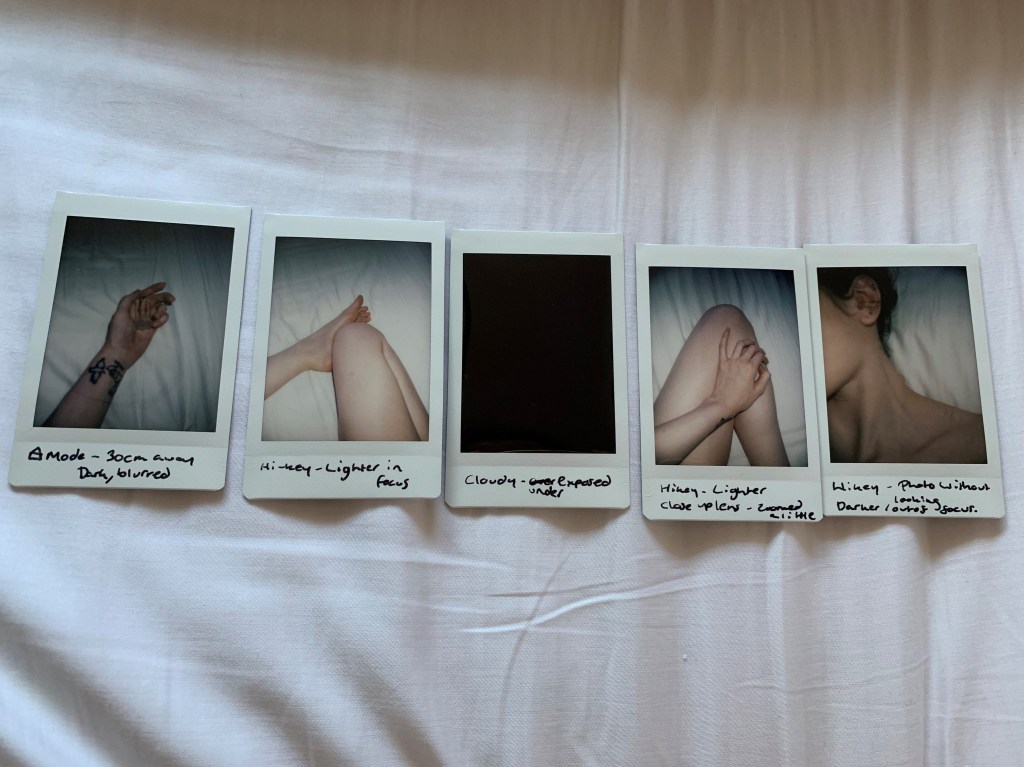
The furthest image to the left (see Fig.1.) was taken with the suggested lighting mode on the Instax Mini 8 camera. As I was indoors away from direct sunlight during the late afternoon, the night/indoor meter lit up to make sure the exposure was suitable for this location. In terms of camera distance to the subject, was roughly 30cm if not less to prevent the picture from being out of focus once developed. To centralise the subject, it is suggested that you tilt the camera slightly to the right as the viewfinder shows a slightly different version of what will be shot and printed. As we can see, the image is slightly too dark and out of focus by a short margin.
For the second image, I referred to an article by Adorama that provided settings from brightest to darkest along with apertures for each one. The Hi-Key setting is the brightest of all lighting choices, resulting in a lighter and softer image (Adorama, 2021). I changed the camera settings to Hi-Key and repeated that same process as before, but changed the subject matter. The image was brighter, evenly balanced tonally and more in focus than the first shot.
The middle shot was a failed attempt as it was heavily underexposed. Using the cloudy setting indoors is not a wise move.
The shot second from the right was once again taken using the Hi-Key light setting but instead of using the camera as it was, I decided to add the close-up lens filter to see if it made a significant difference to the framing. The crop was very slight and pulled the subject closer to the lens, but only by a small distance. Lighting wise, the composition was even throughout and well lit minus a slight vignette around the edges. I wouldn’t say the lens filter made enough of a difference to use it for this project, however, it was worth testing.
I removed my ability to see the subject in the last image, by taking a picture in ‘selfie’ style. This is a challenging way to take an image at the best of times if you don’t have a clear view of the camera screen, but it’s even worse when you can’t see what the camera is picking up at all. As shown above, the framing is off and slightly out of focus. While the photograph isn’t awful, my original plan was to take a picture of my shoulder rather than an ear and part of a neck!
Reflection
The best course of action for taking images indoors would be to use the Hi-key light setting during the early morning or afternoon. Keeping the lens as intended prevents any further vignetting, as it doesn’t affect the ‘zoom’ much at all. Being able to see what the viewfinder can see is more ideal in terms of achieving a well-framed image, however, an out of focus centre image adds a bit of character and secrecy to the shot.
References
Adorama. (2021) How to Use the Fujifilm Instax 8 [online] Available at: https://www.adorama.com/alc/how-to-use-the-fujifilm-instax-8-everything-you-need-to-know/ [Accessed 14 June 2021].
List of images
Figure. 1. Powell, L. (2021) Test shots [image] In possession of: Lauren Powell: Eastleigh.
Research for ‘Photography is simple’ + Mindmap
Assignment 5, Online Research, Practitioner Research, Thoughts & IdeasSummary:
In this post I
– Inserted my mind-map exploring the ideas Opposites and Minimalism with a paragraph reflecting on the results
– Discussed the concepts I want to explore and research in further detail in this post
– Wrote a paragraph on the Minimalism art movement and what it consists of
– Provided a short paragraph about the photographer Paloma Parrot, along with an image which I briefly analysed
– Studied the history of the polaroid camera, the interest behind it and the benefits
– Researched Ziqian Liu and analysed one of her images in detail before reflecting on the post as a whole
– Decided to explore the combination of a minimal composition with a complex subject, to explore the ‘simple’ statement while arguing my belief that photography is anything but simple.
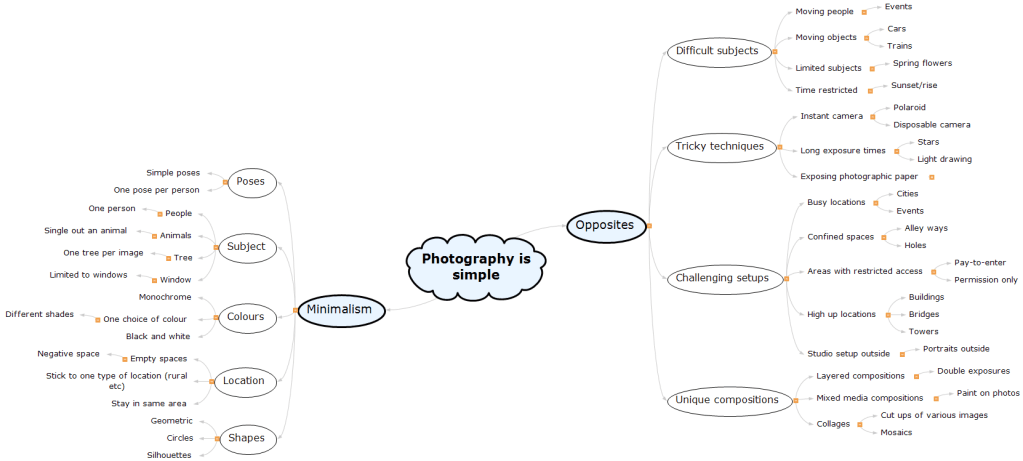
My mind-map (see Fig. 1) explores various branches of ideas underneath the Opposites and Minimalism concepts briefly discussed in my initial thoughts post (2021). Experimenting with difficult subjects would bring a challenge to the project as I would have to get the shutter speeds correct, plan accordingly to fit within specific time scales and events. Bearing that in mind, it wouldn’t be the most ideal choice due to restrictions with travel and gatherings. I like the idea of using an instant camera whether that be a polaroid camera or disposable, as that restricts me to a set amount of shots, not an easy task. Mixed media or collages would be interesting to combine with the use of physical photographic prints.
Simple poses would be perfect to use in unison with a single person for my subject choice, this takes the pressure off of the individual to get into positions they’re not comfortable with. A ‘candid’ aesthetic could be achieved if I explored this route. Negative space and restrictions in colour would provide a clear focal point for the viewer and could influence the particular mood the composition is trying to portray as a whole.
Limiting the type of subject of interest could become quite challenging depending on what is chosen, for example, capturing various styles of windows in a built-up area may not be as easy as it sounds due to a set blueprint for the buildings.
Further research on a few of these concepts needs to take place so that I can decide on a final idea for this assignment.
I will look at minimalism in more detail, explore the history of polaroid photography, portraits and artists who subtly portray complex ideas.
Minimalism:
‘Minimalism is an extreme form of abstract art developed in the USA in the 1960s and typified by artworks composed of simple geometric shapes based on the square and the rectangle’ (Tate, 2017).
Minimalist art pushes the boundaries of abstract art and what it is, by removing the elements that could encourage the viewer to see a piece of art in a particular way. A ‘typical’ form of abstract art could contain a variety of colours that mix to depict a certain mood, action or a sequence of shapes and lines that form a bigger subject. This approach goes back to basics by using simple shapes, a minimal selection of colours if any, pushing the viewer to “just see what you see” (Frank Stella 1966, cited in ARTnews, 2015:2) without much information at all.
The movement began in the late ’50s before continuing to grow in the ’60s and ’70s with the likes of Donald Judd and Robert Morris. It is compared with the conceptual art movement due to the similarities between the ‘unusual and its ability to challenge the stereotypes of what art is, usually only appreciated by a specific audience (Tate, 2017).
Simplicity can be beautiful, as it strips back any unnecessary details that may otherwise clutter or influence the final result of the art.
Paloma Parrot
Paloma Parrot is a minimalist photographer based in Ruhr, Germany. She has over 20 years of photographic experience, encourages that people take a camera wherever they go and sticks to a colour palette of grey/white with a burst of colour to draw attention. Her toolkit consists of a tripod, remote trigger to help capture self-portraits without the additional help of others or a timer (Parrot, n.d.).
Parrot is minimal in every sense of the word from the tonal choice, subject, titles and such, an inspiring way to work, to say the least. As photographers, we can get carried away with an abundance of different lens, lights and cameras, that it’s not always ideal when shooting on the go. Keeping everything manageable and light must make the photographic experience more enjoyable and smooth.
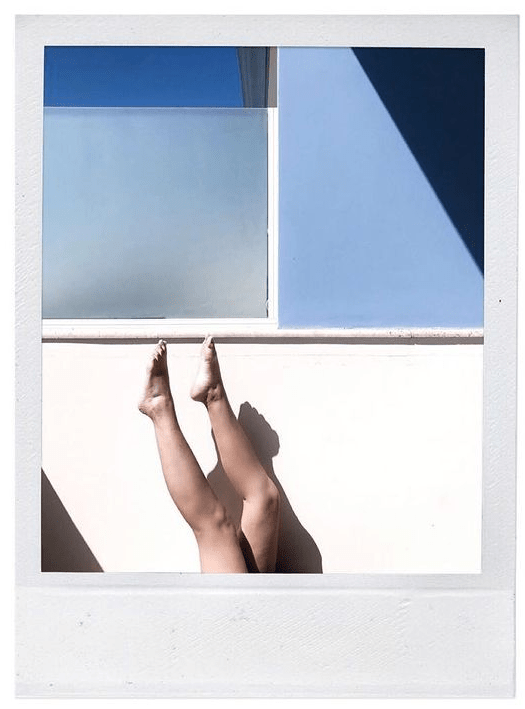
One of my favourite images from her Instagram page is Upside down (see. Fig. 1) as it features little colour, besides a few different shades of blue and the standard white, greys with the occasional dark shadow to add depth to the composition. While it may look like an effortless image the framing will have taken time to perfect, it seems to have been taken on a polaroid implying a limited amount of attempts and the subject in question had to pose in the most abstract way for the image. Nothing about this is that simple besides the shapes and colour palette. Geometric shapes bring complexity to the photograph, cutting the frame into sections and encouraging the eyes to explore the piece in its entirety. Using the legs as the focal point is an interesting choice, as the audience is left wondering who the person is, why they’re in that position in the first place and what else is outside of the frame. Conceptually the portrait may be referencing the action of falling down a rabbit hole like Alice in Wonderland, adding a layer of humour to the piece and fleshing out what could be seen as quite a ‘boring’ picture. The context for this art isn’t given so despite the arrangement being minimal there are many messages and possible references this shot could explore, in turn, forming a juxtaposition within itself.
‘Instant Photography – Polaroid photography
The polaroid was created by Dr Edwin Land, a scientist and CEO of the Polaroid company following a conversation with his young daughter who asked why she couldn’t see the picture following its capture. When Land started the company in the 1930s Kodak bought his first product — the polarizing filter. And for most of the ’50s and ’60s, it manufactured negatives that Polaroid used in its film packs (Legacy User, 2012).
Polaroid cameras do everything that a dark room would have to do, the film is exposed to create a negative image before it is developed within the camera to create a positive print that becomes permanent once it develops in its entirety. The company hired a selection of famous artists to use the cameras and film, as a way to advertise the product and draw attention to it through the eyes of the most prominent creators at the time (Legacy User, 2012).
Watching an image come to life right in front of you is exciting to experience, as you feel as if you are part of the entire process from pressing the shutter to development, without the additional chemicals and time-consuming process. Over recent years, the camera has become increasingly popular with a younger modern audience. Instax has created models that are less expensive and more accessible to those who are on a budget but still want to experience the magic of polaroid photography.
Due to the limited number of film sheets in a pack, the lack of self-timers and the ability to delete the image once it’s been taken makes the photographs taken more unique and challenging to prepare for. Each picture counts, so thinking about your composition is important if you’re unable to have a backlog of films to hand.
Unlike disposable cameras, prints are available instantly beside the developing time, this allows the creator to enjoy the photographs without having to pay or wait for the film to be developed in a lab.
Ziqian Liu
Ziqian Liu, a Shanghai-based photographer, specialises in self-portraiture. Similar to Paloma Parrot her approach is minimal and subtle with the colour palettes chosen for the subject. A lot of her pieces explore the relationship between flowers, fruit and us as humans much like Carol Sharp, a macro photographer who connects with plants as a way to capture their beauty.
‘In her work, the image in the mirror represents the idealized world she wishes to live in,’ (ARTPIL, 2019). Taking a picture of a reflection shows it from a different perspective and angle to what would initially be seen if it were taken with the subject directly in front of the camera. For example, the reflection of a palm shows the opposing side of the back of a hand.
Documenting the body in such a simplistic manner brings intimacy and privacy to the composition, targeting a singular area to be the focal point puts it at the forefront of the photograph. As a result, the audience can appreciate and connect with the body in the frame a lot more than a full-body image. We are given less opportunity to look for what we want, instead of being lead to analyse what is provided and understand it.
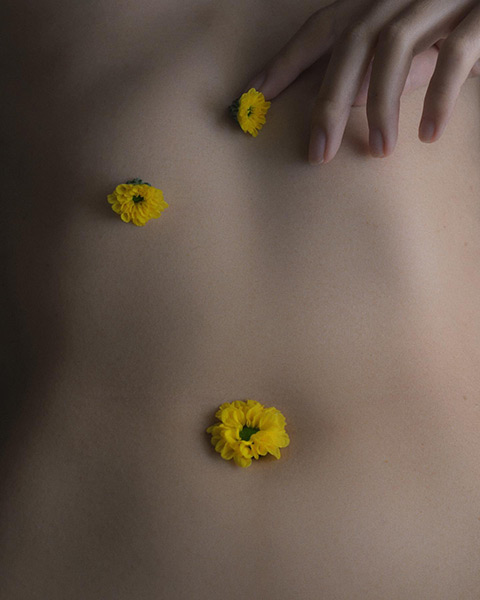
The example I have picked from Liu’s Skin album (see. Fig. 2) is delicate. From the soft diffused light to the smooth texture of the skin in the frame. A pop of colour brings life to composition, possibly referencing the beauty of life’s process within nature and for us as human beings, we all have a life and death cycle that is fragile as one another. A gentle placement of the hand at the top, adds intimacy to the piece by touching and connecting with the human body. The pose isn’t tense or obnoxious, everything about it is calm and warm. Cropped framing brings you closer to the subject, enhancing the textures and shapes that the body has, something we all have so is a source of relatability. The tones are fairly neutral, but compliment the photograph as harsher colours, highlights and shadows would’ve created a jarring, intense image rather than a welcoming one. There is a subtle leading line throughout due to the placement of the flowers. Starting from the top and curving slightly round towards the bigger flower head on the belly button or back. The context for this composition is quite blurred as it’s unclear as to which part of the body this is, which I touched on in the previous sentence.
Art such as this feels personal, creating a story for the audience whether they know the context or concept beforehand. The human body is an incredibly relatable subject, the ‘flaws’ and marks that each of us have that show a journey or make us unique. It’s simple from an aesthetic standpoint, however, if you look deeper there is much more to be explored.
Intimacy in film and TV
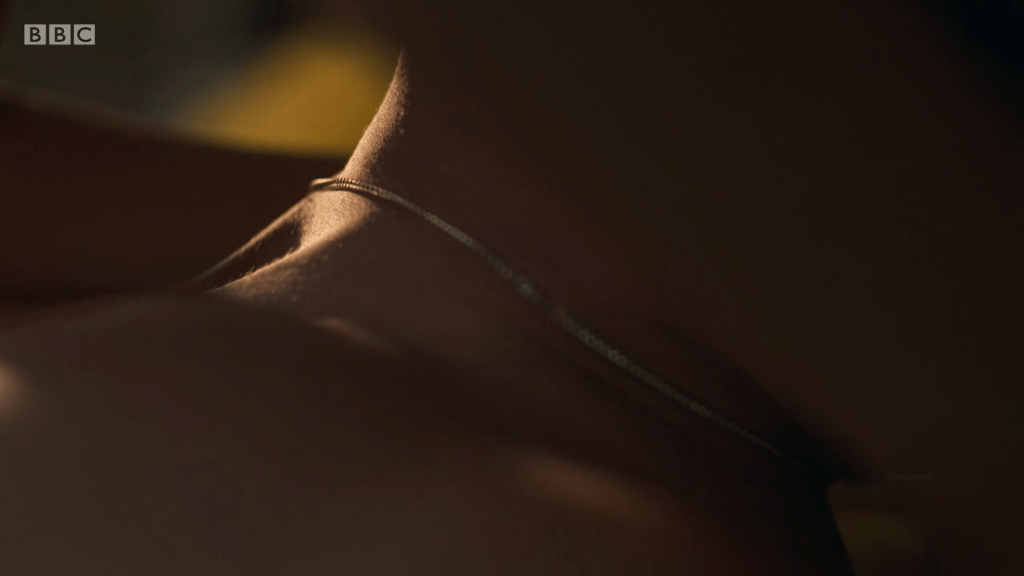
Normal People has been considered one of the best television productions in the modern age, due to its handling of young love, the hardships and beauty of it all. It includes many intimate scenes which is unusual for BBC productions, however, they were directed beautifully, respectfully and it comes across through the camera extraordinarily. The shallow depth of field softens the environment around the characters, enhancing the delicate nature of the skin on show, lighting is warm and inviting, rather than cold and uncomfortable. Close framing respects the actor’s privacy as well as focusing on the parts of the body that make us human or add personality (see Fig. 3). This approach brings the viewers into a place that may be familiar, challenging or easing their feelings surrounding intimacy and image. Many sexual scenes are over the top, extreme and unrealistic to most viewers, so to have a variety of scenes that perfectly portray the reality of opening up and showing yourself to another or a mirror is powerful. It’s human.
Reflection:
The open nature of this brief allows for a flexible brief without too many restrictions, it is up to us as the students to decide what we think the project should be about and how we’re going to portray that idea.
Taking the word ‘simple’ and exploring the minimalist art movement has been one way for me to inject the concept of photography being as such. However, gathering examples from minimalist photographers further supports my belief that despite a ‘basic’ composition, subject or theme, the background and makeup of the pieces are less than straightforward. Photography is full of thoughts, planning and meanings that flesh out the art, allowing the audience to connect with it more deeply.
Combining a minimalist art style, with the use of an instant camera and a complex subject such as the human body, a system full of organs, cells, DNA creates a juxtaposition between the aesthetic and concept. I would be able to fulfil the statement ‘Photography is simple’ while proving my point at the same time, creating a ‘for and against the type of project.
Going forward I intend to take a few test shots with my Instax instant camera to see how achievable this project will be.
References:
ARTPIL. (2019) Ziqian Liu [online] Available at: https://artpil.com/ziqian-liu/ [Accessed 14 June 2021].
Legacy User. (2012) History of Polaroid and Edwin Land [online] Available at: https://www.boston.com/uncategorized/noprimarytagmatch/2012/10/03/history-of-polaroid-and-edwin-land/ [Accessed 14 June 2021].
Parrot, P. (n.d.) 5 Minutes With a Photographer : Paloma Parrot [online] Available at: https://www.artifactuprising.com/photographer-interview-paloma-parrot [Accessed 13 June].
Powell, L. (2021) Initial thoughts on ‘Photography is simple’ [online] Available at: https://laurenpowelloca.photo.blog/2021/06/14/initial-thoughts-on-photography-is-simple/ [Accessed 14 June 2021].
Tate. (2017) Minimalism – Art Term [online] Available at: https://www.tate.org.uk/art/art-terms/m/minimalism [Accessed 14 June 2021].
Stella, F. (1966) ‘Questions to Stella and Judd’ In: What You See Is What You See p. 2. Available at: https://www.artnews.com/art-news/retrospective/what-you-see-is-what-you-see-donald-judd-and-frank-stella-on-the-end-of-painting-in-1966-4497/ [Accessed 13 June 2021].
List of images:
Figure. 1. Parrot, P. (2018) Upside Down [Instagram, screenshot] Available at: https://www.instagram.com/palomaparrot/
[Accessed 13 June 2021].
Figure. 2. Liu, Ziqian (n.d.) Skin [image] Available at: https://www.ziqianqian.net/skin [Accessed 14 June 2021].
Figure. 3. Abrahamson, L. (2020) Normal People: Episode 5 [BBC iPlayer, screenshot] Available at: https://www.bbc.co.uk/iplayer/episode/p089j889/normal-people-series-1-episode-5?seriesId=p089g8vv (Accessed 24th August 2021).
 Lauren Powell OCA