
Summary:
In this post I
– Included the exercise brief to re-visit Henri Cartier-Bresson’s photograph Behind the Gare Saint-Lazare (1982)
– Before inserting the image and explaining the point within the image I felt was the most signification and why.
– Referenced one of my own images to give context to the use of a focal point and the rule of thirds.
– Included a short reflection on the importance of understanding the pivotal points within a piece of art.
Brief:
‘If photography is an event then looking at photography should also be an event.
Look again at Henri Cartier-Bresson’s photograph Behind the Gare Saint-Lazare in Part Three.
(If you can get to the Victoria & Albert Museum in London you can see an original print
on permanent display in the Photography Gallery.) Is there a single element in the image
that you could say is the pivotal ‘point’ to which the eye returns again and again? What
information does this ‘point’ contain? Remember that a point is not a shape. It may be a
place, or even a ‘discontinuity’ – a gap. The most important thing though is not to try to
guess the ‘right answer’ but to make a creative response, to articulate your ‘personal voice’.
Include a short response to Behind the Gare Saint-Lazare in your learning log. You can be as
imaginative as you like. In order to contextualise your discussion, you might want to include
one or two of your own shots, and you may wish to refer to Rinko Kawauchi’s photograph
mentioned above or the Theatres series by Hiroshi Sugimoto discussed in Part Three. Write
about 300 words.‘ (Bloomfield, 2018).
Behind the Gare Saint-Lazare re-visit:
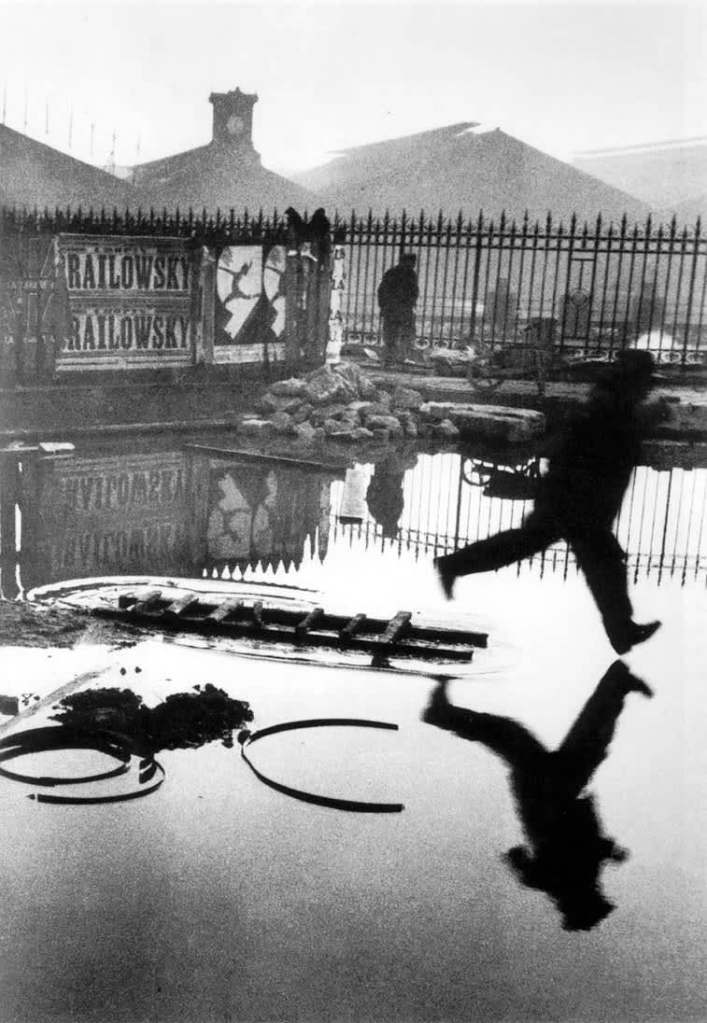
Behind the Gare Saint-Lazare is extraordinary as Cartier-Bresson shot it through a small gap in the wall, unaware of the activity going on behind it. The pivotal point for this shot is the movement. Despite the composition being full of details, textures and shapes becoming a playground for the viewer to explore, the eyes are always drawn back to the blur within the shot. It stands out from the rest, a frozen backdrop in black and white while the mysterious shape to the right flies through the frame.
You are made aware of the direction of movement and the travel speed without being there in the moment. It’s an image that tells its own story, a moment of urgency on a wet day as they jumped over or through the puddles below. You want to know where they are going, why they are running and if something exciting or disastrous happened outside the frame.
The tonal balance within this picture is mixed, with the majority of them being light greys and white. Meanwhile, the silhouette and items nearby are heavily contrasted, making it difficult to ignore.
There is life within the frame, a definitive moment that took place and was unique in photographic execution. Not many images can document a piece of history intriguing enough for the audience to stay and observe it for a length of time over and over. While there may not be a clear leading line, there is an obvious focal point pushing the eyes to look and appreciate it whether they want to or not. It’s so powerful.
An example of drawing the eyes towards a particular point without a leading line features in one of my product images (see Fig. 1) through the use of the rule of thirds.

Reflection
Re-visiting an image can help you appreciate the piece of work, especially if you have more knowledge to hand. Understanding what ‘makes’ an image and shapes it, encouraging the viewer to look deeper and sit with the art for longer solidifies the importance of composition, balance and intent.
References:
Bloomfield, R., 2018. Photography 1: Expressing your Vision. 4th ed. [pdf] Barnsley: OCA, p. 109. Available at: https://www.oca-student.com/course/photography-1-expressing-your-vision [Accessed 13 June 2021].
List of images:
Figure. 1. Cartier-Bresson, H. (1932) Behind the Gare Saint-Lazare [image] Available at: https://en.wikipedia.org/wiki/Behind_the_Gare_Saint-Lazare#/media/File:Henri_Cartier-Bresson_-_Behind_the_Gare_Saint-Lazare,_1932.jpg [Accessed 13 June 2021].
Figure. 2. Powell, L. (2021) Sloth [image] In possession of: Lauren Powell: Eastleigh.
 Lauren Powell OCA