Technical research and ideas

Assignment 4, Books & Magazines, Online Research, Reflection on assignments, Thoughts & Ideas

Summary

In this post I have

– Briefly discussed my mind-map post

– Explained how my preferred concepts led me to research via YouTube and books

– Before explaining three techniques, how they’re done and the results you can get

– Including screenshots and scans of the examples from the research

– Finishing the post with a short reflection about these techniques and what I plan to do as a project.

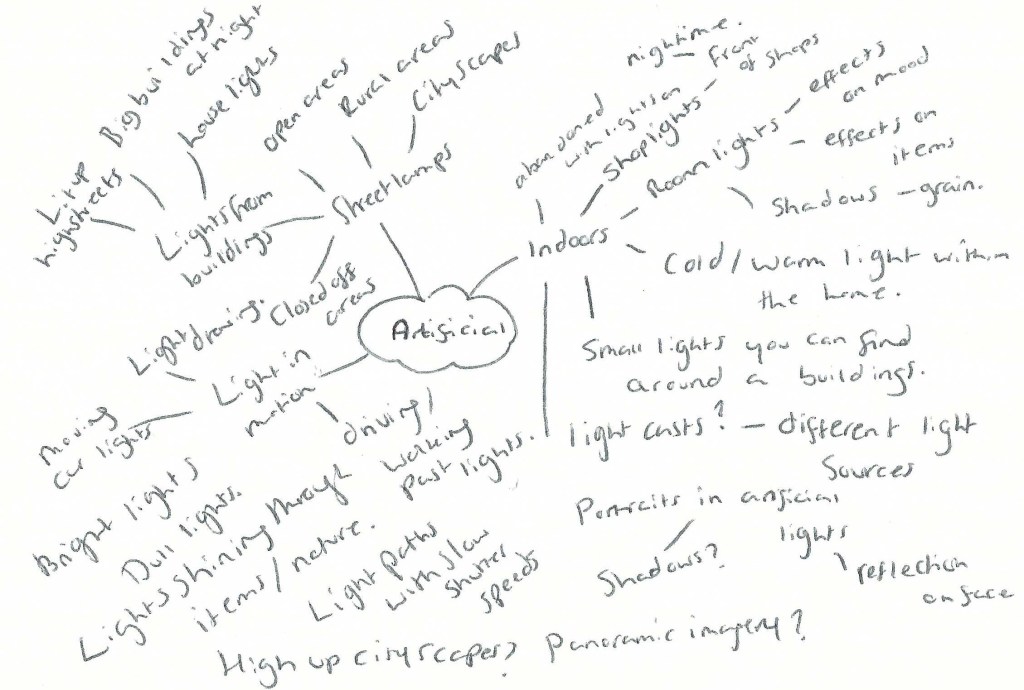
In my last post, I briefly discussed my mind-maps for both artificial light and controlled light, the multiple techniques, concepts and possible subjects that could be explored, along with their pros and cons. The ideas ranged from cityscapes to light casts, streetlamps and their shadows, light drawings, spotlight photography, commercial and lightbox photography.

As mentioned in my initial thoughts I sat with the ideas I was interested in most, which were silhouette and lightbox photography. While these ideas were in the foreground of my mind, I searched YouTube for further ideas and tutorials for lightbox, abstract and macro photography, as well as referring to an experimental photography book. This helped me figure out the direction I want to take for this assignment while pushing me to explore techniques I’d not done before or in a long time.

Oil and water

One of the first concepts I thought of when exploring the idea of using a lightbox, was oil and water macro photography, a simple set-up with incredibly unique results. Lighting the subject from behind (or below if it’s flat on a surface) and lifting the subject high above the light source intensifies the shallow depth of field, diffusing the colours below and making sure the main focal point is the bubbles in the frame. You can adjust the colours used underneath, the direction they’re pointing and the shape of the oil bubbles by stirring it and manipulating the mixture (Adaptalux, 2019). Ben from Adaptalux inserted videography of his results at the end of the YouTube tutorial, which I was able to take a screenshot of (See Fig. 1) for future reference.

Having more control over the process, can result in some incredible shots and allow you to get the exact outcome you’re looking for, however, it is possible to let gravity and chemistry take control of the subject while you focus on the light. This technique is full of flexibility, depending on what you prefer to do, but not so much so that you don’t have to plan or take control of what is going on. While this would be perfect to use for a controlled light project, it is also a concept I’ve explored myself in the past, so isn’t ideal for pushing myself further. The set-up and technical information regarding light placement, filters and stability for the camera/subject from this specific tutorial have still been beneficial for me to consider for this assignment, so worth the watch and research time.
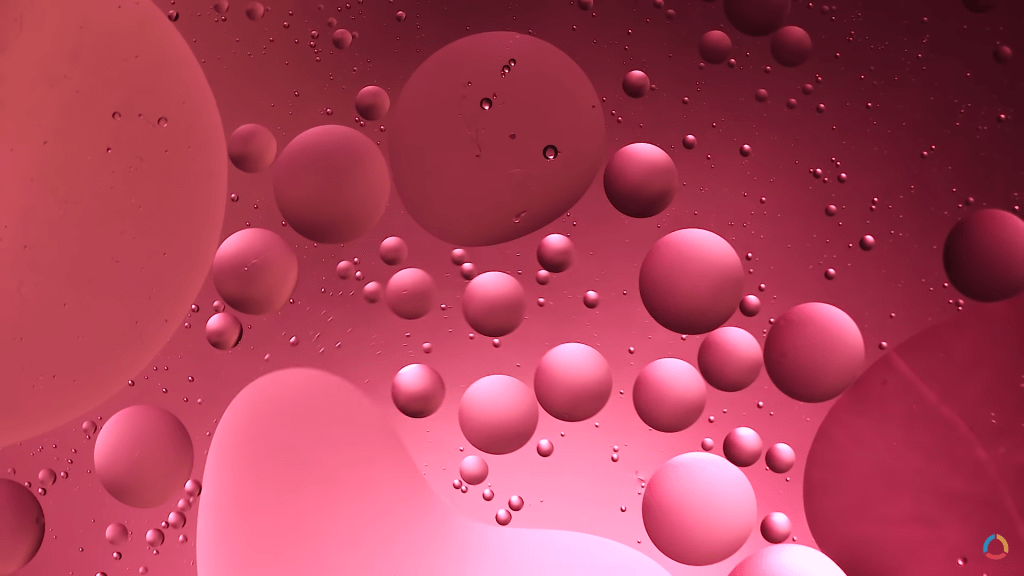
Fig. 1. Oil and Bubble (2019)

Abstract paper photography

Another tutorial I saw from Adaptalux on YouTube, was an abstract photography project with nothing but lighting and paper. Much like the previous project with the oil and water the lighting is coming from underneath the subject (backlit when it’s flat on a surface) via the use of a lighting arm and some diffusion filters for additional colour. Before shooting, the camera is set up on a tripod and the focus is set beforehand so all that has to be changed is the paper folds, positioning or lighting direction/colour. The height of your camera and the focal range of your lens can result in an extremely close frame or a wider shot depending on your preference, making this another flexible technique to try out (Adaptalux, 2020). You can either fold the paper, roll it up, use one sheet or multiple sheets and manipulate their shape to get a variety of styles to shoot. Despite being lit from below, due to the curves in the paper, soft shadows are captured as opposed to a silhouette or flat image of the item in the frame.

Shooting the cross-section of paper is much more interesting than I first imagined it would be, as it cuts the camera frame into multiple sections and is ambiguous in terms of the subject (see Fig. 2). Abstract art is meant to be ambiguous and cause questions to be asked, in turn making it a much more complex idea to explore and play around with.

I’ll definitely consider exploring this particular technique, even if it’s not chosen for this assignment.
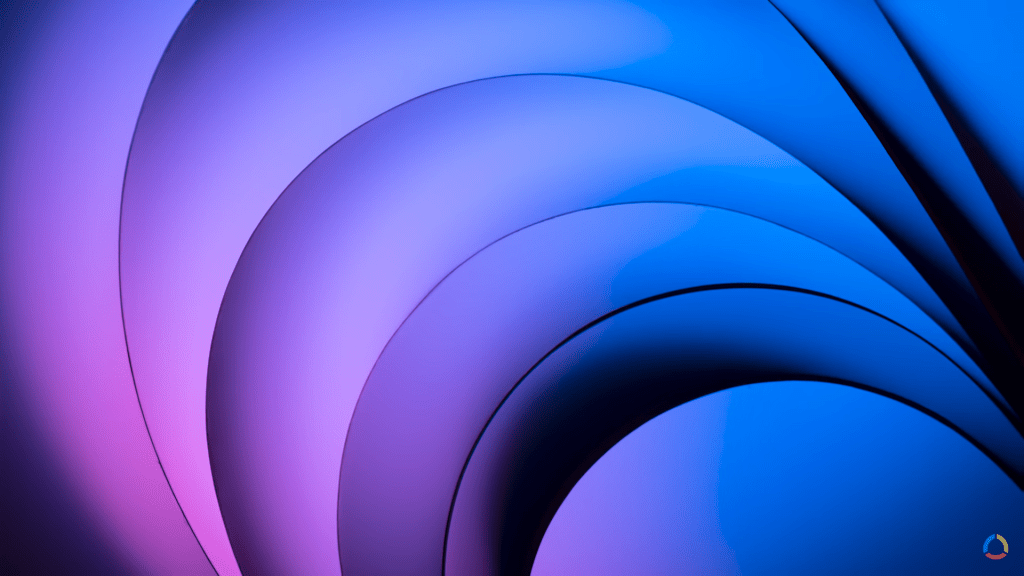
Fig. 2. Abstract photography with paper (2020)

Lumen prints

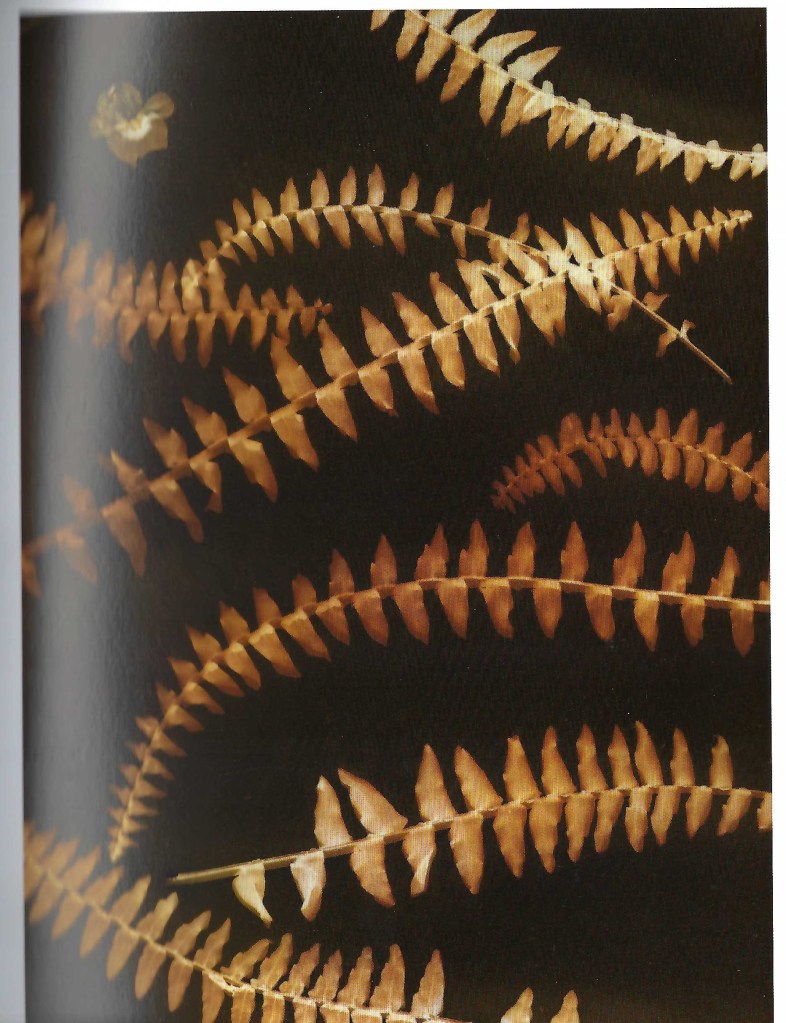
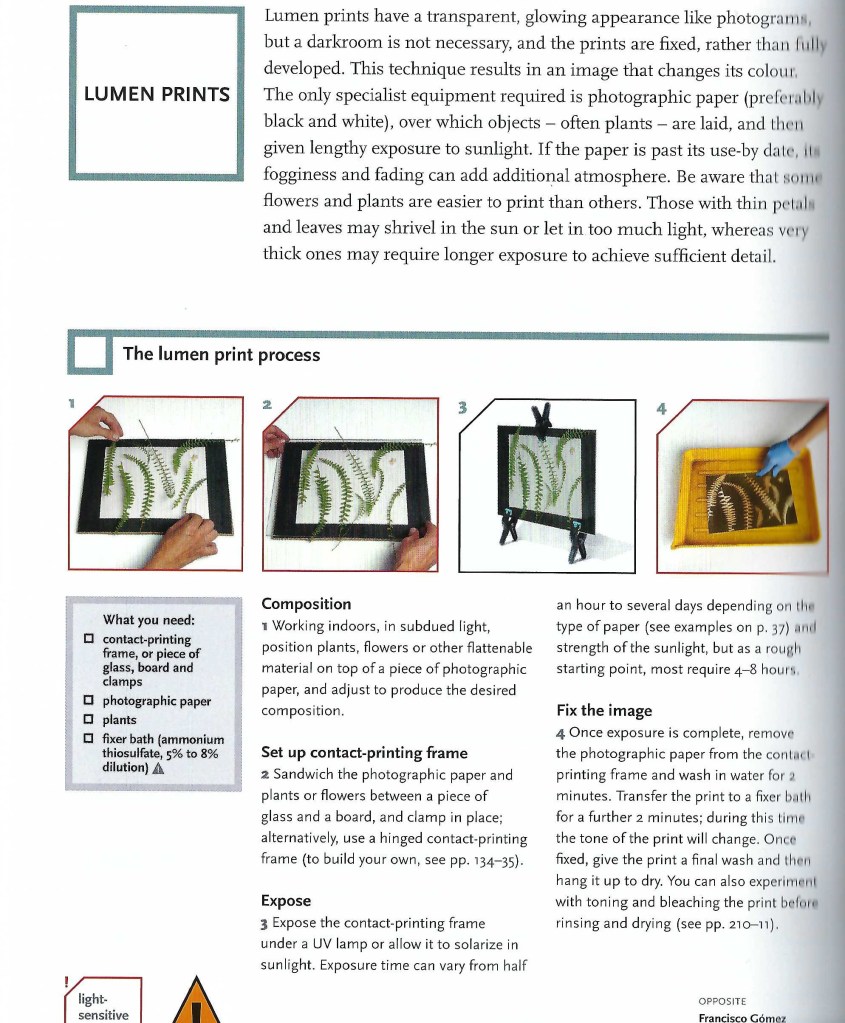
Despite not having the products needed for this particular experiment, looking through Thames & Hudson’s book Experimental Photography (Bendandi et al., 2015) gave me something to think about in terms of photographic presentation and technical choices made in photography. The contact printing frame used for this experiment (see Fig. 3) looked similar to a light pad, a thin LED glass pad used for tracing for art and other such things, while the lumen print Francisco Gomez managed to produce (see Fig. 4), reminded me of a photographic film after they’ve been developed. Placing the leaves on a piece of photographic paper, blocked those specific areas from the light, much like objects do when shooting with film. The denser subject is shown via a ghostly silhouette; with a few shadows to define the details where light has seeped through, while the open areas are much darker to show how much light the paper was subjected to during the experiment. By ‘inverting’ the print with Photoshops gradient map, the image looks like a typical sepia print, which has got me thinking about the possibility of creating digital ‘negatives’ for this assignment and how light can affect the results of an image.
Reflection

The techniques explored in this post have helped me understand a variety of techniques that can be used for this particular assignment, including macro photography, inverting photographs and experimenting with light, colour and its subjects. Abstract photography is unique and results in a never-ending list of outcomes, especially if the subject is constantly moving, such as oil bubbles in the water. Despite having total control of the light it doesn’t mean that you are in control of everything which I like. Lumen prints could be similar if you measure the exact amount of time the paper is exposed for, but the subjects used to make the composition are most likely to be different, even by a millimetre.

This has me thinking about film photography and how you have a restricted amount of time to get the desired image. Over or underexposure could make or break an image, influencing the mood or details of the subject. One second out, or one wrong move and you could’ve missed the ‘perfect’ composition. Light levels are shown on a negative via the translucent and opaque areas; the lighter areas are caused by denser objects that have been less exposed to light, in comparison to the darker areas such as a clear sky or another strong light source.

For my Languages of light assignment, I may explore the use of a light pad or lightbox to illuminate subjects from the bottom, how lens filters or gels could affect the overall image and how to create digital ‘negatives. Further research is needed to make this decision.


References

Adaptalux, 2019. Oil & Water Bubble Photography & Videography Tips | Macro Photography Tutorial. Available at: https://www.youtube.com/watch?v=mixLIIQ5N00&t=678s [Accessed 18 May 2021].

Adaptalux, 2020. How to shoot beautiful abstract photography using paper!. Available at: https://www.youtube.com/watch?v=2oM41u3JyCc&t=335s [Accessed 18 May 2021].

Bendandi, L., Minniti, S., Gómez, F., Lungarella, G. and Antonini, M., 2015. Experimental photography. 1st ed. London: Thames & Hudson, pp.34-35.

List of images

Figure. 1 Adaptalux. (2019) Oil and Bubble videograph by Adaptalux [YouTube, screenshot] Available at: https://www.youtube.com/watch?v=mixLIIQ5N00&t=678s [Accessed 18 May 2021].

Figure. 2 Adaptalux. (2020) Abstract photography with paper by Adaptalux [YouTube, screenshot] Available at: https://www.youtube.com/watch?v=2oM41u3JyCc&t=335s [Accessed 18 May 2021].

Figure. 3 Gómez, F. (2013) Lumen Prints [Scanned page] In: Bendandi, L., Minniti, S., Gómez, F., Lungarella, G. and Antonini, M. (2015) Experimental photography. 1st ed. London: Thames & Hudson, p.34.

Figure. 4 Gómez, F. (2013) Lumen Print [image] In: Bendandi, L., Minniti, S., Gómez, F., Lungarella, G. and Antonini, M. (2015) Experimental photography. 1st ed. London: Thames & Hudson, p.35.
Assignment 4 – Initial Ideas (Mind-Maps)

Assignment 4, Reflection on assignments, Thoughts & Ideas

Summary

In this post I

– Included the brief for this assignment and

– Listed my initial thoughts, reasonings for choosing a specific path

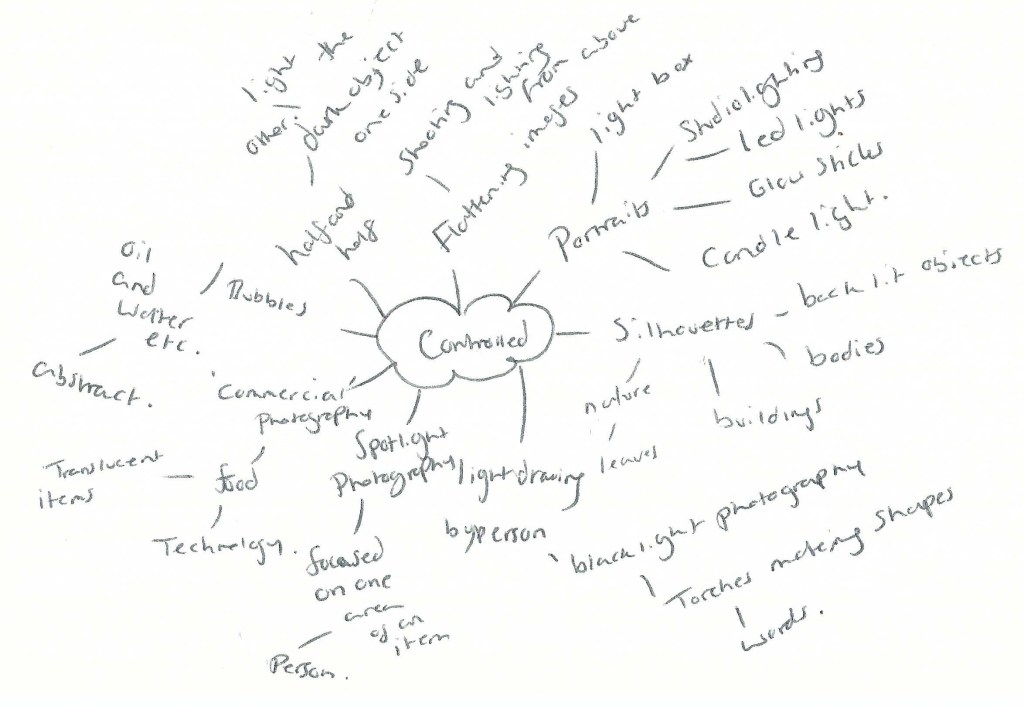
– Before attaching two mind-maps with various ideas/concepts

– Then listing the pros and cons for each technical approach

– With a short reflection on my ideas and how I will come to decide what I want to do for Languages of Light.

Brief

‘Revisit one of the exercises on daylight, artificial light or controlled light from Part Four (Ex 4.1, Ex 4.2 or Ex 4.3) and develop it into a formal assignment submission. The submission requirement for this assignment is a set of between six and ten high-quality photographic prints‘ (Bloomfield, 2018).

Initial thoughts

As I’ve used natural light a lot for personal work and past assignments, I feel it’s necessary to push myself out of my comfort zone and explore either artificial or controlled light for this particular assignment. Both 4.2 and 4.3 were interesting to do as well as the analysis of the results and what they taught me, so choosing the exercise I would like to revisit may take a little longer than anticipated.

I’ve gathered together multiple ideas for each technical approach and formulated two individual mind-maps, allowing me to figure out the subjects or projects that stand out to me most over the next few days. I plan to sit with these ideas for 2-3 days, see which ones come back to mind most and begin researching the different techniques or approaches, before exploring the chosen project in more detail.


Mindmaps

Artificial light

– Shooting with artificial light will remove the option for me to control how the light falls, forcing me to capture it in an interesting way from what is available.

– Working outside would be more realistic currently, given the slow ease of lockdown restrictions.

– If I didn’t want to go outside, there is always the possibility to explore artificial light within the home e.g. lamps, lights from house windows, lights from technology etc.

– Shooting during the night would mean fewer people around so wouldn’t have to worry about social distancing and could capture shop windows/high streets in a way we may not see usually. Ghosttown-esque?

– Could experiment with light paths by capturing images from a moving vehicle or by moving around the light source. Abstract?

– Capturing cityscapes and working at night isn’t something I usually do so would be interesting to explore.

– Portraits would be interesting to take at night, as I’ve never done that before and could result in some really interesting shots depending on location and light source.

– It’s nearing summertime so would have to work much later than expected, which isn’t as ideal.

– May have to travel to photograph cityscapes or highstreets, so would have to plan transport.

– Lighting within the home is possible, but more restrictive and not pushing myself further.

Controlled light

– I have control of the light and how it falls on the subject, which could result in some really interesting shots.

– Would push me far out of my comfort zone, having avoided studio lighting for many years.

– Trying out various light sources would be interesting and provide me with much more knowledge than before.

– Could work within the home which is ideal for social distancing purposes and removing the need to travel.

– Silhouette work would be interesting to explore, as they may have the ability to be much more defined than if I were to shoot using a duller artificial light.

– I could make a set-up within the home or garden, which is easier to do than setting up outside with no electrical sources etc.

– Lightbox photography is something I’ve explored briefly before and could link in with silhouette photography, combining multiple ideas.

– If I wanted to use a model for this project, I would have to consider social distancing still if the set-up was indoors.

– Space would be more restrictive working within the home which may not be ideal, depending on what I decide to shoot.

– May have to invest in more lights for this project, as I have very limited options in my pre-existing kit.

Reflection

There are pros and cons for each exercise, ranging from lack of kit to the planning of travel and considering the time of day. Despite all of this, there are some strong ideas that I’d be more than happy to explore and willing to take the time to gather equipment or plan. Silhouette photography, the use of a lightbox and creating abstract images are currently the strongest contenders for me. If I wanted to use a model for this assignment and work around social distancing, I could either model myself with a tripod set up or ask a family member. Sourcing a variety of lights is also possible with a little bit of research and asking around, but still doable.

Any struggles that may occur during this assignment are making me more excited to explore and shoot for Languages of light, as it will push me to work with what I’ve got, find a way around the difficult stages and grow from it.

Still undecided on whether to use artificial or controlled light, but I have plenty of ideas to think about and research in the meantime. Looking forward to this assignment and what results will come from it.


References

Bloomfield, R., 2018. Photography 1: Expressing your Vision. 4th ed. [pdf] Barnsley: OCA, p. 97. Available at: https://www.oca-student.com/course/photography-1-expressing-your-vision [Accessed 18 May 2021].

List of images

Figure. 1 Powell, L (2021) Collection [Ballpoint pen on paper] In possession of: Lauren Powell: Eastleigh.

Figure. 2 Powell, L (2021) Artificial [Ballpoint pen on paper] In possession of: Lauren Powell: Eastleigh.

Exercise 4.4 – Personal Voice

Online Research, Part 4, Practitioner Research, Reflection on coursework, Thoughts & Ideas

In this post I have:

– Provided the brief for this exercise,
– As well as writing a short research point about Ernst Haas and his photograph Geranium, USA 1961.
– Inserted a screenshot from google, having searched “Green leaves” as my subject,
– Before explaining my shoot plan in brief, along with camera settings.
– My contact sheets for this exercise are attached to show a variety of shots,
– But only one final image was chosen and analysed in further detail.
– A short reflection at the end explains how this exercise has confirmed to me that each image is different and unique, regardless of subject.

Brief

Make a Google Images search for ‘landscape’, ‘portrait’, or any ordinary subject such as ‘apple’
or ‘sunset’. Add a screengrab of a representative page to your learning log and note down
the similarities you find between the images.
Now take a number of your own photographs of the same subject, paying special attention
to the ‘Creativity’ criteria at the end of Part One. You might like to make the subject appear
‘incidental’, for instance by using focus or framing. Or you might begin with the observation
of Ernst Haas, or the ‘camera vision’ of Bill Brandt. Or if you’re feeling bold you might forget
about your camera completely and think about the tricky question of originality in a
different way – http://penelopeumbrico.net/index.php/project/suns/
Add a final image to your learning log, together with a selection of preparatory shots. In
your notes describe how your photograph or representation differs from your Google
Images source images of the same subject
‘ (Bloomfield, 2018:96).

Research:

Ernst Haas (1921 – 1986)

Ernst Haas was a well known European photographer, born in Vienna, Austria; mostly celebrated for his involvement in colour photography and his work documenting the Austrian prisoners of war returning home. Haas moved to the United States in his 30’s where he began exploring Kodachrome Colour Film, in turn, making him one of the first to have a colour photo feature in LIFE magazine (Ernst Haas Estate, 2018). A few years later, his work was exhibited in New York’s MoMA and again was one of the first colour photography exhibitions.

The Ernst Haas Estate website has a wide range of Haas’ photographic works from across the years, exploring both his B&W pieces, portraiture, coloured compositions using multiple techniques and subjects such as flora, rubbish, people and architectural elements. 

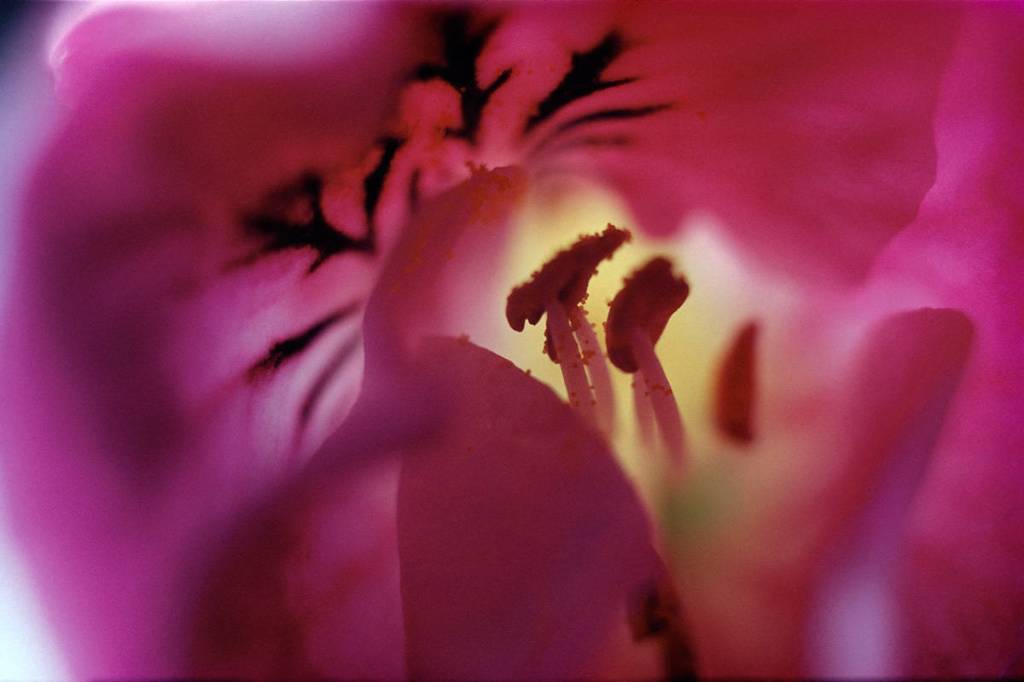
Haas’ New Color Collection: Creation (1959-85) is more neutral in its colour palette, enhancing the earthy colours within the earth’s desert locations and the animals that inhabit them, whereas his Classic Color Collection: Creation (1960-81) is vibrant, full of flora, snow and water. Geranium, USA 1961 (see fig.1) is one of my favourites from the Classic Color Creation collection, as the use of what seems to be a macro lens, captures the minute vein details within the flower petals, the ‘hairs’ of the stamen as it’s surrounded by a warm yellow glow in amongst a sea of pinks.

Shallow depth of field allows the subject that isn’t in the frame to be out of focus and soft, in this case, enhancing the delicate nature of the flower petals and how silky they feel to the touch. Haas captures his subjects in a more detailed and intimate way, rather than shooting them from a distance to get the whole object in the frame. This helps us understand the beauty of nature much more and gives us the ability to explore what some of us may not have taken the time to examine.

Fig. 1. Geranium, USA (1961)

Shoot plan:

Fig. 2. Green Leaves (2021)

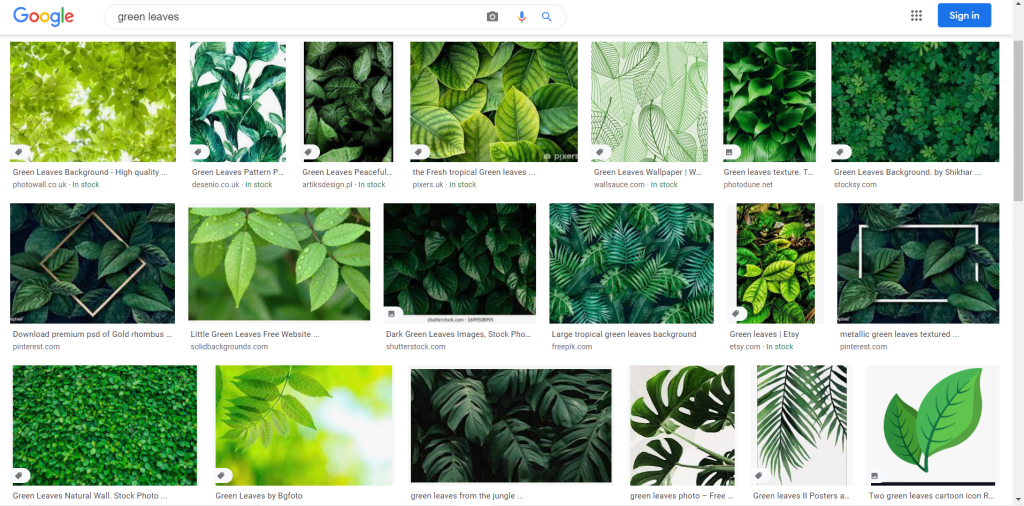
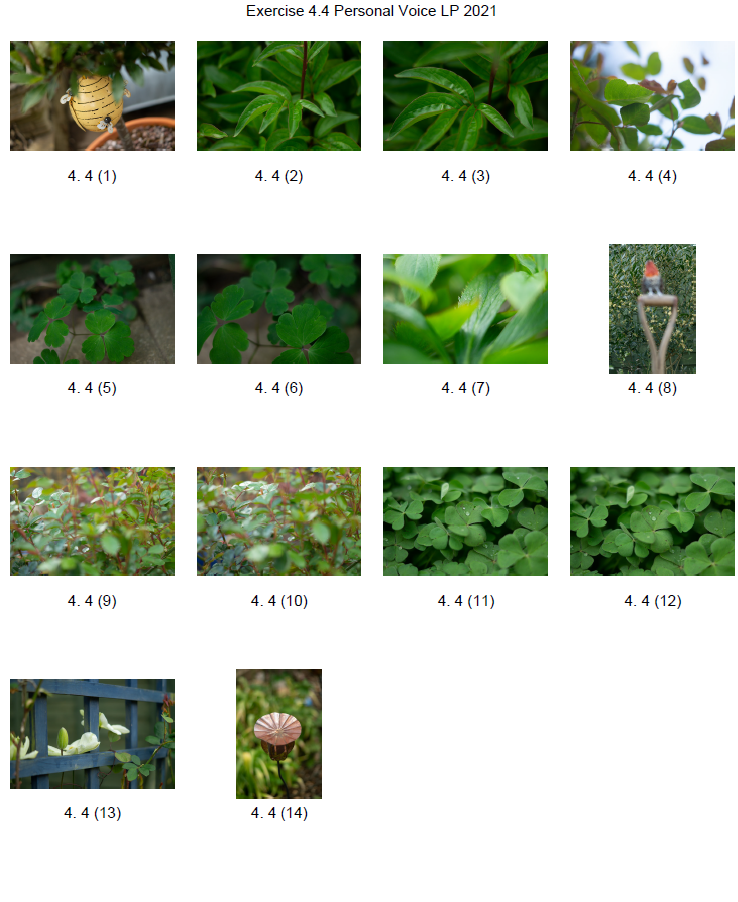
For this exercise, I googled “Green Leaves” (see Fig. 2) to see the variety of images that would come up and how I could explore this subject in my photography. Thankfully there was enough of a range that I could take inspiration and look around my garden to see what I could find in correlation to this search.

My SONY A57 was on manual mode, as was the Sony DT 50mm F1.8 SAM lens, this was so I could have more control over the focus and shutter speed for the exposure. The ISO was at 100, while the aperture was set to f/1.8 to achieve a shallow depth of field when capturing the leaves in a group or in front of other objects. The exercise was quick and easy as it took place in my garden, but despite the ease it beneficial as well as successful.


Contact Sheet:

Fig. 3. Contact sheet (2021)

Final image for analysis:

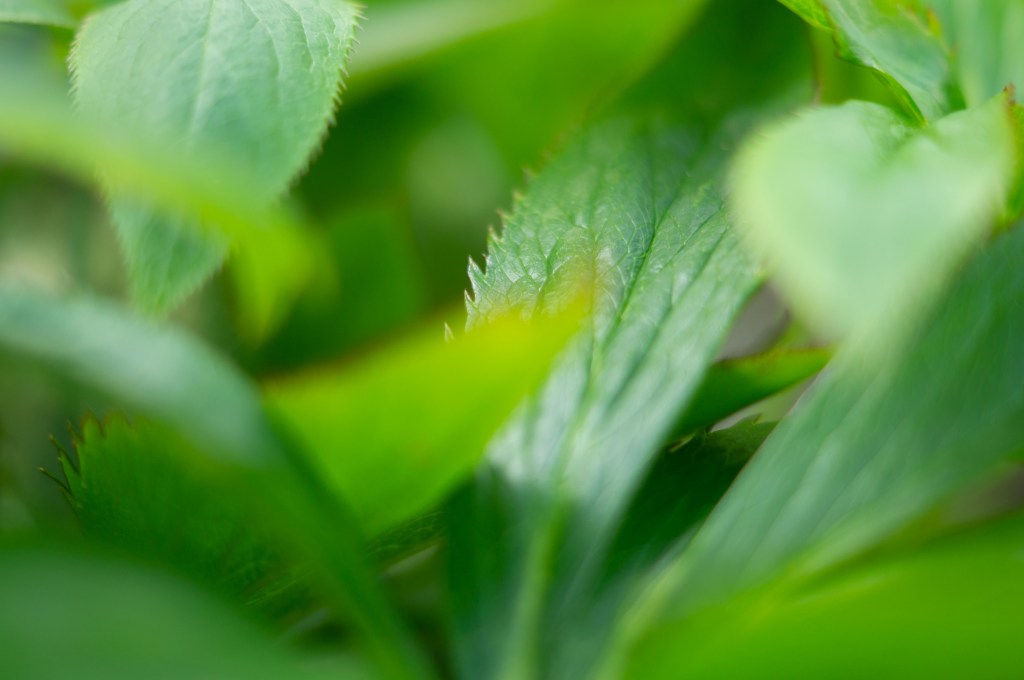
Fig. 4. 4.4 8 (2021)

By observing and looking further into the subject at hand (see fig. 2), I was able to capture the fine, wrinkled veins of the leaves through the shallow depth of field in the foreground. They look similar to the wrinkles we find on the palm of our hands, which go in all sorts of directions, are different depths and shapes. The natural light bounces off of the leaves from the left, giving texture to the image and helping the viewer understand that this is a smooth and shiny leaf, as opposed to a rough, matte leaf. The focal point being in the midframe pushes the eyes to be drawn into the image, rather than the subject being in the foreground and giving the audience a direct path to reach. It’s more like rummaging through the leaves yourself via a photograph, which is a fun concept to me. Shooting this in landscape was a reference to the majority of the images found via google, however, the differences between this composition and the ones in the screenshot make it my own. 

None of the images in the screengrab includes the focal point being midframe or behind a group of other leaves, creating a ‘blockage’ in the foreground. The use of shallow depth of field is used, but the subjects are directly in the foreground, creating a blurred background instead. Most of the green leaf shots seen above are darker and more tropical, whereas the exposure for mine is light, airy and a more typical form of leaf you would find in the garden. Lighting in the google searches is usually either coming from behind the leaves or lit from above minus a few exceptions in the middle row. The final image I have chosen feels like an adventure that you feel involved in, to understand the details, whereas the photographs above provide a clear frame of leaves, in focus, detailed and pretty direct.

Reflection:

While images may be the same in terms of subject matter, orientation or colour, it depends on how it is captured that makes the difference. For example, Ernst Haas’ choice to shoot images of flora up close and personal, allows the viewer to understand the parts that make up a flower, rather than the subject as a whole. 

Taking the time to observe, explore and look at what you are capturing, brings a whole new depth into the photograph as you connect with it more, you’ve planned it and taken the time to understand the composition more. Every image is unique, no matter whether it’s framed the same way or not, they are taken at different times, by different people, with a variety of equipment, weather changes, life circumstances and so much more. Sometimes you may not even intend to shoot a particular subject, but it makes its way into the frame anyway which is wonderful.

Each photograph is always different and personal to each individual, no matter how many times it’s documented.


References:

Bloomfield, R., 2018. Photography 1: Expressing your Vision. 4th ed. [pdf] Barnsley: OCA, p. 96. Available at: https://www.oca-student.com/course/photography-1-expressing-your-vision [Accessed 10 May 2021].

Ernst Haas Estate. (2018) Biography | Ernst Haas [online] Available at: http://ernst-haas.com/biography/ (Accessed 10 May 2021).

List of images:

Figure. 1. Haas, E. (1961) Geranium, USA 1961 [image] Available at: http://ernst-haas.com/classic-color-creation/ (Accessed 10 May 2021).

Figure. 2. Powell, L. (2021) Green leaves [Google, screenshot] In possession of: Lauren Powell: Eastleigh.

Figure. 3. Powell, L. (2021) Contact sheet [pdf, screenshot] In possession of: Lauren Powell: Eastleigh.

Figure. 4. Powell, L. (2021) 4.4 8 [image] In possession of: Lauren Powell: Eastleigh.

Exercise 4.3 – Ex Nihilo

Notes, Part 4, Reflection on coursework

In this post I;

– Provided short descriptions for Quality, Contrast, Colour and Direction.

– Described my shoot set up, with camera details,

– And provided the contact sheets for this exercise.

– Chose six final images to analyse briefly,

– Before reflecting on this exercise, what it taught me and what I could’ve explored more.

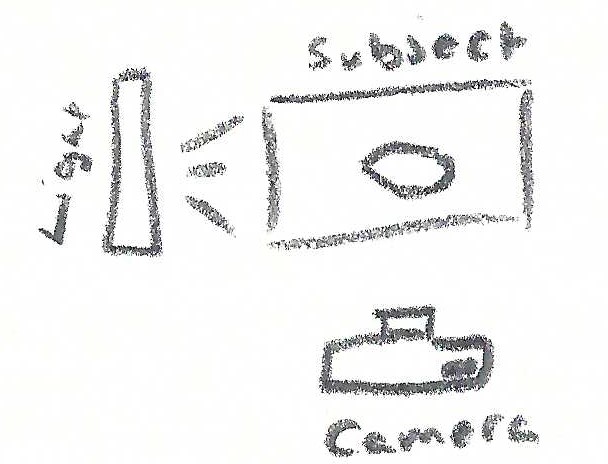
‘Use a combination of quality, contrast, direction and colour to light an object in order to reveal its form. For this exercise, we recommend that you choose a natural or organic object such as an egg or stone rather than a man-made object. Man-made or cultural artefacts can be fascinating to light but they’re already authored to some degree, which requires interpretation by the photographer; this exercise is just about controlling the light to reveal form. Add the sequence to your learning log. Draw a simple lighting diagram for each of your shots showing the position of the camera, the subject and the direction of the key light and fill. Don’t labour the diagrams; quick sketches with notes will be just as useful as perfect graphics‘ (Bloomfield, 2018:91).

Unlike the previous exercises where the light was found, observed and uncontrollable, this exercise explores studio lighting and the photographer’s ability to control the lighting that falls on the subject in the frame.

There is a brief description in the coursebook explaining what quality, contrast, direction and colour is, along with the possible effects on the image and subjects themselves. 

The quality of light is determined by how it looks when it falls, for example, soft shadows are caused by a diffused light, whereas harsher, more defined shadows are due to hard light like direct sunlight at midday. 

Contrast is controllable by a fill light, which can either be another light source or a reflector of some kind like a whiteboard. The ratio between highlights and shadows is measured to determine the contrast ‘if you measure the shadows at f5.6 and the highlights at f8 you have a ratio of 1:2, which means that the fill light is half the intensity of the main light’ (Bloomfield, 2018).

The direction of light can alter an image dependent on the distance and the angle. If the light is placed directly in front, the subject will be significantly flatter than being lit from below or the side. As a result, harsher shadows enhancing the shapes and textures within the frame would occur.

Colour can be significant within photography to give context to the composition or encourage a specific mood and emotion to come through. Lighting filters can cover the lights to colour the background, or ‘by light bounced from a coloured reflector’ (Bloomfield, 2018).

Shoot set up:

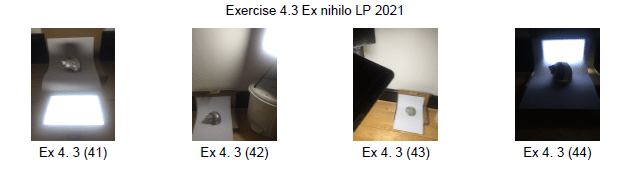
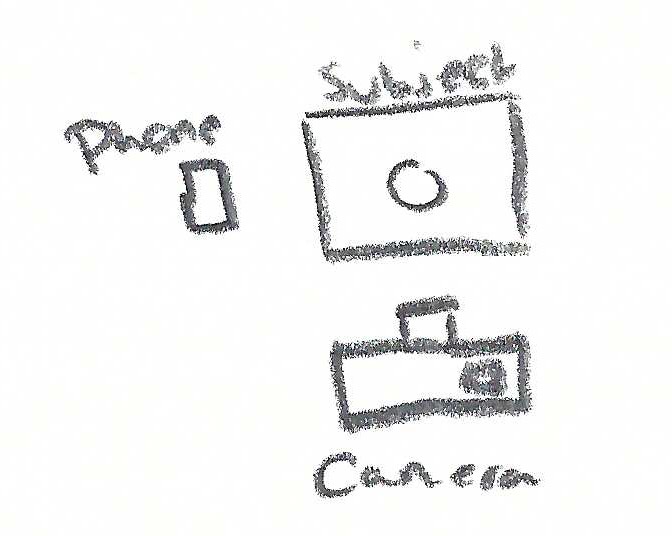
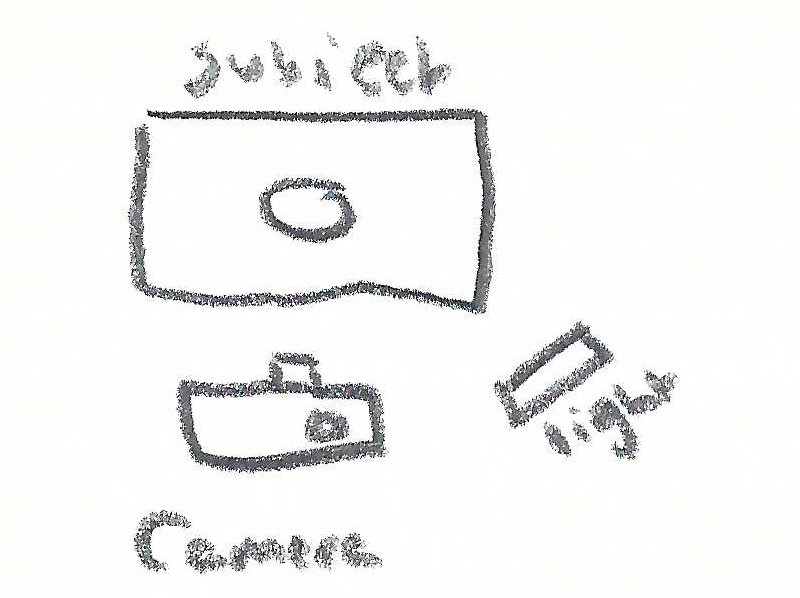
My Sony A57 was on manual mode, with an aperture of f/1.8 and an ISO of 200. The only changes made were the shutter speed and focal length where necessary. The subject sat in the corner of a bedroom to compensate for how small my LED light is, ultimately a wise choice as the shadows became very soft when pulled away from the corner. A sheet of A4 paper was on a small cardboard box to act as a curved background for the shell to sit and reflect the light. I used a small LED lightbox on a tripod as a stabiliser when stood up and a handle when lifting the light from the floor. During the second part of the shoot, I used the light from my iPhone 6 to see the effects a tiny, duller light would have on the shell.

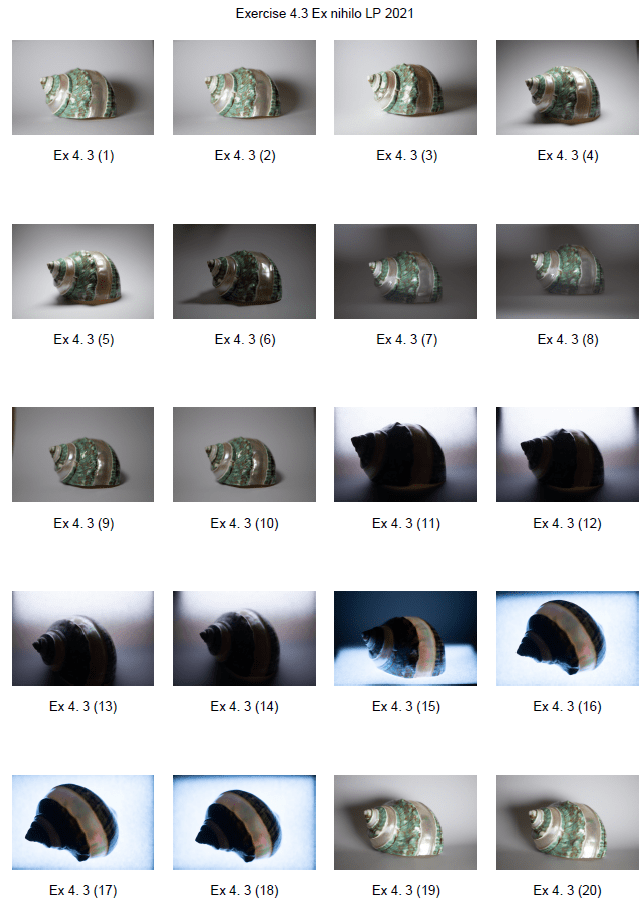
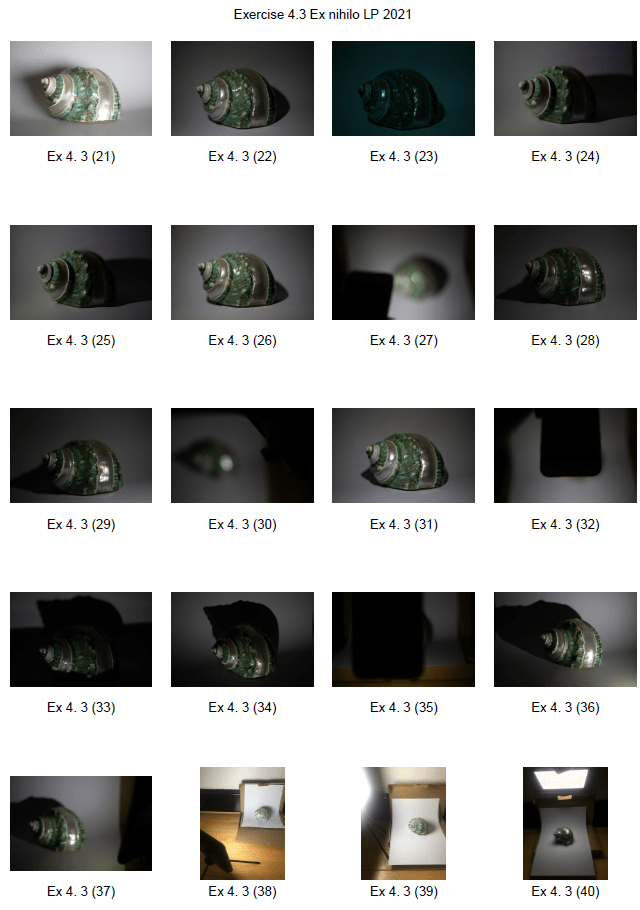
Contact Sheets:


Images for analysis:

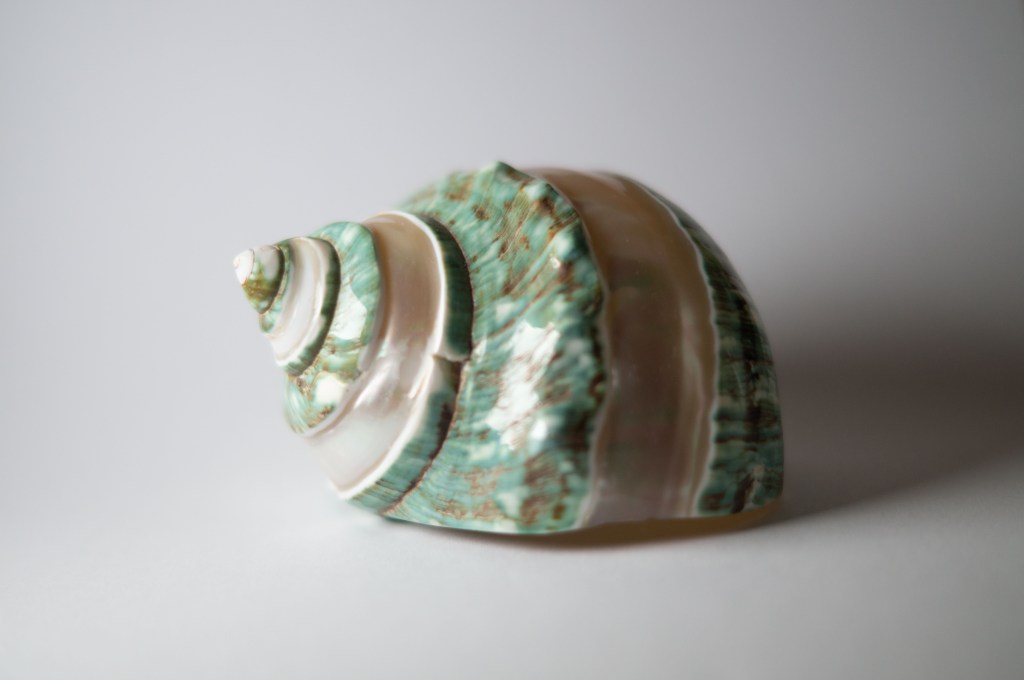
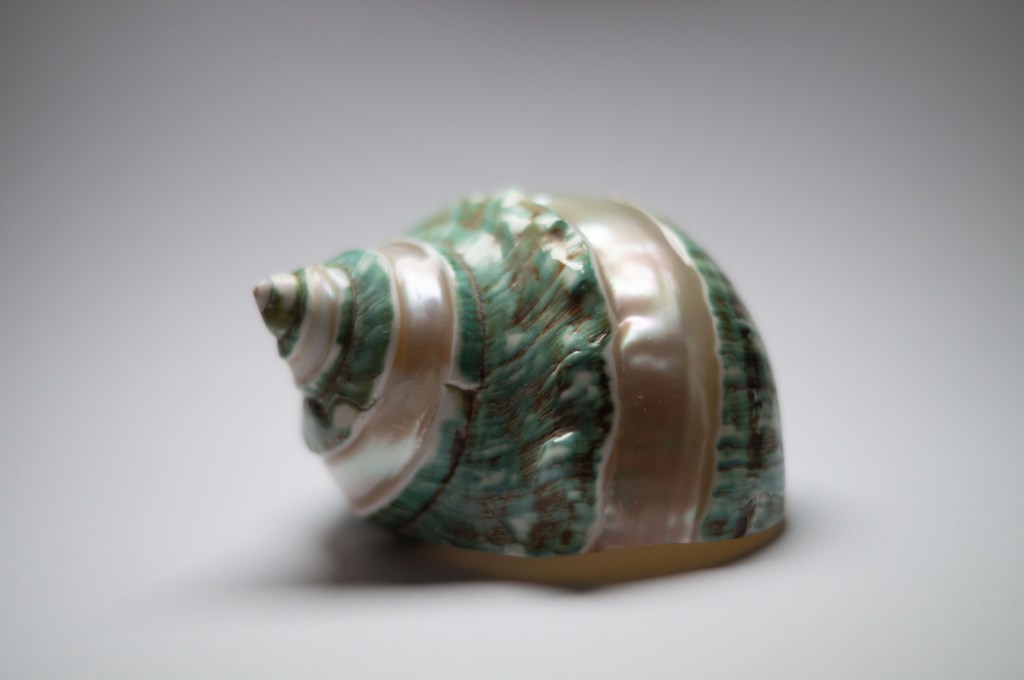
1- The LED box placed close to the side of the shell resulted in a softer diffused shadow, which follows the curve of the paper. Due to the intensity of the light, there are bright highlighted patches by the point of the shell, enhancing the shiny reflecting surface while the shadows fill in the grooves and curves. A very subtle yellow colour can be seen underneath the shadow, a reflection of the light entering and bouncing off of the inside of the shell, providing a bit of warmth to the aqua greens.

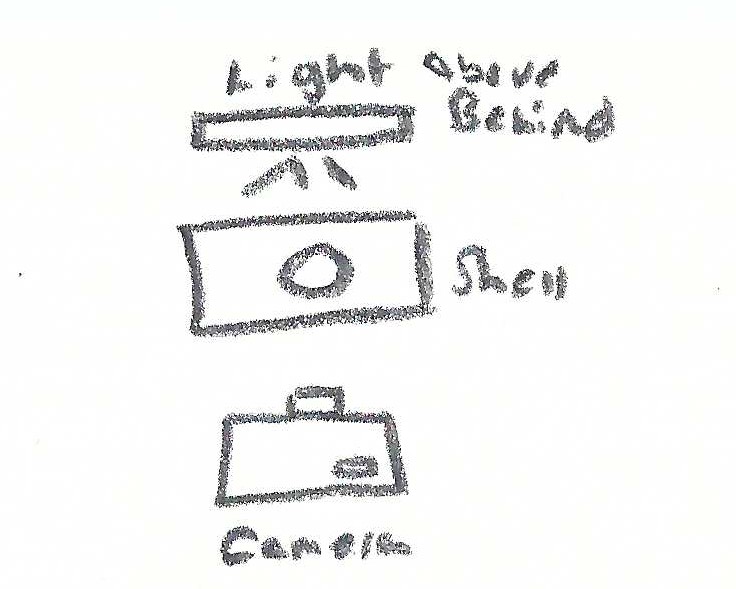
2- I lifted the LED light above and behind the shell to see what results I would get if it were down-lit, rather than the typical front or side position. The contrast between the highlights and shadows are much more even than the previous shot, without being flat. Lighting the shell from behind defined the textures and shapes within without being too bright or too dark. The image isn’t a flat silhouette due to the height of the light, forming a slightly stronger shadow that provides depth from the front of the shell, indicating the direction of light.

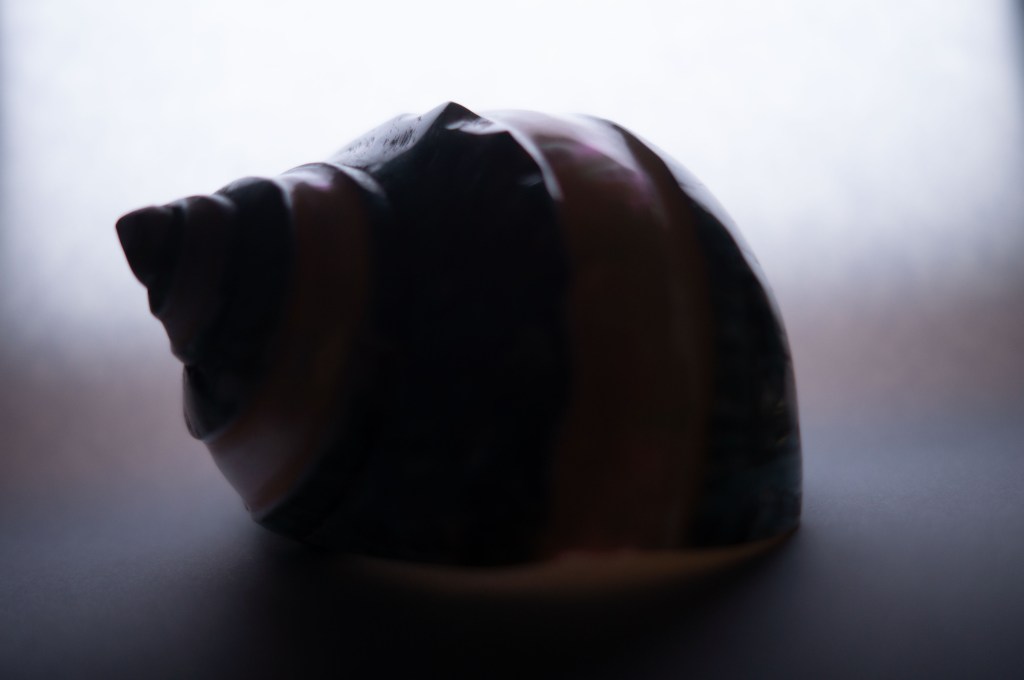
3- A bolder approach was used for this picture by lighting the shell entirely from behind. I covered the LED light with the white sheet of paper and shot the image directly from the front to capture a silhouette of the shell. The shell is not a full silhouette because we can see the grooves and textures of the surface; due to the light falling on top and through the thin walls of its body. The highlights and shadows are still heavily contrasted as the whites are extremely bright, while the blacks are dark, capturing a harsher outline of the subject.

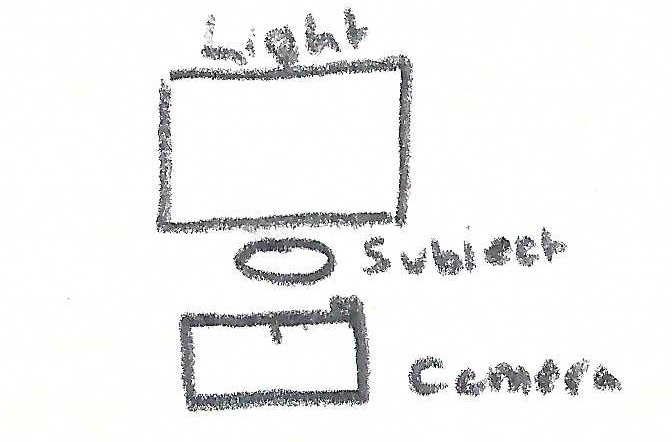
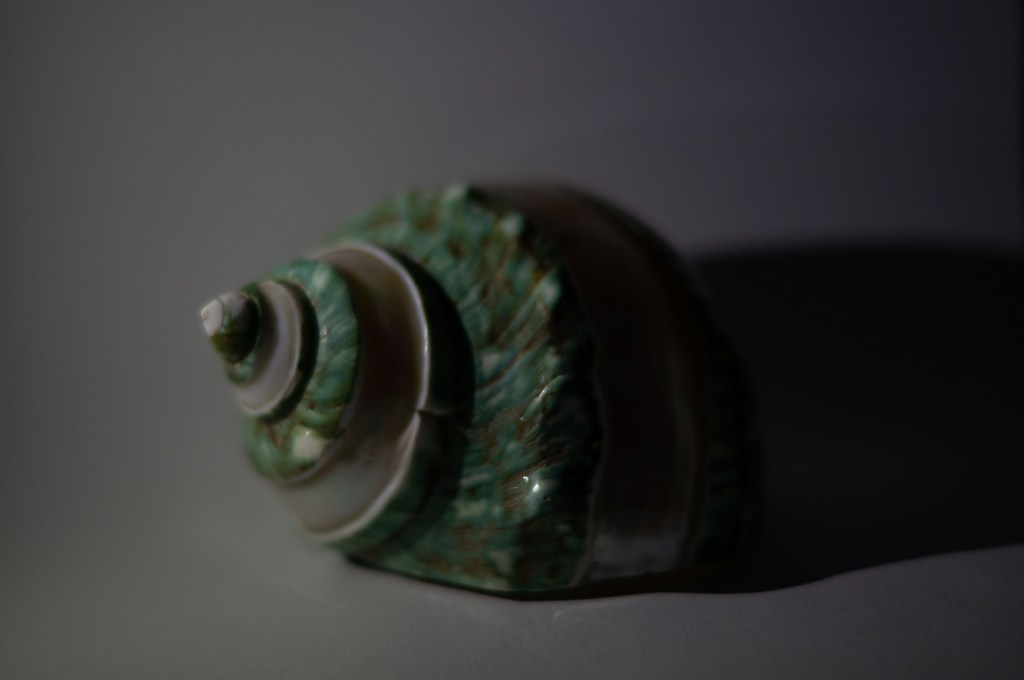
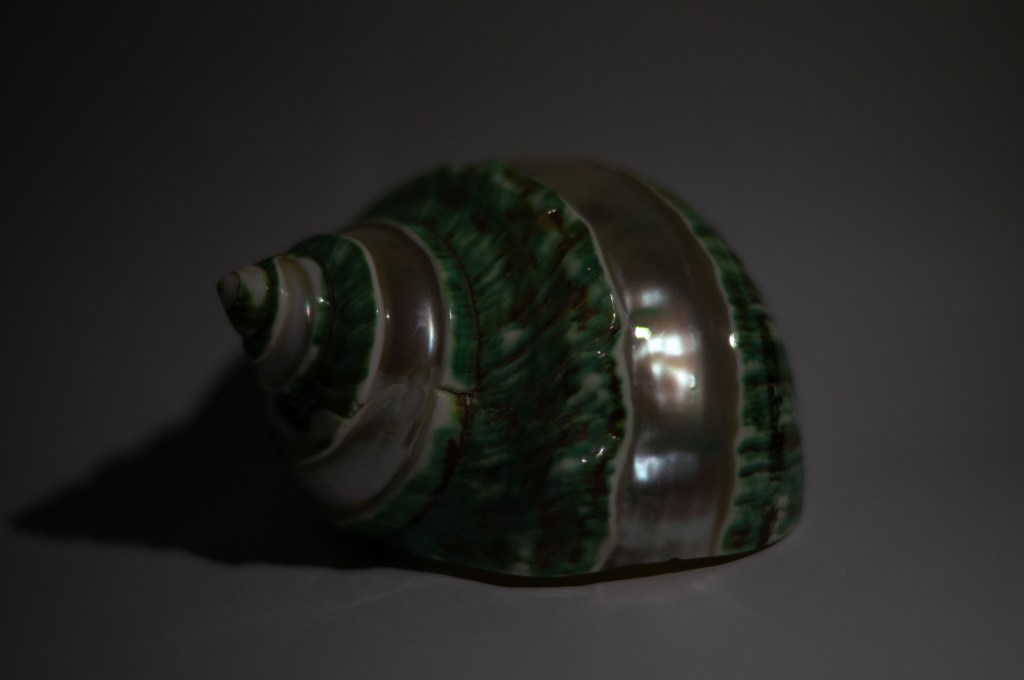
4- The light source for the following images is from an iPhone 6, which is less intense and much smaller than the LED box. Compared to image 1, this light is a lot duller, while the shadows are harsher due to the size and proximity to the subject. The swirls within the shell are heavily defined in this shot due to the darker nature of these images.

5- Lighting from a front angle has allowed the highlights to reflect off its shiny surface and show off the pearlescent colours of the body. Meanwhile, the shadows are enhancing the natural swirls within the point of the shell and defining the sharpness of the point via a hard shadow to the left of the paper. Despite the light being slightly further away from the shell, the tones and overall balance of the image if fairly similar to the 4th image.

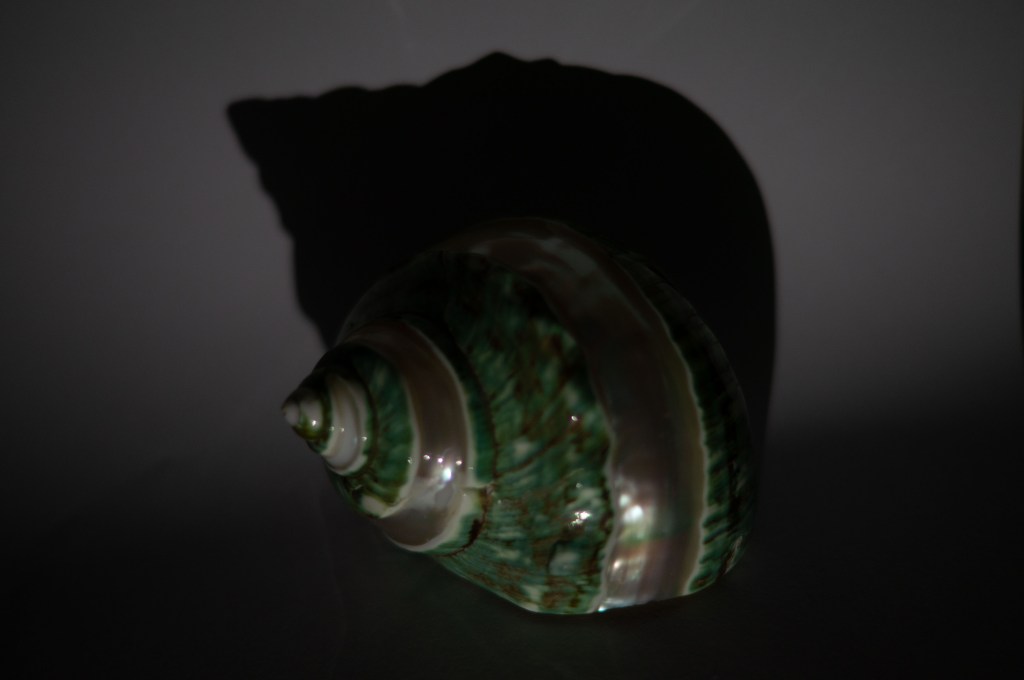
6- For the final image, I lit the image from the front but shot from an angle above the shell, capturing the shadow that fell behind it. The front of the shell is evenly lit, reflecting off of the body as the light hits it, while the back half of the shell is dark and less defined due to the lack of light. Despite the white sheet of paper, the light wasn’t strong enough to act as a fill light. Shooting from above allows us to see the intense, dark and extended shadow, rather than a tiny shadow at the bottom if we were to place the camera directly in front of the shell.

Reflection:

Studio lighting can dramatically change the result of composition. Having complete control over the distance of the light to the subject, the angle, the temperature or the colour of the light can decide how contrasted or defined the image is. Lighting a person or object from the front and having the camera at the same position would result in a flatter image with few shadows to help with definition. Lighting from the side or at an angle and shooting from the front allows for more textural details to be shown and brings more depth to the shot. Backlighting on a small scale was quite challenging as the light didn’t fill the paper, but I could’ve taken more time to frame the image a little closer in. 

I didn’t explore contrast and metering much in this exercise, however, it’s helped me understand how balancing highlights and shadows, or doing the complete opposite by pushing one or the other to the extreme can help change the mood or finish of the piece.

References:

Bloomfield, R., 2018. Photography 1: Expressing your Vision. 4th ed. [pdf] Barnsley: OCA, pp. 90, 91. Available at: https://www.oca-student.com/course/photography-1-expressing-your-vision [Accessed 7 May 2021].

List of images:

Figure. 1. Powell, L. (2021) Contact sheet 1 [pdf, screenshot] In possession of: Lauren Powell: Eastleigh.

Figure. 2. Powell, L. (2021) Contact sheet 2 [pdf, screenshot] In possession of: Lauren Powell: Eastleigh.

Figure. 3. Powell, L. (2021) Contact sheet 3 [pdf, screenshot] In possession of: Lauren Powell: Eastleigh.

Figure. 4. Powell, L. (2021) 1 [image] In possession of: Lauren Powell: Eastleigh.

Figure. 5. Powell, L. (2021) Diagram 1 [scanned document] In possession of: Lauren Powell: Eastleigh.

Figure. 6. Powell, L. (2021) 2 [image] In possession of: Lauren Powell: Eastleigh.

Figure. 7. Powell, L. (2021) Diagram 2 [scanned document] In possession of: Lauren Powell: Eastleigh.

Figure. 8. Powell, L. (2021) 3 [image] In possession of: Lauren Powell: Eastleigh.

Figure. 9. Powell, L. (2021) Diagram 3 [scanned document] In possession of: Lauren Powell: Eastleigh.

Figure. 10. Powell, L. (2021) 4 [image] In possession of: Lauren Powell: Eastleigh.

Figure. 11. Powell, L. (2021) Diagram 4 [scanned document] In possession of: Lauren Powell: Eastleigh.

Figure. 12. Powell, L. (2021) 5 [image] In possession of: Lauren Powell: Eastleigh.

Figure. 13. Powell, L. (2021) Diagram 5 [scanned document] In possession of: Lauren Powell: Eastleigh.

Figure. 14. Powell, L. (2021) 6 [image] In possession of: Lauren Powell: Eastleigh.

Figure. 15. Powell, L. (2021) Diagram 6 [scanned document] In possession of: Lauren Powell: Eastleigh.