Summary:
For this post I have;
– Researched the (in)decisive moment and compared it to the decisive moment.
– Summarised the differences and similarities between the two moments.
– Written about Nick Waplington, Martin Dietrich and Nigel Shafran, their lives, careers and approaches to their work.
– Analysed one of each image from each practitioner, exploring the techniques and messages I have gathered from their work.
– Reflected on the research as a whole.
Indecisive moment:
Unlike Henri Cartier-Bresson’s ‘Decisive Moment’, the (in)decisive moment seems to challenge the belief of a singular moment being the most important and unique by exploring the idea that all moments are just as important as the other and no less unique. Even if the moment doesn’t capture the most exciting of moments, as long as it means something and shows a passage of time, it’s still special.
Another difference between the two moments is that the (in)decisive moment tends to remove expression and gesture, by documenting “deadpan” moments, or the banalest of subjects. The lack of clear emotion may cause more questions to arise from the viewer as it may not be as clear as to how the subject is feeling or what is happening. ‘..the works’ bland expressions and lack of visual triggers, such as gesture, confound our expectations of discovering a person’s character through their appearance’ (Cotton, 2014, p. 106). For me, this ability to form questions, makes the imagery more flexible and interesting than a decisive moment, that more often than not, cuts straight to the point in terms of context and meaning.
While some planning takes place for a decisive moment, for example, setting up the camera in preparation for the perfect moment to fall within the frame at any given point, the photographer doesn’t have much control over the event or outcome of the image. The (in)decisive moment, however, feels like a more hands-on and regimented approach, whether that is through manipulation of movement, poses, expression, location or amount of images taken within a particular time.
Despite these differences, the two moments appear to be interchangeable and overlap in concept, for example, both require some form of planning and awareness of the outcome you’re hoping for, as well as the active decision to press the camera shutter at a specific time rather than spontaneously. Bearing these things in mind, I’m not sure if they can be considered two separate approaches or not?
Nick Waplington – (1965- )
Nick Waplington is a British artist; based between London and New York, mostly known for his contemporary photography practises but not limited to, as a painter, sculptor and has explored the world of video. Boundaries have been pushed and explored throughout his work, shown by the juxtaposition of traditional and new media (1972 Agency, 2020). Waplington’s collaborations with artists such as Alexander McQueen, Miguel Calderón and David Shrigley, further confirm this desire to create and work with those who produce something out of the ordinary.
The topics documented throughout his work, range from the daily lives of working-class people, youth culture, his family, businesses or organisations expanding globally (1972 Agency, 2020). Subjects like these may seem mundane to some but are without a doubt, impactful once you start to analyse the meaning or feelings Waplington is trying to portray.
Living Room (1991) is the first project Waplington published as a young man, shortly followed by an exhibition in 23rd Street Gallery, New York and then globally for a few years after. The prints were put into storage and requested to be destroyed, ‘having moved on to new projects’ (Juxtapoz, 2019). However, it was discovered in 2018 that Waplington’s gallerist Holly Solomon never got rid of the prints, were still in possession of her son Thomas and have since been presented by Little Big Man for the first time in 26 years.
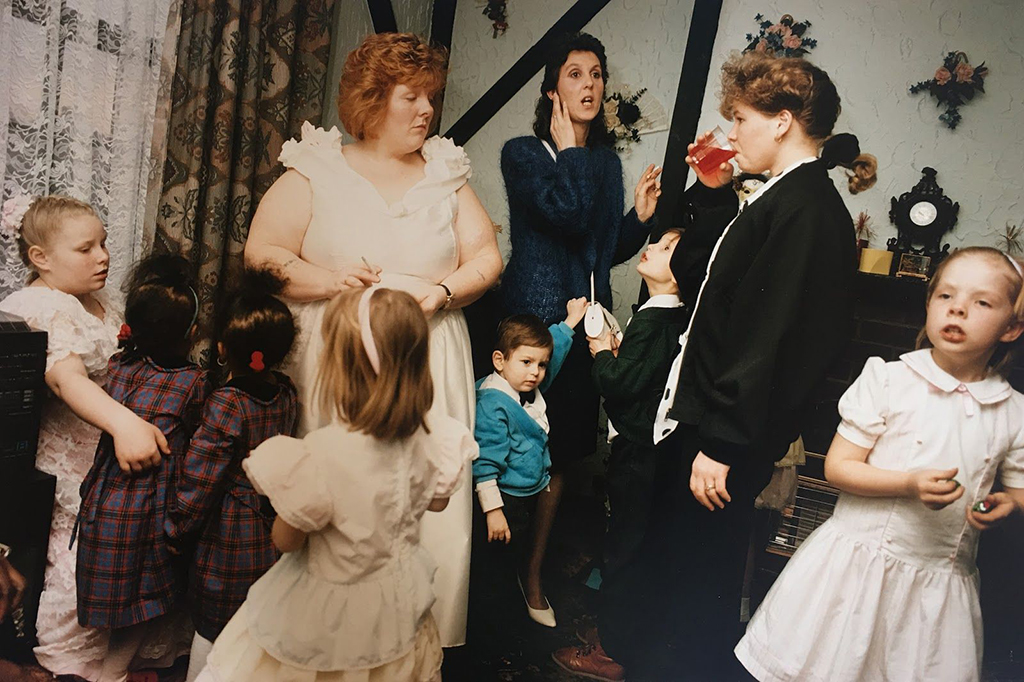
Living Room (1991), is a series of images taken across four years, documenting the daily life of two families who lived on the same council estate as his grandparents in Nottingham.
It gives us an insight into the lives of people we have no connection with, as well as capturing the struggles and differences that families faced due to industry collapse, unemployment and poverty caused by a decade of a neglectful conservative government (Bint photoBooks, 2016).
The chaos portrayed (see Fig. 1) encapsulates the historical turmoil going on at the time. A time full of uncertainty and disorganisation, mixed emotions and lack of stability in the area. Waplington’s use of a fast shutter speed has frozen at least eight different moments in time, if not more that we cannot see directly. The child on the right, has a deadpan expression, distracted by something out of the frame, are they talking to somebody? Has someone caught their attention? We aren’t aware of the cause, allowing us as the audience to explore further and try to put the pieces together, using the rest of the picture as context. Midframe, we have someone who seems to be in conversation with another person, again, outside of the frame, but it isn’t clear how they are feeling or whether they are aware of the two children trying to either get their attention or grab the bag that is at an arms reach. The worried face of the child to the left is somewhat humorous. It feels as if they are trying to prevent the curtains from being pulled down or other mischievous events occurring while the adults are distracted by other things. There is a faint orb-like blur to the bottom right of the image, perhaps created by a light source just outside of the frame, smoke from the right, a smudge on the lens, or a small imperfection with the film or printing process. Waplington has shot this image at a very slight angle; whether that is intentional or not, the tilt enhances the mayhem shown in the photograph, ‘imperfect’ and unbalanced, much like daily life. Saturated colours and the grainy nature of film photography, not only shows the difference in photography practises and cameras from just a few decades ago, but makes the images feel much more intimate, soft and nostalgic. They’re not crisp, vibrant pieces that uniquely grab the viewers eye. Instead, the imagery is natural, full of life and movement, but still unique.
Martin Dietrich – (1980’s – )
Martin Dietrich is a Fine Art Photographer based in Frankfurt, Germany, mostly known for his architectural and street photography. Dietrich’s journey with photography started in 2009, as a way to balance his day to day job which is ‘full of numbers’ as a tax auditor (Dietrich, 2016), something that has only continued to grow and help other young artists besides himself with the Neoprime International Fine Arts label, founded in 2014.
Abstract, minimalism and geometrics within nature, are Dietrich’s main focus areas, continually explored through his architectural and street photography. Exploring the locations in question, inspires him to come up with concepts that may not be suitable for the chosen surroundings, in turn creating abstract compositions that allow multiple and endless paths for the viewer to explore. According to Dietrich, removing a subject out of its usual context can hide the original story or meaning behind the image, therefore creating a whole new picture, whereas minimalist images are straight forward, reduced to one subject or exciting element, a complete juxtaposition to his abstract work (Dietrich, 2016).
Growing up in a city has meant that urban life is extremely familiar and has fascinated him for years. Street photography documents real moments ‘frozen in time forever and yet offers so many different interpretations, stories and meanings. Street Photography is by no means artificial, it’s the real world, with real characters and real moments’ (Dietrich, 2016).
Dietrich’s double exposures have been created by using slow shutter speeds, in combination with moving the camera to create what he calls an ‘abstract sketch’ (Dietrich, 2016).
The Ghosts That Carried Us Away (2014), consists of 7 black and white double exposures of various people riding an escalator and climbing the stairs, documenting movement, time and indecisiveness. All double exposures were shot in-camera using a Fujifilm X-Pro 1.
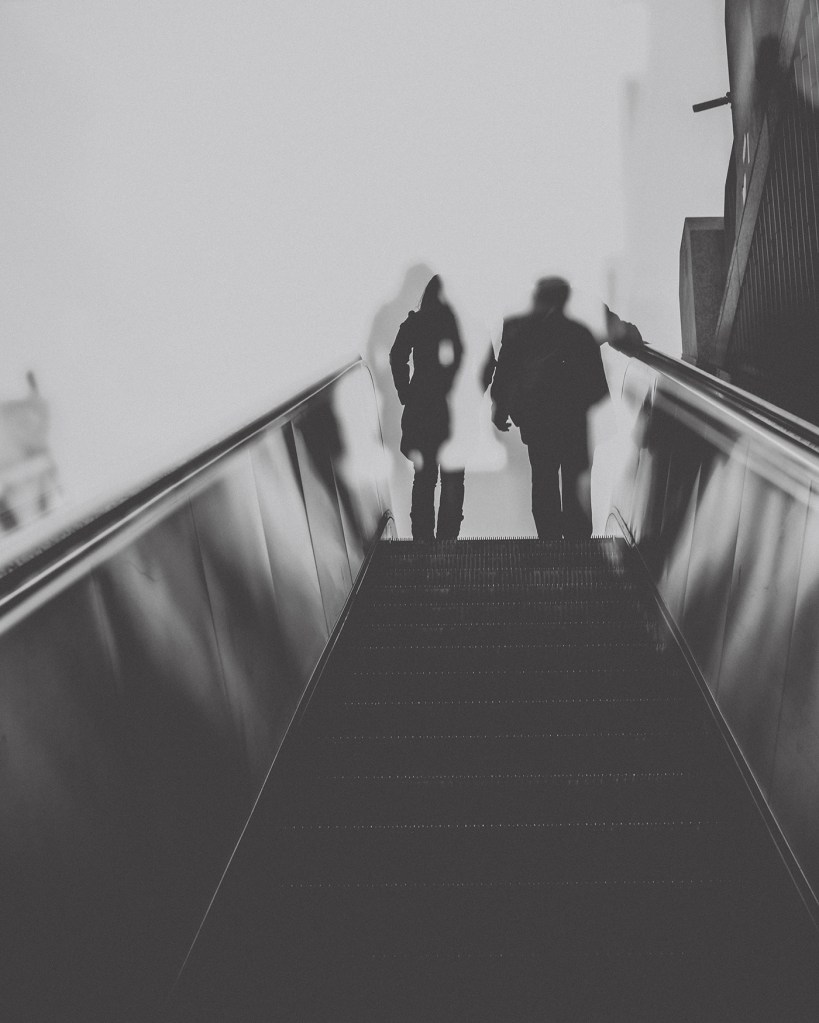
This image (see Fig. 2) combines both abstract and minimalism into one complete frame. The lack of expression and context given from the blurred silhouettes in the background, due to their backs facing the camera, formulates a list of questions. Are they a couple? Are they strangers? Are they happy? Angry? In conversation? What are they doing? Where are they going?
Dietrich has perfectly backed up his view of abstract work and how removing part of a subject, can carve out multiple paths for the viewer to go down and explore. Black and white photography, not only enhance the highlights and shadows, the textures and shapes within the frame, but it also removes the influence that colour may have on the picture. It could be a beautiful sunny day, but without the help of colour, for me, this composition documents a gloomy day, in what feels like a silent city.
By isolating the escalator, a small part of a building and capturing the negative space surrounding them on the left, allows me to understand that the subjects are in an urban location and shows the minimalist elements within the photograph.
However, the position of the camera in comparison to the people prevents us from seeing anything else beyond that. We could assume they’re on top of a building or walking into a mall, but we cannot be sure without further information, that’s what makes it so interesting. The rule of thirds and leading lines work perfectly together, as the eyes are drawn from the bottom of the frame, right up to the main focal point at the top, taking you on a journey and moving the viewer through the image as an escalator would do. Slow shutter speeds don’t freeze a moment, they follow the moment and capture the path taken during the time the shutter is open, so instead documents multiple ‘invisible’ moments in one frame and is something I would consider to be indecisive.
Nigel Shafran – (1964 – )
Nigel Shafran is a well-known photographer and artist based in the UK, having established himself as one of the most respected fashion photographers in the 1990s (James Hyman Gallery, n.d). Much like Nick Waplington, Shafran is passionate about capturing day-to-day life, the ordinary and overlooked subjects that surround us. Unlike most photographers who have explored the decisive moment and aim to capture the unique, the extraordinary and ‘never to be seen again’ moments in time, Shafran explores the beauty in the mundane and accepting what we have around us.
His work is so casual, so familiar and domestic but still beautiful, full of life and uniqueness.
Washing up (2000) is a series of images taken across an unknown time, capturing the chaos and daily findings of a kitchen. Something all of us can relate to and find comfort in, making this project somewhat personal without it being so.
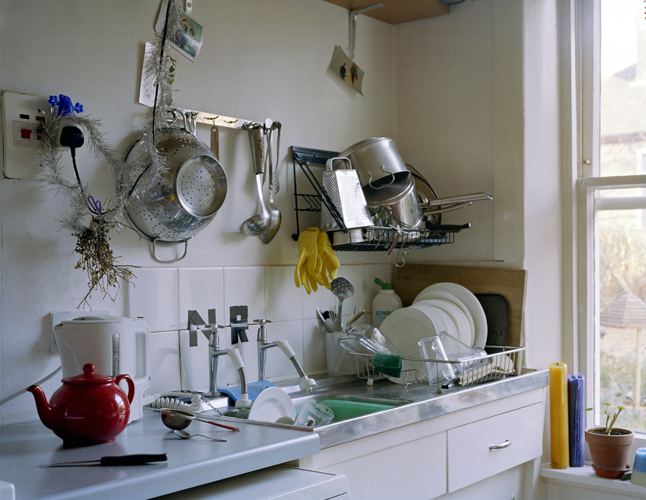
Fig. 3. 001washing_up (2000) 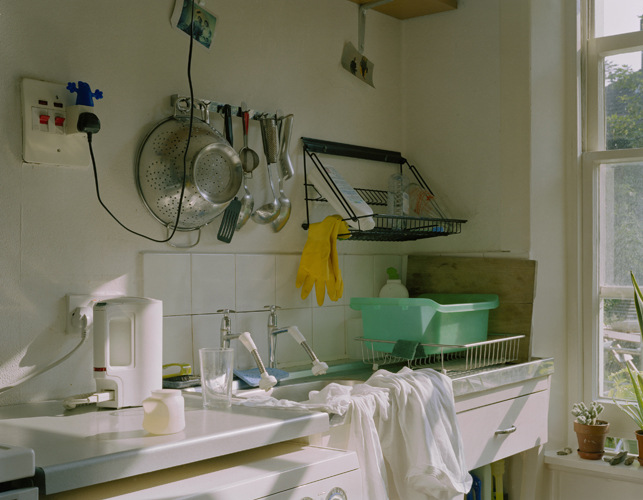
Fig. 4. 013washing_up (2000)
The consistent framing between these two images implies that a tripod was used, or some form of stable surface for the camera to sit on to document the changes within this kitchen without having to change location or composition. They are very much the same, yet different.
001washing_up see Fig. 3) looks to have been taken while the sun was fully out and out of reach of the window, creating a cold atmosphere due to the lack of sunbeams, blue tones and grey shadows within the picture. Tinsel is hanging off of the wires, just above the red teapot, enhancing the fact that this photograph could’ve been taken on a cold winters day. To the right, is a potted plant that seems to be dormant and withering away, the natural circle of life. There is crockery everywhere, in the sink, on the draining board, a knife has been left out on the side and the pots and pans in the top right are screaming indecisiveness and chaos.
013washing_up (see Fig. 4) is slightly more organised, tidier and warm. In comparison to Fig. 3. this image appears to have been taken during the morning, just as the sun is rising. Shadows in this composition are soft, as is the light on the walls and surfaces, making it feel more homely and welcoming. Despite the differences between the two photographs, the mess, the lack of decision making and the reality of the busy lives we lead, the pictures on the walls are still the same, the blue figurine on the plug socket is still in its usual place, the kettle and rubber gloves are where they belong.
They may not be the most outstanding photographs taken, but they document life, the changes that we make, the life and death of nature, the rise and fall of the sun. These pictures have captured time and how it evolves, which I think is just as important as capturing one unique moment in time.
Reflection:
– The (in)decisive moment doesn’t have to be something extraordinary or unique and is very much similar to the decisive moment, in terms of planning and setting the camera up to capture the moments.
– The ordinary can be the most beautiful and interesting subjects to capture and explore.
– No one moment is unique and all capture important moments in time.
– The ‘Decisive’ moment is the moment you decide to capture, when and where.
– The (in)decisive moment doesn’t mean you don’t have to prepare and look for fruitful moments.
– The (in)decisive moment captures a period or path of time, rather than one moment.
References:
1972.agency. (2020) Nick Waplington Biography – 1972. [online] Available at: https://1972.agency/artists/nick-waplington/bio (Accessed 2nd February 2021).
Cotton, C. (2014) The Photograph As Contemporary Art. 3rd ed. London: Thames & Hudson.
Bint photoBooks. (2016) Views & Reviews A Tribute to the Family as a wild Tribe Living Room Nick Waplington Photography. [online] Available at: http://bintphotobooks.blogspot.com/2016/05/views-reviews-tribute-to-family-as-wild.html (Accessed 15th February 2021).
Dietrich, M. (2016) From Experimental to Ordinary: LomoAmigo Martin Dietrich Tests the Minitar-1 Art Lens [online] Available at: https://www.lomography.com/magazine/317995-from-experimental-to-ordinary-lomoamigo-martin-dietrich-tests-the-minitar-1-art-lens (Accessed 22nd March 2021).
James Hyman Gallery. n.d. Nigel Shafran [online] Available at: http://www.jameshymangallery.com/artists/14896/biography/nigel-shafran (Accessed 22nd March 2021).
Juxtapoz. (2019) Exhibition unearths Nick Waplington’s long thought destroyed “Living Room” prints. [online] Available: https://www.juxtapoz.com/news/photography/exhibition-unearths-nick-waplington-s-long-thought-destroyed-living-room-prints/ (Accessed 15th February 2021).
List of images
Figure. 1. Waplington. N. (1991) Living Room [image] Available at: https://loeildelaphotographie.com/en/nick-waplington-living-room-bb/ (Accessed on 15th February 2021).
Figure. 2. Dietrich. M. (2014) The Ghosts That Carried Us Away [image] Available at: https://www.behance.net/gallery/14029499/The-ghosts-that-carried-us-away (Accessed on 22nd March 2021).
Figure. 3. Shafran. N. (2000) Washing up [image] Available at: http://nigelshafran.com/category/washing-up-2000-2000/page/2/ (Accessed 22nd March 2021).
Figure. 4. Shafran. N. (2000) Washing up [image] Available at: http://nigelshafran.com/category/washing-up-2000-2000/ (Accessed 22nd March 2021).
 Lauren Powell OCA
One thought on “(In)decisive moment practitioner research”