
Summary:
For this post I have;
– Researched the ‘Inspired’ moment, written by Olivier Duong, to further understand the Decisive Moment in a slightly simpler form.
– Written three detailed paragraphs about Henry Cartier-Bresson, Garry Winogrand, Bruce Davidson and KayLynn Deveney, exploring their career history, what they capture and why.
– As well as writing a short analysis for one or two images from each practitioner, stating what I enjoyed about their work and what I took from it.
– Before reflecting on the post as a whole.
The ‘Inspired’ Moment
The Decisive Moment for me is one of those topics that I believe is clear to understand at first until I find myself questioning it once more, therefore I have found a definition that strips the technique down to the bare basics.
Olivier Duong also struggled to piece together the elements that make up a Decisive Moment, so took it upon themselves to break it down into their own words, or as they call it ‘The Inspired Moment’ (Duong, 2013). A diagram of the Inspired Moment (see Fig. 1.) shows the alignment of the photographer’s eye, the photograph, the heart and the mind, a combination of compositions, emotions and thoughts that pull together to create that ‘perfect’ moment (Duong, 2013).
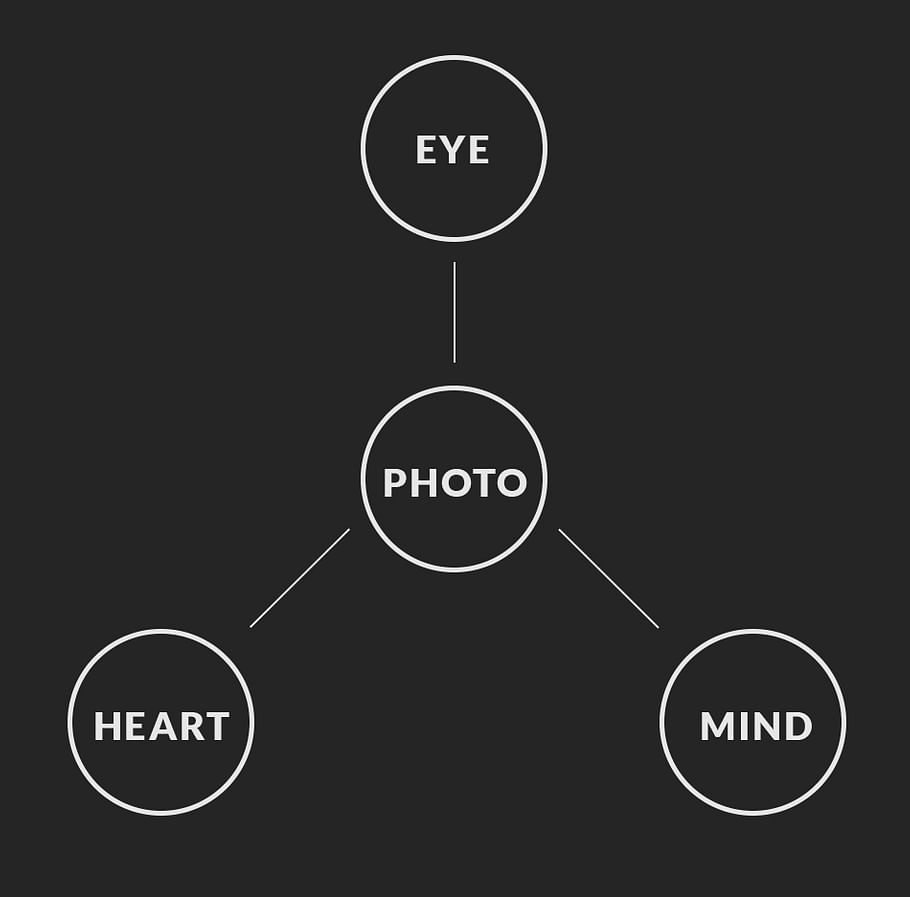
Duong continues to describe the Decisive moment in terms of time; Chronos and Kairos time. Chronos being ‘linear time’ and a much more definitive view on time, whereas Kairos is opportune and varies, as is the Decisive Moment. A Decisive Moment can happen at any time, hence you have to grab it when it arises or you will miss it, ‘you could not catch him by the hair because he is bald from the back’ (Duong, 2013). You must always be responsive and ready for any given moment, see it and shoot, have your camera settings ready to avoid missing the shot.
In summary, you must see the image in your mind’s eye, be ready both physically, mentally and technically and shoot before you miss.
Henri Cartier-Bresson (1908-2004)
Henri Cartier-Bresson was a photographer, painter, filmmaker and prisoner of war, well known for being a master of street photography and the Decisive Moment. Cartier-Bresson had a strong interest in surrealism, an art movement that inspired the direction of his photographic work. Peter Galassi explains in his book Henri Cartier-Bresson, The Early Work, that the surrealists ‘…approached the street: with a voracious appetite for the usual and unusual…’ (Galessi, 1987:33), meaning they saw more than an ordinary photograph and understood the deeper meanings and unplanned situations.
In 1952, upon his return to Europe after a three-year stream of travelling, Cartier-Bresson published Images à la Sauvette or as we know it, The Decisive Moment. This book provides the viewer with a collection of images that were taken in an instant, with intuition and ‘in visual terms, questions and decides simultaneously’ (Cartier-Bresson, n.d.).
‘Cartier-Bresson did not “point and shoot” to achieve this effect. He often framed a picture in the viewfinder of his Leica, and then waited for the perfect event to occur, normally a person passing through the scene’ (Huxley Parlour, 2017).
Huxley Parlour provides a perfect example of this approach, shown in Behind the Gare Saint-Lazare (1932), a frozen yet slightly blurred silhouette of a figure leaping over what seems to be a rain-sodden ground, a result of ‘luck’ as Cartier-Bresson calls it in the documentary L’amour Tout Court. It was almost a matter of fate due to the fact he slotted his camera in between the planks, just barely managing to fit the lens through, meaning he could not see the composition (L’amour Tout Court, 2001). The image is beautifully balanced and perfectly timed, the feet of the person just inches from the ground before splashing into the water below. We know what is going to happen without the documentation of the result, this is achieved by intuition. Ripples surrounding what looks like a wooden ladder implies that it may have fallen or at least been disturbed recently. The dark pile of rubble next to the hoops on the floor, brings further texture to the image, contrasting the wet, shiny water. Cartier-Bresson placed a lot of emphasis on the ‘geometry’ of an image, an element that will enable the composition to be proportionate (L’amour Tout Court, 2001). Despite his lack of sight for this piece, the balance was still maintained as the silhouette is framed within the far right of the frame and as a result achieves the rule of thirds. A small figure in the background of the shot may pose a few questions for the viewer. Are they in front or behind the railings? Is that a police officer or a civilian looking at them? Or are they even looking? The motion blur implies a fast movement, however, we are unaware as to why they are leaping, or whether they are running from or to something. The tensions throughout this artwork create intrigue and have helped me understand the true power of a decisive moment, intuition and awareness.
Garry Winogrand (1928-1984)
Garry Winogrand was a New York based photographer who captured the hustle and bustle of busy streets, airports, people at rodeos and animals in the zoo (Fraenkel Gallery, 2012).
A number of his works have been exhibited in museums and galleries across the world, as well as being published to accompany the exhibitions. Winogrand’s work is considered highly influential in the street photography genre, having provided slices ‘… of 20th-century American culture, replete with all the nightlife, excitement, heartbreak, trauma, and banality…’ (artnet, 2011) that makes up the foundations of life.
Documenting monumental events that have taken place due to the social issues in the U.S., enabled Winogrand to excel and become one of very few artists that stand out in the world of street photography.
Winogrand worked as a freelance photojournalist, as well as exploring the world of advertising in the 50s and 60s, before teaching the subject in the ’70s. Following his death it was discovered that a huge majority of his older works had been left undeveloped, no proofed exposures or only got as far as being made into contact sheets (MoMA, 2009).
One image that stands out for me is New York, 1969, (see Fig. 2.) part of the Women are Beautiful series, a collection of images taken in various locations of women in their natural state, observing, partying or otherwise occupied in some way. In the foreground we are presented with a woman in her early 20’s perhaps, her thick hair is down, resting naturally against her shoulders, seemingly unaware of the photographer taking her picture just a distance away. The shot has been taken just before the pretzel in her hand reaches her mouth, freezing time and showing the process of a decisive moment, showing the neutral emotion of eating while on the move in a busy environment with no time to savour the event. In the background we see multiple darker figures of people passing by, the natural light not quite reaching them like the woman closest to the camera. They’re noticeable of course, adding movement and providing context for the location, as well as their acknowledgement of the camera, potentially questioning what is happening. That being said, they don’t stand out because they are not the subject in question, the woman in front is, she is the focal point of this composition. A variety of tones run through the photograph, adding depth to the shot, enhancing the brickwork in the architecture and the natural marking of the lighter buildings, dirtied by pollution, animals or other such elements. The horizontal and vertical structures, create leading lines for the viewer to explore the street behind the bustling pavements and roads, drawing the eyes further into the background towards the left before leading out of the image. Balance is maintained by the use of the rule of thirds, as the woman in question is placed perfectly within the lines of the left intersections of a camera grid, complimented by the shallow depth of field that further encourages the eyes to focus. As previously mentioned, the Women are Beautiful series documents women in various situations, dressed to the nines or in her casual wear. Conceptually this may be exploring the pressure that women have been put under for centuries. Using the decisive moment to photograph women without any makeup on, their hair flowing naturally, eating what may be considered ‘junk food’, showing the true nature of women in the comfort and without the mask of societal norms influencing the moment. A compelling statement and a chance to empower women, quirks and all.
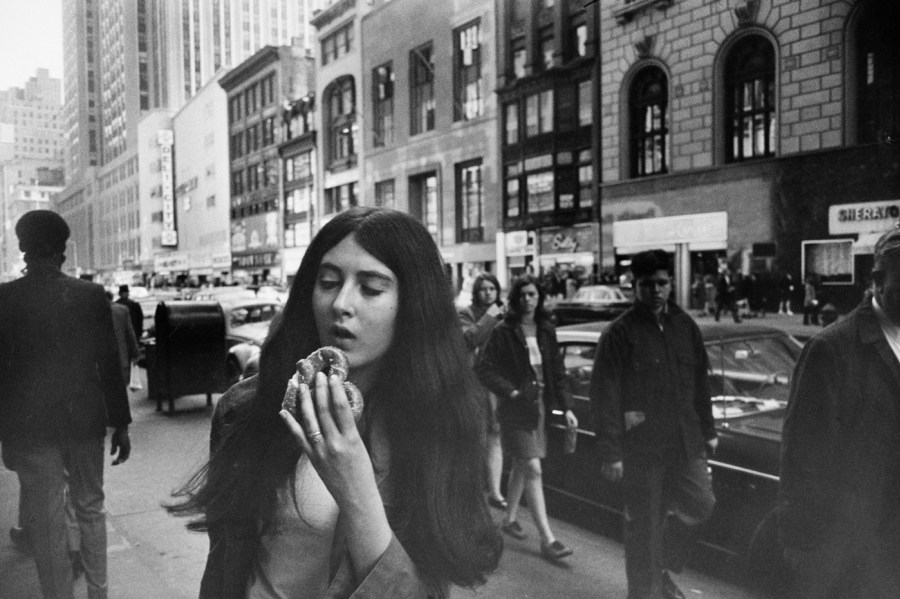
Fig. 2. New York (1969)
Bruce Davidson (1933 – )
Bruce Davidson is an American photographer based in New York, a member and contributor to Henri Cartier-Bresson’s Magnum Photos. Davidson began taking photos from the age of 10, the catalyst for studying and furthering his knowledge on the subject at Rochester Institute of Technology and Yale University (Magnum Photos, 2008).
After returning from the army in 1957, Davidson began doing freelance work for LIFE magazine before creating a variety of influential works such as The Dwarf, Brooklyn Gang and Freedom Rides (Magnum Photos, 2008).
Davidson has exhibited in many museums and galleries over the years, one of them being the Museum of Modern Art, New York, where East 100th Street was displayed following its publication at Harvard University and St. Ann’s press in 1970. Most of the work produced by Davidson documents events or situations within society, capturing the different walks of life through the lens of a camera, much like his friend Henri Cartier-Bresson did years before him. Many pieces of work from the past 50 years have been published in monographs and reside in both public and private fine art collections worldwide (Magnum Photos, 2008).
“If I am looking for a story at all, it is in my relationship to the subject — the story that tells me, rather than that I tell” (Bruce Davidson, n.d.).
One example that explores the above statement, is Woman on tube holding flowers, London, 1960 (Davidson, 1960) a photograph that seems to show no sense of the relationship between Davidson and the people on the train. Of course, the connection between the members of the public is unknown, however, the fact we know that the photographer is outside of the train, most likely positioned on the station’s platform while the woman looks onward down the cabin, implies that she is unaware anyone is watching her. The woman has a fairly neutral face however, a slight hint of anger or confusion shines through with her subtle furrowed brow and puckering of the lips. We are unaware of what this person is thinking, what is in front of her as the scene is tightly framed, creating a mystery for the viewer. Is she in deep thought? Has someone said something to make her angry? Is she even angry or is this how her expression naturally falls? Her posture seems relaxed, hands overlapping each other gently while holding the bunch of flowers, so perhaps she is just in deep thought. Who are the flowers for? Again we don’t know and have to piece our own story together with our imagination due to this lack of information. The cabin is brightly lit and contrasts with the dark body of the train creating balance in the composition, as well as drawing our attention to others on the tube. The man to the left is leaning forward with a confused or shocked face, as if he’s missed his stop, while the man to the right grabs his head in his hands, maybe from stress or despair? Meanwhile, the woman next to him seems blissfully unaware as to what is going on, as her head bows down over a book or a newspaper?
There are a lot of stories that can be told throughout this image, not necessarily accurate to the facts of what happened when this was shot, but a story none-the-less. All of the elements within this photograph, create intrigue, keep the viewer interested, forms tension and captures the natural state of people within seconds, a recipe for a successful decisive moment.
As Davidson stated in the quote above, he has let the story tell itself, rather than placing it into our hands.
KayLynn Deveney (1967- )
KayLynn Deveney, born in Albuquerque, New Mexico is a photographer and lecturer now based in Belfast, Northern Ireland.
Deveney studied and earned a bachelor’s degree for journalism while living in Albuquerque, before becoming a staff photographer for the Albuquerque Tribune for 9 years, covering a wide range of topics across that period (KayLynn Deveney Photography, 2015).
In 1999, Deveney and her boyfriend travelled to the UK where she furthered her education by going to graduate school and going on the earn a masters degree in documentary photography at the University of Wales, Newport in the early 2000s. In 2009, she completed her Ph. D. in Photography, exploring how ‘contemporary and historical photographic diaries and self-books address myths of domesticity’ (KayLynn Deveney Photography, 2015).
Since her many years of education, Deveney’s work has been exhibited across the world, as well as being held in permanent exhibitions at The Museum of Contemporary Photography in Chicago, Illinois, Light Work in Syracuse, New York and the Portland Art Museum in Oregon (KayLynn Deveney Photography, 2015).
Deveney’s first photography book was released in 2007, capturing the life of an elderly man called Albert Hastings within his home and local area in Wales. Following their first meeting in 2001, she began to learn about Bert’s history, his memories of WWII and his many interests, albeit simple. This encouraged Deveney to document the mundane aspects of daily life, the familiar items or routines that make life what it is and what makes a home, a home.
When the images were presented to Bert, Deveney began to realise that they had differing opinions regarding their perspectives. Art is subjective after all. The captions that are written throughout the series, come from Bert Hastings himself, some of which match the photographer’s intentions for the image, while others contribute a more ‘critical second perspective’ (Deveney, 2015).
While this series is only a small window into someone’s life, it is still incredibly powerful. Documenting someone’s life, no matter how brief, provides a little bit of context as to how they live, how they act, how they respond to the banalest of things. It shows intimacy and peels back the privacy barrier we all have; whether it’s intentional or not, which allows us or at least try to understand the life of others.
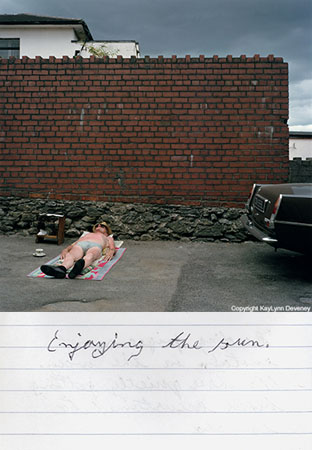
One image that stood out for me was Far Sun, n.d. (see Fig. 3.) as it feels so out of place, humorous and not something you see every day, something I believe the concept of the decisive moment encourages. Regarding the balance of the composition, Bert’s body is positioned perfectly within the bottom left box and his head directly on the 1st vertical line of the grid. Not only does this draw the eyes to the left from the start, but it also follows Cartier-Bresson’s ‘rule’ of maintaining balance and being aware of the geometry within the frame. The first point of interest for myself is Bert; which makes complete sense as the series is about him, however, in comparison to the dark tarmac and brick wall in the background, he stands out like a sore thumb with a bright blue and pink towel to support him. You can’t miss him. Moving on to the second point of interest, the black car; that is positioned in between the middle right and bottom right of the grid, provides a little bit of context as to where this may be taking place. Is this in a car park? Why is he in a car park? Also, why is he sunbathing on the tarmac when it looks like it is about to rain? Juxtaposition; as previously mentioned in my post The Decisive and (In)decisive moment, 2020, is another strong element to consider when documenting decisive moments. It creates a conversation and a list of questions for the viewer, making them think about what is in front of them for a little bit longer. The moment seems so unique and whacky, that it feels staged, but I don’t think it was due to the fun personality that comes through in the candid shots of Albert. As an outsider looking in, with very little knowledge of this person, it feels like a very Bert thing to do, especially if he didn’t have a garden or local beach to visit.
The captions make the images a touch more personal, something I feel brings the collection together and may help the audience understand the photographs more, or at least learn about Bert’s thought process.
Reflection:
– The Decisive moment doesn’t necessarily mean dropping everything, to capture the perfect moment.
– As long as you are aware of your surroundings and what is happening around you, that is what matters.
– You can set up your camera to get the composition you want, to provide balance and understanding of what is in front of you, then wait for the moment to come to you at the right time.
– Be intuitive and be ready for the ‘perfect’ moment to come, before you miss it.
– The subject may be aware of your presence, but as long as you make them feel comfortable or blend into the background, you can document some incredibly candid and personal moments that may have otherwise been missed.
– Don’t just focus on one subject, be observant about EVERYTHING.
– Street photography allows for some very unique moments, however, they aren’t restricted to this form of photography or location type.
References:
Artnet. (2011) Garry Winogrand | artnet [online] Available at : http://www.artnet.com/artists/garry-winogrand/ (Accessed 23rd November 2020).
Cartier-Bresson, H. (n.d) Henri Cartier-Bresson – Fondation [online] Available at : https://www.henricartierbresson.org/en/hcb/ (Accessed 23rd November 2020).
Davidson, B. (n.d.) Bruce Davidson . Photographer Profile . Magnum Photos [online] Available at: https://www.magnumphotos.com/photographer/bruce-davidson/ (Accessed 23rd November 2020).
Davidson, B. (1960) Woman on Tube Holding Flowers, London, England, 1960 [image] Available at: https://huxleyparlour.com/works/woman-on-tube-holding-flowers-london-england-1960/ (Accessed 23rd November 2020).
Deveney, K. (2015) The Day to Day Life of Albert Hastings [online] Available at: https://kaylynndeveney.com/the-day-to-day-life-of-albert-hastings (Accessed 23rd November 2020).
Duong, O. (2013) How to understand the Decisive Moment | INSPIRED EYE [online] Available at: https://www.theinspiredeye.net/street-photography-tips/decisive-moment/ (Accessed 23rd November 2020).
Galassi, P. (1987) Henry Cartier-Bresson: The Early Work [pdf] (Accessed 23rd November 2020).
H. Cartier-Bresson: l’amour tout court (2001) Directed by O’Byrne, R. [online video] Available at: https://vimeo.com/106009378 |(Accessed 25 March 2020).
Huxley Parlour. (2017) Henry Cartier-Bresson [online] Available at: https://huxleyparlour.com/artists/henri-cartier-bresson/ (Accessed 23rd November 2020).
Fraenkel Gallery. (2012) Garry Winogrand | Fraenkel Gallery [online] Available at: https://fraenkelgallery.com/artists/garry-winogrand (Accessed 23rd November 2020).
KayLynn Deveney Photography. (2015) Bio – KayLynn Deveney Photographer [online] Available at: https://kaylynndeveney.com/bio (Accessed 23rd November 2020).
Magnum Photos. (2008) Bruce Davidson . Photographer Profile. Magnum Photos [online] Available at: https://www.magnumphotos.com/photographer/bruce-davidson/ (Accessed 23rd November 2020).
MoMA. (2009) Garry Winogrand | MoMA [online] Available at: https://www.moma.org/artists/6399 (Accessed 23rd November 2020).
Cartier-Bresson, H. (2015) Henri Cartier-Bresson. Behind the Gare St. Lazare. 1932 [image] Available at: https://www.moma.org/collection/works/98333 (Accessed 23rd November 2020).
Winogrand, G. (2013) Women are Beautiful | Fraenkel Gallery [image] Available at: https://fraenkelgallery.com/portfolios/women-are-beautiful (Accessed 23rd November 2020).
List of Images:
Figure 1. Duong. O. (2013) Decisive Moment [image] Available at: https://www.theinspiredeye.net/street-photography-tips/decisive-moment/ (Accessed 23rd November 2020).
Figure 2. Winogrand, G. (1969) New York [image] Available at: https://fraenkelgallery.com/portfolios/women-are-beautiful (Accessed 23rd November 2020).
Figure 3. Deveney, K. (n.d.) Far Sun [image] Available at: https://kaylynndeveney.com/bert-grid (Accessed 23rd November 2020).
 Lauren Powell OCA