
Summary:
For the final exercise I;
– Expressed the difficulties faced during this task due to the continuing UK lock down and inability to travel far, therefore having to find a work around to achieve an image that fit the brief.
– Explained how I executed the exercise, the camera used, as well as the settings before,
– Documenting what I saw during each layer of the viewpoint and the details within them that I may not have noticed had I just raised my camera and clicked.
– Inserted the end result with the technical details and reflected on the exercise as a whole, the importance of looking and the impact it can have on the composition.
Brief:
‘Find a good viewpoint, perhaps fairly high up (an upstairs window might do) where you
can see a wide view or panorama. Start by looking at the things closest to you in the
foreground. Then pay attention to the details in the middle distance and then the things
towards the horizon. Now try and see the whole view together, from the foreground to
horizon (you can move your eyes). Include the sky in your observation and try to see the
whole visual field together, all in movement. When you’ve got it, raise your camera and
release the shutter. Add the picture and a description of the process to your learning log‘
(Bloomfield, 2018).
Due to the UK being on lockdown for the time being, I had to find a workaround for this exercise as my upstairs windows do not open wide enough for me to get an unobtrusive shot of the garden, therefore wasn’t a possible option. While I would’ve liked to shoot from a high-rise building to get a broader view, my only alternative was shooting from the hilltop near home.
Before taking this shot (see Fig. 1), I set my SONY A57 to shutter priority mode, used auto-focus to ensure that the image would be entirely focused, as well as adjusting the shutter speed to level out the exposure before raising my camera and shooting.
While observing this viewpoint, I first became aware of the bare tree branches in the foreground creeping into view and blocking the houses to the left of me, shortly before my eyes followed the descent of the hill leading towards the hedges and large bricked house in the middle distance. The houses behind look tiny in comparison as they get further away from the foreground, framed by the variety of evergreen and deciduous trees along the horizon and a faint foggy silhouette of woodland far aware in the background. A blanket of clouds blocked the previously sunny sky, a few grey clouds spread across before it started to rain.
Once I’d looked at all of the elements in their sections, I then sat and viewed the scene as a whole without using my viewfinder in camera. This exercise was slightly challenging as I usually look at what is in front of me through the camera before shooting, so to step back and discover in real-life was an eye-opener.
I took a brief look at the LED screen to make sure the sky was in my composition, then returned my eyes to the view while pressing the shutter button.
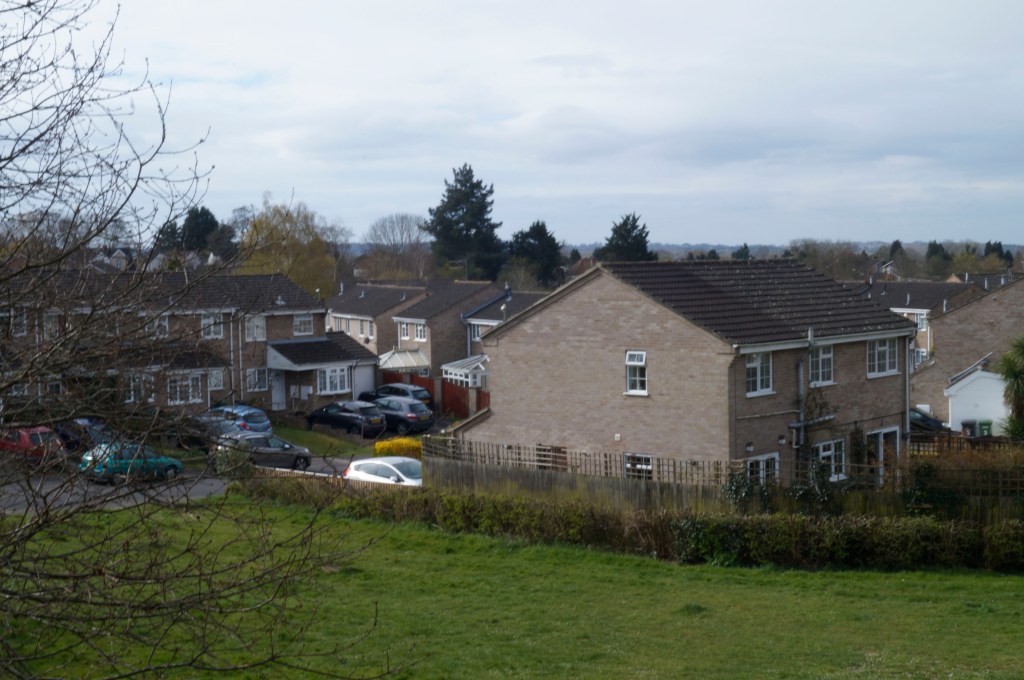
1/25 sec; f/32; ISO 200
Reflection
These past few exercises and research points have helped my understand the importance of being aware of your surroundings, to look before you shoot instead of raising your camera and taking a snapshot, hoping for the best. By spending more time to observe and understand what is in front of you, makes the shot a lot more meaningful, not only for you as the photographer, but for the viewer as more effort has gone in to make sure the composition looks ‘right’.
While it is difficult to refrain from just raising the camera and looking, it is a task worth doing to spend a few extra moments taking in the scene and what you’re about to capture.
References:
Bloomfield, R., 2018. Photography 1: Expressing your Vision. 4th ed. [pdf] Barnsley: OCA, p. 73. Available at: https://www.oca-student.com/course/photography-1-expressing-your-vision [Accessed 30 March 2020].
List of images:
Figure. 1. Powell, L. (2020) Look [image] In possession of: Lauren Powell: Eastleigh.
 Lauren Powell OCA