Summary:
For this personal research post I;
– Briefly explained my reasoning for gathering anonymous responses for this assignment and
– Provided the results of the online survey via screenshots.
– Listed my research, taken over the space of a few days to see how they correlated with the online survey results.
– Reviewed the collection of results as a whole, explored what I was surprised and glad to see from the responses
– Before suggesting a few areas I may look further into throughout this assignment like privilege, luxury and necessity e.t.c.
Instead of solely relying on my own opinions and views about the necessities in life, I wanted to see what others felt were necessary items in their daily life to hopefully build selection to experiment with when it comes to shooting my imagery.
Therefore, as part of my research for this assignment, I decided to gather some non-biased responses from anonymous persons using an online survey by asking ‘What everyday items do you consider are a necessity? (Something you need)’ (Powell, 2020).
Here are the responses:
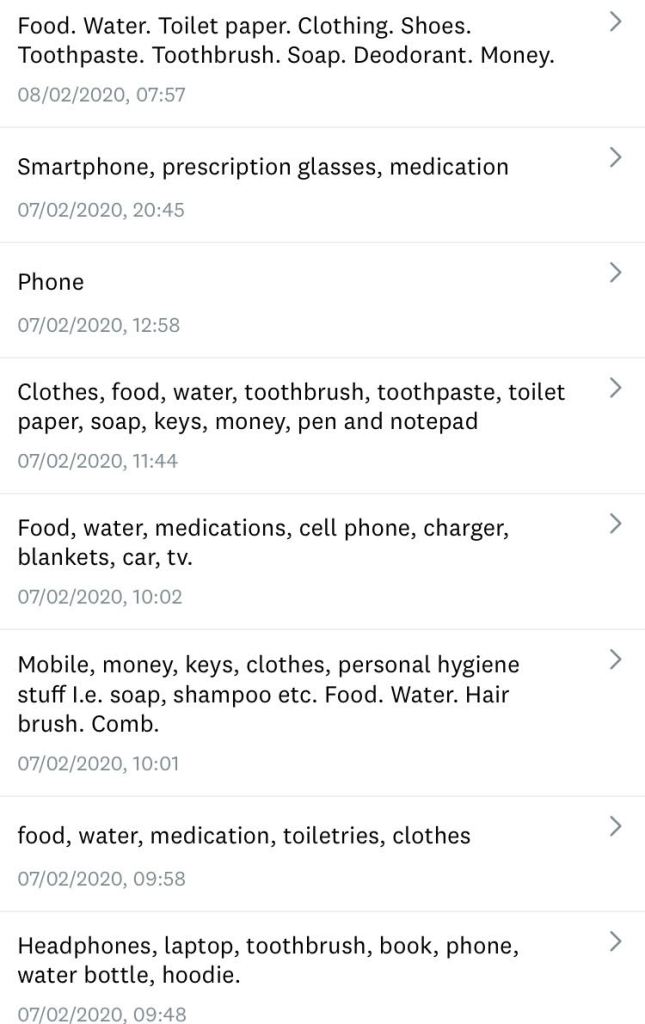
Fig. 1. Survey Monkey 1 (2020). 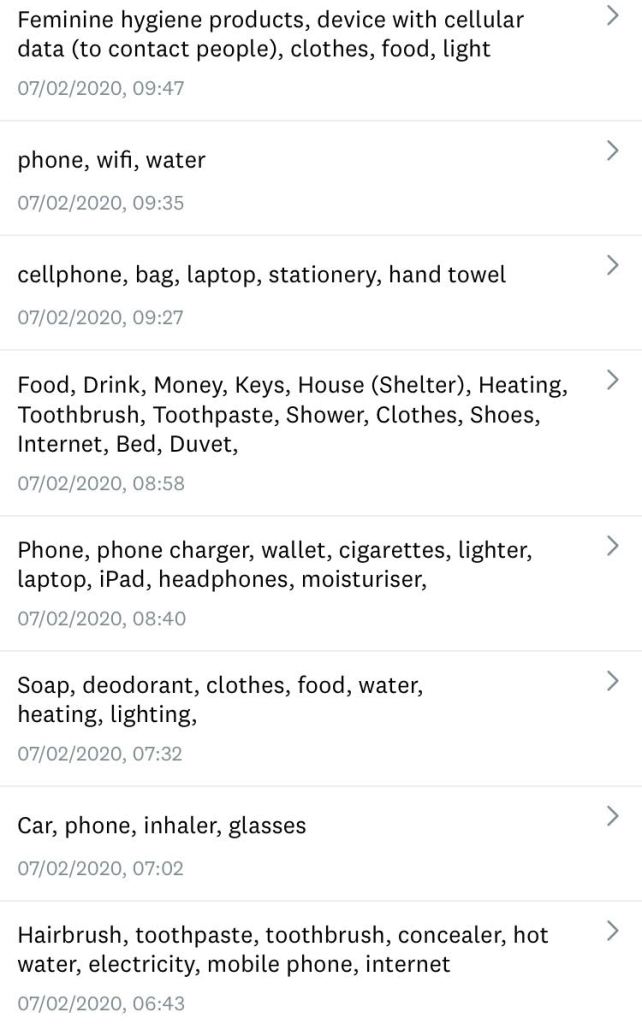
Fig. 2. Survey Monkey 2 (2020).
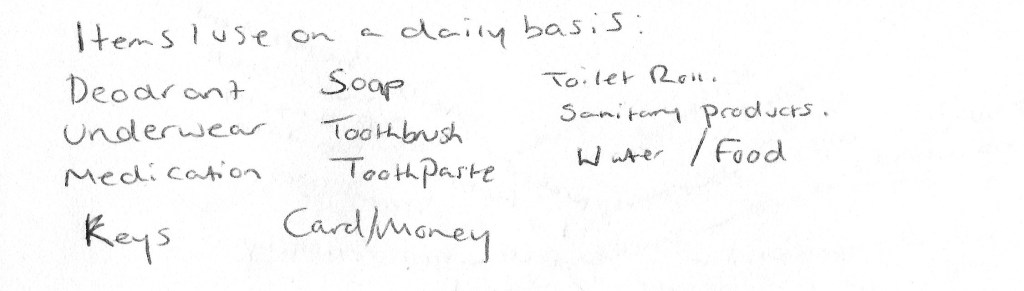
I also took part in the research, noting down items I used daily and what I considered a necessary item (see Fig. 3) before comparing it with the survey responses. The note-taking was quite interesting for me to do, as it made me more aware of what I use and how often, something we don’t necessarily tend to do when items become a part of daily life.
Here is my response to the question:
Review of the responses:
After comparing the two sets of responses (see Fig. 1. and Fig. 2), it is clear that there is a common theme of items to work with, such as clothing, money, keys, hygiene products, medication as well as a few extras that I hadn’t thought about.
Initially, I didn’t expect to see so many people list phones, laptops and other electrical items as a necessity, however, it does make sense when you consider the modern way of communication, technology in careers and education. Without technology, many people would struggle to contact loved ones, reach emergency services or access their money due to banks going digital. Even hospitals use technology to save people’s lives, so while we may feel phones and such are a luxury, they are becoming a necessity more and more.
Those with good health may not have to be concerned about glasses or medications, however, some people wouldn’t be able to navigate safely or survive comfortably without such items that show privilege by not having to rely on prescriptions.
One item that reflected my research in the survey responses is sanitary products for those who have periods (see. Fig. 2). There has been controversy surrounding the tampon tax and free sanitary products in bathrooms, schools and shops for those who cannot afford it. Periods are a part of nature and cannot be prevented without the pill or other forms of contraception, therefore sanitary products should be widely accessible for people so they can go about their daily life comfortably and cleanly. It shouldn’t be a case of who has money or not, as it isn’t a matter of choice that highlights areas of inequality in society.
Other items that were interesting to see were cigarettes, a lighter and concealer (see. Fig. 2.). A lot of people would probably consider these items as unnecessary, however, without being in that person’s shoes you have no idea why these products are essential whether you agree with it or not. This may be due to situations such as addiction, insecurities, social pressures or self-satisfaction.
Final thoughts:
This research has given me a wide range of paths to experiment with and explore, such as politics, privilege and equality. Depending on my artist research I may decide to group up items that share the same concept, visuals and technical approaches but conflict with one another when placed together as a collection e.g Luxury vs Necessary, or Electrical vs Manual. The overriding theme that has been discovered through this research is that necessities are subjective and highlights individuality and diversity. This will allow me to form a cohesive concept for the images I wish to shoot, which I am yet to decide on.
References :
Powell, L. (2020) ‘Necessary Everyday Items’. [online] Available at : https://www.surveymonkey.com/r/KWWFQGM (Accessed 11 February 2020).
List of images :
Figure 1. Powell, L. (2020) Survey Monkey 1 [Survey Monkey, screenshot] In possession of: Lauren Powell: Eastleigh.
Figure 2. Powell, L. (2020) Survey Monkey 2 [Survey Monkey, screenshot] In possession of: Lauren Powell: Eastleigh.
Figure 3. Powell, L. (2020) Necessity List [Ballpoint pen on paper] In possession of: Lauren Powell: Eastleigh.
 Lauren Powell OCA
One thought on “Community Survey + Personal Research Results for ‘Things’”