
Summary:
For this research section I have;
– Challenged the critics theories about Arnatt’s level of influence in the conceptual art movement.
– Briefly explored the definition of conceptual art.
– Drawn upon Arnatt’s planning and technical approaches to his work.
– Analysed a selection of Arnatt’s artwork and
– Stated which techniques I would like to use in my own work, such as pre-planning my camera settings, concepts and compositions to gather a cohesive set of images
– To reflect on my understanding of how Arnatt works and how this can be implemented in my own work.
Keith Arnatt
Keith Arnatt (1930-2008) was primarily known as a British conceptual artist, however, his work was also spoken about concerning land art, minimalism, and photography.
Arnatt was born in Oxford in 1930, where he continued to reside to study at Oxford School of Art in the early 1950s, however, he furthered his education at the Royal Academy Schools in London later on in life. From 1962 he taught in Liverpool and up until 1969, Arnatt taught in Manchester.
Settings for his work we’re as follows, Liverpool (The beach at Formby); the moors around his farmhouse in Todmorden, Yorkshire; and his garden in Tintern which was surrounded by woodland.
Arnatt’s work was associated with the new conceptual art movement by the late 1960s, during which he took part in various exhibitions for conceptual art such as the following; ‘Konzeption-Conception, Städtichen Museum, Leverkusen’, 1969; ‘Information’, MoMA, New York, 1970; ‘Umwelt-Akzente / Die Expansion der Kunst’, Kunstkreis Monschau, 1970 and ‘Art as Idea in England’, CAYC (Centro de Arte y Comunicación), Buenos Aires, 1971′, (Wikipedia, 2019).
There was plenty of theorising over the amount of influence Arnatt may have had within the contemporary art practice of that time, mainly due to his realistic style of shooting.
Having looked at some of his work such as ‘Miss Grace’s Lane’ (Arnatt, 1986-7) and ‘Pictures from a Rubbish Tip’ (Arnatt, 1988-9) I can understand how critics or other artists may have gone back and forth about his impact on the practice because he does indeed show the subject in frame as it is without ‘manipulating’ it if you will.
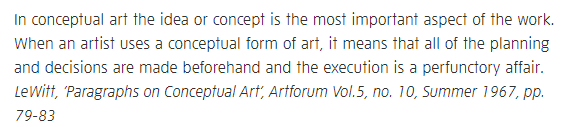
However, after researching further about conceptual art and what it means (see Fig. 1.), it’s not as black and white as people may believe. Just because an artwork isn’t abstract or experimental, doesn’t mean that it isn’t conceptual or contemporary.
A summary of ‘Pictures from a Rubbish Tip’ (Arnatt, 1988-9) provides us with the idea that Arnatt may have planned his approach, due to the way he composed the series and stayed consistent with his choice of natural lighting and fixed camera distance. ‘Although the types of rubbish shown and their exact position within the compositions varies slightly, each is presented at a fixed distance from the camera and this, as well as the similar lighting effects used across the five works, creates a sense of cohesion in the series’ (Tate, 2014).
Therefore, with this information, I feel as if Arnatt had quite a significant influence on the contemporary movement by challenging what people assumed experimental looked like.
‘a conceptual artist uses whatever materials and whatever form is most appropriate to putting their idea across’ (Tate, 2017) which I feel as if Arnatt did, as his work has made me think about how long it had been there, who it belonged to before and see beyond the fact that it is just a pile of rubbish in a tip.
The clear plastic bags in the background of the objects in the frame allow for the colours to pop and draw your eyes towards the bottom right corner where the focal point is. One of the works from the series features a collection of meat ridden bones and a brightly coloured pool of ketchup in the top right-hand corner. In my eyes this is thought provoking, mainly because to some it could just be seen as a condiment for a meat eater’s dinner, but could it also represent the blood of the animal it used to be?
Highlights and shadows help bring depth into a piece of art, defining the shapes in the composition, leading your eyes around the work and giving texture to the subject.
I like how the edges are lighter in the work with the loaf of bread, slowly getting darker as you look further towards the middle, showing that the bread is cushioned by the rubbish underneath and triggers the mind into thinking that the items below were possibly quite soft, like dough almost?
Someone made that bread with their own hands, with love and care, yet it’s ended up in the bin? This leads me to the idea that despite how beautiful, how healthy or useful things are, it may not matter to some, it can be thrown aside. Although, that being said, maybe our perception of a rubbish tip should change from trash to treasure. Items that can be found there have provided life, nutrition, memories and happiness to some, as well as the various negatives.
This reflects the idea previously mentioned that artwork doesn’t have to be viewed so simply, even if you think it is just a realist piece.
Upon researching and reading Arnatt’s work, I see a lot of similarities within our thought/creative processes. I tend to plan what I want to shoot beforehand, think about why an image has been shot that way and whether others will see the work in the way it was intended. Shallow depth of field and natural light is my preferred style too as you get a much softer background while maintaining a clear and sharp focus on the subject.
One of the techniques I would like to bring into my work, however, is creating a series of images that are cohesive and make sense alongside one another, whether that is through the concept or in literal terms e.g. Similar compositions, shapes, colours e.t.c.
Another piece of work I find intriguing is the black and white variant of ‘Portrait of the Artist as a Shadow of his Former Self’ (Arnatt, 1969-72). It is not only a self-portrait shot in a unique way, but it is also once again challenging people’s views about his influence on contemporary art practice. This is a much more obvious conceptual piece, as the medium of chalk and paint have also been used within the work, making it rather experimental by combining more than one medium.
The shadows from the street which are falling around Arnatt’s form creates a spotlight effect and almost emphasises what the work is about. The artist.
Looking further into the image and noticing the graffiti sprayed, dirt-covered brick walls in the background provide a little bit of character to the building by aging it and showing the wear and tear it been through over the years. It shows history.
‘Arnatt has commented: ‘I was beginning to become aware of the unreliability of photographic evidence and began to play with that feature. I felt that what a photograph could not tell or show might be just as significant as what it could.’ (Quoted in John Roberts, The Impossible Document: Photography and Conceptual Art in Britain 1966–1976, London 1997, p.47.)’ (Tate, 2014).
As Arnatt has stated himself, this piece of work is playing around with what a photograph can be. Initially, I thought the dark area within the chalk lines, were indeed his shadow, but with further research, I now know it was painted. The lines are distorted and exaggerated, but you understand what he was trying to portray even though it wasn’t his shadow in the image, instead, it was an outline of what once was there before he disappeared out of frame. A very clever way to work with a concept.
Once again, there are similarities between my work and Arnatt’s. We both think out of the box, play with words and what could be. I also like to exaggerate ideas within my work through props, outfits, makeup or expressions, much like the distorted shadow. However, one thing I would like to explore more is the use of black and white photography. It takes the element of colour away but helps the viewer be a little more intimate with the different tones and textures within a piece of work which you may not have noticed in a colour image.
In ‘The Square Mile’ assignment, I would like to use my style, however, implement the various techniques Arnatt has used in his work so I can create a successful series of images that mold with one another.
List of works, materials, and proposals that are held at various galleries, collections from the late 60s-80s;
Self Burial – the version documenting the WDR televised Self-Burial (Television Interference Project) (1969), and Trouser-Word Piece (1972-89 version) are held in the Tate collection.
Examples of early materials are held at The Henry Moore Institute in Yorkshire, including slides of early works. Leeds City Art Gallery holds drawings from the early 1960’s.
Examples of proposals are held at the V&A Museum in London.
Documentation of proposals that Arnatt gave to Robert Smithson were donated to LACMA, Los Angeles by Nancy Holt.
Tate Archive has proposal related materials by Arnatt including correspondence with the writer Barbara Reise.
References:
Arnatt, K., 1986. Miss Grace’s Lane. [image] Available at: https://www.tate.org.uk/art/artworks/arnatt-miss-graces-lane-t13166 [Accessed 13 August 2019].
Arnatt, K., 1969. Portrait of the artist as a shadow of his former self. [image] Available at: https://www.tate.org.uk/art/artworks/arnatt-portrait-of-the-artist-as-a-shadow-of-his-former-self-p13143 [Accessed 13 August 2019].
Arnatt, K., 1998. Pictures from a Rubbish Tip. [image] Available at: https://www.tate.org.uk/art/artworks/arnatt-pictures-from-a-rubbish-tip-t13170 [Accessed 13 August 2019].
Tate. 2014. ‘Portrait of the artist as a shadow of his former self’, Keith Arnatt, 1969–72 | Tate. [online] Available at: https://www.tate.org.uk/art/artworks/arnatt-portrait-of-the-artist-as-a-shadow-of-his-former-self-p13143 [Accessed 13 August 2019].
Tate. 2017. Conceptual art – Art Term | Tate. [online] Available at: https://www.tate.org.uk/art/art-terms/c/conceptual-art [Accessed 13 August 2019].
Tate. 2014. ‘Pictures from a Rubbish Tip’, Keith Arnatt, 1988 | Tate. [online] Available at: https://www.tate.org.uk/art/artworks/arnatt-pictures-from-a-rubbish-tip-t13170 [Accessed 13 August 2019].
Wikipedia. 2019. Keith Arnatt – Wikipedia. [online] Available at: https://en.wikipedia.org/wiki/Keith_Arnatt [Accessed 13 August 2019].
List of images:
Figure 1. ‘Conceptual art – Art Term | Tate’. (2017) [Tate, screenshot] Available at: https://www.tate.org.uk/art/art-terms/c/conceptual-art [Accessed 13 August 2019].
 Lauren Powell OCA
3 thoughts on “Keith Arnatt Research”